

- Featured in Physics
- Open Access
Spectroscopic Measurements and Models of Energy Deposition in the Substrate of Quantum Circuits by Natural Ionizing Radiation
PRX Quantum 5, 040323 – Published 12 November, 2024
DOI: https://doi.org/10.1103/PRXQuantum.5.040323
Abstract
Naturally occurring background radiation is a potential source of correlated decoherence events in superconducting qubits that will challenge error-correction schemes. In order to characterize the radiation environment in an unshielded laboratory representative of superconducting qubits’ environments, we performed broadband, spectroscopic measurements of background radiation events inside a millikelvin refrigerator. The spectrometer was designed to mimic the size and composition of a quantum circuit. Specifically, we measured the background radiation spectra in silicon substrates of two thicknesses, 500 and 1500 µm, and one area, 25 . The observed spectra span energies from a few kilo-electron-volts up to nearly 10 MeV, are nearly featureless, and decrease in intensity by a factor of 40 000 between 100 keV and 3 MeV for the 500-µm substrate. We integrate the spectra to obtain the average event rates and deposited power levels. These quantities correspond to a rate of 0.023 events per second and a power of 4.9 keV , when counting events that deposit at least 40 keV for the 500-µm-thick substrate. We find that the cryogenic measurements are in good agreement with predictions based on simple measurements of the terrestrial gamma-ray flux outside the refrigerator, published models of cosmic-ray fluxes, a crude model of the cryostat, and radiation-transport simulations. This model requires no free parameters to predict the background radiation spectra in the silicon substrates. The agreement between measurements and predictions demonstrates that the model we present can be used to assess the relative contributions of terrestrial and cosmic-ray sources to background radiation interactions in silicon substrates of varying thickness. These spectroscopic measurements are performed with a novel combination of superconducting microresonators located on micromachined silicon islands that define the interaction volume with background radiation. The resonators transduce deposited energy to a readily detectable electrical signal. Microresonator readout closely resembles dispersive superconducting qubit readout, so similar devices—with or without micromachined islands—are suitable for integration with superconducting quantum circuits as detectors for background radiation events. For our specific laboratory conditions, we find that gamma-ray emissions from radioisotopes are responsible for the majority of events that deposit . We present results demonstrating that the background radiation spectrum contains relevant contributions from cosmic-ray particles other than muons, particularly a tail of multi-mega-electron-volt events due to protons and neutrons. These observations suggest several paths to reducing the impact of background radiation on quantum circuits, supported by an empirically validated model for generating reliable predictions of radiation interactions with silicon substrates.
Physics Subject Headings (PhySH)
 synopsis

Quantifying the Background Radiation Hitting Superconducting Qubits
Researchers have characterized the naturally occurring background radiation hitting a typical quantum circuit—a result that might help with the engineering of devices that are less vulnerable to radiation-induced decoherence.
See more in Physics
Popular Summary
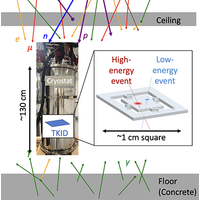
Qubits, the fundamental physical unit of quantum information, promise extraordinary computational power, but they are extraordinarily fragile. Rare but catastrophic “decoherence events” are known to happen without warning and can ruin hours-long calculations. Naturally occurring background radiation has long been suspected as the primary culprit. Such backgrounds consist of both gamma rays emitted by concrete and other building materials and cosmic rays, energetic particles from space. With a new type of superconducting energy detector, researchers have been able to directly measure the radiation spectrum generated in a qubitlike circuit by natural background radiation.
The new sensor is a thermal kinetic inductance detector, or TKID. It uses an unusual property of superconducting materials (in this case, titanium and titanium nitride) to monitor the temperature of a much thicker centimeter-scale silicon “island.” This thin-film superconductor on an isolated island makes TKIDs similar in size, composition, and temperature to qubit circuits. The TKIDs were operated for many days at a time, collecting tens of thousands of records of disruptive events. The spectrum of energies and the event rates they observed were consistent with the known terrestrial and cosmic sources of radiation.
This confirmation will help quantum information scientists decide on productive strategies to shield their circuits. We plan further development of TKID technology as a sensitive detector for charged particles that will be useful for many nuclear physics measurements. At the same time, we hope that the sensor design can be adapted to reside alongside qubits on the same silicon substrate, where TKIDs might serve as reliable indicators of when the delicate linkage in a quantum computation has been compromised.
Article Text
References (59)
- S. Bravyi, O. Dial, J. M. Gambetta, D. Gil, and Z. Nazario, The future of quantum computing with superconducting qubits, J. Appl. Phys. 132, 160902 (2022).
- M. Kjaergaard, M. E. Schwartz, J. Braumüller, P. Krantz, J. I.-J. Wang, S. Gustavsson, and W. D. Oliver, Superconducting qubits: Current state of play, Annu. Rev. Condens. Matter Phys. 11, 369 (2020).
- G. Burkard, T. D. Ladd, A. Pan, J. M. Nichol, and J. R. Petta, Semiconductor spin qubits, Rev. Mod. Phys. 95, 025003 (2023).
- A. P. Vepsäläinen, A. H. Karamlou, J. L. Orrell, A. S. Dogra, B. Loer, F. Vasconcelos, D. K. Kim, A. J. Melville, B. M. Niedzielski, J. L. Yoder, et al., Impact of ionizing radiation on superconducting qubit coherence, Nature 584, 551 (2020).
- M. McEwen, et al., Resolving catastrophic error bursts from cosmic rays in large arrays of superconducting qubits, Nat. Phys. 18, 107 (2022).
- J. Zmuidzinas, Superconducting microresonators: Physics and applications, Annu. Rev. Condens. Matter Phys. 3, 169 (2012).
- L. Cardani, et al., Reducing the impact of radioactivity on quantum circuits in a deep-underground facility, Nat. Commun. 12, 2733 (2021).
- C. D. Wilen, S. Abdullah, N. A. Kurinsky, C. Stanford, L. Cardani, G. D’Imperio, C. Tomei, L. Faoro, L. B. Ioffe, C. H. Liu, et al., Correlated charge noise and relaxation errors in superconducting qubits, Nature 594, 369 (2021).
- T. Thorbeck, A. Eddins, I. Lauer, D. T. McClure, and M. Carroll, Two-level-system dynamics in a superconducting qubit due to background ionizing radiation, PRX Quantum 4, 020356 (2023).
- K. Karatsu, A. Endo, J. Bueno, P. J. de Visser, R. Barends, D. J. Thoen, V. Murugesan, N. Tomita, and J. J. A. Baselmans, Mitigation of cosmic ray effect on microwave kinetic inductance detector arrays, Appl. Phys. Lett. 114, 032601 (2019).
- J. M. Martinis, Saving superconducting quantum processors from decay and correlated errors generated by gamma and cosmic rays, npj Quantum Inf. 7, 90 (2021).
- V. Iaia, J. Ku, A. Ballard, C. P. Larson, E. Yelton, C. H. Liu, S. Patel, R. McDermott, and B. L. T. Plourde, Phonon downconversion to suppress correlated errors in superconducting qubits, Nat. Commun. 13, 6425 (2022).
- C. Papastefanou, S. Stoulos, and M. Manolopoulou, The radioactivity of building materials, J. Radioanal. Nucl. Chem. 266, 367 (2005).
- S. Nemlioglu, N. Sezgin, and B. O. Cumali, in Advances in the Toxicity of Construction and Building Materials (Woodhead, Duxford, UK, 2022) Chap. 8, p. 171.
- S. Chu, L. Ekström, and R. Firestone, WWW Table of Radioactive Isotopes, database version 1999-02-28, http://nucleardata.nuclear.lu.se/toi/.
- Chapter 10 of G.F. Knoll’s Radiation Detection and Measurement (4th ed., 2010) provides an excellent and intuitive introduction to all the typical gamma-ray interaction processes occurring in “macroscopic” radiation detectors.
- S. Agostinelli, et al., Geant4–a simulation toolkit, Nucl. Instrum. Methods Phys. Res. A: Accel. Spectrom. Detect. Assoc. Equip. 506, 250 (2003).
- J. Allison, et al., Geant4 developments and applications, IEEE Trans. Nucl. Sci. 53, 270 (2006).
- J. Allison, et al., Recent developments in Geant4, Nucl. Instrum. Methods Phys. Res. A: Accel. Spectrom. Detect. Assoc. Equip. 835, 186 (2016).
- J. Perl, J. Shin, J. Schümann, B. Faddegon, and H. Paganetti, TOPAS: An innovative proton Monte Carlo platform for research and clinical applications, Med. Phys. 39, 6818 (2012).
- B. Faddegon, J. Ramos-Méndez, J. Schuemann, A. McNamara, J. Shin, J. Perl, and H. Paganetti, The TOPAS tool for particle simulation, a Monte Carlo simulation tool for physics, biology and clinical research, Phys. Med. 72, 114 (2020).
- K.-H. Kampert and A. A. Watson, Extensive air showers and ultra high-energy cosmic rays: A historical review, Eur. Phys. J. H 37, 359 (2012).
- J. Knapp, D. Heck, S. Sciutto, M. Dova, and M. Risse, Extensive air shower simulations at the highest energies, Astropart. Phys. 19, 77 (2003).
- T. Sato, Analytical model for estimating the zenith angle dependence of terrestrial cosmic ray fluxes, PLoS One 11, e0160390 (2016).
- T. Sato, K. Niita, N. Matsuda, S. Hashimoto, Y. Iwamoto, S. Noda, T. Ogawa, H. Iwase, H. Nakashima, T. Fukahori, et al., Particle and heavy ion transport code system, PHITS, version 2.52, J. Nucl. Sci. Technol. 50, 913 (2013).
- R. L. Workman, et al., Particle Data Group, Review of particle physics, chapter 34: Passage of particles through matter, PTEP 2022, 083C01 (2022).
- B. Loer, P. Harrington, B. Archambault, E. Fuller, B. Pierson, I. Arnquist, K. Harouaka, T. Schlieder, D. Kim, A. Melville, et al., Abatement of ionizing radiation for superconducting quantum devices, J. Instrum. 19, P09001 (2024).
- P. K. Day, H. G. LeDuc, B. A. Mazin, A. Vayonakis, and J. Zmuidzinas, A broadband superconducting detector suitable for use in large arrays, Nature 425, 817 (2003).
- T. Cecil, A. Miceli, L. Gades, A. Datesman, O. Quaranta, V. Yefremenko, V. Novosad, and B. Mazin, Kinetic inductance detectors for x-ray spectroscopy, Phys. Procedia 37, 697 (2012).
- T. W. Cecil, L. Gades, T. Madden, D. Yan, and A. Miceli, Optimization of thermal kinetic inductance detectors for x-ray spectroscopy, IEEE Trans. Appl. Supercond. 25, 2400805 (2015).
- G. Ulbricht, B. A. Mazin, P. Szypryt, A. B. Walter, C. Bockstiegel, and B. Bumble, Highly multiplexible thermal kinetic inductance detectors for x-ray imaging spectroscopy, Appl. Phys. Lett. 106, 251103 (2015).
- K. D. Irwin, G. C. Hilton, D. A. Wollman, and J. M. Martinis, X-ray detection using a superconducting transition-edge sensor microcalorimeter with electrothermal feedback, Appl. Phys. Lett. 69, 1945 (1996).
- K. D. Irwin and G. C. Hilton, in Cryogenic Particle Detection, Topics in Applied Physics, Vol. 99, edited by C. Enss (Springer, Berlin, Heidelberg, 2005).
- J. N. Ullom and D. A. Bennett, Review of superconducting transition-edge sensors for x-ray and gamma-ray spectroscopy, Supercond. Sci. Technol. 28, 084003 (2015).
- E. M. Scott, J. Caylor, M. S. Dewey, J. Gao, C. Heikes, S. F. Hoogerheide, H. P. Mumm, J. S. Nico, J. Stevens, J. Ullom, et al., Large-area TKIDs for charged particle detection, J. Low Temp. Phys. 209, 502 (2022).
- N. R. Werthamer, Theory of the superconducting transition temperature and energy gap function of superposed metal films, Phys. Rev. 132, 2440 (1963).
- J. M. Martinis, G. Hilton, K. Irwin, and D. Wollman, Calculation of in a normal-superconductor bilayer using the microscopic-based Usadel theory, Nucl. Instrum. Methods Phys. Res. A: Accel. Spectrom. Detect. Assoc. Equip. 444, 23 (2000).
- M. R. Vissers, J. Gao, M. Sandberg, S. M. Duff, D. S. Wisbey, K. D. Irwin, and D. P. Pappas, Proximity-coupled Ti/TiN multilayers for use in kinetic inductance detectors, Appl. Phys. Lett. 102, 232603 (2013).
- M. Tinkham, Introduction to Superconductivity (Dover, New York, NY, USA, 2004), 2nd ed.
- R. D. Deslattes, E. Kessler, and P. Indelicato, X-ray transition energies: New approach to a comprehensive evaluation, Rev. Mod. Phys. 75, 35 (2003).
- M. J. Berger, J. Hubbell, S. Seltzer, J. Chang, J. Coursey, R. Sukumar, D. Zucker, and K. Olsen, XCOM: Photon Cross Section Database (version 1.5), NIST Standard Reference Database 8, Tech. Rep. (U.S. National Institute of Standards and Technology, 2010).
- International Commission on Radiation Units and Measurements, ICRU Report 37, Stopping Powers for Electrons and Positrons, Tech. Rep. (ICRU, 1984), https://physics.nist.gov/PhysRefData/Star/Text/ESTAR.html.
- A. P. M. Place, et al., New material platform for superconducting transmon qubits with coherence times exceeding 0.3 milliseconds, Nat. Commun. 12, 1779 (2021).
- J. Lisenfeld, A. Bilmes, A. Megrant, R. Barends, J. Kelly, P. Klimov, G. Weiss, J. M. Martinis, and A. V. Ustinov, Electric field spectroscopy of material defects in transmon qubits, npj Quantum Inf. 5, 105 (2019).
- F. Henriques, F. Valenti, T. Charpentier, M. Lagoin, C. Gouriou, M. Martínez, L. Cardani, M. Vignati, L. Grünhaupt, D. Gusenkova, et al., Phonon traps reduce the quasiparticle density in superconducting circuits, Appl. Phys. Lett. 115, 212601 (2019).
- M. McEwen, et al., Resisting high-energy impact events through gap engineering in superconducting qubit arrays, arXiv:2402.15644.
- Y. Chen, D. Sank, P. O’Malley, T. White, R. Barends, B. Chiaro, J. Kelly, E. Lucero, M. Mariantoni, A. Megrant, et al., Multiplexed dispersive readout of superconducting phase qubits, Appl. Phys. Lett. 101, 182601 (2012).
- J. L. Orrell and B. Loer, Sensor-assisted fault mitigation in quantum computation, Phys. Rev. Appl. 16, 024025 (2021).
- https://github.com/usnistgov/mass.
- P. Du, D. Egana-Ugrinovic, R. Essig, and M. Sholapurkar, Sources of low-energy events in low-threshold dark-matter and neutrino detectors, Phys. Rev. X 12, 011009 (2022).
- A. Suzuki, T. Iida, J. Moriizumi, and Y. Sakuma, The effects of different types of concrete on population doses, Radiat. Prot. Dosimetry. 90, 437 (2000).
- A Muon Simulation for Cosmic Ray Analysis Tasks, https://github.com/joefowler/MuscRat.jl.
- C. Hagmann, D. Lange, and D. Wright, in 2007 IEEE Nuclear Science Symposium Conference Record (IEEE, 2007), p. 1143.
- N. Su, Y. Liu, L. Wang, B. Wu, and J. Cheng, A comparison of muon flux models at sea level for muon imaging and low background experiments, Front. Energy Res. 9, 750159 (2021).
- J. W. Fowler, L. F. Fortson, C. C. H. Jui, D. B. Kieda, R. A. Ong, C. L. Pryke, and P. Sommers, A measurement of the cosmic ray spectrum and composition at the knee, Astropart. Phys. 15, 49 (2001).
- J. Gao, The Physics of Superconducting Microwave Resonators, Ph.D. thesis, California Institute of Technology, 2008.
- A. E. Szymkowiak, R. L. Kelley, S. H. Moseley, and C. K. Stahle, Signal processing for microcalorimeters, J. Low Temp. Phys. 93, 281 (1993).
- S. Agrawal, B. Steinbach, J. J. Bock, C. Frez, L. Minutolo, H. Nguyen, R. O’Brient, A. Turner, and A. Wandui, Strong negative electrothermal feedback in thermal kinetic inductance detectors, J. Appl. Phys. 130, 124503 (2021).
- J. W. Fowler, B. K. Alpert, W. B. Doriese, J. Hays-Wehle, Y.-I. Joe, K. M. Morgan, G. C. O’Neil, C. D. Reintsema, D. R. Schmidt, J. N. Ullom, et al., When “optimal filtering” isn’t, IEEE Trans. Appl. Supercond. 27, 1 (2017).

