

- Featured in Physics
- Open Access
Fundamental Limitations on the Reliabilities of Power and Work in Quantum Batteries
PRX Quantum 7, 033057 – Published 15 September, 2026
DOI: https://doi.org/10.1103/fnv6-yqmk
Abstract
Quantum batteries, microscopic devices designed to address energy demands in quantum technologies, promise high power during charging and discharging processes. However, their performance depends crucially on reliability, quantified by the inverse of noise-to-signal ratios (NSRs), i.e., normalized fluctuations of work and power. We establish fundamental limits to this reliability: both work and power NSRs are universally bounded from below by a function of charging speed, imposing a reliability limit inherent to any quantum battery. More strikingly, we find that a quantum mechanical uncertainty relation forbids the simultaneous suppression of work and power fluctuations, revealing a fundamental trade-off that also limits the reliability of quantum batteries. We analyze the trade-off and limits, as well as their scaling behavior, across parallel, collective, and hybrid charging schemes for many-body quantum batteries, finding that increasing power by exploiting stronger entanglement comes at the cost of diminished reliability of power. Similar trends are also observed in the charging of quantum batteries utilizing Ising-like interactions. These suggest that achieving both high power and reliability requires neither parallel nor collective charging, but a hybrid charging scheme with an intermediate range of interactions. Therefore, our analysis shapes the practical and efficient design of reliable and high-performance quantum batteries.
Physics Subject Headings (PhySH)
 synopsis

How Reliable Are Quantum Batteries?
Increasing the charging rate of a quantum battery leads to unavoidable fluctuations in the total energy stored.
See more in Physics
Popular Summary
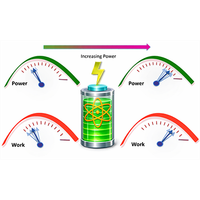
Quantum batteries are microscopic energy-storage devices that could power quantum computers and other emerging quantum technologies. Unlike conventional batteries used in everyday life, their behavior is governed by quantum mechanics. By exploiting collective quantum effects, particularly entanglement, quantum batteries may achieve faster charging with higher power. However, their practical usefulness depends not only on their high power but also on their reliability, which is affected by intrinsic dynamical quantum fluctuations. In this work, we quantify the reliability of quantum batteries through the noise-to-signal ratios of work and power. These quantities measure the fluctuations of work and power relative to their respective average values, and therefore determine how precisely and consistently a battery can store or deliver energy during charging and discharging. A small noise-to-signal ratio corresponds to reliable operation, whereas a large value indicates that fluctuations are significant compared with the useful energetic output. We establish universal lower bounds on the noise-to-signal ratios of both work and power and show that they are fundamentally constrained by the charging speed. We also uncover a fundamental trade-off that prevents the relative fluctuations of work and power from being simultaneously reduced beyond a fundamental limit. By studying different many-body charging protocols, we further find that collective charging strategies involving a higher degree of entanglement can produce high power, but often at the cost of a larger noise-to-signal ratio of power and, consequently, reduced power reliability. Therefore, our findings suggest that an intermediate hybrid charging strategy provides the most favorable balance among charging power, work reliability, and power reliability. Our findings establish relative fluctuations as a central measure of quantum-battery performance and provide universal guidelines for designing high-power and reliable quantum energy-storage devices.
Article Text
References (72)
- R. Alicki and M. Fannes, Entanglement boost for extractable work from ensembles of quantum batteries, Phys. Rev. E 87, 042123 (2013).
- F. Binder, L. A. Correa, C. Gogolin, J. Anders, and G. Adesso, Thermodynamics in the Quantum Regime (Springer International Publishing, Cham, Switzerland, 2018), Vol. 195, 10.1007/978-3-319-99046-0
- A. Auffèves, Quantum technologies need a quantum energy initiative, PRX Quantum 3, 020101 (2022).
- J. Q. Quach, G. Cerullo, and T. Virgili, Quantum batteries: The future of energy storage?, Joule 7, 2195 (2023).
- Y. Kurman, K. Hymas, A. Fedorov, W. J. Munro, and J. Quach, Powering quantum computation with quantum batteries, Phys. Rev. X 16, 011016 (2026).
- D. Ferraro, F. Cavaliere, M. G. Genoni, G. Benenti, and M. Sassetti, Opportunities and challenges of quantum batteries, Nat. Rev. Phys. 8, 115 (2026).
- F. Campaioli, F. A. Pollock, F. C. Binder, L. Céleri, J. Goold, S. Vinjanampathy, and K. Modi, Enhancing the charging power of quantum batteries, Phys. Rev. Lett. 118, 150601 (2017).
- D. Ferraro, M. Campisi, G. M. Andolina, V. Pellegrini, and M. Polini, High-power collective charging of a solid-state quantum battery, Phys. Rev. Lett. 120, 117702 (2018).
- S. Julià-Farré, T. Salamon, A. Riera, M. N. Bera, and M. Lewenstein, Bounds on the capacity and power of quantum batteries, Phys. Rev. Res. 2, 023113 (2020).
- F. Mayo and A. J. Roncaglia, Collective effects and quantum coherence in dissipative charging of quantum batteries, Phys. Rev. A 105, 062203 (2022).
- J.-Y. Gyhm, D. Šafránek, and D. Rosa, Quantum charging advantage cannot be extensive without global operations, Phys. Rev. Lett. 128, 140501 (2022).
- S. Sugimoto, T. Sagawa, and R. Hamazaki, Optimal work extraction from finite-time closed quantum dynamics, arXiv:2508.20512.
- F. C. Binder, S. Vinjanampathy, K. Modi, and J. Goold, Quantacell: Powerful charging of quantum batteries, New J. Phys. 17, 075015 (2015).
- B. Mohan and A. K. Pati, Quantum speed limits for observables, Phys. Rev. A 106, 042436 (2022).
- F. Mazzoncini, V. Cavina, G. M. Andolina, P. A. Erdman, and V. Giovannetti, Optimal control methods for quantum batteries, Phys. Rev. A 107, 032218 (2023).
- J.-Y. Gyhm, D. Rosa, and D. Šafránek, Minimal time required to charge a quantum system, Phys. Rev. A 109, 022607 (2024).
- A. K. Pati, B. Mohan, Sahil, and S. L. Braunstein, Exact quantum speed limits, Phys. Rev. A 112, 062209 (2025).
- D. Rosa, D. Rossini, G. M. Andolina, M. Polini, and M. Carrega, Ultra-stable charging of fast-scrambling SYK quantum batteries, J. High Energy Phys. 11 (2020) 067.
- J. Q. Quach and W. J. Munro, Using dark states to charge and stabilize open quantum batteries, Phys. Rev. Appl. 14, 024092 (2020).
- B. Mohan and A. K. Pati, Reverse quantum speed limit: How slowly a quantum battery can discharge, Phys. Rev. A 104, 042209 (2021).
- R. Grazi, H. Johannesson, D. Ferraro, and N. T. Ziani, Finite-time protocols stabilize charging in noisy Ising quantum batteries, arXiv:2512.14521.
- Z.-G. Lu, G. Tian, X.-Y. Lü, and C. Shang, Topological quantum batteries, Phys. Rev. Lett. 134, 180401 (2025).
- D. Rossini, G. M. Andolina, D. Rosa, M. Carrega, and M. Polini, Quantum advantage in the charging process of Sachdev-Ye-Kitaev batteries, Phys. Rev. Lett. 125, 236402 (2020).
- T. K. Konar, L. G. C. Lakkaraju, S. Ghosh, and A. Sen(De), Quantum battery with ultracold atoms: Bosons versus fermions, Phys. Rev. A 106, 022618 (2022).
- V. Shaghaghi, V. Singh, G. Benenti, and D. Rosa, Micromasers as quantum batteries, Quantum Sci. Technol. 7, 04LT01 (2022).
- R. K. Shukla, R. Kumar, U. Sen, and S. K. Mishra, Optimizing quantum battery performance by reducing battery influence in charging dynamics, arXiv:2505.08029.
- A. H. A. Malavazi, B. Ahmadi, P. Horodecki, and P. R. Dieguez, Charge-preserving operations in quantum batteries, PRX Energy 5, 023004 (2026).
- B. Ahmadi, A. H. A. Malavazi, J. Splettstoesser, P. Horodecki, and L. Du, Charging quantum batteries with chiral squeezing, arXiv:2606.16764.
- J. Joshi and T. S. Mahesh, Experimental investigation of a quantum battery using star-topology NMR spin systems, Phys. Rev. A 106, 042601 (2022).
- J. Q. Quach, K. E. McGhee, L. Ganzer, D. M. Rouse, B. W. Lovett, E. M. Gauger, J. Keeling, G. Cerullo, D. G. Lidzey, and T. Virgili, Superabsorption in an organic microcavity: Toward a quantum battery, Sci. Adv. 8, eabk3160 (2022).
- X. Huang, K. Wang, L. Xiao, L. Gao, H. Lin, and P. Xue, Demonstration of the charging progress of quantum batteries, Phys. Rev. A 107, L030201 (2023).
- A. Camposeo, T. Virgili, F. Lombardi, G. Cerullo, D. Pisignano, and M. Polini, Quantum batteries: A materials science perspective, Adv. Mater. 37, 2415073 (2025).
- D. J. Tibben, E. Della Gaspera, J. van Embden, P. Reineck, J. Q. Quach, F. Campaioli, and D. E. Gómez, Extending the self-discharge time of Dicke quantum batteries using molecular triplets, PRX Energy 4, 023012 (2025).
- C.-K. Hu et al., Quantum charging advantage in superconducting solid-state batteries, Phys. Rev. Lett. 136, 060401 (2026).
- F. Campaioli, S. Gherardini, J. Q. Quach, M. Polini, and G. M. Andolina, Colloquium: Quantum batteries, Rev. Mod. Phys. 96, 031001 (2024).
- N. Friis and M. Huber, Precision and work fluctuations in Gaussian battery charging, Quantum 2, 61 (2018).
- E. McKay, N. A. Rodríguez-Briones, and E. Martín-Martínez, Fluctuations of work cost in optimal generation of correlations, Phys. Rev. E 98, 032132 (2018).
- M. D. Perarnau-Llobet and R. Uzdin, Collective operations can extremely reduce work fluctuations, New J. Phys. 21, 083023 (2019).
- A. Crescente, M. Carrega, M. Sassetti, and D. Ferraro, Charging and energy fluctuations of a driven quantum battery, New J. Phys. 22, 063057 (2020).
- F. Caravelli, G. Coulter-De Wit, L. P. García-Pintos, and A. Hamma, Random quantum batteries, Phys. Rev. Res. 2, 023095 (2020).
- L. P. García-Pintos, A. Hamma, and A. del Campo, Fluctuations in extractable work bound the charging power of quantum batteries, Phys. Rev. Lett. 125, 040601 (2020).
- P. Bakhshinezhad, B. R. Jablonski, F. C. Binder, and N. Friis, Trade-offs between precision and fluctuations in charging finite-dimensional quantum batteries, Phys. Rev. E 109, 014131 (2024).
- S. Imai, O. Gühne, and S. Nimmrichter, Work fluctuations and entanglement in quantum batteries, Phys. Rev. A 107, 022215 (2023).
- A. Sarkar, P. Chaki, P. Ghosh, and U. Sen, Fluctuation in energy extraction from quantum batteries: How open should the system be to control it?, arXiv:2505.16851.
- D. Rinaldi, R. Filip, D. Gerace, and G. Guarnieri, Reliable quantum advantage in quantum battery charging, Phys. Rev. A 112, 012205 (2025).
- B. Polo and F. Centrone, Precision bounds for bosonic quantum batteries, arXiv:2505.24604.
- A. E. Allahverdyan, R. Balian, and T. M. Nieuwenhuizen, Maximal work extraction from finite quantum systems, Europhys. Lett. 67, 565 (2004).
- M. Esposito, U. Harbola, and S. Mukamel, Nonequilibrium fluctuations, fluctuation theorems, and counting statistics in quantum systems, Rev. Mod. Phys. 81, 1665 (2009).
- A. E. Allahverdyan and T. M. Nieuwenhuizen, Fluctuations of work from quantum subensembles: The case against quantum work-fluctuation theorems, Phys. Rev. E 71, 066102 (2005).
- A. E. Allahverdyan, Nonequilibrium quantum fluctuations of work, Phys. Rev. E 90, 032137 (2014).
- P. Solinas and S. Gasparinetti, Full distribution of work done on a quantum system for arbitrary initial states, Phys. Rev. E 92, 042150 (2015).
- P. Talkner and P. Hänggi, Aspects of quantum work, Phys. Rev. E 93, 022131 (2016).
- P. Solinas and S. Gasparinetti, Probing quantum interference effects in the work distribution, Phys. Rev. A 94, 052103 (2016).
- B.-M. Xu, J. Zou, L.-S. Guo, and X.-M. Kong, Effects of quantum coherence on work statistics, Phys. Rev. A 97, 052122 (2018).
- G. Francica, Most general class of quasiprobability distributions of work, Phys. Rev. E 106, 054129 (2022).
- G. Francica and L. Dell’Anna, Quasiprobability distribution of work in the quantum Ising model, Phys. Rev. E 108, 014106 (2023).
- S. Hernández-Gómez, S. Gherardini, A. Belenchia, M. Lostaglio, A. Levy, and N. Fabbri, Projective measurements can probe nonclassical work extraction and time correlations, Phys. Rev. Res. 6, 023280 (2024).
- P. Talkner, E. Lutz, and P. Hänggi, Fluctuation theorems: Work is not an observable, Phys. Rev. E 75, 050102(R) (2007).
- K. V. Hovhannisyan and A. Imparato, Energy conservation and fluctuation theorem are incompatible for quantum work, Quantum 8, 1336 (2024).
- T. A. B. Pinto Silva and D. Gelbwaser-Klimovsky, Quantum work: Reconciling quantum mechanics and thermodynamics, Phys. Rev. Res. 6, L022036 (2024).
- G. Rubino, K. V. Hovhannisyan, and P. Skrzypczyk, Revising the quantum work fluctuation framework to encompass energy conservation, npj Quantum Inf. 11, 102 (2025).
- H. P. Robertson, The uncertainty principle, Phys. Rev. 34, 163 (1929).
- E. Schrödinger, Zum heisenbergschen unschärfeprinzip, Sitzungsberichte der Preussischen Akademie der Wissenschaften, Physikalisch-mathematische Klasse 14, 296 (1930).
- F. Gaines, On the arithmetic mean-geometric mean inequality, Am. Math. Mon. 74, 305 (1967).
- L. Maccone and A. K. Pati, Stronger uncertainty relations for all incompatible observables, Phys. Rev. Lett. 113, 260401 (2014).
- P. Sathe, L. P. García-Pintos, and F. Caravelli, Operator-based quantum thermodynamic uncertainty relations, arXiv:2406.11974.
- J.-Y. Gyhm and U. R. Fischer, Beneficial and detrimental entanglement for quantum battery charging, AVS Quantum Sci. 6, 012001 (2024).
- R. K. Shukla, S. K. Mishra, and U. Sen, Collective dynamics versus entanglement in quantum battery performance, arXiv:2601.03119.
- Quantum Scientists for Disarmament, Quantum scientists for disarmament: A manifesto, arXiv:2601.14282.
- T. Nishiyama, A tight lower bound for the Hellinger distance with given means and variances, arXiv:2010.13548.
- T. Nishiyama and Y. Hasegawa, Speed limits and thermodynamic uncertainty relations for quantum systems with the non-Hermitian Hamiltonian, Phys. Rev. A 111, 012214 (2025).
- Y. Hasegawa, Unifying speed limit, thermodynamic uncertainty relation and Heisenberg principle via bulk-boundary correspondence, Nat. Commun. 14, 2828 (2023).

