

- Tutorial
- Open Access
A Guide to Higher-Order Quantum Operations
PRX Quantum 7, 042001 – Published 13 November, 2026
DOI: https://doi.org/10.1103/92c4-g7qs
Abstract
Many complex quantum phenomena require a description that goes beyond the standard paradigm of state preparations, evolutions, and measurements. A suitable framework for tackling such scenarios is that of higher-order quantum operations, i.e., quantum operations that transform quantum operations. These objects are fundamental to modern quantum theory, and recent years have seen a proliferation of technical and conceptual results that fundamentally rely on them; they naturally emerge in quantum circuit architectures, correlated open dynamics, and investigations of quantum causality, to name but a few fields of application. In this tutorial, we provide a pedagogical introduction to higher-order quantum operations: we offer the tools to work with them in various contexts and firmly embed them within the current research landscape. Through this approach, our intent is to enable multiple points of access to the field, highlight the interconnectedness of a priori distinct areas, and provide the means to meaningfully engage with state-of-the-art research developments. We conclude by identifying open problems and future research directions in this rapidly evolving field.
Physics Subject Headings (PhySH)
- Open quantum systems & decoherence
- Quantum algorithms & computation
- Quantum circuits
- Quantum communication, protocols & technology
- Quantum computation
- Quantum computing models
- Quantum correlations, foundations & formalism
- Quantum formalism
- Quantum foundations
- Quantum information processing
- Quantum information theory
- Quantum simulation
Popular Summary
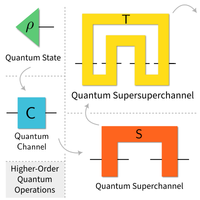
Quantum operations form a fundamental pillar of quantum theory and play a central role in quantum technology. Traditionally, they have been viewed simply as devices for transforming quantum states—such as quantum communication channels between distant parties or gates in a quantum circuit. However, quantum operations can themselves be transformed, and when treated as inputs to higher-order quantum operations (HOQOs), an entirely new layer of structure emerges. HOQOs describe transformations between quantum objects at all levels: they can map unitary gates to unitary gates, transform quantum channels into other quantum channels, manipulate measurements, compose circuits, and describe multitime open quantum processes. This generalization has unlocked powerful mathematical tools and a unified framework for analyzing quantum circuits, learning unknown quantum operations, characterizing quantum measurements, formalizing non-Markovian dynamics and memory effects, and understanding the origins of quantum chaos. Beyond these practical applications, HOQOs address profound foundational questions about the nature of quantum theory itself. The key insight is that quantum operations possess a richer internal structure than quantum states. They have explicit inputs and outputs, creating a functional hierarchy that naturally raises questions about causality and the temporal order of events. Consequently, quantum processes can exhibit indefinite causal order—neither one operation occurring before another, nor even a definite probabilistic mixture of such orders. This opens a new window into understanding how causality and quantum mechanics are fundamentally connected. This tutorial provides a comprehensive guide to HOQOs, beginning with the essential mathematical framework and core concepts. The pedagogical foundations are illustrated throughout with concrete examples that clarify key ideas. Following this introduction, the tutorial demonstrates the breadth and power of the HOQO approach through applications spanning quantum information processing, open quantum systems, dynamics of many-body quantum systems, quantum chaos, strong-coupling quantum thermodynamics, and foundational questions about causality in quantum theory.
Article Text
References (680)
- R. Landauer, Irreversibility and heat generation in the computing process, IBM J. Res. Dev. 5, 183 (1961).
- L. Hardy, Quantum theory from five reasonable axioms, arXiv:quant-ph/0101012.
- R. Clifton, J. Bub, and H. Halvorson, Characterizing quantum theory in terms of information-theoretic constraints, Found. Phys. 33, 1561 (2003).
- G. Chiribella, G. M. D’Ariano, and P. Perinotti, Informational derivation of quantum theory, Phys. Rev. A 84, 012311 (2011).
- G. M. D’Ariano, G. Chiribella, and P. Perinotti, Quantum Theory from First Principles: An Informational Approach (Cambridge University Press, Cambridge, England, 2017).
- J. Preskill, Fault-tolerant quantum computation, Introduction to Quantum Computation, edited by H.-K. Lo, S. Popescu, and T. P. Spiller (World Scientific, Singapore, 1997), p. 213.
- J. Preskill, Quantum computing in the NISQ era and beyond, Quantum 2, 79 (2018).
- J. Preskill, Beyond NISQ: the megaquop machine, ACM Trans. Quantum Comput. 6, 1 (2025).
- N. Gisin, G. Ribordy, W. Tittel, and H. Zbinden, Quantum cryptography, Rev. Mod. Phys. 74, 145 (2002).
- S. Pirandola, U. L. Andersen, L. Banchi, M. Berta, D. Bunandar, R. Colbeck, D. Englund, T. Gehring, C. Lupo, C. Ottaviani, J. L. Pereira, M. Razavi, J. Shamsul Shaari, M. Tomamichel, V. C. Usenko, G. Vallone, P. Villoresi, and P. Wallden, Advances in quantum cryptography, Adv. Opt. Photonics 12, 1012 (2020).
- V. Giovannetti, S. Lloyd, and L. Maccone, Advances in quantum metrology, Nat. Photonics 5, 222 (2011).
- G. Tóth and I. Apellaniz, Quantum metrology from a quantum information science perspective, J. Phys. A 47, 424006 (2014).
- J. Goold, M. Huber, A. Riera, L. del Rio, and P. Skrzypczyk, The role of quantum information in thermodynamics—A topical review, J. Phys. A 49, 143001 (2016).
- F. Binder, L. A. Correa, C. Gogolin, J. Anders, and G. Adesso, Thermodynamics in the Quantum Regime: Fundamental Aspects and New Directions (Springer International Publishing, Cham, Switzerland, 2018).
- I. de Vega and D. Alonso, Dynamics of Non-markovian open quantum systems, Rev. Mod. Phys. 89, 015001 (2017).
- H. Weimer, A. Kshetrimayum, and R. Orús, Simulation methods for open quantum many-body systems, Rev. Mod. Phys. 93, 015008 (2021).
- C. D. Bruzewicz, J. Chiaverini, R. McConnell, and J. M. Sage, Trapped-ion quantum computing: progress and challenges, Appl. Phys. Rev. 6, 021314 (2019).
- I. Siddiqi, Engineering high-coherence superconducting qubits, Nat. Rev. Mater. 6, 875 (2021).
- A. Chatterjee, P. Stevenson, S. De Franceschi, A. Morello, N. P. de Leon, and F. Kuemmeth, Semiconductor qubits in practice, Nat. Rev. Phys. 3, 157 (2021).
- P. Kok, W. J. Munro, K. Nemoto, T. C. Ralph, J. P. Dowling, and G. J. Milburn, Linear optical quantum computing with photonic qubits, Rev. Mod. Phys. 79, 135 (2007).
- J. L. O’Brien, Optical quantum computing, Science 318, 1567 (2007).
- A. Acín, I. Bloch, H. Buhrman, T. Calarco, C. Eichler, J. Eisert, D. Esteve, N. Gisin, S. J. Glaser, F. Jelezko, S. Kuhr, M. Lewenstein, M. F. Riedel, P. O. Schmidt, R. Thew, A. Wallraff, I. Walmsley, and F. K. Wilhelm, The quantum technologies roadmap: a european community view, New J. Phys. 20, 080201 (2018).
- D. D. Awschalom et al., A roadmap for quantum interconnects, Argonne National Laboratory (ANL), Argonne, IL, USA, Technical Report 2022.
Strictly speaking, the distinction we wish to make here is that of dynamic vs kinematic properties, and those we consider “spatial” do not necessarily have to be encoded in spatially distinct degrees of freedom. Since physically relevant setups often involve distributing parts of quantum states to spatially separated parties, we use this nomenclature for its intuitive merit.
- S. Milz, F. Sakuldee, F. A. Pollock, and K. Modi, Kolmogorov extension theorem for (Quantum) Causal modelling and general probabilistic theories, Quantum 4, 255 (2020).
- G. Chiribella, G. M. D’Ariano, and P. Perinotti, Quantum circuit architecture, Phys. Rev. Lett. 101, 060401 (2008).
- G. Chiribella, G. M. D’Ariano, and P. Perinotti, Theoretical framework for quantum networks, Phys. Rev. A 80, 022339 (2009).
- F. A. Pollock, C. Rodríguez-Rosario, T. Frauenheim, M. Paternostro, and K. Modi, Non-Markovian quantum processes: complete framework and efficient characterization, Phys. Rev. A 97, 012127 (2018).
- F. A. Pollock, C. Rodríguez-Rosario, T. Frauenheim, M. Paternostro, and K. Modi, Operational Markov condition for quantum processes, Phys. Rev. Lett. 120, 040405 (2018).
- O. Oreshkov, F. Costa, and Č. Brukner, Quantum correlations with no Causal order, Nat. Commun. 3, 1092 (2012).
- G. Chiribella, G. M. D’Ariano, P. Perinotti, and B. Valiron, Quantum computations without definite Causal structure, Phys. Rev. A 88, 022318 (2013).
- S. Shrapnel, F. Costa, and G. Milburn, Updating the born rule, New J. Phys. 20, 053010 (2018).
- G. A. L. White, C. D. Hill, F. A. Pollock, L. C. L. Hollenberg, and K. Modi, Demonstration of Non-Markovian process characterisation and control on a quantum processor, Nat. Commun. 11, 6301 (2020).
- G. A. L. White, F. A. Pollock, L. C. L. Hollenberg, C. D. Hill, and K. Modi, What can unitary sequences tell us about multi-time physics?, Quantum 9, 1695 (2025).
- P. Figueroa-Romero, K. Modi, R. J. Harris, T. M. Stace, and M.-H. Hsieh, Randomized benchmarking for Non-Markovian noise, PRX Quantum 2, 040351 (2021).
- P. Figueroa-Romero, K. Modi, and M.-H. Hsieh, Towards a general framework of randomized benchmarking incorporating non-Markovian noise, Quantum 6, 868 (2022).
- J. Morris, F. A. Pollock, and K. Modi, Quantifying non-markovian memory in a superconducting quantum computer, Open Syst. Inf. Dyn. 29, 2250007 (2022).
- G. Chiribella, G. M. D’Ariano, and P. Perinotti, Transforming quantum operations: Quantum supermaps, Europhys. Lett. 83, 30004 (2008).
- M. T. Quintino, Q. Dong, A. Shimbo, A. Soeda, and M. Murao, Reversing unknown quantum transformations: Universal quantum circuit for inverting general unitary operations, Phys. Rev. Lett. 123, 210502 (2019).
- M. T. Quintino, Q. Dong, A. Shimbo, A. Soeda, and M. Murao, Probabilistic exact universal quantum circuits for transforming unitary operations, Phys. Rev. A 100, 062339 (2019).
- M. T. Quintino and D. Ebler, Deterministic transformations between unitary operations: exponential advantage with adaptive quantum circuits and the power of indefinite Causality, Quantum 6, 679 (2022).
- A. Kitaev and J. Watrous, Parallelization, amplification, and exponential time simulation of quantum interactive proof systems, in Proceedings of the 32nd Annual ACM Symposium on Theory of Computing (STOC) (Association for Computing Machinery, New York, NY, USA, 2000), p. 608.
- A. Ambainis, Quantum lower bounds by quantum arguments, in Proceedings of the 32nd Annual ACM Symposium on Theory of Computing (STOC) (Association for Computing Machinery, New York, NY, USA, 2000), p. 636, arXiv:quant-ph/0002066.
- G. Gutoski and J. Watrous, Toward a general theory of quantum games, in Proceedings of the 39th Annual ACM Symposium on Theory of Computing (STOC) (Association for Computing Machinery, New York, NY, USA, 2007), p. 565, arXiv:quant-ph/0611234.
- C. Portmann, C. Matt, U. Maurer, R. Renner, and B. Tackmann, Causal boxes: Quantum information-processing systems closed under composition, IEEE Trans. Inf. Theory 63, 3277 (2017).
- Ä. Baumeler and S. Wolf, Non-causal computation, Entropy 19, 326 (2017).
- M. Araújo, P. A. Guérin, and Ä. Baumeler, Quantum computation with indefinite causal structures, Phys. Rev. A 96, 052315 (2017).
- Ä. Baumeler and S. Wolf, Computational tameness of classical non-causal models, Proc. R. Soc. A 474, 20170698 (2018).
- M. Araújo, C. Branciard, F. Costa, A. Feix, C. Giarmatzi, and Č. Brukner, Witnessing causal nonseparability, New J. Phys. 17, 102001 (2015).
- J. Bavaresco, M. Araújo, Č. Brukner, and M. T. Quintino, Semi-device-independent certification of indefinite causal order, Quantum 3, 176 (2019).
- S. Milz, J. Bavaresco, and G. Chiribella, Resource theory of Causal connection, Quantum 6, 788 (2022).
- F. Costa and S. Shrapnel, Quantum causal modelling, New J. Phys. 18, 063032 (2016).
- P. Taranto, F. A. Pollock, S. Milz, M. Tomamichel, and K. Modi, Quantum Markov order, Phys. Rev. Lett. 122, 140401 (2019).
- P. Taranto, S. Milz, F. A. Pollock, and K. Modi, Structure of quantum stochastic processes with finite Markov order, Phys. Rev. A 99, 042108 (2019).
- P. Taranto, F. A. Pollock, and K. Modi, Non-Markovian memory strength bounds quantum process recoverability, npj Quantum Inf. 7, 149 (2021).
- D. Kretschmann and R. F. Werner, Quantum channels with memory, Phys. Rev. A 72, 062323 (2005).
- K. Modi, Operational approach to open dynamics and quantifying initial correlations, Sci. Rep. 2, 581 (2012).
- K. Modi, C. A. Rodríguez-Rosario, and A. Aspuru-Guzik, Positivity in the presence of initial system-environment correlation, Phys. Rev. A 86, 064102 (2012).
- M. Ringbauer, C. J. Wood, K. Modi, A. Gilchrist, A. G. White, and A. Fedrizzi, Characterizing quantum dynamics with initial system-environment correlations, Phys. Rev. Lett. 114, 090402 (2015).
- O. Oreshkov and C. Giarmatzi, Causal and causally separable processes, New J. Phys. 18, 093020 (2016).
- M. A. Nielsen and I. L. Chuang, Quantum Computation and Quantum Information (Cambridge University Press, Cambridge, England, 2000).
The latter are often called “supermaps” throughout the literature.
- W. F. Stinespring, Positive functions on -algebras, Proc. Am. Math. Soc. 6, 211 (1955).
- G. Chiribella and D. Ebler, Optimal quantum networks and one-shot entropies, New J. Phys. 18, 093053 (2016).
- J. Miyazaki, A. Soeda, and M. Murao, Complex conjugation supermap of unitary quantum maps and its universal implementation protocol, Phys. Rev. Res. 1, 013007 (2019).
- D. Ebler, M. Horodecki, M. Marciniak, T. Młynik, M. T. Quintino, and M. Studziński, Optimal universal quantum circuits for unitary complex conjugation, IEEE Trans. Inf. Theory 69, 5069 (2023).
Similarly to pure quantum states, unitary operators differing only by global phases represent identical physical operations, as verified by the identity for all real .
- J. Thompson, K. Modi, V. Vedral, and M. Gu, Quantum plug n’ play: Modular computation in the quantum regime, New J. Phys. 20, 013004 (2018).
- S. Yoshida, A. Soeda, and M. Murao, Reversing unknown qubit-unitary operation, deterministically and exactly, Phys. Rev. Lett. 131, 120602 (2023).
- S. Yoshida, A. Soeda, and M. Murao, Universal construction of decoders from encoding black boxes, Quantum 7, 957 (2023).
- S. Yoshida, A. Soeda, and M. Murao, Universal adjointation of isometry operations using transformation of quantum supermaps, Quantum 9, 1750 (2025).
- Y.-A. Chen, Y. Mo, Y. Liu, L. Zhang, and X. Wang, Quantum advantage in reversing unknown unitary evolutions, arXiv:2403.04704.
- Y. Mo, L. Zhang, Y.-A. Chen, Y. Liu, T. Lin, and X. Wang, Parameterized quantum comb and simpler circuits for reversing unknown qubit-unitary operations, npj Quantum Inf. 11, 32 (2025).
- C. Zhu, Y. Mo, Y.-A. Chen, and X. Wang, Reversing unknown quantum processes via virtual combs for channels with limited information, Phys. Rev. Lett. 133, 030801 (2024).
- J. Bavaresco, M. Murao, and M. T. Quintino, Strict hierarchy between parallel, sequential, and indefinite-causal-order strategies for channel discrimination, Phys. Rev. Lett. 127, 200504 (2021).
- J. Bavaresco, M. Murao, and M. T. Quintino, Unitary channel discrimination beyond group structures: Advantages of sequential and indefinite-causal-order strategies, J. Math. Phys. (N.Y.) 63, 042203 (2022).
- A. Bisio, G. Chiribella, G. M. D’Ariano, S. Facchini, and P. Perinotti, Optimal quantum tomography, IEEE J. Sel. Top. Quantum Electron. 15, 1646 (2009).
- A. Bisio, G. Chiribella, G. M. D’Ariano, S. Facchini, and P. Perinotti, Optimal quantum learning of a unitary transformation, Phys. Rev. A 81, 032324 (2010).
- M. Sedlák, A. Bisio, and M. Ziman, Optimal probabilistic storage and retrieval of unitary channels, Phys. Rev. Lett. 122, 170502 (2019).
- X. Zhao, X. Wang, and G. Chiribella, Shadow simulation of quantum processes, Phys. Rev. Lett. 133, 120804 (2024).
- A. Raza, M. C. Caro, J. Eisert, and S. Khatri, Online learning of quantum processes, arXiv:2406.04250.
- Y.-A. Chen, C. Zhu, K. He, Y. Liu, and X. Wang, Hypothesis testing of symmetry in quantum dynamics, arXiv:2411.14292.
- C. Zhu, S. He, Y.-A. Chen, L. Zhang, and X. Wang, Optimal Hamiltonian recognition of unknown quantum dynamics, npj Quantum Inf. 12, 36 (2026).
This poses no inconsistency in notation, as one can always consider the output Hilbert spaces to be trivial.
- A. Feix and Č. Brukner, Quantum superpositions of ‘common-cause’ and ‘direct-cause’ causal structures, New J. Phys. 19, 123028 (2017).
- J.-M. A. Allen, J. Barrett, D. C. Horsman, C. M. Lee, and R. W. Spekkens, Quantum common causes and quantum causal models, Phys. Rev. X 7, 031021 (2017).
- Y. Guo, P. Taranto, B.-H. Liu, X.-M. Hu, Y.-F. Huang, C.-F. Li, and G.-C. Guo, Experimental demonstration of instrument-specific quantum memory effects and non-Markovian process recovery for common-cause processes, Phys. Rev. Lett. 126, 230401 (2021).
- M. Nery, M. T. Quintino, P. A. Guérin, T. O. Maciel, and R. O. Vianna, Simple and maximally robust processes with no classical common-cause or direct-cause explanation, Quantum 5, 538 (2021).
- M. Araújo, A. Feix, M. Navascués, and Č. Brukner, A purification postulate for quantum mechanics with indefinite causal order, Quantum 1, 10 (2017).
- O. Oreshkov, Time-delocalized quantum subsystems and operations: On the existence of processes with indefinite causal structure in quantum mechanics, Quantum 3, 206 (2019).
- J. Wechs, H. Dourdent, A. A. Abbott, and C. Branciard, Quantum circuits with classical versus quantum control of Causal order, PRX Quantum 2, 030335 (2021).
- J. Wechs, C. Branciard, and O. Oreshkov, Existence of processes violating causal inequalities on time-delocalised subsystems, Nat. Commun. 14, 1471 (2023).
- F. Dupuis, O. Fawzi, and R. Renner, Entropy accumulation, Commun. Math. Phys. 379, 867 (2020).
- T. Metger, O. Fawzi, D. Sutter, and R. Renner, Generalised entropy accumulation, in Proceedings of the IEEE 63rd Annual Symposium on Foundations of Computer Science (FOCS) (2022), p. 844, arXiv:2203.04989.
- J. Cotler, X. Han, X.-L. Qi, and Z. Yang, Quantum causal influence, J. High Energy Phys. 07 (2019) 42.
- J. Barrett, R. Lorenz, and O. Oreshkov, Quantum causal models, arXiv:1906.10726.
- A. Bisio, G. Chiribella, G. M. D’Ariano, and P. Perinotti, Quantum networks: General theory and applications, Acta Phys. Slovaca 61, 273 (2011), https://www.physics.sk/aps/pub.php?y=2011&pub=aps-11-03.
- F. Caruso, V. Giovannetti, C. Lupo, and S. Mancini, Quantum channels and memory effects, Rev. Mod. Phys. 86, 1203 (2014).
- L. Hardy, Quantum gravity computers: on the theory of computation with indefinite Causal structure, in Quantum Reality, Relativistic Causality, and Closing the Epistemic Circle: Essays in Honour of Abner Shimony, edited by W. C. Myrvold and J. Christian (Springer, Dordrecht, Netherlands, 2009), p. –379.
- L. Hardy, The operator tensor formulation of quantum theory, Phil. Trans. R. Soc. A 370, 3385 (2012).
- L. Hardy, Quantum theory with bold operator tensors, Phil. Trans. R. Soc. A 373, 20140239 (2015).
- P. Perinotti, Causal structures and the classification of higher order quantum computations, in Time in Physics, edited by R. Renner and S. Stupar (Springer International Publishing, Cham, Switzerland, 2017), p. 103.
- A. Bisio and P. Perinotti, Theoretical framework for higher-order quantum theory, Proc. R. Soc. A 475, 20180706 (2019).
Note that an operator between two Hilbert spaces and is linear if it satisfies for all and .
- J. Barrett, Information processing in generalized probabilistic theories, arXiv:quant-ph/0508211.
- L. Masanes and M. P. Müller, A derivation of quantum theory from physical requirements, New J. Phys. 13, 063001 (2011).
In this Tutorial, we reserve the term “HOQOs” to refer to linear maps, thus excluding analogous models such as closed time-like curves [108, 109, 110, 111] and multitime states [112, 113, 114], which generally exhibit non-linear features.
- D. Deutsch, Quantum mechanics near closed timelike lines, Phys. Rev. D 44, 3197 (1991).
- C. H. Bennett, Simulated Time Travel, Teleportation Without Communication, and How to Conduct a Romance with Someone who has Fallen into a Black Hole (2005).
- S. Lloyd, L. Maccone, R. Garcia-Patron, V. Giovannetti, Y. Shikano, S. Pirandola, L. A. Rozema, A. Darabi, Y. Soudagar, L. K. Shalm, and A. M. Steinberg, Closed timelike curves via Postselection: Theory and experimental test of consistency, Phys. Rev. Lett. 106, 040403 (2011).
- S. Lloyd, L. Maccone, R. Garcia-Patron, V. Giovannetti, and Y. Shikano, Quantum mechanics of time travel through post-selected teleportation, Phys. Rev. D 84, 025007 (2011).
- Y. Aharonov, P. G. Bergmann, and J. L. Lebowitz, Time symmetry in the quantum process of measurement, Phys. Rev. 134, 1410 (1964).
- Y. Aharonov, J. Anandan, S. Popescu, and L. Vaidman, Superpositions of time evolutions of a quantum system and a quantum time-translation machine, Phys. Rev. Lett. 64, 2965 (1990).
- R. Silva, Y. Guryanova, A. J. Short, P. Skrzypczyk, N. Brunner, and S. Popescu, Connecting processes with indefinite causal order and multi-time quantum states, New J. Phys. 19, 103022 (2017).
- K. Kraus, States, Effects, and Operations: Fundamental Notions of Quantum Theory (Springer Berlin Heidelberg, Berlin, Germany, 1983).
Eq. (2.16) ensures that each outcome of an effect is positive and together they sum to unity, i.e., the Born rule leads to a valid probability distribution.
When we say that an operation is CP, we automatically mean that it is also Hermiticity preserving.
- E. C. G. Sudarshan, P. M. Mathews, and J. Rau, Stochastic dynamics of quantum-mechanical systems, Phys. Rev. 121, 920 (1961).
- G. Lüders, Concerning the state-change due to the measurement process, Ann. Phys. (Amsterdam) 518, 663 (2006); Ann. Phys. (Berlin) 443, 322 (2006).
- A. Jamiołkowski, Linear transformations which preserve trace and positive semidefiniteness of operators, Rep. Math. Phys. 3, 275 (1972).
- M.-D. Choi, Completely positive linear maps on complex matrices, Linear Algebra Its Appl. 24, 285 (2017).
Since by definition , technically, the resulting operator is an element of and an appropriate relabeling of spaces is tacitly assumed; whenever more diligent bookkeeping is required, we will be explicit.
- A. S. Holevo, The Choi–Jamiolkowski forms of quantum Gaussian channels, J. Math. Phys. (N.Y.) 52, 042202 (2011).
Choi states also possess interesting properties for larger sets of linear maps such as positive but not completely positive maps, which do not necessarily represent quantum channels. For a discussion concerning the CJI for such maps, as well as a more detailed presentation of the CJI for CPTP maps, see, e.g., Refs. [125, 126].
- K. Życzkowski and I. Bengtsson, On duality between quantum maps and quantum states, Open Syst. Inf. Dyn. 11, 3 (2004).
- I. Bengtsson and K. Życzkowski, Geometry of Quantum States: An Introduction to Quantum Entanglement (Cambridge University Press, Cambridge, England, 2010).
Recall that this additional transpose arises from the definition we take for the CJI; therefore it is entirely conventional (we choose it so that the standard Born rule applies) and has no physical consequence.
- G. Chiribella, G. M. D’Ariano, and P. Perinotti, Probabilistic theories with purification, Phys. Rev. A 81, 062348 (2010).
- G. M. D’Ariano, Causality re-established, Phil. Trans. R. Soc. A 376, 20170313 (2018).
While our notation convention suggests that quantum states should technically be denoted by sans-serif letters, i.e., , we maintain the traditional Greek letter notation, i.e., .
We emphasize that the space the “output” state is defined on is labeled by here, i.e., an “input” () label. This is owed to the fact that we label spaces from the perspective of the experimenter, not the superchannel, and the roles of inputs and outputs are exchanged for both. This notational ambiguity is unavoidable and we adhere to the convention that when we denote something as an input/output of an object, we refer to what is inserted into it/comes out of it, independent of the labeling of the respective spaces.
Throughout, we frequently change the labeling of spaces depending on whether we want to emphasize the time—leading to labels —or the laboratory—leading to labels —of the respective spaces.
Since is traced over, the partial transposition (which acts only on this space) can be applied to either operator or due to the duality of transposition within said trace; we simply choose as a matter of convention.
- Č. Brukner, Talk given at 554. WE-heraeus-seminar conference quantum contextuality, Non-locality, and the foundations of quantum mechanics (2014).
- Y. Guryanova, R. Silva, A. J. Short, P. Skrzypczyk, N. Brunner, and S. Popescu, Exploring the limits of no backwards in time signalling, Quantum 3, 211 (2019).
- S. Milz, F. A. Pollock, and K. Modi, An introduction to operational quantum dynamics, Open Syst. Inf. Dyn. 24, 1740016 (2017).
The terms “quantum comb” and “process tensor” both refer to the same object: causally ordered, sequential deterministic quantum processes with open slots for interventions. The two distinct names are vestiges of the fact that they were derived independently through two different communities. We will use the terms interchangeably throughout to accommodate for the fact that readers will encounter both names throughout the literature.
As mentioned previously, throughout we reserve the term “superchannel” for quantum combs/process tensors with one slot, both for trivial and non-trivial initial input space .
- M. Ziman, Process positive-operator-valued measure: A mathematical framework for the description of process tomography experiments, Phys. Rev. A 77, 062112 (2008).
- S. Milz and M. T. Quintino, Characterising transformations between quantum objects, ‘completeness’ of quantum properties, and transformations without a fixed causal order, Quantum 8, 1415 (2024).
- K. Życzkowski, Quartic quantum theory: An extension of the standard quantum mechanics, J. Phys. A 41, 355302 (2008).
- G. Chiribella, Perfect discrimination of no-signalling channels via quantum superposition of causal structures, Phys. Rev. A 86, 040301 (2012).
- T. Hoffreumon and O. Oreshkov, The multi-round process matrix, Quantum 5, 384 (2021).
- W. Simmons and A. Kissinger, Higher-order causal theories are models of BV-logic, arXiv:2205.11219.
In this and the following section, we simplify notation as compared to the previous sections, denoting Hilbert spaces by instead of and labeling auxiliary spaces by . Additionally, since it is more intuitive for the channel case, we switch the role of input and input and output and denote them by and instead of and respectively as would follow from the convention in the previous section. We will return to the latter convention when we discuss genuinely multitime quantum combs.
Since is positive semidefinite, the additional dagger on in the definition of the purification of is somewhat superfluous. Here, we explicitly include it to adhere to the convention chosen in Refs. [27, 97].
- G. Chiribella, G. M. D’Ariano, and P. Perinotti, Realization schemes for quantum instruments in finite dimensions, J. Math. Phys. (N.Y.) 50, 042101 (2009).
In this section, we often let HOQOs start on an output space . This amounts merely to making a specific choice and has no bearing on the following arguments; the case where combs start on an input space can easily be recovered by setting .
We emphasize that—similar to the case of CPTP maps, where trace preservation already implies complete trace preservation (see Sec. 2d1)—here, requiring complete trace preservation preservation does not add any further constraints (see Refs. [89, 140] and below).
Similar to trace non-increasing CP maps—the probabilistic elements corresponding to deterministic quantum channels—we can say that probabilistic HOQOs are those HOQOs that satisfy for some deterministic HOQO (we will discuss probabilistic HOQOs further in Sec. 2d4).
Here, for simplicity, we assume that and “start” on fixed spaces that are labeled by 0 and 1, respectively, and that they are defined on all spaces between and . The arguments can be extended without any added difficulty to the case where these starting times are chosen differently, and where there are “holes” in the set of spaces they are defined on.
When taking the tensor product of two quantum combs, subtleties with respect to the temporal ordering of the resulting comb arise (see Ref. [27]). Here, we do not discuss these issues in detail and assume that the times the resulting comb is defined on are given by the labels of the involved Hilbert spaces.
Alternatively, one can employ the requirement of “compatibility with remote connection” [27], which yields an axiomatic definition of HOQOs that coincides with that of Prop. t30.
In what follows, to avoid an additional relabeling step in the derivation, we tacitly suppress the terms and that respectively occur in the definitions of and ; this is merely done for notational convenience and not a conceptual step.
We again suppress the term to avoid additional relabeling.
Since in this section we only consider superinstruments—and not the quantum combs that they act on—we omit the “breves” we added to the notation of superinstruments in Sec. 2c3.
Such general superinstruments are, e.g., used to demonstrate the advantage of causally indefinite HOQOs over all causally ordered ones for the task of channel discrimination [75, 76].
Note that for this definition of , we have , due to the definition of the link product.
- J. Burniston, M. Grabowecky, C. M. Scandolo, G. Chiribella, and G. Gour, Necessary and sufficient conditions on measurements of quantum channels, Proc. R. Soc. A 476, 20190832 (2020).
- L. Hardy, Probability theories with dynamic Causal structure: a new framework for quantum gravity, arXiv:gr-qc/0509120.
- L. Hardy, Towards quantum gravity: A framework for probabilistic theories with non-fixed causal structure, J. Phys. A 40, 3081 (2007).
- Ä. Baumeler, F. Costa, T. C. Ralph, S. Wolf, and M. Zych, Reversible time travel with freedom of choice, Classical Quantum Gravity 36, 224002 (2019).
- M. Zych, F. Costa, I. Pikovski, and Č. Brukner, Bell’s theorem for temporal order, Nat. Commun. 10, 3772 (2019).
Here, again, we employ the breve to signify that the “input” spaces of one comb correspond to the “output” spaces of the other.
- D. Genkina, G. Chiribella, and L. Hardy, Optimal probabilistic simulation of quantum channels from the future to the past, Phys. Rev. A 85, 022330 (2012).
- O. Oreshkov and N. J. Cerf, Operational quantum theory without predefined time, New J. Phys. 18, 073037 (2016).
- S. Milz, F. A. Pollock, T. P. Le, G. Chiribella, and K. Modi, Entanglement, non-Markovianity, and causal non-separability, New J. Phys. 20, 033033 (2018).
- Ä. Baumeler and S. Wolf, Perfect signaling among three parties violating predefined causal order, in Proceedings of the 2014 IEEE International Symposium on Information Theory (ISITs) (2014), p. 526, arXiv:1312.5916.
- A. A. Abbott, C. Giarmatzi, F. Costa, and C. Branciard, Multipartite causal correlations: Polytopes and inequalities, Phys. Rev. A 94, 032131 (2016).
- J. Wechs, A. A. Abbott, and C. Branciard, On the definition and characterisation of multipartite causal (non)separability, New J. Phys. 21, 013027 (2019).
- M. Kläy, C. Randall, and D. Foulis, Tensor products and probability weights, Int. J. Theor. Phys. 26, 199 (1987).
- H. Barnum, C. A. Fuchs, J. M. Renes, and A. Wilce, Influence-free states on compound quantum systems, arXiv:quant-ph/0507108.
- G. Gutoski, Properties of local quantum operations with shared entanglement, Quantum Inf. Comput. 9, 739 (2009).
Since the output of when acting on non-signaling maps is equal to 1, the projector on the output space is the trivial identity projector , and we have as the (trivial) trace condition on the output space.
- P. Skrzypczyk and D. Cavalcanti, Semidefinite Programming in Quantum Information Science (IOP Publishing, Bristol, United Kingdom, 2023).
- C. Branciard, Witnesses of causal nonseparability: an introduction and a few case studies, Sci. Rep. 6, 26018 (2016).
- R. F. Werner, Quantum states with Einstein-Podolsky-Rosen correlations admitting a hidden-variable model, Phys. Rev. A 40, 4277 (1989).
- Ä. Baumeler, A. Feix, and S. Wolf, Maximal incompatibility of locally classical behavior and global causal order in multiparty scenarios, Phys. Rev. A 90, 042106 (2014).
- C. Branciard, M. Araújo, A. Feix, F. Costa, and Č. Brukner, The simplest causal inequalities and their violation, New J. Phys. 18, 013008 (2015).
- A. Feix, M. Araújo, and Č. Brukner, Causally nonseparable processes admitting a causal model, New J. Phys. 18, 083040 (2016).
- T. Purves and A. J. Short, Quantum theory cannot violate a causal inequality, Phys. Rev. Lett. 127, 110402 (2021).
- H. Dourdent, A. A. Abbott, N. Brunner, I. Šupić, and C. Branciard, Semi-device-independent certification of causal nonseparability with trusted quantum inputs, Phys. Rev. Lett. 129, 090402 (2022).
- H. Dourdent, A. A. Abbott, I. Šupić, and C. Branciard, Network-device-independent certification of causal nonseparability, Quantum 8, 1514 (2024).
- T. van der Lugt, J. Barrett, and G. Chiribella, Device-independent certification of indefinite causal order in the quantum switch, Nat. Commun. 14, 5811 (2023).
- T. van der Lugt and N. Ormrod, Possibilistic and maximal indefinite causal order in the quantum switch, Quantum 8, 1543 (2024).
- M. Araújo, F. Costa, and Č. Brukner, Computational advantage from quantum-controlled ordering of gates, Phys. Rev. Lett. 113, 250402 (2014).
- L. M. Procopio, A. Moqanaki, M. Araújo, F. Costa, I. Alonso Calafell, E. G. Dowd, D. R. Hamel, L. A. Rozema, Č. Brukner, and P. Walther, Experimental superposition of orders of quantum gates, Nat. Commun. 6, 7913 (2015).
- K. Goswami, C. Giarmatzi, M. Kewming, F. Costa, C. Branciard, J. Romero, and A. G. White, Indefinite causal order in a quantum switch, Phys. Rev. Lett. 121, 090503 (2018).
- G. Rubino, L. A. Rozema, A. Feix, M. Araújo, J. M. Zeuner, L. M. Procopio, Č. Brukner, and P. Walther, Experimental verification of an indefinite causal order, Sci. Adv. 3, 1602589 (2017).
- K. Goswami and J. Romero, Experiments on quantum causality, AVS Quantum Sci. 2, 037101 (2020).
- L. A. Rozema, T. Strömberg, H. Cao, Y. Guo, B.-H. Liu, and P. Walther, Experimental aspects of indefinite causal order in quantum mechanics, Nat. Rev. Phys. 6, 483 (2024).
- Q. Dong, M. T. Quintino, A. Soeda, and M. Murao, The quantum switch is uniquely defined by its action on unitary operations, Quantum 7, 1169 (2023).
- G. Chiribella and Z. Liu, Quantum operations with indefinite time direction, Commun. Phys. 5, 1 (2022).
In what follows, we assume that and .
An alternative option would be to take the adjoint instead of the transpose in this equation [193]. In this case, the resulting channel and the corresponding time flip would depend on the explicit choice of Kraus operators and we thus do not consider it here.
- T. Strömberg, P. Schiansky, M. T. Quintino, M. Antesberger, L. A. Rozema, I. Agresti, Č. Brukner, and P. Walther, Experimental superposition of a quantum evolution with its time reverse, Phys. Rev. Res. 6, 023071 (2024).
- Y. Guo, Z. Liu, H. Tang, X.-M. Hu, B.-H. Liu, Y.-F. Huang, C.-F. Li, G.-C. Guo, and G. Chiribella, Experimental demonstration of input-output indefiniteness in a single quantum device, Phys. Rev. Lett. 132, 160201 (2024).
- A. Kissinger and S. Uijlen, A categorical semantics for causal structure, Log. Methods Comput. Sci. 15, 15 (2019).
- T. Hoffreumon and O. Oreshkov, Projective characterization of higher-order quantum transformations, Quantum 10, 1978 (2026).
- L. Apadula, A. Bisio, and P. Perinotti, No-signalling constrains quantum computation with indefinite causal structure, Quantum 8, 1241 (2024).
- T. Theurer, D. Egloff, L. Zhang, and M. B. Plenio, Quantifying operations with an application to coherence, Phys. Rev. Lett. 122, 190405 (2019).
- Z.-W. Liu and A. Winter, Resource theories of quantum channels and the universal role of resource erasure, arXiv:1904.04201.
- G. Gour and C. M. Scandolo, Dynamical resources, arXiv:2101.01552.
- G. Gour and C. M. Scandolo, Dynamical entanglement, Phys. Rev. Lett. 125, 180505 (2020).
- G. Gour and C. M. Scandolo, Entanglement of a bipartite channel, Phys. Rev. A 103, 062422 (2021).
- G. Gour, D. Kim, T. Nateeboon, G. Shemesh, and G. Yoeli, Inevitable negativity: Additivity commands negative quantum channel entropy, Phys. Rev. A 111, 052424 (2025).
- G. D. Berk, A. J. P. Garner, B. Yadin, K. Modi, and F. A. Pollock, Resource theories of multi-time processes: A window into quantum non-Markovianity, Quantum 5, 435 (2021).
- M. Wilson and G. Chiribella, A mathematical framework for transformations of physical processes, arXiv:2204.04319.
- M. Wilson, G. Chiribella, and A. Kissinger, Quantum supermaps are characterized by locality, Quantum 10, 2013 (2026).
- M. Wilson and G. Chiribella, Free polycategories for unitary supermaps of arbitrary dimension, arXiv:2207.09180.
- J. Hefford and C. Comfort, Coend optics for quantum combs, Electron. Proc. Theor. Comput. Sci., 380, 63 (2023).
- J. Hefford and M. Wilson, A profunctorial semantics for quantum supermaps, in Proceedings of the 39th Annual ACM/IEEE Symposium on Logic in Computer Science (LICS) (Association for Computing Machinery, New York, NY, USA, 2024), p. 1, arXiv:2402.02997.
- A. Jenčová, On the structure of higher order quantum maps, Quantum 10, 2090 (2026).
In more general situations, depending on the sets of objects between which the HOQO of interest maps, the additional demand of “completeness” may be insufficient to guarantee positivity and lead to structurally different sets of HOQOs [140]. Consequently, in all following considerations, we will require positivity of the considered (Choi states of) HOQOs as an explicit assumption.
Since , it is already ensured that yields a positive semidefinite operator when acting on a positive semidefinite object, so that we do not have to demand this property as an additional requirement here.
- E. Castro-Ruiz, F. Giacomini, and Č. Brukner, Dynamics of quantum Causal structures, Phys. Rev. X 8, 011047 (2018).
- R. Orús, A practical introduction to tensor networks: matrix product states and projected entangled pair states, Ann. Phys. (Amsterdam) 349, 117 (2014).
- J. I. Cirac, D. Pérez-García, N. Schuch, and F. Verstraete, Matrix product states and projected entangled pair states: concepts, symmetries theorems, Rev. Mod. Phys. 93, 045003 (2021).
- M. Boyer, G. Brassard, P. Høyer, and A. Tapp, Tight bounds on quantum searching, Fortschr. Phys. 46, 493 (1998).
- A. Chefles, A. Kitagawa, M. Takeoka, M. Sasaki, and J. Twamley, Unambiguous discrimination among oracle operators, J. Phys. A 40, 10183 (2007).
- J. Thompson, A. J. P. Garner, V. Vedral, and M. Gu, Using quantum theory to simplify input–output processes, npj Quantum Inf. 3, 6 (2017).
- T. J. Elliott, M. Gu, A. J. P. Garner, and J. Thompson, Quantum adaptive agents with efficient long-term memories, Phys. Rev. X 12, 011007 (2022).
- J. Xing, T. Feng, Z. Fan, H. Ma, K. Bharti, D. E. Koh, and Y. Xiao, Fundamental limitations on communication over a quantum network, arXiv:2306.04983.
- J. F. Fitzsimons and E. Kashefi, Unconditionally verifiable blind quantum computation, Phys. Rev. A 96, 012303 (2017).
- J. F. Fitzsimons, Private quantum computation: an introduction to blind quantum computing and related protocols, npj Quantum Inf. 3, 23 (2017).
- I. D. Smith, M. Krumm, L. J. Fiderer, H. P. Nautrup, and H. J. Briegel, The min-entropy of classical-quantum combs for measurement-based applications, Quantum 7, 1206 (2023).
- P. Selinger, Towards a quantum programming language, Math. Struct. Comput. Sci. 14, 527 (2004).
- P. Selinger and B. Valiron, A lambda calculus for quantum computation with classical control, in Typed Lambda Calculi and Applications (Springer, Berlin, Germany, 2005), , 354.
- G. Chiribella, G. M. D’Ariano, and P. Perinotti, Optimal cloning of unitary transformation, Phys. Rev. Lett. 101, 180504 (2008).
- G. Chiribella, Y. Yang, and C. Huang, Universal superreplication of unitary gates, Phys. Rev. Lett. 114, 120504 (2015).
- A. Bisio, G. M. D’Ariano, P. Perinotti, and M. Sedlák, Optimal processing of reversible quantum channels, Phys. Lett. A 378, 1797 (2014).
- W. Dür, P. Sekatski, and M. Skotiniotis, Deterministic superreplication of one-parameter unitary transformations, Phys. Rev. Lett. 114, 120503 (2015).
- Q. Dong, S. Nakayama, A. Soeda, and M. Murao, Controlled quantum operations and combs, and their applications to universal controllization of divisible unitary operations, arXiv:1911.01645.
- M. Soleimanifar and V. Karimipour, No-go theorem for iterations of unknown quantum gates, Phys. Rev. A 93, 012344 (2016).
- A. Soeda, Limitations on quantum subroutine designing due to the linear structure of quantum operators, in Proceedings of the 3rd International Conference on Quantum Information and Technology (ICQIT2013) (2013).
- M. Araújo, A. Feix, F. Costa, and Č. Brukner, Quantum circuits cannot control unknown operations, New J. Phys. 16, 093026 (2014).
Similar to the quantum state fidelity, the quantum channel fidelity here respects various properties which are desired for quantifying the similarity between two quantum channels; see, e.g., Refs. [238, 239].
- M. Raginsky, A fidelity measure for quantum channels, Phys. Lett. A 290, 11 (2001).
- A. Gilchrist, N. K. Langford, and M. A. Nielsen, Distance measures to compare real and ideal quantum processes, Phys. Rev. A 71, 062310 (2005).
Equations (3.3) and (3.5) differ up to a transpose on ; however, since the optimization is taken over a class of HOQOs (e.g., parallel, sequential, or causally indefinite), and transposition leaves any such class of HOQOs invariant, it follows that .
- Q. Dong, M. T. Quintino, A. Soeda, and M. Murao, Success-or-draw: A strategy allowing repeat-until-success in quantum computation, Phys. Rev. Lett. 126, 150504 (2021).
- A. S. Holevo, Probabilistic and Statistical Aspects of Quantum Mechanics, Monographs (Scuola Normale Superiore) (Edizioni Della Normale, Springer, Basel, 2011).
In such cases, these two figures of merit also coincide with the white noise robustness [41].
- Y. Yang, R. Renner, and G. Chiribella, Optimal universal programming of unitary gates, Phys. Rev. Lett. 125, 210501 (2020).
- S. Ishizaka and T. Hiroshima, Asymptotic teleportation scheme as a universal programmable quantum processor, Phys. Rev. Lett. 101, 240501 (2008).
- S. Ishizaka and T. Hiroshima, Quantum teleportation scheme by selecting one of multiple output ports, Phys. Rev. A 79, 042306 (2009).
- M. Mozrzymas, M. Studziński, S. Strelchuk, and M. Horodecki, Optimal port-based teleportation, New J. Phys. 20, 053006 (2018).
- G. Chiribella, G. M. D’Ariano, and M. F. Sacchi, Optimal estimation of group transformations using entanglement, Phys. Rev. A 72, 042338 (2005).
- S. Yoshida, J. Miyazaki, and M. Murao, Quantum advantage in storage and retrieval of isometry channels, Phys. Rev. Lett. 136, 190601 (2026).
- D. Grinko and M. Ozols, Linear programming with unitary-equivariant constraints, Commun. Math. Phys. 405, 278 (2024).
- D. Grinko, S. Yoshida, M. Murao, and M. Ozols, Sequential quantum processes with group symmetries, arXiv:2510.07100.
- S. Yoshida, Y. Koizumi, M. Studziń’ski, M. T. Quintino, and M. Murao, One-to-one correspondence between deterministic port-based teleportation and unitary estimation, IEEE Trans. Inf. Theory 72, 2358 (2026).
- X.-Q. Zhou, T. C. Ralph, P. Kalasuwan, M. Zhang, A. Peruzzo, B. P. Lanyon, and J. L. O’Brien, Adding control to arbitrary unknown quantum operations, Nat. Commun. 2, 413 (2011).
- N. Friis, V. Dunjko, W. Dür, and H. J. Briegel, Implementing quantum control for unknown subroutines, Phys. Rev. A 89, 030303 (2014).
- A. Bisio, M. Dall’Arno, and P. Perinotti, Quantum conditional operations, Phys. Rev. A 94, 022340 (2016).
- Z. Gavorová, M. Seidel, and Y. Touati, Topological obstructions to quantum computation with unitary oracles, Phys. Rev. A 109, 032625 (2024).
- A. Y. Kitaev, Quantum measurements and the Abelian stabilizer problem, arXiv:quant-ph/9511026.
- M. A. Nielsen and I. L. Chuang, Programmable quantum gate arrays, Phys. Rev. Lett. 79, 321 (1997).
- A. Bisio, G. M. D’Ariano, P. Perinotti, and M. Sedlák, Quantum learning algorithms for quantum measurements, Phys. Lett. A 375, 3425 (2011).
- M. Sedlák and M. Ziman, Probabilistic storage and retrieval of qubit phase gates, Phys. Rev. A 102, 032618 (2020).
- M. Sedlák, R. Stárek, N. Horová, M. Mičuda, J. Fiurášek, and A. Bisio, Storage and retrieval of two unknown unitary channels, arXiv:2410.23376.
- F. Grosshans, M. Horodecki, M. Murao, T. Młynik, M. T. Quintino, M. Studziński, and S. Yoshida, Multicopy quantum state teleportation with application to storage and retrieval of quantum programs, Quantum 10, 2105 (2026).
- V. Brzić, S. Yoshida, M. Murao, and M. T. Quintino, Higher-order quantum computing with known input states, arXiv:2510.20530.
- S. Yoshida, H. Yoshida, and M. Murao, Asymptotically optimal unitary estimation in by the analysis of graph Laplacian, arXiv:2509.20608.
- M. Christandl, F. Leditzky, C. Majenz, G. Smith, F. Speelman, and M. Walter, Asymptotic performance of port-based teleportation, Commun. Math. Phys. 381, 379 (2021).
- J. Haah, R. Kothari, R. O’Donnell, and E. Tang, Query-optimal estimation of unitary channels in diamond distance in Proceedings of the IEEE 64th Annual Symposium on Foundations of Computer Science (FOCS) (2023), p. 363, arXiv:2302.14066.
- P. Lewandowska, R. Kukulski, Ł. Pawela, and Z. Puchała, Storage and retrieval of von Neumann measurements, Phys. Rev. A 106, 052423 (2022).
- P. Lewandowska and R. Kukulski, Storage and retrieval of von Neumann measurements via indefinite causal order structures, Phys. Rev. A 110, 042422 (2024).
- M. Navascués, Resetting uncontrolled quantum systems, Phys. Rev. X 8, 031008 (2018).
- D. Trillo, B. Dive, and M. Navascués, Translating uncontrolled systems in time, Quantum 4, 374 (2020).
- D. Trillo, B. Dive, and M. Navascués, Universal quantum rewinding protocol with an arbitrarily high probability of success, Phys. Rev. Lett. 130, 110201 (2023).
- P. Schiansky, T. Strömberg, D. Trillo, V. Saggio, B. Dive, M. Navascués, and P. Walther, Demonstration of universal time-reversal for qubit processes, Optica 10, 200 (2023).
- I. S. B. Sardharwalla, T. S. Cubitt, A. W. Harrow, and N. Linden, Universal refocusing of systematic quantum noise, arXiv:1602.07963.
- S. Nakayama, A. Soeda, and M. Murao, Quantum algorithm for universal implementation of the projective measurement of energy, Phys. Rev. Lett. 114, 190501 (2015).
- T. Odake, H. Kristjánsson, A. Soeda, and M. Murao, Higher-order quantum transformations of Hamiltonian dynamics, Phys. Rev. Res. 6, L012063 (2024).
- T. Odake, H. Kristjánsson, P. Taranto, and M. Murao, Universal algorithm for transforming Hamiltonian eigenvalues, Phys. Rev. Res. 7, 013331 (2025).
- A. Zhao, Learning the structure of any hamiltonian from minimal assumptions, in Proceedings of the 57th Annual ACM Symposium on Theory of Computing (STOC) (Association for Computing Machinery, New York, NY, USA, 2025), p. 1201, arXiv:2410.21635.
- X. Zhao, Y. Yang, and G. Chiribella, Quantum metrology with indefinite causal order, Phys. Rev. Lett. 124, 190503 (2020).
- A. Altherr and Y. Yang, Quantum metrology for Non-markovian processes, Phys. Rev. Lett. 127, 060501 (2021).
- Q. Liu, Z. Hu, H. Yuan, and Y. Yang, Optimal strategies of quantum metrology with a strict hierarchy, Phys. Rev. Lett. 130, 070803 (2023).
- S. Kurdziałek, W. Górecki, F. Albarelli, and R. Demkowicz-Dobrzański, Using adaptiveness and causal superpositions against noise in quantum metrology, Phys. Rev. Lett. 131, 090801 (2023).
- R. Mothe, C. Branciard, and A. A. Abbott, Reassessing the advantage of indefinite causal orders for quantum metrology, Phys. Rev. A 109, 062435 (2024).
- Z.-Y. Zhou, J.-T. Qiu, and D.-J. Zhang, Strict hierarchy of optimal strategies for global estimations: Linking global estimations with local ones, Phys. Rev. Res. 6, L032048 (2024).
- G. Chiribella, Optimal networks for quantum metrology: Semidefinite programs and product rules, New J. Phys. 14, 125008 (2012).
- Y. Yang, Memory effects in quantum metrology, Phys. Rev. Lett. 123, 110501 (2019).
- S. Kurdzialek, P. Dulian, J. Majsak, S. Chakraborty, and R. Demkowicz-Dobrzanski, Quantum metrology using quantum combs and tensor network formalism, New J. Phys. 27, 013019 (2025).
- Q. Liu, Z. Hu, H. Yuan, and Y. Yang, Fully-optimized quantum metrology: Framework, tools, and applications, Adv. Quantum Technol. 7, 2400094 (2024).
- J. J. Meyer, S. Khatri, D. S. França, J. Eisert, and P. Faist, Quantum metrology in the finite-sample regime, PRX Quantum 6, 030336 (2025).
- J. Bavaresco, P. Lipka-Bartosik, P. Sekatski, and M. Mehboudi, Designing optimal protocols in Bayesian quantum parameter estimation with higher-order operations, Phys. Rev. Res. 6, 023305 (2024).
- E. L. André, J. Bavaresco, and M. Mehboudi, Strategy optimization for Bayesian quantum parameter estimation with finite copies: Adaptive greedy, parallel, sequential, and general strategies, arXiv:2602.09655.
See also Refs. [292, 293, 294] for results on the task of “Hamiltonian learning,” which aims to learn an unknown Hamiltonian given only access to its dynamics. However, these works do not explicitly employ the framework of HOQOs.
- N. Wiebe, C. Granade, C. Ferrie, and D. Cory, Quantum Hamiltonian learning using imperfect quantum resources, Phys. Rev. A 89, 042314 (2014).
- H.-Y. Huang, Y. Tong, D. Fang, and Y. Su, Learning many-body Hamiltonians with Heisenberg-limited scaling, Phys. Rev. Lett. 130, 200403 (2023).
- A. Bakshi, A. Liu, A. Moitra, and E. Tang, Structure learning of Hamiltonians from real-time evolution, in Proceedings of the IEEE 65th Annual Symposium on Foundations of Computer Science (FOCS) (2024), p. 1037, arXiv:2405.00082.
- C. Macchiavello and G. M. Palma, Entanglement-enhanced information transmission over a quantum channel with correlated noise, Phys. Rev. A 65, 050301 (2002).
- G. Bowen and S. Mancini, Quantum channels with a finite memory, Phys. Rev. A 69, 012306 (2004).
- V. Giovannetti and S. Mancini, Bosonic memory channels, Phys. Rev. A 71, 062304 (2005).
- K. Banaszek, A. Dragan, W. Wasilewski, and C. Radzewicz, Experimental demonstration of entanglement-enhanced classical communication over a quantum channel with correlated noise, Phys. Rev. Lett. 92, 257901 (2004).
- J. Ball, A. Dragan, and K. Banaszek, Exploiting entanglement in communication channels with correlated noise, Phys. Rev. A 69, 042324 (2004).
- F. A. Mele, L. Lami, and V. Giovannetti, Restoring quantum communication efficiency over high loss optical fibers, Phys. Rev. Lett. 129, 180501 (2022).
- M. B. Plenio and S. Virmani, Spin chains and channels with memory, Phys. Rev. Lett. 99, 120504 (2007).
- M. B. Plenio and S. Virmani, Many-body physics and the capacity of quantum channels with memory, New J. Phys. 10, 043032 (2008).
- A. D’Arrigo, G. Benenti, and G. Falci, A semiclassical model for a memory dephasing channel, Phys. Scr. T135, 014052 (2009).
- G. Benenti, A. D’Arrigo, and G. Falci, Enhancement of transmission rates in quantum memory channels with damping, Phys. Rev. Lett. 103, 020502 (2009).
- C. W. Helstrom, Quantum detection and estimation theory, J. Stat. Phys. 1, 231 (1969).
- G. Chiribella, G. M. D’Ariano, and P. Perinotti, Memory effects in quantum channel discrimination, Phys. Rev. Lett. 101, 180501 (2008).
- A. Hayashi, T. Hashimoto, and M. Horibe, Extended quantum color coding, Phys. Rev. A 71, 012326 (2005).
- G. Chiribella, G. M. D’Ariano, P. Perinotti, and M. F. Sacchi, Covariant quantum measurements that maximize the likelihood, Phys. Rev. A 70, 062105 (2004).
- G. Chiribella, G. M. D’Ariano, P. Perinotti, and M. F. Sacchi, Maximum likelihood estimation for a group of physical transformations, Int. J. Quantum. Inform. 04, 453 (2006).
- A. W. Harrow, A. Hassidim, D. W. Leung, and J. Watrous, Adaptive versus nonadaptive strategies for quantum channel discrimination, Phys. Rev. A 81, 032339 (2010).
- V. Katariya and M. M. Wilde, Evaluating the advantage of adaptive strategies for quantum channel distinguishability, Phys. Rev. A 104, 052406 (2021).
- S. Pirandola, R. Laurenza, C. Lupo, and J. L. Pereira, Fundamental limits to quantum channel discrimination, npj Quantum Inf. 5, 50 (2019).
- Q. Zhuang and S. Pirandola, Ultimate limits for multiple quantum channel discrimination, Phys. Rev. Lett. 125, 080505 (2020).
- M. Sedlák and M. Ziman, Optimal single-shot strategies for discrimination of quantum measurements, Phys. Rev. A 90, 052312 (2014).
- M. Miková, M. Sedlák, I. Straka, M. Mičuda, M. Ziman, M. Ježek, M. Dušek, and J. Fiurášek, Optimal entanglement-assisted discrimination of quantum measurements, Phys. Rev. A 90, 022317 (2014).
- Z. Puchała, L. Pawela, A. Krawiec, and R. Kukulski, Strategies for optimal single-shot discrimination of quantum measurements, Phys. Rev. A 98, 042103 (2018).
- S. Manna, S. Suresh, M. S. Kachhawaha, and D. Saha, Single-shot distinguishability and antidistinguishability of quantum measurements, Phys. Rev. A 111, 022221 (2025).
- A. Krawiec, Ł. Pawela, and Z. Puchała, Discrimination and certification of unknown quantum measurements, Quantum 8, 1269 (2024).
- A. Krawiec, Ł. Pawela, and Z. Puchała, Discrimination of POVMs with rank-one effects, Quantum Inf. Process. 19, 428 (2020).
- N. Sudarsanan Ragini and M. Ziman, Single-shot labeling of quantum observables, Phys. Rev. A 109, 052415 (2024).
- Z. Ji, Y. Feng, R. Duan, and M. Ying, Identification and distance measures of measurement apparatus, Phys. Rev. Lett. 96, 200401 (2006).
- Z. Puchała, Ł. Pawela, A. Krawiec, R. Kukulski, and M. Oszmaniec, Multiple-shot and unambiguous discrimination of von Neumann measurements, Quantum 5, 425 (2021).
- C. Eid and M. T. Quintino, Post-measurement states are (very) useful for measurement discrimination, arXiv:2602.12258.
- M. Sedlák and M. Ziman, Unambiguous comparison of unitary channels, Phys. Rev. A 79, 012303 (2009).
- A. Shimbo, A. Soeda, and M. Murao, Equivalence determination of unitary operations, arXiv:1803.11414.
- A. Soeda, A. Shimbo, and M. Murao, Optimal quantum discrimination of single-qubit unitary gates between two candidates, Phys. Rev. A 104, 022422 (2021).
- Y. Hashimoto, A. Soeda, and M. Murao, Comparison of unknown unitary channels with multiple uses, arXiv:2208.12519.
- M. Ziman, T. Heinosaari, and M. Sedlák, Unambiguous comparison of quantum measurements, Phys. Rev. A 80, 052102 (2009).
- G. Chiribella and D. Ebler, Quantum speedup in the identification of cause-effect relations, Nat. Commun. 10, 1472 (2019).
- K. Nakahira, Quantum process discrimination with restricted strategies, Phys. Rev. A 104, 062609 (2021).
- K. Nakahira and K. Kato, Generalized quantum process discrimination problems, Phys. Rev. A 103, 062606 (2021).
- K. Nakahira and K. Kato, Simple upper and lower bounds on the ultimate success probability for discriminating arbitrary finite-dimensional quantum processes, Phys. Rev. Lett. 126, 200502 (2021).
- P. Lewandowska, Ł. Pawela, and Z. Puchała, Strategies for single-shot discrimination of process matrices, Sci. Rep. 13, 3046 (2023).
- E. Chitambar and G. Gour, Quantum resource theories, Rev. Mod. Phys. 91, 025001 (2019).
- D. Schmid, D. Rosset, and F. Buscemi, The type-independent resource theory of local operations and shared randomness, Quantum 4, 262 (2020).
- A. Rico, M. B. Morán, F. Shahbeigi, and K. Życzkowski, Channel nonlocality under decoherence, arXiv:2408.10317.
- D. Schmid, H. Du, M. Mudassar, G. C.-d.. Wit, D. Rosset, and M. J. Hoban, Postquantum common-cause channels: the resource theory of local operations and shared entanglement, Quantum 5, 419 (2021).
- J. H. Selby, A. B. Sainz, and P. Horodecki, Revisiting dynamics of quantum Causal structures—When can Causal order evolve?, Entropy 26, 643 (2024).
- V. Pandey, U. Singh, S. Das, and Sohail, Fundamental limitations on the recoverability of quantum processes, Ann. Henri Poincaré 27, 933 (2025).
- S. Das, K. Goswami, and V. Pandey, Conditional entropy and information of quantum processes, arXiv:2410.01740.
- C. Arenz, R. Hillier, M. Fraas, and D. Burgarth, Distinguishing decoherence from alternative quantum theories by dynamical decoupling, Phys. Rev. A 92, 022102 (2015).
- S. Milz, M. S. Kim, F. A. Pollock, and K. Modi, Completely positive divisibility does not mean Markovianity, Phys. Rev. Lett. 123, 040401 (2019).
- H. Carmichael, An Open Systems Approach to Quantum Optics (Springer-Verlag, Berlin, Germany, 1993).
- H.-P. Breuer and F. Petruccione, The Theory of Open Quantum Systems (Oxford University Press, Oxford, UK, 2002).
- C. W. Gardiner and P. Zoller, Quantum Noise: A Handbook of Markovian and Non-Markovian Quantum Stochastic Methods with Applications to Quantum Optics (Springer Berlin Heidelberg, Berlin, Germany, 2010).
- Á. Rivas, S. F. Huelga, and M. B. Plenio, Quantum non-Markovianity: Characterization, quantification and detection, Rep. Prog. Phys. 77, 094001 (2014).
- H.-P. Breuer, E.-M. Laine, J. Piilo, and B. Vacchini, Colloquium: Non-Markovian dynamics in open quantum systems, Rev. Mod. Phys. 88, 021002 (2016).
- F. Campaioli, J. H. Cole, and H. Hapuarachchi, Quantum master Equations: Tips and tricks for quantum optics, quantum computing, and beyond, PRX Quantum 5, 020202 (2024).
- L. Li, M. J. W. Hall, and H. M. Wiseman, Concepts of quantum non-Markovianity: A hierarchy, Phys. Rep. 759, 1 (2018).
- S. Milz and K. Modi, Quantum stochastic processes and quantum Non-markovian phenomena, PRX Quantum 2, 030201 (2021).
- A.-m.. Kuah, K. Modi, C. A. Rodríguez-Rosario, and E. C. G. Sudarshan, How state preparation can affect a quantum experiment: Quantum process tomography for open systems, Phys. Rev. A 76, 02113 (2007).
- K. Modi and E. C. G. Sudarshan, Role of preparation in quantum process tomography, Phys. Rev. A 81, 052119 (2010).
- K. Modi, Preparation of states in open quantum mechanics, Open Syst. Inf. Dyn. 18, 253 (2011).
- P. Pechukas, Reduced dynamics need not be completely positive, Phys. Rev. Lett. 73, 1060 (1994).
- R. Alicki, Comment on “Reduced dynamics need not be completely positive”, Phys. Rev. Lett. 75, 3020 (1995).
- P. Pechukas, Pechukas replies, Phys. Rev. Lett. 75, 3021 (1995).
- J. L. O’Brien, G. J. Pryde, A. Gilchrist, D. F. V. James, N. K. Langford, T. C. Ralph, and A. G. White, Quantum process tomography of a controlled-NOT gate, Phys. Rev. Lett. 93, 080502 (2004).
- Y. S. Weinstein, T. F. Havel, J. Emerson, N. Boulant, M. Saraceno, S. Lloyd, and D. G. Cory, Quantum process tomography of the quantum Fourier transform, J. Chem. Phys. 121, 6117 (2004).
- S. H. Myrskog, J. K. Fox, M. W. Mitchell, and A. M. Steinberg, Quantum process tomography on vibrational states of atoms in an optical lattice, Phys. Rev. A 72, 013615 (2005).
- K. Modi, A theoretical analysis of experimental open quantum dynamics, PhD Thesis, The University of Texas at Austin, 2008, arXiv:0903.2724.
- P. Štelamchovič and V. Bužek, Dynamics of open quantum systems initially entangled with environment: Beyond the Kraus representation, Phys. Rev. A 64, 062106 (2001).
- T. F. Jordan, A. Shaji, and E. C. G. Sudarshan, Dynamics of initially entangled open quantum systems, Phys. Rev. A 70, 052110 (2004).
- A. Shaji and E. C. G. Sudarshan, Who’s afraid of not completely positive maps?, Phys. Lett. A 341, 48 (2005).
- T. F. Jordan, A. Shaji, and E. C. G. Sudarshan, Mapping the Schrödinger picture of open quantum dynamics, Phys. Rev. A 73, 012106 (2006).
- H. A. Carteret, D. R. Terno, and K. Życzkowski, Dynamics beyond completely positive maps: Some properties and applications, Phys. Rev. A 77, 042113 (2008).
- B. Vacchini and G. Amato, Reduced dynamical maps in the presence of initial correlations, Sci. Rep. 6, 37328 (2016).
- A. Shaji, Dynamics of initially entangled open quantum systems, The University of Texas at Austin, 2005.
- C. A. Rodríguez-Rosario, K. Modi, A. Kuah, A. Shaji, and E. C. G. Sudarshan, Completely positive maps and classical correlations, J. Phys. A 41, 205301 (2008).
- C. A. Rodríguez-Rosario, K. Modi, and A. Aspuru-Guzik, Linear assignment maps for correlated system-environment states, Phys. Rev. A 81, 012313 (2010).
- A. Brodutch, A. Datta, K. Modi, Á. Rivas, and C. A. Rodríguez-Rosario, Vanishing quantum discord is not necessary for completely positive maps, Phys. Rev. A 87, 042301 (2013).
- B. Vacchini, A. Smirne, E.-M. Laine, J. Piilo, and H.-P. Breuer, Markovianity and non-Markovianity in quantum and classical systems, New J. Phys. 13, 093004 (2011).
- D. Chruściński, A. Kossakowski, and Á. Rivas, Measures of non-Markovianity: Divisibility versus backflow of information, Phys. Rev. A 83, 052128 (2011).
The number is the dimension of the space spanned by the set of CP maps acting on , which can be seen by noting that the Choi states of CP maps are operators that span a -dimensional vector space.
- I. A. Luchnikov, S. V. Vintskevich, H. Ouerdane, and S. N. Filippov, Simulation complexity of open quantum dynamics: Connection with tensor networks, Phys. Rev. Lett. 122, 160401 (2019).
- C. Giarmatzi and F. Costa, Witnessing quantum memory in non-Markovian processes, Quantum 5, 440 (2021).
- S. Milz, C. Spee, Z.-P. Xu, F. A. Pollock, K. Modi, and O. Gühne, Genuine multipartite entanglement in time, SciPost Phys. 10, 141 (2021).
- I. Aloisio, G. White, C. Hill, and K. Modi, Sampling complexity of open quantum systems, PRX Quantum 4, 020310 (2023).
- N. Dowling, K. Modi, R. N. Muñoz, S. Singh, and G. A. L. White, Capturing long-range memory structures with tree-geometry process tensors, Phys. Rev. X 14, 041018 (2024).
- D. Burgarth, P. Facchi, D. Lonigro, and K. Modi, Quantum non-Markovianity elusive to interventions, Phys. Rev. A 104, L050404 (2021).
- G. Lindblad, Non-Markovian quantum stochastic processes and their entropy, Commun. Math. Phys. 65, 281 (1979).
- L. Accardi, A. Frigerio, and J. T. Lewis, Quantum stochastic processes, Publ. RIMS 18, 97 (1982).
- H. I. Nurdin and J. Gough, From the heisenberg to the schrödinger picture: quantum stochastic processes and process tensors, in Proceedings of the 60th IEEE Conference on Decision and Control (CDC) (2021), p. 4164, arXiv:2109.09256.
- M. Capela, L. C. Céleri, R. Chaves, and K. Modi, Quantum Markov monogamy inequalities, Phys. Rev. A 106, 022218 (2022).
- P. Taranto, Memory effects in quantum processes, Int. J. Quantum. Inform. 18, 1941002 (2020).
- A. A. Budini, Quantum Non-Markovian processes break conditional past-future independence, Phys. Rev. Lett. 121, 240401 (2018).
- A. A. Budini, Conditional past-future correlation induced by non-Markovian dephasing reservoirs, Phys. Rev. A 99, 052125 (2019).
Interestingly, similar phenomena can arise in classical stochastic processes where measurements are noisy and cannot be resolved to a sufficient level of granularity [388, 389, 390]; although these can be “argued away” on grounds of fundamentality in the classical realm, it remains an important issue from a practical standpoint.
- M. Siefert, A. Kittel, R. Friedrich, and J. Peinke, On a quantitative method to analyze dynamical and measurement noise, Europhys. Lett. 61, 466 (2003).
- F. Böttcher, J. Peinke, D. Kleinhans, R. Friedrich, P. G. Lind, and M. Haase, Reconstruction of complex dynamical systems affected by strong measurement noise, Phys. Rev. Lett. 97, 090603 (2006).
- B. Lehle, Analysis of stochastic time series in the presence of strong measurement noise, Phys. Rev. E 83, 021113 (2011).
- P. Taranto, T. J. Elliott, and S. Milz, Hidden quantum memory: Is memory there when somebody looks?, Quantum 7, 991 (2023).
- M. Bonifacio and A. A. Budini, Perturbation theory for operational quantum non-Markovianity, Phys. Rev. A 102, 022216 (2020).
- A. A. Budini, Detection of bidirectional system-environment information exchanges, Phys. Rev. A 103, 012221 (2021).
- A. A. Budini, Quantum Non-markovian environment-to-system backflows of information: Nonoperational vs operational approaches, Entropy 24, 649 (2022).
Such causal breaks are a generalization of “do-operations” that are used in the field of classical causal modeling [396] to discover causal relations by actively resetting the state of the system to a known one.
- J. Pearl, Causality: Models, Reasoning and Inference (Cambridge University Press, Cambridge, UK; New York, USA, 2009).
This definition closely resembles the causal Markov condition employed for classical stochastic processes where interventions are allowed, such as in causal modeling [396]. There, too, one requires a notion such as a causal break, since active interventions can be unsharp, as opposed to the assumption of standard classical probability theory where the measurements are assumed to be sharp. See Refs. [52, 86, 95, 96] for related discussion regarding quantum causal modeling.
- G. D. Berk, S. Milz, F. A. Pollock, and K. Modi, Extracting quantum dynamical resources: consumption of non-Markovianity for noise reduction, npj Quantum Inf. 9, 104 (2023).
- G. Zambon, Process tensor distinguishability measures, Phys. Rev. A 110, 042210 (2024).
- G. D. Berk, S. Milz, and K. Modi, Monotones in resource theories for dynamical decoupling, arXiv:2412.11595.
- C. Guo, Quantifying non-Markovianity in open quantum dynamics, SciPost Phys. 13, 028 (2022).
- G. A. L. White, F. A. Pollock, L. C. L. Hollenberg, K. Modi, and C. D. Hill, Non-markovian quantum process tomography, PRX Quantum 3, 020344 (2022).
- A. Smirne, D. Egloff, M. G. Díaz, M. B. Plenio, and S. F. Huelga, Coherence and non-classicality of quantum Markov processes, Quantum Sci. Technol. 4, 01LT01 (2018).
- P. Strasberg and M. G. Díaz, Classical quantum stochastic processes, Phys. Rev. A 100, 022120 (2019).
- S. Milz, D. Egloff, P. Taranto, T. Theurer, M. B. Plenio, A. Smirne, and S. F. Huelga, When is a non-Markovian quantum process classical?, Phys. Rev. X 10, 041049 (2020).
- P. Strasberg, A. Winter, J. Gemmer, and J. Wang, Classicality, Markovianity, and local detailed balance from pure-state dynamics, Phys. Rev. A 108, 012225 (2023).
- M. F. Richter, A. Smirne, W. T. Strunz, and D. Egloff, Classical invasive description of informationally-complete quantum processes, Ann. Phys. (Amsterdam) 536, 2300304 (2024).
- A. A. Budini, Violation of diagonal non-invasiveness: A hallmark of non-classical memory effects, Phys. Lett. A 555, 130788 (2025).
We emphasize that the notion of classicality discussed in this section is not the only way of conceptualizing classical processes (see, e.g., Ref. [410] for an overview). It is, however, the one that is most amenable to being phrased in terms of HOQOs, which is why we opt to present it here.
- P. Strasberg, Classicality with(out) decoherence: concepts, relation to Markovianity, and a random matrix theory approach, SciPost Phys. 15, 024 (2023).
- A. N. Kolmogorov, Grundbegriffe der Wahrscheinlichkeitsrechnung (Springer, Berlin, Germany, 1933); [A. N. KolmogorovFoundations of the Theory of Probability (Chelsea, New York, USA 1956)].
- C. Piron, Ideal measurement and probability in quantum mechanics, Erkenntnis 16, 397 (1981).
- A. J. Leggett and A. Garg, Quantum mechanics versus macroscopic realism: Is the flux there when nobody looks?, Phys. Rev. Lett. 54, 857 (1985).
- A. J. Leggett, Realism and the physical world, Rep. Prog. Phys. 71, 022001 (2008).
- C. Emary, N. Lambert, and F. Nori, Leggett-Garg inequalities, Rep. Prog. Phys. 77, 016001 (2014).
- D. Lonigro, F. Sakuldee, Ł. Cywiński, D. Chruściński, and P. Szańkowski, Double or nothing: A Kolmogorov extension theorem for multitime (bi)probabilities in quantum mechanics, Quantum 8, 1447 (2024).
- P. Strasberg, T. E. Reinhard, and J. Schindler, First principles numerical demonstration of emergent decoherent histories, Phys. Rev. X 14, 041027 (2024).
- J. Wang and P. Strasberg, Decoherence of histories: Chaotic versus integrable systems, Phys. Rev. Lett. 134, 220401 (2025).
Since this approach does not explicitly rely on the formalism of HOQOs, we will not discuss it in detail here. For an overview, see, e.g., Refs. [420, 421].
- R. Omnès, Consistent interpretations of quantum mechanics, Rev. Mod. Phys. 64, 339 (1992).
- J. P. Paz and W. H. Zurek, Environment-induced decoherence, classicality, and consistency of quantum histories, Phys. Rev. D 48, 2728 (1993).
- R. B. Griffiths, Consistent histories and the interpretation of quantum mechanics, J. Stat. Phys. 36, 219 (1984).
- R. Omnès, Logical reformulation of quantum mechanics. I. Foundations, J. Stat. Phys. 53, 893 (1988).
- M. Gell-Mann and J. B. Hartle, Quantum mechanics in the light of quantum cosmology, in Foundations of Quantum Mechanics in the Light of New Technology (World Scientific, Singapore, 1997), Vol. 4, p. 347; arXiv:1803.04605.
- M. Lax, Formal theory of quantum fluctuations from a driven state, Phys. Rev. 129, 2342 (1963).
- M. B. Plenio and S. Virmani, An introduction to entanglement measures, Quantum Inf. Comput. 7, 1 (2007).
- R. Horodecki, P. Horodecki, M. Horodecki, and K. Horodecki, Quantum entanglement, Rev. Mod. Phys. 81, 865 (2009).
- S. Akibue, Entanglement and Causal relation in distributed quantum computation, PhD Thesis, The University of Tokyo, 2015.
- E. Chitambar, J. I. de Vicente, M. W. Girard, and G. Gour, Entanglement manipulation beyond local operations and classical communication, J. Math. Phys. (N.Y.) 61, 042201 (2020).
- D. Beckman, D. Gottesman, M. A. Nielsen, and J. Preskill, Causal and localizable quantum operations, Phys. Rev. A 64, 052309 (2001).
- E. Chitambar and G. Gour, Critical examination of incoherent operations and a physically consistent resource theory of quantum coherence, Phys. Rev. Lett. 117, 030401 (2016).
- E. Chitambar and G. Gour, Comparison of incoherent operations and measures of coherence, Phys. Rev. A 94, 052336 (2016).
- I. Marvian and R. W. Spekkens, How to quantify coherence: Distinguishing speakable and unspeakable notions, Phys. Rev. A 94, 052324 (2016).
In Refs. [435, 436], the possibility to model external quantum noise a classical noise field was employed as an explicit notion of classicality based on quantum processes. Here, concerning classical memory effects, we instead focus on structural properties of HOQOs.
- P. Szańkowski and Ł. Cywiński, Noise representations of open system dynamics, Sci. Rep. 10, 22189 (2020).
- P. Szańkowski and Ł. Cywiński, Objectivity of classical quantum stochastic processes, Quantum 8, 1390 (2024).
- P. Taranto, M. T. Quintino, M. Murao, and S. Milz, Characterising the hierarchy of multi-time quantum processes with classical memory, Quantum 8, 1328 (2024).
- T.-A. Ohst, S. Zhang, H. Chau Nguyen, M. Plávala, and M. T. Quintino, Characterising memory in quantum channel discrimination via constrained separability problems, Quantum 10, 1988 (2026).
- A. K. Roy, V. Srivastava, S. Mahanti, C. Giarmatzi, and A. Gilchrist, Semi-device-independent certification of quantum non-Markovianity using sequential random access codes, Phys. Rev. A 110, 012608 (2024).
- K. Goswami, A. K. Roy, V. Srivastava, B. Perez, C. Giarmatzi, A. Gilchrist, and F. Costa, Hamiltonian characterisation of multi-time processes with classical memory, New J. Phys. 27, 114515 (2025).
- L. B. Vieira, H.-Y. Ku, and C. Budroni, Entanglement-breaking channels are a quantum memory resource, Phys. Rev. Res. 7, 043281 (2025).
- M. Gu, K. Wiesner, E. Rieper, and V. Vedral, Quantum mechanics can reduce the complexity of classical models, Nat. Commun. 3, 762 (2012).
- F. C. Binder, J. Thompson, and M. Gu, Practical unitary simulator for Non-markovian complex processes, Phys. Rev. Lett. 120, 240502 (2018).
- C. Yang, F. C. Binder, V. Narasimhachar, and M. Gu, Matrix product states for quantum stochastic modeling, Phys. Rev. Lett. 121, 260602 (2018).
- W. Y. Suen, T. J. Elliott, J. Thompson, A. J. P. Garner, J. R. Mahoney, V. Vedral, and M. Gu, Surveying structural complexity in quantum many-body systems, J. Stat. Phys. 187, 4 (2022).
- J. Thompson, A. J. P. Garner, J. R. Mahoney, J. P. Crutchfield, V. Vedral, and M. Gu, Causal asymmetry in a quantum world, Phys. Rev. X 8, 031013 (2018).
- K. Korzekwa and M. Lostaglio, Quantum advantage in simulating stochastic processes, Phys. Rev. X 11, 021019 (2021).
- N. Makri and D. E. Makarov, Tensor propagator for iterative quantum time evolution of reduced density matrices. I. Theory, J. Chem. Phys. 102, 4600 (1995).
- N. Makri and D. E. Makarov, Tensor propagator for iterative quantum time evolution of reduced density matrices. II. Numerical methodology, J. Chem. Phys. 102, 4611 (1995).
- G. Cohen, E. Gull, D. R. Reichman, and A. J. Millis, Taming the dynamical sign problem in real-time evolution of quantum many-body problems, Phys. Rev. Lett. 115, 266802 (2015).
- A. Lerose, M. Sonner, and D. A. Abanin, Influence matrix approach to many-body floquet dynamics, Phys. Rev. X 11, 021040 (2021).
- A. Strathearn, P. Kirton, D. Kilda, J. Keeling, and B. W. Lovett, Efficient non-Markovian quantum dynamics using time-evolving matrix product operators, Nat. Commun. 9, 3322 (2018).
- G. E. Fux, P. Fowler-Wright, J. Beckles, E. P. Butler, P. R. Eastham, D. Gribben, J. Keeling, D. Kilda, P. Kirton, E. D. C. Lawrence, B. W. Lovett, E. O’Neill, A. Strathearn, and R. de Wit, OQuPy: A Python package to efficiently simulate non-markovian open quantum systems with process tensors, J. Chem. Phys. 161, 124108 (2024).
- The TEMPO Collaboration, TimeEvolvingMPO: A python 3 package to efficiently compute Non-markovian open quantum systems (2024).
- M. Cygorek and E. M. Gauger, ACE: a general-purpose Non-markovian open quantum systems simulation toolkit based on process tensors, J. Chem. Phys. 161, 074111 (2024).
- T. Lacroix, A. Burgess, N. Lorenzoni, J. Wiercinski, K. Damezin, J. Lim, D. Tamascelli, A. W. Chin, M. Cygorek, B. W. Lovett, J. Keeling, S. F. Huelga, M. B. Plenio, and E. M. Gauger, Tensor network methods for non-perturbative dynamics of open quantum systems, arXiv:2608.09850
- A. Strathearn, B. W. Lovett, and P. Kirton, Efficient real-time path integrals for non-markovian spin-boson models, New J. Phys. 19, 093009 (2017).
- E. Ye and G. K.-L. Chan, Constructing tensor network influence functionals for general quantum dynamics, J. Chem. Phys. 155, 044104 (2021).
- D. Gribben, D. M. Rouse, J. Iles-Smith, A. Strathearn, H. Maguire, P. Kirton, A. Nazir, E. M. Gauger, and B. W. Lovett, Exact dynamics of nonadditive environments in non-markovian open quantum systems, PRX Quantum 3, 010321 (2022).
- M. Cygorek, M. Cosacchi, A. Vagov, V. M. Axt, B. W. Lovett, J. Keeling, and E. M. Gauger, Simulation of open quantum systems by automated compression of arbitrary environments, Nat. Phys. 18, 662 (2022).
- G. E. Fux, D. Kilda, B. W. Lovett, and J. Keeling, Tensor network simulation of chains of non-Markovian open quantum systems, Phys. Rev. Res. 5, 033078 (2023).
- N. Ng, G. Park, A. J. Millis, G. K.-L. Chan, and D. R. Reichman, Real-time evolution of Anderson impurity models via tensor network influence functionals, Phys. Rev. B 107, 125103 (2023).
- G. Park, N. Ng, D. R. Reichman, and G. K.-L. Chan, Tensor network influence functionals in the continuous-time limit: Connections to quantum embedding, bath discretization, and higher-order time propagation, Phys. Rev. B 110, 045104 (2024).
- H. Nguyen, N. Ng, L. P. Lindoy, G. Park, A. J. Millis, G. Kin-Lic Chan, and D. R. Reichman, Correlation functions from tensor network influence functionals: The case of the spin-boson model, J. Chem. Phys. 161, 104111 (2024).
- M. Cygorek and E. M. Gauger, Understanding and utilizing the inner bonds of process tensors, SciPost Phys. 18, 024 (2025).
- M. Cygorek, B. W. Lovett, J. Keeling, and E. M. Gauger, Treelike process tensor contraction for automated compression of environments, Phys. Rev. Res. 6, 043203 (2024).
- M. Cygorek, J. Keeling, B. W. Lovett, and E. M. Gauger, Sublinear scaling in non-Markovian open quantum systems simulations, Phys. Rev. X 14, 011010 (2024).
- R. Chen, X. Xu, and C. Guo, Grassmann time-evolving matrix product operators for quantum impurity models, Phys. Rev. B 109, 045140 (2024).
- C. Guo and R. Chen, Efficient construction of the Feynman-Vernon influence functional as matrix product states, SciPost Phys. Core 7, 063 (2024).
- C. Guo and R. Chen, Infinite grassmann time-evolving matrix product operator method in the steady state, Phys. Rev. B 110, 045106 (2024).
- Z. Sun, R. Chen, Z. Li, and C. Guo, Infinite Grassmann time-evolving matrix product operators for quantum impurity problems after a quench, Phys. Rev. B 112, 125145 (2025).
- D. Gribben, A. Strathearn, G. E. Fux, P. Kirton, and B. W. Lovett, Using the environment to understand non-Markovian open quantum systems, Quantum 6, 847 (2022).
- H.-R. Wang, X.-Y. Yang, and Z. Wang, Exact hidden Markovian dynamics in quantum circuits, Phys. Rev. Lett. 133, 170402 (2024).
- G. E. Fux, E. P. Butler, P. R. Eastham, B. W. Lovett, and J. Keeling, Efficient exploration of hamiltonian parameter space for optimal control of non-Markovian open quantum systems, Phys. Rev. Lett. 126, 200401 (2021).
- C. Ortega-Taberner, E. O’Neill, E. Butler, G. E. Fux, and P. R. Eastham, Unifying methods for optimal control in non-Markovian quantum systems via process tensors, J. Chem. Phys. 161, 124119 (2024).
- E. P. Butler, G. E. Fux, C. Ortega-Taberner, B. W. Lovett, J. Keeling, and P. R. Eastham, Optimizing performance of quantum operations with Non-Markovian decoherence: The tortoise or the hare?, Phys. Rev. Lett. 132, 060401 (2024).
- F. A. Pollock and K. Modi, Tomographically reconstructed master equations for any open quantum dynamics, Quantum 2, 76 (2018).
- M. R. Jørgensen and F. A. Pollock, Exploiting the Causal tensor network structure of quantum processes to efficiently simulate non-markovian path integrals, Phys. Rev. Lett. 123, 240602 (2019).
- M. R. Jørgensen and F. A. Pollock, Discrete memory Kernel for multitime correlations in non-Markovian quantum processes, Phys. Rev. A 102, 052206 (2020).
- J. Cerrillo and J. Cao, Non-markovian dynamical maps: numerical processing of open quantum trajectories, Phys. Rev. Lett. 112, 110401 (2014).
- R. Rosenbach, J. Cerrillo, S. F. Huelga, J. Cao, and M. B. Plenio, Efficient simulation of non-Markovian system-environment interaction, New J. Phys. 18, 023035 (2016).
- F. A. Pollock, E. Gull, K. Modi, and G. Cohen, Reduced dynamics of full counting statistics, SciPost Phys. 13, 027 (2022).
- Y.-Q. Chen, K.-L. Ma, Y.-C. Zheng, J. Allcock, S. Zhang, and C.-Y. Hsieh, Non-Markovian noise characterization with the transfer tensor method, Phys. Rev. Appl. 13, 034045 (2020).
- S. Gherardini, A. Smirne, S. F. Huelga, and F. Caruso, Transfer-tensor description of memory effects in open-system dynamics and Multi-time statistics, Quantum Sci. Technol. 7, 025005 (2022).
- V. Link, H.-H. Tu, and W. T. Strunz, Open quantum system dynamics from infinite tensor network contraction, Phys. Rev. Lett. 132, 200403 (2024).
- J. del Pino, F. A. Y. N. Schröder, A. W. Chin, J. Feist, and F. J. Garcia-Vidal, Tensor network simulation of Non-Markovian dynamics in organic polaritons, Phys. Rev. Lett. 121, 227401 (2018).
- F. A. Y. N. Schröder, D. H. P. Turban, A. J. Musser, N. D. M. Hine, and A. W. Chin, Tensor network simulation of multi-environmental open quantum dynamics via machine learning and entanglement renormalisation, Nat. Commun. 10, 1062 (2019).
- S. Cerezo-Roquebrún, A. Bou-Comas, J. T. Schneider, E. López, L. Tagliacozzo, and S. Carignano, Spatio-temporal tensor-network approaches to out-of-equilibrium dynamics bridging open and closed systems, arXiv:2502.20214.
- A. Berezutskii et al., Tensor networks for quantum computing, Nat. Rev. Phys. 7, 581 (2025).
- P. Fowler-Wright, B. W. Lovett, and J. Keeling, Efficient many-body Non-markovian dynamics of organic polaritons, Phys. Rev. Lett. 129, 173001 (2022).
- J. Wiercinski, E. M. Gauger, and M. Cygorek, Phonon coupling versus pure dephasing in the photon statistics of cooperative emitters, Phys. Rev. Res. 5, 013176 (2023).
- J. Wiercinski, M. Cygorek, and E. M. Gauger, Role of polaron dressing in superradiant emission dynamics, Phys. Rev. Res. 6, 033231 (2024).
- T. K. Bracht, M. Cygorek, T. Seidelmann, V. M. Axt, and D. E. Reiter, Temperature-independent almost perfect photon entanglement from quantum dots via the SUPER scheme, Opt. Quantum 1, 103 (2023).
- R. de Wit, J. Keeling, B. W. Lovett, and A. W. Chin, Process tensor approaches to modeling two-dimensional spectroscopy, Phys. Rev. Res. 7, 013209 (2025).
- K. Boos, S. K. Kim, T. Bracht, F. Sbresny, J. M. Kaspari, M. Cygorek, H. Riedl, F. W. Bopp, W. Rauhaus, C. Calcagno, J. J. Finley, D. E. Reiter, and K. Müller, Signatures of dynamically dressed states, Phys. Rev. Lett. 132, 053602 (2024).
- L. Reichl, The Transition to Chaos: Conservative Classical and Quantum Systems (Springer, Cham, Switzerland, 2021).
- Y. Sekino and L. Susskind, Fast scramblers, J. High Energy Phys. 10 (2008) 065.
- N. Lashkari, D. Stanford, M. Hastings, T. Osborne, and P. Hayden, Towards the fast scrambling conjecture, J. High Energy Phys. 04 (2013) 22.
- A. Vikram and V. Galitski, Exact universal bounds on quantum dynamics and fast scrambling, Phys. Rev. Lett. 132, 040402 (2024).
- C. Gogolin and J. Eisert, Equilibration, Thermalisation, and the Emergence of Statistical Mechanics in Closed Quantum Systems, Rep. Prog. Phys. 79, 056001 (2016).
- J. M. Deutsch, Eigenstate Thermalization Hypothesis, Rep. Prog. Phys. 81, 082001 (2018).
- A. Vikram and V. Galitski, Dynamical quantum ergodicity from energy level statistics, Phys. Rev. Res. 5, 033126 (2023).
- N. Dowling and K. Modi, Operational metric for quantum chaos and the corresponding spatiotemporal-entanglement structure, PRX Quantum 5, 010314 (2024).
- P. Hayden and J. Preskill, Black holes as mirrors: Quantum information in random subsystems, J. High Energy Phys. 09 (2007) 120.
- S. H. Shenker and D. Stanford, Black holes and the butterfly effect, J. High Energy Phys. 3 (2014) 67.
- J. Maldacena, S. H. Shenker, and D. Stanford, A bound on chaos, J. High Energy Phys. 8 (2016) 106.
- P. Hosur, X.-L. Qi, D. A. Roberts, and B. Yoshida, Chaos in quantum channels, J. High Energy Phys. 2 (2016) 4.
- D. A. Roberts and B. Yoshida, Chaos and complexity by design, J. High Energy Phys. 4 (2017) 121.
- J. S. Cotler, D. Ding, and G. R. Penington, Out-of-time-order operators and the butterfly effect, Ann. Phys. (Amsterdam) 396, 318 (2018).
- I. García-Mata, R. A. Jalabert, and D. A. Wisniacki, Out-of-time-order correlations and quantum chaos, Scholarpedia 18, 55237 (2023).
- K. Hashimoto, K. Murata, and R. Yoshii, Out-of-time-order correlators in quantum mechanics, J. High Energy Phys. 10 (2017) 138.
- E. B. Rozenbaum, S. Ganeshan, and V. Galitski, Lyapunov exponent and out-of-time-ordered correlator’s growth rate in a chaotic system, Phys. Rev. Lett. 118, 086801 (2017).
- V. Balachandran, G. Benenti, G. Casati, and D. Poletti, From the eigenstate thermalization hypothesis to algebraic relaxation of OTOCs in systems with conserved quantities, Phys. Rev. B 104, 104306 (2021).
- V. Balachandran and D. Poletti, Relaxation exponents of OTOCs and overlap with local Hamiltonians, Entropy 25, 59 (2023).
- V. Balachandran, L. F. Santos, M. Rigol, and D. Poletti, Slow relaxation of out-of-time-ordered correlators in interacting integrable and nonintegrable spin- XYZ chains, Phys. Rev. B 107, 235421 (2023).
- N. Dowling, P. Kos, and K. Modi, Scrambling is necessary but not sufficient for chaos, Phys. Rev. Lett. 131, 180403 (2023).
- M. Zonnios, J. Levinsen, M. M. Parish, F. A. Pollock, and K. Modi, Signatures of quantum chaos in an out-of-time-order tensor, Phys. Rev. Lett. 128, 150601 (2022).
- T. Prosen and M. Žnidarič, Is the efficiency of classical simulations of quantum dynamics related to integrability?, Phys. Rev. E 75, 015202 (2007).
- T. Prosen and I. Pižorn, Operator space entanglement entropy in a transverse Ising chain, Phys. Rev. A 76, 032316 (2007).
- B. Bertini, P. Kos, and T. Prosen, Operator entanglement in local quantum circuits I: Chaotic dual-unitary circuits, SciPost Phys. 8, 067 (2020).
- B. Bertini, P. Kos, and T. Prosen, Operator entanglement in local quantum circuits II: Solitons in chains of qubits, SciPost Phys. 8, 068 (2020).
- P. Kos, M. Ljubotina, and T. c. v. Prosen, Many-body quantum chaos: Analytic connection to random matrix theory, Phys. Rev. X 8, 021062 (2018).
- A. Chan, A. De Luca, and J. T. Chalker, Solution of a minimal model for many-body quantum chaos, Phys. Rev. X 8, 041019 (2018).
- D. E. Parker, X. Cao, A. Avdoshkin, T. Scaffidi, and E. Altman, A universal operator growth hypothesis, Phys. Rev. X 9, 041017 (2019).
Here, a pure operation is any rank-one operation, which could be proportional to a unitary operation, projective measurement, or projective measurement followed by a pure state preparation (see Sec. 2c3 for the general framework of superinstruments).
- F. Sakuldee, S. Milz, F. A. Pollock, and K. Modi, Non-Markovian quantum control as coherent stochastic trajectories, J. Phys. A 51, 414014 (2018).
- R. Alicki and M. Fannes, Defining quantum dynamical entropy, Lett. Math. Phys. 32, 75 (1994).
- W. Słomczyński and K. Życzkowski, Quantum chaos: An entropy approach, J. Math. Phys. (N.Y.) 35, 5674 (1994).
- F. Benatti, V. Cappellini, and F. Zertuche, Quantum dynamical entropies in discrete classical chaos, J. Phys. A 37, 105 (2004).
- J. Cotler, C.-M. Jian, X.-L. Qi, and F. Wilczek, Superdensity operators for spacetime quantum mechanics, J. High Energy Phys. 9 (2018) 93.
Throughout this section, we take the process tensor to be normalized such that entropic quantities are well-behaved.
- G. Lindblad, Quantum ergodicity and chaos, Fundamental Aspects of Quantum Theory, edited by V. Gorini-A. Frigerio (Springer USA, Boston, MA, 1986), p. 199.
- M. C. Bañuls, M. B. Hastings, F. Verstraete, and J. I. Cirac, Matrix product states for dynamical simulation of infinite chains, Phys. Rev. Lett. 102, 240603 (2009).
- A. Müller-Hermes, J. I. Cirac, and M. C. Bañuls, Tensor network techniques for the computation of dynamical observables in one-dimensional quantum spin systems, New J. Phys. 14, 075003 (2012).
- M. B. Hastings and R. Mahajan, Connecting entanglement in time and space: Improving the folding algorithm, Phys. Rev. A 91, 032306 (2015).
- S. Carignano, C. R. Marimón, and L. Tagliacozzo, Temporal entropy and the complexity of computing the expectation value of local operators after a quench, Phys. Rev. Res. 6, 033021 (2024).
- A. Lerose, M. Sonner, and D. A. Abanin, Scaling of temporal entanglement in proximity to integrability, Phys. Rev. B 104, 035137 (2021).
- M. Sonner, A. Lerose, and D. A. Abanin, Influence functional of many-body systems: Temporal entanglement and matrix-product state representation, Ann. Phys. (Amsterdam) 435, 168677 (2021).
- J. Thoenniss, M. Sonner, A. Lerose, and D. A. Abanin, Efficient method for quantum impurity problems out of equilibrium, Phys. Rev. B 107, L201115 (2023).
- A. Foligno, T. Zhou, and B. Bertini, Temporal entanglement in chaotic quantum circuits, Phys. Rev. X 13, 041008 (2023).
- L. Leone, S. F. E. Oliviero, Y. Zhou, and A. Hamma, Quantum chaos is quantum, Quantum 5, 453 (2021).
- A. Bouland, B. Fefferman, and U. Vazirani, Computational pseudorandomness, the wormhole growth paradox, and constraints on the AdS/CFT duality, arXiv:1910.14646.
- J. K. Taylor and I. P. McCulloch, Wavefunction branching: when you can’t tell pure states from mixed states, Quantum 9, 1670 (2025).
- P. Strasberg and J. Schindler, Shearing off the tree: emerging branch structure and born’s rule in an equilibrated multiverse, arXiv:2310.06755.
- B. Skinner, J. Ruhman, and A. Nahum, Measurement-induced phase transitions in the dynamics of entanglement, Phys. Rev. X 9, 031009 (2019).
- S. P. Kelly and J. Marino, Entanglement transitions induced by quantum-data collection, Phys. Rev. A 111, L010402 (2025).
- S. P. Kelly and J. Marino, Generalizing measurement-induced phase transitions to information exchange symmetry breaking, Phys. Rev. A 111, 012425 (2025).
- M. Ippoliti and W. W. Ho, Dynamical purification and the emergence of quantum state designs from the projected ensemble, PRX Quantum 4, 030322 (2023).
- P. O’Donovan, N. Dowling, K. Modi, and M. T. Mitchison, Diagnosing chaos with projected ensembles of process tensors, PRX Quantum 7, 020322 (2026).
See also the early work in Ref. [551] for discussion on the thermodynamics of irreversible quantum processes.
- N. G. van Kampen, Quantum statistics of irreversible processes, Physica 20, 603 (1954).
- P. Strasberg, Operational approach to quantum stochastic thermodynamics, Phys. Rev. E 100, 022127 (2019).
- P. Strasberg and A. Winter, Stochastic thermodynamics with arbitrary interventions, Phys. Rev. E 100, 022135 (2019).
- P. Strasberg, Repeated interactions and quantum stochastic thermodynamics at strong coupling, Phys. Rev. Lett. 123, 180604 (2019).
- P. Strasberg, Thermodynamics of quantum Causal models: an inclusive, hamiltonian approach, Quantum 4, 240 (2020).
- P. Strasberg, Quantum Stochastic Thermodynamics: Foundations and Selected Applications (OUP Oxford, Oxford, UK, 2022).
- G. Zambon and G. Adesso, Quantum processes as thermodynamic resources: The role of non-Markovianity, Phys. Rev. Lett. 134, 200401 (2025).
- P. Figueroa-Romero, K. Modi, and F. A. Pollock, Equilibration on average in quantum processes with finite temporal resolution, Phys. Rev. E 102, 032144 (2020).
- N. Dowling, P. Figueroa-Romero, F. A. Pollock, P. Strasberg, and K. Modi, Equilibration of multitime quantum processes in finite time intervals, SciPost Phys. Core 6, 043 (2023).
- N. Dowling, P. Figueroa-Romero, F. A. Pollock, P. Strasberg, and K. Modi, Relaxation of multitime statistics in quantum systems, Quantum 7, 1027 (2023).
- P. Figueroa-Romero, K. Modi, and F. A. Pollock, Almost markovian processes from closed dynamics, Quantum 3, 136 (2019).
- P. Figueroa-Romero, F. A. Pollock, and K. Modi, Markovianization with approximate unitary designs, Commun. Phys. 4, 127 (2021).
- X. Xu, C. Guo, and D. Poletti, Interplay of interaction and disorder in the steady state of an open quantum system, Phys. Rev. B 97, 140201 (2018).
- X. Xu, C. Guo, and D. Poletti, Emergence of steady currents due to strong prethermalization, Phys. Rev. A 107, 022220 (2023).
- P. Zhang et al., Emergence of steady quantum transport in a superconducting processor, Nat. Commun. 15, 10115 (2024).
- P. O’Donovan, P. Strasberg, K. Modi, J. Goold, and M. T. Mitchison, Quantum master equation from the eigenstate thermalization hypothesis, Phys. Rev. B 112, 014312 (2025).
- A. Grinbaum, How device-independent approaches change the meaning of physical theory, Stud. Hist. Philos. Sci. B 58, 22 (2017).
- L. Letertre, The operational framework for quantum theories is both epistemologically and ontologically neutral, Stud. Hist. Philos. Sci. A 89, 129 (2021).
- L. Letertre, Causal nonseparability and its implications for spatiotemporal relations, Stud. Hist. Philos. Sci. A 95, 64 (2022).
- L. Letertre, Temporal nonlocality from indefinite causal orders, arXiv:2501.12870.
The consequences of quantum mechanics holding locally, i.e., in Alice’s and Bob’s laboratory, combined with an additional non-signaling constraint between them (which we do not impose here) has been investigated in Ref. [572], which demonstrated that correlations obtained in such non-signaling scenarios can always be explained by means of a global quantum state that produces standard quantum correlations in a Bell non-locality scenario.
- H. Barnum, S. Beigi, S. Boixo, M. B. Elliott, and S. Wehner, Local quantum measurement and no-signaling imply quantum correlations, Phys. Rev. Lett. 104, 140401 (2010).
A notable exception is the quantum time flip [193], whose action is only well-defined on a subset of all CPTP maps (see Sec. 2e4).
- T. Colnaghi, G. M. D’Ariano, S. Facchini, and P. Perinotti, Quantum computation with programmable connections between gates, Phys. Lett. A 376, 2940 (2012).
Due to differences in the definition of the CJI, our definition here may differ by a transposition from that found in the literature (see, e.g., Refs. [30, 49]); this difference is merely notational.
- A. A. Abbott, J. Wechs, F. Costa, and C. Branciard, Genuinely multipartite noncausality, Quantum 1, 39 (2017).
- M. L. Almeida, J.-D. Bancal, N. Brunner, A. Acín, N. Gisin, and S. Pironio, Guess your neighbor’s input: A multipartite nonlocal game with no quantum advantage, Phys. Rev. Lett. 104, 230404 (2010).
In addition to advantages for such information theoretic games, causally non-separable process matrices have also been shown to be resourceful for implementing quantum functions, as well as for metrological and channel discrimination tasks; see Sec. 3a.
- Ä. Baumeler and S. Wolf, The space of logically consistent classical processes without causal order, New J. Phys. 18, 013036 (2016).
- R. Kunjwal and O. Oreshkov, Nonclassicality in correlations without causal order, arXiv:2307.02565.
- R. Kunjwal and O. Oreshkov, Generalizing Bell nonlocality without global causal assumptions, arXiv:2411.11397.
- Č. Brukner, Bounding quantum correlations with indefinite causal order, New J. Phys. 17, 083034 (2015).
- S. S. Bhattacharya and M. Banik, Biased non-causal game, arXiv:1509.02721.
- Z. Liu and G. Chiribella, Tsirelson bounds for quantum correlations with indefinite causal order, Nat. Commun. 16, 3314 (2025).
- J. Bavaresco, Ä. Baumeler, Y. Guryanova, and C. Budroni, Indefinite causal order in boxworld theories, arXiv:2411.00951.
- V. Vilasini, N. Nurgalieva, and L. del Rio, Multi-agent paradoxes beyond quantum theory, New J. Phys. 21, 113028 (2019).
- I. Ibnouhsein and A. Grinbaum, Information-theoretic constraints on correlations with indefinite causal order, Phys. Rev. A 92, 042124 (2015).
We emphasize again that the definition of causal non-separability is more involved in the multipartite case; nonetheless, the distinction between causally non-separable processes and those that violate a causal inequality remains the same conceptually.
- A. A. Abbott, M. Mhalla, and P. Pocreau, Quantum query complexity of Boolean functions under indefinite causal order, Phys. Rev. Res. 6, L032020 (2024).
- Ä. Baumeler and S. Wolf, Device-independent test of causal order and relations to fixed-points, New J. Phys. 18, 035014 (2016).
- A. Vanrietvelde, H. Kristjánsson, and J. Barrett, Routed quantum circuits, Quantum 5, 503 (2021).
- A. Vanrietvelde, N. Ormrod, H. Kristjánsson, and J. Barrett, Consistent circuits for indefinite causal order, Quantum 9, 1923 (2025).
- P. Arrighi, C. Cedzich, M. Costes, U. Rémond, and B. Valiron, Addressable quantum gates, ACM Trans. Quantum Comput. 4, 18 (2023).
- J. Bavaresco, H. Kristjánsson, M. Murao, T. Odake, M. T. Quintino, P. Taranto, and S. Yoshida, Simulating the quantum switch with quantum circuits is computationally hard, Nat. Commun. 16, 10216 (2025).
- Y. Aharonov and E. Y. Gruss, Two-time interpretation of quantum mechanics, arXiv:quant-ph/0507269.
- Y. Xiao, K. Sengupta, S. Yang, and G. Gour, Uncertainty principle of quantum processes, Phys. Rev. Res. 3, 023077 (2021).
- Y. Xiao, Y. Yang, X. Wang, Q. Liu, and M. Gu, Quantum uncertainty principles for measurements with interventions, Phys. Rev. Lett. 130, 240201 (2023).
- C. Giarmatzi and F. Costa, A quantum causal discovery algorithm, npj Quantum Inf. 4, 17 (2018).
- G. Bai, Y.-D. Wu, Y. Zhu, M. Hayashi, and G. Chiribella, Quantum causal unravelling, npj Quantum Inf. 8, 69 (2022).
- J.-P. W. MacLean, K. Ried, R. W. Spekkens, and K. J. Resch, Quantum-coherent mixtures of causal relations, Nat. Commun. 8, 15149 (2017).
While the possibility of superposition distinguishes causal relations in quantum mechanics from those in classical physics, the admissible signaling structures, i.e., the sets of directed graphs depicting how events can influence each other, are likely the same in both theories [602].
- E.-E. Tselentis and Ä. Baumeler, Admissible causal structures and correlations, PRX Quantum 4, 040307 (2023).
- Ä. Baumeler and E.-E. Tselentis, Equivalence of grandfather and information antinomy under intervention, in Proceedings 17th International Conference on Quantum Physics and Logic (QPL), Electronic Proceedings in Theoretical Computer Science (EPTCS) (Open Publishing Association, Waterloo NSW, Australia, 2004) pp. 1, arXiv:2004.12921.
- C. H. Bennett, D. P. DiVincenzo, C. A. Fuchs, T. Mor, E. Rains, P. W. Shor, J. A. Smolin, and W. K. Wootters, Quantum nonlocality without entanglement, Phys. Rev. A 59, 1070 (1999).
- S. Akibue, M. Owari, G. Kato, and M. Murao, Entanglement-assisted classical communication can simulate classical communication without causal order, Phys. Rev. A 96, 062331 (2017).
- R. Kunjwal and Ä. Baumeler, Trading causal order for locality, Phys. Rev. Lett. 131, 120201 (2023).
- A. Steffinlongo and H. Dourdent, Simulating noncausality with quantum control of causal orders, Phys. Rev. Res. 8, 013127 (2026).
- W. Simmons and A. Kissinger, A complete logic for causal consistency, arXiv:2403.09297.
A discussion of whether experiments implement or rather simulate a causally non-separable HOQOs, and what implementation means in the first place, can be found, e.g., in Refs. [90, 191, 610, 611, 612, 613]. Here, we shall stay agnostic with respect to this question.
- G. Chiribella and H. Kristjánsson, Quantum Shannon theory with superpositions of trajectories, Proc. R. Soc. A 475, 20180903 (2019).
- N. Ormrod, A. Vanrietvelde, and J. Barrett, Causal structure in the presence of sectorial constraints, with application to the quantum switch, Quantum 7, 1028 (2023).
- V. Kabel, A.-C. de la Hamette, L. Apadula, C. Cepollaro, H. Gomes, J. Butterfield, and Č. Brukner, Identification is pointless: Quantum Reference frames, localisation of events, and the quantum hole argument, Commun. Phys. 8, 185 (2025).
- V. Vilasini and R. Renner, Fundamental limits for realizing quantum processes in spacetime, Phys. Rev. Lett. 133, 080201 (2024).
- M. M. Taddei, J. Cariñe, D. Martínez, T. García, N. Guerrero, A. A. Abbott, M. Araújo, C. Branciard, E. S. Gómez, S. P. Walborn, L. Aolita, and G. Lima, Computational advantage from the quantum superposition of multiple temporal orders of photonic gates, PRX Quantum 2, 010320 (2021).
- M. J. Renner and Č. Brukner, Reassessing the computational advantage of quantum-controlled ordering of gates, Phys. Rev. Res. 3, 043012 (2021).
- M. J. Renner and Č. Brukner, Computational advantage from a quantum superposition of qubit gate orders, Phys. Rev. Lett. 128, 230503 (2022).
“Switch-like” processes refer to the quantum switch and simple generalizations thereof, where one can perform arbitrary unitary operations both before and after the input operations, and before and after the global past and global future.
- A. Z. Goldberg, K. Heshami, and L. L. Sánchez-Soto, Evading noise in multiparameter quantum metrology with indefinite causal order, Phys. Rev. Res. 5, 033198 (2023).
- P. A. Guérin, A. Feix, M. Araújo, and Č. Brukner, Exponential communication complexity advantage from quantum superposition of the direction of communication, Phys. Rev. Lett. 117, 100502 (2016).
- D. Ebler, S. Salek, and G. Chiribella, Enhanced communication with the assistance of indefinite Causal order, Phys. Rev. Lett. 120, 120502 (2018).
- S. Salek, D. Ebler, and G. Chiribella, Quantum communication in a superposition of causal orders, arXiv:1809.06655.
- N. Loizeau and A. Grinbaum, Channel capacity enhancement with indefinite causal order, Phys. Rev. A 101, 012340 (2020).
- H. Kristjánsson, G. Chiribella, S. Salek, D. Ebler, and M. Wilson, Resource theories of communication, New J. Phys. 22, 073014 (2020).
- G. Chiribella, M. Banik, S. S. Bhattacharya, T. Guha, M. Alimuddin, A. Roy, S. Saha, S. Agrawal, and G. Kar, Indefinite causal order enables perfect quantum communication with zero capacity channels, New J. Phys. 23, 033039 (2021).
- A. A. Abbott, J. Wechs, D. Horsman, M. Mhalla, and C. Branciard, Communication through coherent control of quantum channels, Quantum 4, 333 (2020).
- C. Branciard, A. Clément, M. Mhalla, and S. Perdrix, Coherent Control and Distinguishability of Quantum Channels via PBS-Diagrams, in 46th International Symposium on Mathematical Foundations of Computer Science (MFCS), Leibniz International Proceedings in Informatics (LIPIcs) (Schloss Dagstuhl–Leibniz-Zentrum für Informatik, Dagstuhl, Germany, 2021) pp. 22, arXiv:2103.02073.
- Y. Mo, C. Zhu, Z. Liu, M. Jing, and X. Wang, Enhancement of nonstabilizerness within indefinite causal order, Phys. Rev. A 109, 062428 (2024).
- D. Felce and V. Vedral, Quantum refrigeration with indefinite causal order, Phys. Rev. Lett. 125, 070603 (2020).
- G. Karpat and B. Çakmak, Memory in quantum processes with indefinite time direction and causal order, Phys. Rev. A 110, 012446 (2024).
- S. Gogioso and N. Pinzani, The geometry of causality, arXiv:2303.09017.
- V. Baumann, Ä. Baumeler, and E.-E. Tselentis, No quantum advantage for violating fixed-order inequalities?, New J. Phys. 27, 104507 (2025).
- H. Kristjánsson, T. Odake, S. Yoshida, P. Taranto, J. Bavaresco, M. T. Quintino, and M. Murao, Exponential separation in quantum query complexity of the quantum switch with respect to simulations with standard quantum circuits, arXiv:2409.18420.
- J. Barrett, R. Lorenz, and O. Oreshkov, Cyclic quantum causal models, Nat. Commun. 12, 885 (2021).
- W. Yokojima, M. T. Quintino, A. Soeda, and M. Murao, Consequences of preserving reversibility in quantum superchannels, Quantum 5, 441 (2021).
- F. Costa, A no-go theorem for superpositions of causal orders, Quantum 6, 663 (2022).
- S. Milz, F. A. Pollock, and K. Modi, Reconstructing non-Markovian quantum dynamics with limited control, Phys. Rev. A 98, 012108 (2018).
Note that a similar construction works in the continuous variable case, with the sum replaced by an integral, probability distribution replaced by a probability density function, etc. (see, e.g., Ref. [77]).
- I. L. Chuang and M. A. Nielsen, Prescription for experimental determination of the dynamics of a quantum black box, J. Mod. Opt. 44, 2455 (1997).
- M. Mohseni, A. T. Rezakhani, and D. A. Lidar, Quantum-process tomography: Resource analysis of different strategies, Phys. Rev. A 77, 032322 (2008).
- G. White, Characterization and control of non-Markovian quantum noise, Nat. Rev. Phys. 4, 287 (2022).
- M. Cramer, M. B. Plenio, S. T. Flammia, R. Somma, D. Gross, S. D. Bartlett, O. Landon-Cardinal, D. Poulin, and Y.-K. Liu, Efficient quantum state tomography, Nat. Commun. 1, 149 (2010).
- S. Aaronson, Shadow tomography of quantum states, arXiv:1711.01053.
- H.-Y. Huang, R. Kueng, and J. Preskill, Predicting many properties of a quantum system from very few measurements, Nat. Phys. 16, 1050 (2020).
- G. A. L. White, K. Modi, and C. D. Hill, Filtering crosstalk from bath Non-markovianity via spacetime classical shadows, Phys. Rev. Lett. 130, 160401 (2023).
- G. A. L. White, Many-time physics in practice: Characterising and controlling non-Markovian quantum stochastic processes, PhD Thesis, The University of Melbourne, 2024, arXiv:2405.05416.
- G. A. L. White, P. Jurcevic, C. D. Hill, and K. Modi, Unifying Non-Markovian characterization with an efficient and self-consistent framework, Phys. Rev. X 15, 021047 (2025).
- T. Baumgratz, D. Gross, M. Cramer, and M. B. Plenio, Scalable reconstruction of density matrices, Phys. Rev. Lett. 111, 020401 (2013).
- M. Holzäpfel, T. Baumgratz, M. Cramer, and M. B. Plenio, Scalable reconstruction of unitary processes and hamiltonians, Phys. Rev. A 91, 042129 (2015).
- S. Shrapnel, F. Costa, and G. Milburn, Quantum Markovianity as a supervised learning task, Int. J. Quantum. Inform. 16, 1840010 (2018).
- I. A. Luchnikov, S. V. Vintskevich, D. A. Grigoriev, and S. N. Filippov, Machine learning Non-Markovian quantum dynamics, Phys. Rev. Lett. 124, 140502 (2020).
- C. Guo, K. Modi, and D. Poletti, Tensor-network-based machine learning of non-Markovian quantum processes, Phys. Rev. A 102, 062414 (2020).
- C. Guo, Reconstructing non-Markovian open quantum evolution from multiple time measurements, Phys. Rev. A 106, 022411 (2022).
- X. Zhang, Z. Wu, G. A. L. White, Z. Xiang, S. Hu, Z. Peng, Y. Liu, D. Zheng, X. Fu, A. Huang, D. Poletti, K. Modi, J. Wu, M. Deng, and C. Guo, Learning and forecasting open quantum dynamics with correlated noise, Commun. Phys. 8, 29 (2025).
- C. Guo, Z. Jie, W. Lu, and D. Poletti, Matrix product operators for sequence-to-sequence learning, Phys. Rev. E 98, 042114 (2018).
- G. Torlai, C. J. Wood, A. Acharya, G. Carleo, J. Carrasquilla, and L. Aolita, Quantum process tomography with unsupervised learning and tensor networks, Nat. Commun. 14, 2858 (2023).
- J. Eisert, D. Hangleiter, N. Walk, I. Roth, D. Markham, R. Parekh, U. Chabaud, and E. Kashefi, Quantum certification and benchmarking, Nat. Rev. Phys. 2, 382 (2020).
- M. Kliesch and I. Roth, Theory of quantum system certification, PRX Quantum 2, 010201 (2021).
- P. Figueroa-Romero, M. Papič, A. Auer, M.-H. Hsieh, K. Modi, and I. de Vega, Operational Markovianization in randomized benchmarking, Quantum Sci. Technol. 9, 035020 (2024).
- Z. Liu, Y. Xiao, and Z. Cai, Non-markovian noise suppression simplified through channel representation, arXiv:2412.11220.
- S.-X. Yang, P. Figueroa-Romero, and M.-H. Hsieh, Machine learning of average non-markovianity from randomized benchmarking, arXiv:2207.01542.
- E. Nielsen, J. K. Gamble, K. Rudinger, T. Scholten, K. Young, and R. Blume-Kohout, Gate set tomography, Quantum 5, 557 (2021).
- Z.-T. Li, C.-C. Zheng, F.-X. Meng, H. Zeng, T. Luan, Z.-C. Zhang, and X.-T. Yu, Non-Markovian quantum gate set tomography, Quantum Sci. Technol. 9, 035027 (2024).
- A. Tanggara, M. Gu, and K. Bharti, Strategic code: a unified spatio-temporal framework for quantum error-correction, arXiv:2405.17567.
- N. Basak, A. Tanggara, A. Mohan, G. Paul, and K. Bharti, Approximate dynamical quantum error-correcting codes, arXiv:2502.09177.
- J. F. Kam, S. Gicev, K. Modi, A. Southwell, and M. Usman, Detrimental non-Markovian errors for surface code memory, Quantum Sci. Technol. 10, 035060 (2025).
- F. Kobayashi, H. Manabe, G. A. L. White, T. Farrelly, K. Modi, and T. Stace, Tensor-network decoders for process tensor descriptions of non-Markovian noise, arXiv:2412.13739.
- G. A. L. White, L. C. L. Hollenberg, C. D. Hill, and K. Modi, Practical learning of multi-time statistics in open quantum systems, arXiv:2412.17862.
- L. Xiang, Z. Zong, Z. Zhan, Y. Fei, C. Run, Y. Wu, W. Jin, Z. Jia, P. Duan, J. Wu, Y. Yin, and G. Guo, Quantify the non-markovian process with intervening projections in a superconducting processor, arXiv:2105.03333.
- C. Giarmatzi, T. Jones, A. Gilchrist, P. Pakkiam, A. Fedorov, and F. Costa, Multi-time quantum process tomography on a superconducting qubit, Quantum 9, 1952 (2025).
- K. Goswami, Y. Cao, G. A. Paz-Silva, J. Romero, and A. G. White, Increasing communication capacity via superposition of order, Phys. Rev. Res. 2, 033292 (2020).
- Y. Guo, X.-M. Hu, Z.-B. Hou, H. Cao, J.-M. Cui, B.-H. Liu, Y.-F. Huang, C.-F. Li, G.-C. Guo, and G. Chiribella, Experimental transmission of quantum information using a superposition of Causal orders, Phys. Rev. Lett. 124, 030502 (2020).
- G. Rubino, L. A. Rozema, D. Ebler, H. Kristjánsson, S. Salek, P. A. Guérin, A. A. Abbott, C. Branciard, Č. Brukner, G. Chiribella, and P. Walther, Experimental quantum communication enhancement by superposing trajectories, Phys. Rev. Res. 3, 013093 (2021).
- T. Strömberg, P. Schiansky, R. W. Peterson, M. T. Quintino, and P. Walther, Demonstration of a quantum switch in a Sagnac configuration, Phys. Rev. Lett. 131, 060803 (2023).
- P. Yin, X. Zhao, Y. Yang, Y. Guo, W.-H. Zhang, G.-C. Li, Y.-J. Han, B.-H. Liu, J.-S. Xu, G. Chiribella, G. Chen, C.-F. Li, and G.-C. Guo, Experimental super-Heisenberg quantum metrology with indefinite gate order, Nat. Phys. 19, 1122 (2023).
- X. Nie, X. Zhu, K. Huang, K. Tang, X. Long, Z. Lin, Y. Tian, C. Qiu, C. Xi, X. Yang, J. Li, Y. Dong, T. Xin, and D. Lu, Experimental realization of a quantum refrigerator driven by indefinite Causal orders, Phys. Rev. Lett. 129, 100603 (2022).
- C. Xi, X. Liu, H. Liu, K. Huang, X. Long, D. Ebler, X. Nie, O. Dahlsten, and D. Lu, Experimental validation of enhanced information capacity by quantum switch in accordance with thermodynamic laws, Phys. Rev. Lett. 133, 040401 (2024).
- G. Zhu, Y. Chen, Y. Hasegawa, and P. Xue, Charging quantum batteries via indefinite causal order: Theory and experiment, Phys. Rev. Lett. 131, 240401 (2023).
- M. Ringbauer, C. Giarmatzi, R. Chaves, F. Costa, A. G. White, and A. Fedrizzi, Experimental test of nonlocal causality, Sci. Adv. 2, 1600162 (2016).
- H. Cao, J. Bavaresco, N.-N. Wang, L. A. Rozema, C. Zhang, Y.-F. Huang, B.-H. Liu, C.-F. Li, G.-C. Guo, and P. Walther, Semi-device-independent certification of indefinite causal order in a photonic quantum switch, Optica 10, 561 (2023).
- M. Antesberger, M. T. Quintino, P. Walther, and L. A. Rozema, Higher-order process matrix tomography of a passively-stable quantum switch, PRX Quantum 5, 010325 (2024).

