Recent Articles

Effect of a Band-Gap Gradient on the Radiative Losses in the Open-Circuit Voltage of Solar Cells

Sevan Gharabeiki, Francesco Lodola, Tilly Schaaf, Taowen Wang, Michele Melchiorre, Nathalie Valle, Jérémy Niclout, Manha Ali, Yucheng Hu, Gunnar Kusch, Rachel A. Oliver, and Susanne Siebentritt

PRX Energy 4, 033006 (2025) - Published 25 July, 2025

Using advanced modeling and spectroscopy, the authors show that band-gap gradients, which are used to reduce non-radiative recombination at contacts, are a major contributor to radiative open-circuit voltage losses in solar cells.

Closing the Accuracy Gap in Tandem Photovoltaic Testing: An Accessible and Efficient Spectral Tuning Method Using LED-Based Simulators for Research Laboratories and Industry

Tao Song, Charles Mack, Jeremy Brewer, John F. Geisz, Rafell Williams, Daniel J. Friedman, and Nikos Kopidakis

PRX Energy 4, 033005 (2025) - Published 21 July, 2025

To improve the reliability of multijunction solar cell characterization across different performance testing setups, a method is developed for calibration of LED-based solar simulators.

Origin of Intrinsically Low Thermal Conductivity in a Garnet-Type Solid Electrolyte: Linking Lattice and Ionic Dynamics with Thermal Transport

Yitian Wang, Yaokun Su, Jesús Carrete, Huanyu Zhang, Nan Wu, Yutao Li, Hongze Li, Jiaming He, Youming Xu, Shucheng Guo, Qingan Cai, Douglas L. Abernathy, Travis Williams, Kostiantyn V. Kravchyk, Maksym V. Kovalenko, Georg K.H. Madsen, Chen Li, and Xi Chen

PRX Energy 4, 033004 (2025) - Published 17 July, 2025

Using a comprehensive experimental and computational approach, this work analyzes the intrinsically low thermal conductivity of solid ionic conductor Li6.5La3Zr1.5Ta0.5O12, a promising electrolyte for all-solid-state batteries.

Large Tunable Thermoelectric Effects in Superconducting Spin Valves with Commercially Available Materials

Pablo Tuero, Johanne Bratland Tjernshaugen, Carlos Sanchez, César Gonzalez-Ruano, Yuan Lu, Jacob Linder, and Farkhad G. Aliev

PRX Energy 4, 033003 (2025) - Published 16 July, 2025

A thermoelectric spin valve that operates at cryogenic temperatures is demonstrated, using a ferromagnet/superconductor/ferromagnet heterojunction with commercially available materials.

A Comparative Study of Solid Electrolyte Interphase Evolution in Ether and Ester-Based Electrolytes for Na-ion Batteries

Liang Zhao, Sara I.R. Costa, Yue Chen, Jack R. Fitzpatrick, Andrew J. Naylor, Oleg Kolosov, and Nuria Tapia-Ruiz

PRX Energy 4, 033002 (2025) - Published 15 July, 2025

Diglyme-based electrolytes promote a thin, uniform, and stable solid electrolyte interphase that can extend the lifespan of sodium-ion batteries, as shown using advanced spectroscopic and electrochemical techniques.

Charge Transport and Defects in Sulfur-Deficient Chalcogenide Perovskite BaZrS3

Garima Aggarwal, Adeem Saeed Mirza, Stefania Riva, Corrado Comparotto, Robert J. W. Frost, Soham Mukherjee, Monica Morales-Masis, Håkan Rensmo, and Jonathan Staaf Scragg

PRX Energy 4, 033001 (2025) - Published 10 July, 2025

To improve the optoelectronic performance of the candidate solar absorber BaZrS3, thin films are annealed in a sulfur-deficient atmosphere, introducing sulfur-vacancies that increase the n-type conductivity more than 100-fold.

Extending the Self-Discharge Time of Dicke Quantum Batteries Using Molecular Triplets

Daniel J. Tibben, Enrico Della Gaspera, Joel van Embden, Philipp Reineck, James Q. Quach, Francesco Campaioli, and Daniel E. Gómez

PRX Energy 4, 023012 (2025) - Published 23 June, 2025

This study demonstrates a 1000-fold enhancement in energy storage lifetime for Dicke-model-based quantum batteries by leveraging molecular triplet states to suppress radiative losses.

Two-Time Weak-Measurement Protocol for Ergotropy Protection in Open Quantum Batteries

André H.A. Malavazi, Rishav Sagar, Borhan Ahmadi, and Pedro R. Dieguez

PRX Energy 4, 023011 (2025) - Published 18 June, 2025

This study presents a protocol for mitigating environment-induced energy loss in quantum batteries.

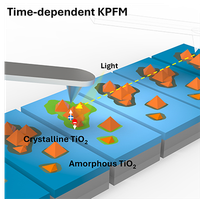
Correlating Local Morphology and Charge Dynamics via Kelvin Probe Force Microscopy to Explain Photoelectrode Performance

Maryam Pourmahdavi, Mauricio Schieda, Ragle Raudsepp, Steffen Fengler, Jiri Kollmann, Yvonne Pieper, Thomas Dittrich, Thomas Klassen, and Francesca M. Toma

PRX Energy 4, 023010 (2025) - Published 9 June, 2025

Charge transport in photoelectrodes for photoelectrochemical cells is influenced by microstructural variations; here, the authors use Kelvin Probe Force Microscopy to correlate local morphology with optoelectronic properties toward optimizing materials toward material optimization.

Parallel Warburg Elements Describe Ionic Transport in Nanopores

Filipe Henrique and Ankur Gupta

PRX Energy 4, 023009 (2025) - Published 21 May, 2025

A theoretical framework highlights the importance of accounting for differences in ion diffusivities when modeling ionic transport. This approach enhances the accuracy of impedance modeling in nanoporous electrodes and may be extended to a broader range of electrochemical systems.

Energy-Consumption Advantage of Quantum Computation

Florian Meier and Hayata Yamasaki

PRX Energy 4, 023008 (2025) - Published 13 May, 2025

A proposed framework quantifies and compares the energy consumption of quantum and classical computation, suggesting that quantum computers can solve a type of problem using much less energy than any classical counterpart.

Fusion Burn Regulation via Deuterium Tritium Mixture Control in the Joint European Torus

M. Lennholm, L. Piron, D. Valcarcel, P. Almond, M. Baruzzo, M. van Berkel, T. Bosman, L. Ceelen, P. Fox, K. Kirov, B. Kool, C. Lowry, J. Mitchell, B. Sieglin, and H. Sun (JET contributors , the EUROfusion Tokamak Exploitation Team )

PRX Energy 4, 023007 (2025) - Published 12 May, 2025

Using the JET tokamak, the study demonstrates feedback control of tritium concentration in a deuterium-tritium plasma, independently of total gas injection.

Computational Simulations and Strategies for Optimal Hydrogen Storage Materials Design

Vikram Mahamiya, Alok Shukla, Abhishek Kumar Adak, Hoonkyung Lee, Nicola Seriani, and Ralph Gebauer

PRX Energy 4, 022001 (2025) - Published 9 May, 2025

This study identifies key challenges in hydrogen storage and proposes computational strategies to design more effective storage materials for next-generation energy systems.

Reducing Dark Conductivity of Cesium Tin Halide Perovskites with Donor Doping

John L. Lyons, Michael W. Swift, Anderson Janotti, and Mercouri G. Kanatzidis

PRX Energy 4, 023006 (2025) - Published 8 May, 2025

This study devises a route to improve the optoelectronic properties of tin-halide perovskites. Using hybrid density functional theory calculations, a donor doping strategy is developed that aims to significantly decrease observed free hole concentrations in these materials.

Hybrid Nature of Metastable Nonradiative Recombination Centers in Perovskites: Merging Shallow and Deep Defect States

Aleksandr O. Tarasevich, Jun Li, Maria A. Kniazeva, Ivan Yu. Eremchev, and Ivan G. Scheblykin

PRX Energy 4, 023005 (2025) - Published 25 April, 2025

Advanced luminescence microscopy reveals that metastable nonradiative centers in metal-halide perovskites have a hybrid two-level structure, likely formed by associated simple defects.

Resolving the Solvation Structure and Transport Properties of Aqueous Zinc Electrolytes from Salt-in-Water to Water-in-Salt Using Neural Network Potential

Chuntian Cao, Arun Kingan, Ryan C. Hill, Jason Kuang, Lei Wang, Chunyi Zhang, Matthew R. Carbone, Hubertus van Dam, Shinjae Yoo, Shan Yan, Esther S. Takeuchi, Kenneth J. Takeuchi, Xifan Wu, AM Milinda Abeykoon, Amy C. Marschilok, and Deyu Lu

PRX Energy 4, 023004 (2025) - Published 11 April, 2025

A neural network potential model is developed for ZnCl2 electrolytes that provides atomic scale insights into the solvation structure and ionic conductivity. The results agree well with experiment and shed light on the performance of aqueous zinc-ion batteries across a wide concentration range of ZnCl2 electrolytes.

Comprehensive Insights into Global Mineral Commodities: Analysis, Visualization, and Intelligent Assistance

Trupti Mohanty, Hasan M. Sayeed, Chitrasen Mohanty, and Taylor D. Sparks

PRX Energy 4, 023003 (2025) - Published 4 April, 2025

A data analytics platform distills mineral commodity information from a large database to create accessible insights for researchers, policymakers, and industry shareholders. Such insight into the global supply chain can inform decisions around sustainable materials and renewable energy technologies.

Crystal Structure Prediction and Phase Stability in Highly Anharmonic Silver-Based Chalcohalide Antiperovskites

Pol Benítez, Cibrán López, Cong Liu, Ivan Caño, Josep-Lluís Tamarit, Edgardo Saucedo, and Claudio Cazorla

PRX Energy 4, 023002 (2025) - Published 3 April, 2025

Using theoretical first-principles methods, stable and metastable phases of silver-based chalcohalide anti-perovskites are predicted, offering insight into their stability for potential energy and optoelectronic applications.

Erratum: Sustainability Strategy for the Cool Copper Collider [PRX Energy 2, 047001 (2023)]

Martin Breidenbach, Brendon Bullard, Emilio Alessandro Nanni, Dimitrios Ntounis, and Caterina Vernieri

PRX Energy 4, 029901 (2025) - Published 2 April, 2025

Pore-Scale Textural Changes upon Ion Adsorption in Voltage-Polarized Nanoporous Carbon Electrodes

Romain Dupuis, Katerina Ioannidou, and Roland J.-M. Pellenq

PRX Energy 4, 023001 (2025) - Published 2 April, 2025

Molecular dynamics simulations of ionic interactions in porous carbon electrodes reveal ion-dependent changes to the electrode structure and highlight the importance of considering electrode flexibility when modeling these systems.

Sign In to Your Journals Account

Filter

Recent Issues

Vol. 5, Iss. 4
October - December 2026
Vol. 5, Iss. 3
July - September 2026
Vol. 5, Iss. 2
April - June 2026
Vol. 5, Iss. 1
January - March 2026
Category
Article Type

Filter

Article Lookup

Enter a citation