Recent Articles

Magnetic exchange coupling in cuprate-analog d9 nickelates

Yusuke Nomura, Takuya Nomoto, Motoaki Hirayama, and Ryotaro Arita

Phys. Rev. Research 2, 043144 (2020) - Published 27 October, 2020

The authors study the magnitude of the magnetic exchange coupling in theoretically-proposed cuprate-analog nickelates, and shows that the nickelates share a common thread with the cuprates in that they also have a significant exchange coupling as large as about 100 meV.

Spin-projection for quantum computation: A low-depth approach to strong correlation

Takashi Tsuchimochi, Yuto Mori, and Seiichiro L. Ten-no

Phys. Rev. Research 2, 043142 (2020) - Published 27 October, 2020

The authors propose a quantum circuit for recovering the quantum spin number in strongly correlated fermionic systems.

Diffusive dynamics in an amorphous superionic conductor

Christoph Tietz, Tobias Michael Fritz, Katharina Holzweber, Michael Legenstein, Bogdan Sepiol, and Michael Leitner

Phys. Rev. Research 2, 043141 (2020) - Published 27 October, 2020

This work shows that ionic diffusion in a prototypic superionic-conducting glass proceeds via vacancies moving over a temporally stable network of ionic sites.

Quantum equation of motion for computing molecular excitation energies on a noisy quantum processor

Pauline J. Ollitrault, Abhinav Kandala, Chun-Fu Chen, Panagiotis Kl. Barkoutsos, Antonio Mezzacapo, Marco Pistoia, Sarah Sheldon, Stefan Woerner, Jay M. Gambetta, and Ivano Tavernelli

Phys. Rev. Research 2, 043140 (2020) - Published 27 October, 2020

The authors introduce a quantum algorithm for the calculation of molecular excited states and apply it to lithium hydride on a superconducting qubit device.

Ion modes in dense ionized plasmas through nonadiabatic molecular dynamics

R. A. Davis, W. A. Angermeier, R. K. T. Hermsmeier, and T. G. White

Phys. Rev. Research 2, 043139 (2020) - Published 27 October, 2020

The authors perform wave-packet molecular dynamics simulations to investigate non-adiabatic effects on the ion structure factor and sound speed of dense plasmas.

Controlling particle currents with evaporation and resetting from an interval

Gennaro Tucci, Andrea Gambassi, Shamik Gupta, and Édgar Roldán

Phys. Rev. Research 2, 043138 (2020) - Published 27 October, 2020

This work uses tools of probability theory and stochastic processes to study a system of small particles moving erratically in space trying to avoid to get trapped into a tiny cage.

Effect of boundaries on grid cell patterns

Mauro M. Monsalve-Mercado and Christian Leibold

Phys. Rev. Research 2, 043137 (2020) - Published 27 October, 2020

The authors show how the addition of static recurrent inhibition to a system of Turing pattern formation removes pattern alignment to boundaries and explains features of medial entorhinal cortex grid cells.

Theory of edge states based on the Hermiticity of tight-binding Hamiltonian operators

Takahiro Fukui

Phys. Rev. Research 2, 043136 (2020) - Published 27 October, 2020

The author derives edge-state Hamiltonians which describe edge-states at one end separated from the bulk spectra.

Possible superconductivity above 40 K in rhenium-doped strontium ruthenates indicated by Fourier-transform infrared spectroscopy

Yurii Aleshchenko, Boris Gorshunov, Elena Zhukova, Andrey Muratov, Alexander Dudka, Rajendra Dulal, Serafim Teknowijoyo, Sara Chahid, Vahan Nikoghosyan, and Armen Gulian

Phys. Rev. Research 2, 042020(R) (2020) - Published 27 October, 2020

The authors show several experimental indications of superconductivity with the onset above 40 K in multiphase strontium ruthenate doped by rhenium and selenium.

Missing links as a source of seemingly variable constants in complex reaction networks

Zachary G. Nicolaou and Adilson E. Motter

Phys. Rev. Research 2, 043135 (2020) - Published 26 October, 2020

The authors show that the omission of small-sensitivity links can create large variations in the estimated rate constants of chemical reaction networks.

Strength and length scale of the interaction between domain walls and pinning disorder in thin ferromagnetic films

P. Géhanne, S. Rohart, A. Thiaville, and V. Jeudy

Phys. Rev. Research 2, 043134 (2020) - Published 26 October, 2020

The authors show the onset of variations of the interaction between domain wall and pinning disorder with domain wall structure.

Nonlinear dynamical response of interacting bosons to synthetic electric field

Arko Roy, Soumya Bera, and Kush Saha

Phys. Rev. Research 2, 043133 (2020) - Published 26 October, 2020

The authors study the bosonic analogue of electronic higher harmonic generation in a system of neutral cold atoms. Under a strong synthetic electric field, the authors predict the generation of higher harmonics in the insulating state.

Cracking urban mobility

H. A. Carmona, A. W. T. de Noronha, A. A. Moreira, N. A. M. Araújo, and J. S. Andrade, Jr.

Phys. Rev. Research 2, 043132 (2020) - Published 26 October, 2020

The authors apply the optimal path crack model to investigate the mobility of road networks and propose a proxy for resilience of urban mobility.

Higher-order topological crystalline insulating phase and quantized hinge charge in topological electride apatite

Motoaki Hirayama, Ryo Takahashi, Satoru Matsuishi, Hideo Hosono, and Shuichi Murakami

Phys. Rev. Research 2, 043131 (2020) - Published 26 October, 2020

This paper uses ab initio calculation to show that an electride apatite, in which electrons serve as anions, realizes a three-dimensional higher-order topological phase with a quantized hinge charge.

Thermal origin of light emission in nonresonant and resonant nanojunctions

Christian Ott, Stephan Götzinger, and Heiko B. Weber

Phys. Rev. Research 2, 042019(R) (2020) - Published 26 October, 2020

Experiments on graphene nanojunctions reveal light emission with a Planck spectrum. The origin of light emission can thus be traced back to hot electrons in the nanojunction.

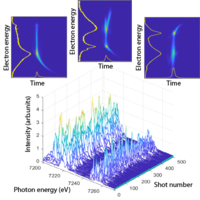
Single- and two-color attosecond hard x-ray free-electron laser pulses with nonlinear compression

Alexander Malyzhenkov, Yunieski P. Arbelo, Paolo Craievich, Philipp Dijkstal, Eugenio Ferrari, Sven Reiche, Thomas Schietinger, Pavle Juranić, and Eduard Prat

Phys. Rev. Research 2, 042018(R) (2020) - Published 26 October, 2020

This work describes a method for the generation of one and two-color ultra-short X-ray free-electron-laser pulses, based on tailoring the Coulomb interaction between the electrons of a highly compressed beam in the nonlinear regime.

Nonadiabatic noncyclic geometric quantum computation in Rydberg atoms

Bao-Jie Liu, Shi-Lei Su, and Man-Hong Yung

Phys. Rev. Research 2, 043130 (2020) - Published 23 October, 2020

This work presents an scheme to realize universal geometrical gates via non-cyclic geometric phase in Rydberg atoms. The authors show that this scheme makes it possible to accelerate the implemented geometric gates against the effects from the environmental decoherence.

Branching fractions and polarizations of D→Vℓνℓ within QCD light-cone sum rule

Hai-Bing Fu, Wei Cheng, Long Zeng, Dan-Dan Hu, and Tao Zhong

Phys. Rev. Research 2, 043129 (2020) - Published 23 October, 2020

The authors use a QCD light-cone sum rules approach to calculate the helicity form factors of a D meson semileptonic decay into a vector meson.

Impossibility of coin flipping in generalized probabilistic theories via discretizations of semi-infinite programs

Jamie Sikora and John H. Selby

Phys. Rev. Research 2, 043128 (2020) - Published 23 October, 2020

This works uses semi-infinite programming to address the problem of coin flipping and shows that it is impossible in a variety of systems

Structural relaxation and low-energy properties of twisted bilayer graphene

Giovanni Cantele, Dario Alfè, Felice Conte, Vittorio Cataudella, Domenico Ninno, and Procolo Lucignano

Phys. Rev. Research 2, 043127 (2020) - Published 23 October, 2020

The authors use large-scale ab-initio density functional theory and tight binding calculations to study the role of atomic relaxation on the low energy physics of twisted bilayer graphene as a function of the twist angle, and show that the flat bands emerging close to charge neutrality can be described taking into account atomic relaxation.

Sign In to Your Journals Account

Filter

Recent Issues

Vol. 8, Iss. 4
October - December 2026
Vol. 8, Iss. 3
July - September 2026
Vol. 8, Iss. 2
April - June 2026
Vol. 8, Iss. 1
January - March 2026
Category
Article Type

Filter

Article Lookup

Enter a citation