Recent Articles

Thermal fluctuations for a three-beads swimmer

R. Ferretta, R. Di Leonardo, and A. Puglisi

Phys. Rev. Research 6, 033117 (2024) - Published 29 July, 2024

Ring solids and supersolids in spherical shell-shaped dipolar Bose-Einstein condensates

J. Sánchez-Baena, R. Bombín, and J. Boronat

Phys. Rev. Research 6, 033116 (2024) - Published 29 July, 2024

Double-gap bicone magnetorheology in steady shear under homogeneous magnetic and flow fields

Guillermo Camacho, Juan de Vicente, and Jose R. Morillas

Phys. Rev. Research 6, 033115 (2024) - Published 29 July, 2024

Ultrabroad-band x-ray source using a picosecond, laser-driven plasma accelerator

N. Lemos, P. M. King, D. Rusby, I. Pagano, M. Sinclair, K. A. Marsh, J. L. Shaw, A. L. Milder, A. Pak, B. B. Pollock, M. Aufderheide, F. V. Hartemann, S. Q. Wu, Y. Hwang, B. M. Hegelich, J. Moody, P. Michel, C. Joshi, and F. Albert

Phys. Rev. Research 6, L032022 (2024) - Published 26 July, 2024

The generation of x-ray beams in the energy range from keV to MeV is an active research area, essential to the study of high-energy-density matter, to improve the understanding of inertial confinement fusion and astrophysical systems. An ultrabroad-band x-ray source, with photon energies from 10 keV to >1 MeV, based on a picosecond laser-driven plasma accelerator, is characterized and used to radiograph a gold half hohlraum with a high-density sphere inside with relevant characteristics for high-energy-density science and inertial confinement fusion.

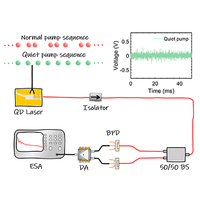
Broadband amplitude squeezing at room temperature in electrically driven quantum dot lasers

Shiyuan Zhao, Shihao Ding, Heming Huang, Isabelle Zaquine, Nicolas Fabre, Nadia Belabas, and Frédéric Grillot

Phys. Rev. Research 6, L032021 (2024) - Published 26 July, 2024

The generation of broadband squeezed states of light is crucial for quantum computing, quantum key distribution, precision measurements, and enhanced metrology. Traditionally achieved by nonlinear optical interactions, this article demonstrates this using semiconductor quantum dot lasers, which can offer improved squeezing performance. The research reveals an efficient amplitude squeezing as large as 3.1 dB at room temperature over a wide frequency range (3 GHz to 12 GHz). This result is supported by comprehensive stochastic simulations that align well with the experiments, underlining the potential of quantum dot lasers to advance quantum information technologies.

Quantum query complexity of Boolean functions under indefinite causal order

Alastair A. Abbott, Mehdi Mhalla, and Pierre Pocreau

Phys. Rev. Research 6, L032020 (2024) - Published 26 July, 2024

The computational power of higher-order quantum operations, or supermaps, is investigated through the lens of quantum query complexity. It is shown that the class of QC supermaps, which use quantum control to exhibit causal indefiniteness, cannot reduce the query complexity of Boolean functions. Nevertheless, when the number of queries is fixed, some functions can be computed with a better probability of success with more general causally indefinite supermaps.

Symmetry constraints and spectral crossing in a Mott insulator with Green's function zeros

Chandan Setty, Shouvik Sur, Lei Chen, Fang Xie, Haoyu Hu, Silke Paschen, Jennifer Cano, and Qimiao Si

Phys. Rev. Research 6, L032018 (2024) - Published 26 July, 2024

In the noninteracting description of electrons in solids, space group symmetries play an essential role for the formation of spectral degeneracies in the Bloch bands and the associated band topology. Electron correlations, when exceeding the width of noninteracting bands, can localize the electrons and cause a Mott insulator. It’s demonstrated that the space group symmetries constrain the dispersion of zeros in the Mott insulator’s Green’s function, thereby opening a way for understanding electronic topology in the strongly correlated limit.

Nonlinear defect theory of thermal relaxation in complex multimoded systems

Emily Kabat, Alba Y. Ramos, Lucas J. Fernández-Alcázar, and Tsampikos Kottos

Phys. Rev. Research 6, 033114 (2024) - Published 26 July, 2024

Dimers and discrete breathers in Bose-Einstein condensates in a quasi-periodic potential

Vladimir V. Konotop

Phys. Rev. Research 6, 033113 (2024) - Published 26 July, 2024

Resource analysis of quantum algorithms for coarse-grained protein folding models

Hanna Linn, Isak Lyngfelt, Laura García-Álvarez, and Göran Johansson

Phys. Rev. Research 6, 033112 (2024) - Published 26 July, 2024

Error-tolerant quantum convolutional neural networks for symmetry-protected topological phases

Petr Zapletal, Nathan A. McMahon, and Michael J. Hartmann

Phys. Rev. Research 6, 033111 (2024) - Published 26 July, 2024

Quantum phase transition between spin liquid and spin nematics in spin-1 Kitaev honeycomb model

Tohru Mashiko and Tsuyoshi Okubo

Phys. Rev. Research 6, 033110 (2024) - Published 26 July, 2024

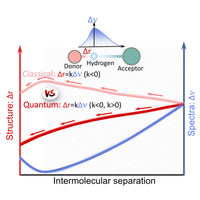
Electronic correlations influence on the anomalous constitutive law between the structure and spectra of hydrogen bonds

Rui Liu, Xinrui Yang, Famin Yu, Depeng Zhang, Lu Wang, Ruhong Zhou, and Zhigang Wang

Phys. Rev. Research 6, L032019 (2024) - Published 25 July, 2024

An anomalous constitutive law of hydrogen bonds (X-H···Y) using a benchmark ab initio method is observed, whereby a donor X-H bond shortening notably leads to a pronounced redshift and enhanced intensity in IR spectra. As a manifestation of quantum effects caused by electronic correlations, such an anomalous constitutive law could be happening widely in nature and stimulate further exploration of research paradigms and experimental characterization techniques.

Diffraction of polar molecules at nanomasks with low charge density

Ksenija Simonović, Richard Ferstl, Anders Barlow, Armin Shayeghi, Christian Brand, and Markus Arndt

Phys. Rev. Research 6, 033109 (2024) - Published 25 July, 2024

Growing Schrödinger's cat states by local unitary time evolution of product states

Saverio Bocini and Maurizio Fagotti

Phys. Rev. Research 6, 033108 (2024) - Published 25 July, 2024

Enhancing quantum utility: Simulating large-scale quantum spin chains on superconducting quantum computers

Talal Ahmed Chowdhury, Kwangmin Yu, Mahmud Ashraf Shamim, M. L. Kabir, and Raza Sabbir Sufian

Phys. Rev. Research 6, 033107 (2024) - Published 25 July, 2024

Understanding multiple timescales in quantum dissipative dynamics: Insights from quantum trajectories

Matthew Gerry, Michael J. Kewming, and Dvira Segal

Phys. Rev. Research 6, 033106 (2024) - Published 25 July, 2024

Markov-chain Monte Carlo method enhanced by a quantum alternating operator ansatz

Yuichiro Nakano, Hideaki Hakoshima, Kosuke Mitarai, and Keisuke Fujii

Phys. Rev. Research 6, 033105 (2024) - Published 25 July, 2024

Continuous operation of large-scale atom arrays in optical lattices

Flavien Gyger, Maximilian Ammenwerth, Renhao Tao, Hendrik Timme, Stepan Snigirev, Immanuel Bloch, and Johannes Zeiher

Phys. Rev. Research 6, 033104 (2024) - Published 25 July, 2024

Weight fluctuations in deep linear neural networks and a derivation of the inverse-variance flatness relation

Markus Gross, Arne P. Raulf, and Christoph Räth

Phys. Rev. Research 6, 033103 (2024) - Published 25 July, 2024

Sign In to Your Journals Account

Filter

Recent Issues

Vol. 8, Iss. 4
October - December 2026
Vol. 8, Iss. 3
July - September 2026
Vol. 8, Iss. 2
April - June 2026
Vol. 8, Iss. 1
January - March 2026
Category
Article Type

Filter

Article Lookup

Enter a citation