Recent Articles

Drawing and using free body diagrams: Why it may be better not to decompose forces

Ivica Aviani, Nataša Erceg, and Vanes Mešić

Phys. Rev. ST Phys. Educ. Res. 11, 020137 (2015) - Published 29 December, 2015

Decomposing forces on free body diagrams appears to impede students’ ability to apply Newton’s laws.

Combination of interventions can change students’ epistemological beliefs

Calvin S. Kalman, Mandana Sobhanzadeh, Robert Thompson, Ahmed Ibrahim, and Xihui Wang

Phys. Rev. ST Phys. Educ. Res. 11, 020136 (2015) - Published 21 December, 2015

Reflective writing and active learning improve students’ epistemological beliefs in an introductory college physics course.

Student ability to distinguish between superposition states and mixed states in quantum mechanics

Gina Passante, Paul J. Emigh, and Peter S. Shaffer

Phys. Rev. ST Phys. Educ. Res. 11, 020135 (2015) - Published 25 November, 2015

Interactive lecture tutorials can help sophomore physics students understand of the difference between superposition states and mixed states that is needed for more advanced quantum mechanics classes.

Students’ proficiency scores within multitrait item response theory

Terry F. Scott and Daniel Schumayer

Phys. Rev. ST Phys. Educ. Res. 11, 020134 (2015) - Published 19 November, 2015

Comparison of factor analysis and item response theory factors for understanding Force Concept Inventory data.

Seeking instructional specificity: An example from analogical instruction

Eric Kuo and Carl E. Wieman

Phys. Rev. ST Phys. Educ. Res. 11, 020133 (2015) - Published 17 November, 2015

More specificity added to broad instructional design principles leads to better student learning.

Equity investigation of attitudinal shifts in introductory physics

Adrienne Traxler and Eric Brewe

Phys. Rev. ST Phys. Educ. Res. 11, 020132 (2015) - Published 9 November, 2015

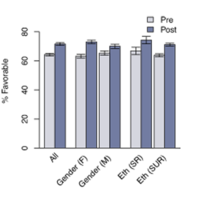
Modeling instruction supports equity in student attitudinal shifts in introductory physics.

Upper-division student difficulties with separation of variables

Bethany R. Wilcox and Steven J. Pollock

Phys. Rev. ST Phys. Educ. Res. 11, 020131 (2015) - Published 5 November, 2015

Student difficulties with separation of variables in the context of upper-division electrostatics.

Validation and analysis of the coupled multiple response Colorado upper-division electrostatics diagnostic

Bethany R. Wilcox and Steven J. Pollock

Phys. Rev. ST Phys. Educ. Res. 11, 020130 (2015) - Published 2 November, 2015

Validation of the multiple response version of the Colorado upper-division electrostatics diagnostic.

Students’ difficulties with vector calculus in electrodynamics

Laurens Bollen, Paul van Kampen, and Mieke De Cock

Phys. Rev. ST Phys. Educ. Res. 11, 020129 (2015) - Published 2 November, 2015

Upper division physics students can do vector calculations but have poor understanding of the conceptual meaning of vector operators.

Judgments of physics problem difficulty among experts and novices

Witat Fakcharoenphol, Jason W. Morphew, and José P. Mestre

Phys. Rev. ST Phys. Educ. Res. 11, 020128 (2015) - Published 23 October, 2015

Content and pedagogy experts can predict how difficult a physics problem is for introductory physics students better than the students themselves.

Students’ framing of laboratory exercises using infrared cameras

Jesper Haglund, Fredrik Jeppsson, David Hedberg, and Konrad J. Schönborn

Phys. Rev. ST Phys. Educ. Res. 11, 020127 (2015) - Published 22 October, 2015

Using infrared cameras to help students improve their modeling of thermal phenomena.

Experts’ understanding of partial derivatives using the partial derivative machine

David Roundy, Eric Weber, Tevian Dray, Rabindra R. Bajracharya, Allison Dorko, Emily M. Smith, and Corinne A. Manogue

Phys. Rev. ST Phys. Educ. Res. 11, 020126 (2015) - Published 23 September, 2015

An innovative device is used to probe how experts in physics, mathematics, and engineering understand and experimentally evaluate partial derivatives.

Assessing student reasoning in upper-division electricity and magnetism at Oregon State University

Justyna P. Zwolak and Corinne A. Manogue

Phys. Rev. ST Phys. Educ. Res. 11, 020125 (2015) - Published 23 September, 2015

Using the Colorado Upper-Divison Electrostatics Assessment in the context of the paradigms curriculum at Oregon State University.

Teaching quantum interpretations: Revisiting the goals and practices of introductory quantum physics courses

Charles Baily and Noah D. Finkelstein

Phys. Rev. ST Phys. Educ. Res. 11, 020124 (2015) - Published 23 September, 2015

The importance of explicitly attending to students’ interpretations of quantum mechanics.

Student understanding of the Boltzmann factor

Trevor I. Smith, Donald B. Mountcastle, and John R. Thompson

Phys. Rev. ST Phys. Educ. Res. 11, 020123 (2015) - Published 23 September, 2015

Research to help students understand the physical significance and applicability of the Boltzmann factor.

Grasping the second law of thermodynamics at university: The consistency of macroscopic and microscopic explanations

Risto Leinonen, Mervi A. Asikainen, and Pekka E. Hirvonen

Phys. Rev. ST Phys. Educ. Res. 11, 020122 (2015) - Published 23 September, 2015

A qualitative study of student thinking about entropy and the second law of thermodynamics at both the macroscopic and microscopic levels.

Brief, embedded, spontaneous metacognitive talk indicates thinking like a physicist

Eleanor C. Sayre and Paul W. Irving

Phys. Rev. ST Phys. Educ. Res. 11, 020121 (2015) - Published 23 September, 2015

Physics majors’ discourse during problem solving reveals evidence of students ‘thinking like a physicist.’

Becoming a physicist: The roles of research, mindsets, and milestones in upper-division student perceptions

Paul W. Irving and Eleanor C. Sayre

Phys. Rev. ST Phys. Educ. Res. 11, 020120 (2015) - Published 23 September, 2015

Phenomenographic study employing a communities of practice framework to explore student perceptions about their transition from student to practitioner.

Framework for understanding the patterns of student difficulties in quantum mechanics

Emily Marshman and Chandralekha Singh

Phys. Rev. ST Phys. Educ. Res. 11, 020119 (2015) - Published 23 September, 2015

A review article that synthesizes many documented patterns of student thinking in quantum mechanics.

Identifying student resources in reasoning about entropy and the approach to thermal equilibrium

Michael Loverude

Phys. Rev. ST Phys. Educ. Res. 11, 020118 (2015) - Published 23 September, 2015

Conceptions and resources used by thermal physics students long after finishing the course.

Sign In to Your Journals Account

Filter

Recent Issues

Vol. 22, Iss. 2
July - December 2026
Vol. 22, Iss. 1
January - June 2026
Vol. 21, Iss. 2
July - December 2025
Vol. 21, Iss. 1
January - June 2025
Category
Article Type

Filter

Article Lookup

Enter a citation