Recent Articles

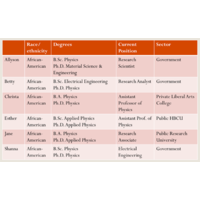
Educational pathways of Black women physicists: Stories of experiencing and overcoming obstacles in life

Katemari Rosa and Felicia Moore Mensah

Phys. Rev. Phys. Educ. Res. 12, 020113 (2016) - Published 1 August, 2016

A case study analysis of successful Black women, with PhDs in physics, and the key themes that led to their success.

Gender gap or program gap? Students’ negotiations of study practice in a course in electromagnetism

Staffan Andersson and Anders Johansson

Phys. Rev. Phys. Educ. Res. 12, 020112 (2016) - Published 1 August, 2016

A qualitative study of student perceptions of practice in physics identifies differences by physics program rather than by gender.

Differences in gender performance on competitive physics selection tests

Kate Wilson, David Low, Matthew Verdon, and Alix Verdon

Phys. Rev. Phys. Educ. Res. 12, 020111 (2016) - Published 1 August, 2016

Comparison of performance on competitive physics tests among Australian high school students revealing gender gaps.

Fitting in or opting out: A review of key social-psychological factors influencing a sense of belonging for women in physics

Karyn L. Lewis, Jane G. Stout, Steven J. Pollock, Noah D. Finkelstein, and Tiffany A. Ito

Phys. Rev. Phys. Educ. Res. 12, 020110 (2016) - Published 1 August, 2016

Review of empirical and theoretical literature on the importance of sense of belonging in academic contexts including recommendations for physics educators.

Women’s and men’s career choices in astronomy and astrophysics

Rachel Ivie, Susan White, and Raymond Y. Chu

Phys. Rev. Phys. Educ. Res. 12, 020109 (2016) - Published 1 August, 2016

Longitudinal study of astronomy graduate students that identifies factors contributing to retention in general with a focus on gender.

Women in physics: A comparison to science, technology, engineering, and math education over four decades

Linda J. Sax, Kathleen J. Lehman, Ramón S. Barthelemy, and Gloria Lim

Phys. Rev. Phys. Educ. Res. 12, 020108 (2016) - Published 1 August, 2016

Four decades of data exploring how women’s interest and intention to major in physics has changed over time in comparison to other fields.

Student evaluations of physics teachers: On the stability and persistence of gender bias

Geoff Potvin and Zahra Hazari

Phys. Rev. Phys. Educ. Res. 12, 020107 (2016) - Published 1 August, 2016

The relationship between student gender and physics identity in evaluating high school physics teachers, finding that students who identify strongly with physics show a stronger bias in favor of male high school physics teachers.

Beneath the numbers: A review of gender disparities in undergraduate education across science, technology, engineering, and math disciplines

Sarah L. Eddy and Sara E. Brownell

Phys. Rev. Phys. Educ. Res. 12, 020106 (2016) - Published 1 August, 2016

Gender disparities beyond physics on measures that have been correlated with a focus on identifying underlying mechanisms to understand how these inequalities arise.

Gender, experience, and self-efficacy in introductory physics

Jayson M. Nissen and Jonathan T. Shemwell

Phys. Rev. Phys. Educ. Res. 12, 020105 (2016) - Published 1 August, 2016

Using an in-the-moment sampling technique the differences between men and women’s self-efficacy in different activity areas is investigated.

Gender gaps and gendered action in a first-year physics laboratory

James Day, Jared B. Stang, N. G. Holmes, Dhaneesh Kumar, and D. A. Bonn

Phys. Rev. Phys. Educ. Res. 12, 020104 (2016) - Published 1 August, 2016

Examination of gender gaps and potential sources of gender gaps through laboratory observations.

Editorial: Focused Collection: Gender in Physics

Eric Brewe and Vashti Sawtelle

Phys. Rev. Phys. Educ. Res. 12, 020001 (2016) - Published 1 August, 2016

Can dual processing theory explain physics students’ performance on the Force Concept Inventory?

Anna K. Wood, Ross K. Galloway, and Judy Hardy

Phys. Rev. Phys. Educ. Res. 12, 023101 (2016) - Published 28 July, 2016

Demonstration of the dual processing theory as a way to understand learning and assessment in introductory physics.

Examining and contrasting the cognitive activities engaged in undergraduate research experiences and lab courses

N. G. Holmes and Carl E. Wieman

Phys. Rev. Phys. Educ. Res. 12, 020103 (2016) - Published 12 July, 2016

Comparison of cognitive activities students use in undergraduate research experiences and lab courses to those required for experimental research.

High school students’ representations and understandings of electric fields

Ying Cao and Bárbara M. Brizuela

Phys. Rev. Phys. Educ. Res. 12, 020102 (2016) - Published 7 July, 2016

A preliminary investigation of Chinese high school students’ productive resources for learning about electric fields.

Discussing underrepresentation as a means to facilitating female students’ physics identity development

Robynne M. Lock and Zahra Hazari

Phys. Rev. Phys. Educ. Res. 12, 020101 (2016) - Published 5 July, 2016

Explicit discussions of the underrepresentation of women in science can change the way that female students interpret their experiences and potential futures as scientists.

Characterizing interactive engagement activities in a flipped introductory physics class

Anna K. Wood, Ross K. Galloway, Robyn Donnelly, and Judy Hardy

Phys. Rev. Phys. Educ. Res. 12, 010140 (2016) - Published 30 June, 2016

Towards the development of more refined descriptions of type and amount of interactivity in an introductory college physics course.

Alternative model for administration and analysis of research-based assessments

Bethany R. Wilcox, Benjamin M. Zwickl, Robert D. Hobbs, John M. Aiken, Nathan M. Welch, and H. J. Lewandowski

Phys. Rev. Phys. Educ. Res. 12, 010139 (2016) - Published 17 June, 2016

A centralized model for the administration and analysis of research-based assessments.

Effective student teams for collaborative learning in an introductory university physics course

Jason J. B. Harlow, David M. Harrison, and Andrew Meyertholen

Phys. Rev. Phys. Educ. Res. 12, 010138 (2016) - Published 16 June, 2016

Students in randomly assigned collaborative learning groups do just as well as those in carefully assigned groups.

Investigating the role of model-based reasoning while troubleshooting an electric circuit

Dimitri R. Dounas-Frazer, Kevin L. Van De Bogart, MacKenzie R. Stetzer, and H. J. Lewandowski

Phys. Rev. Phys. Educ. Res. 12, 010137 (2016) - Published 15 June, 2016

Troubleshooting a malfunctioning apparatus engages students in the core scientific practice of modeling.

Leveraging a relationship with biology to expand a relationship with physics

Vashti Sawtelle and Chandra Turpen

Phys. Rev. Phys. Educ. Res. 12, 010136 (2016) - Published 15 June, 2016

Biology student’s shifts in identity, affect, and epistemology in a physics course which leverages students’ identity and expertise in biology to promote a stronger relationship with physics.

Sign In to Your Journals Account

Filter

Recent Issues

Vol. 22, Iss. 2
July - December 2026
Vol. 22, Iss. 1
January - June 2026
Vol. 21, Iss. 2
July - December 2025
Vol. 21, Iss. 1
January - June 2025
Category
Article Type

Filter

Article Lookup

Enter a citation