

Linking battery electrode science with correlated and quantum materials
Phys. Rev. Materials 9, 110302 – Published 26 November, 2025
DOI: https://doi.org/10.1103/zwkw-zc5n
Abstract
While redox activity in electrode materials is well studied in the context of energy storage, its connection to magnetic and electronic phenomena is perhaps not as widely appreciated. Electrochemistry can be leveraged to provide dynamic control over emergent electronic and magnetic behavior in solid materials. In this perspective we review how alkali-ion (de)insertion has been utilized to alter spin states, induce charge ordering, and drive transitions between insulating, metallic, and magnetically frustrated phases for range of battery materials, including layered and , olivine-, and spinel . We also describe less conventional systems like Wadsley–Roth shear phases and breathing-kagome networks to showcase the broader potential for quantum control via redox chemistry. The evolution of emergent properties like spin frustration, Jahn–Teller distortions, and electron localization/delocalization is related to ion content and crystallographic structure. We conclude that electrochemistry can provide a powerful platform for exploring and manipulating physical phenomena in correlated and quantum materials and discuss some experimental challenges.
Physics Subject Headings (PhySH)
Collections
This article appears in the following collection:
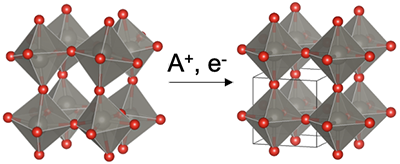
Functional Materials Through Electrochemical Ion Insertion
The Editors of Physical Review Materials are pleased to present the Collection on Functional Materials Through Electrochemical Ion Insertion, highlighting cutting-edge advances in the theory, synthesis, and structural and physical characterization of dynamic property modulation (e.g. optical, electrical, mechanical, chemical) using electrochemical ion insertion into solid state hosts. The Collection is being guest-edited by Veronica Augustyn and Nina Balke of North Carolina State University (USA). Every article published in this collection underwent a rigorous peer review process, adhering to the same high standards applied to all papers. The Physical Review Materials editorial team managed the peer review and made all editorial decisions.
