

Delayed 1T to 2H phase transition upon electrochemical delithiation of
Phys. Rev. Materials 10, 014002 – Published 9 January, 2026
DOI: https://doi.org/10.1103/yyqq-qmhc
Abstract
Molybdenum disulfide () is a widely studied layered material for electronic, optical, and catalytic applications. It can host lithium ions between the van der Waals layers, which triggers a phase transition between the semiconducting 2H phase and metallic 1T phase. While lithium insertion triggers a phase transition to the 1T phase, the phase behavior upon electrochemical lithium removal is not resolved. In this work, we conduct single-flake electrochemical (de)lithiation of using microelectrode arrays. Through both electrochemical voltage analysis and correlative Raman spectroscopy, we show that an electrochemically cycled and delithiated flake initially remains in the 1T phase. However, over the course of several days, it transitions back into the thermodynamically stable 2H phase. This result resolves the phase transformation pathway upon delithiation and showcases the ability to electrochemically synthesize the metastable 1T- phase.
Physics Subject Headings (PhySH)
Collections
This article appears in the following collection:
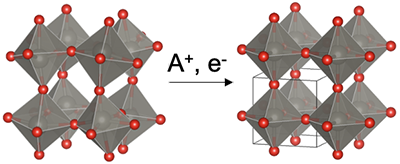
Functional Materials Through Electrochemical Ion Insertion
The Editors of Physical Review Materials are pleased to present the Collection on Functional Materials Through Electrochemical Ion Insertion, highlighting cutting-edge advances in the theory, synthesis, and structural and physical characterization of dynamic property modulation (e.g. optical, electrical, mechanical, chemical) using electrochemical ion insertion into solid state hosts. The Collection is being guest-edited by Veronica Augustyn and Nina Balke of North Carolina State University (USA). Every article published in this collection underwent a rigorous peer review process, adhering to the same high standards applied to all papers. The Physical Review Materials editorial team managed the peer review and made all editorial decisions.
