

Thermodynamics of proton insertion across the perovskite-brownmillerite transition in
Phys. Rev. Materials 10, 025401 – Published 2 February, 2026
DOI: https://doi.org/10.1103/tgp7-n673
Abstract
is a promising off-stoichiometric metal oxide that undergoes a topotactic perovskite- () to-brownmillerite () transition under electrochemical and thermochemical stimuli, with concomitant variations in its electrical, magnetic, thermal, and optical properties. Recent studies on thin-film cycling in electrochemical devices show incomplete reversibility of this transition, with significant acid etching serving as a degradation mechanism. While earlier investigations examined the protonation of brownmillerite , the thermodynamics of protonation across the perovskite-to-brownmillerite transition remain poorly understood. In this work, we combine density functional theory calculations with predictions from universal machine-learning interatomic potentials to elucidate the energetics and implications of protonation across the transition for . These calculations reveal negative hydrogen insertion energies and strong competition with oxygen vacancy formation across the transition for a wide range of conditions. The extent of protonation is primarily limited by the availability of Co states to accommodate reduction by inserted hydrogen. Although hydrogen insertion is often thermodynamically favorable within a defect picture, a convex hull analysis of the resulting phases reveals them to be unstable against decomposition into hydroxides among other products. This instability increases with hydrogen content and provides a thermodynamic basis for the acid etching observed during electrochemical cycling. In the absence of decomposition, our calculations predict protonation to cause significant structural expansion and widening of the band gap. This work advances the fundamental understanding of protonation in and contextualizes experimental observations of related materials in the presence of moisture or .
Physics Subject Headings (PhySH)
Collections
This article appears in the following collection:
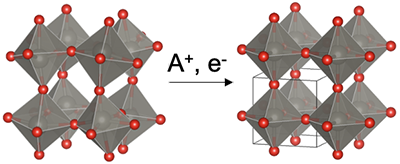
Functional Materials Through Electrochemical Ion Insertion
The Editors of Physical Review Materials are pleased to present the Collection on Functional Materials Through Electrochemical Ion Insertion, highlighting cutting-edge advances in the theory, synthesis, and structural and physical characterization of dynamic property modulation (e.g. optical, electrical, mechanical, chemical) using electrochemical ion insertion into solid state hosts. The Collection is being guest-edited by Veronica Augustyn and Nina Balke of North Carolina State University (USA). Every article published in this collection underwent a rigorous peer review process, adhering to the same high standards applied to all papers. The Physical Review Materials editorial team managed the peer review and made all editorial decisions.
