

Modeling phase transformations in Mn-rich disordered rocksalt cathodes with machine-learning interatomic potentials
Phys. Rev. Materials 9, 105404 – Published 24 October, 2025
DOI: https://doi.org/10.1103/mk2d-tjyj
Abstract
Mn-rich disordered rocksalt (DRX) cathode materials exhibit a phase transformation from a disordered to a partially disordered spinel-like structure (-phase) during electrochemical cycling. In this computational study, we use charge-informed molecular dynamics with a fine-tuned CHGNet foundation potential to investigate the phase transformation in . Our results indicate that transition metal migration occurs and reorders to form the spinel-like ordering in an FCC anion framework. The transformed structure contains a higher concentration of nontransition metal (0-TM) face-sharing channels, which are known to improve Li transport kinetics. Analysis of the Mn valence distribution suggests that the appearance of tetrahedral is a consequence of spinel-like ordering, rather than the trigger for cation migration as previously suggested. Calculated equilibrium intercalation voltage profiles demonstrate that the -phase, unlike the ordered spinel, exhibits solid-solution signatures at low voltage. A higher Li capacity is obtained than in the DRX phase. This study provides atomic insights into solid-state phase transformation and its relation to experimental electrochemistry, highlighting the potential of machine-learning interatomic potentials for understanding complex oxide materials.
Physics Subject Headings (PhySH)
Collections
This article appears in the following collection:
Functional Materials Through Electrochemical Ion Insertion
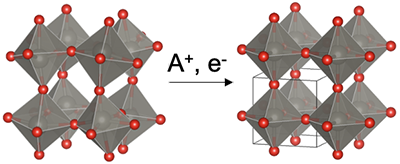
The Editors of Physical Review Materials are pleased to present the Collection on Functional Materials Through Electrochemical Ion Insertion, highlighting cutting-edge advances in the theory, synthesis, and structural and physical characterization of dynamic property modulation (e.g. optical, electrical, mechanical, chemical) using electrochemical ion insertion into solid state hosts. The Collection is being guest-edited by Veronica Augustyn and Nina Balke of North Carolina State University (USA). Every article published in this collection underwent a rigorous peer review process, adhering to the same high standards applied to all papers. The Physical Review Materials editorial team managed the peer review and made all editorial decisions.
