

Influence of octahedral ligand field distortions and temperature on the electrochromic response of tungsten oxides
Phys. Rev. Materials 9, 085201 – Published 8 August, 2025
DOI: https://doi.org/10.1103/ldg7-vms5
Abstract
Tungsten oxides are electrochromic materials whose reversible color change in response to an applied voltage renders them useful for smart windows, adaptive displays, and color-changing wearables. The atomic structure, composition, and microstructure of tungsten oxides influences the resulting optical and electrochemical properties. At the atomic level, electrochromism is governed by the local structure of tungsten metal centers. Subtle structural distortions, such as octahedral tilts, bond length asymmetries, and ligand identity changes can induce shifts in -orbital splitting energies. These can have significant impact on redox behavior and optical transitions. Temperature further influences the electrochromic response by affecting ion mobility, interfacial stability, and reaction pathways during electrochemical cycling. In this work, we characterized the electrochromic properties of crystalline tungsten oxide thin films in acidic aqueous electrolytes, establishing how structural distortions facilitate dual band electrochromism in , a desirable property for independently modulating visible and infrared light. We also demonstrate that lower operating temperatures enhance coloration efficiency by suppressing parasitic hydrogen evolution, improving both switching contrast and cycling stability in aqueous environments.
Physics Subject Headings (PhySH)
Collections
This article appears in the following collection:
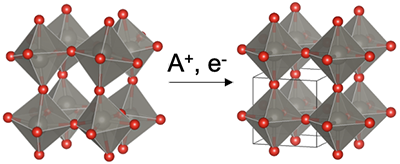
Functional Materials Through Electrochemical Ion Insertion
The Editors of Physical Review Materials are pleased to present the Collection on Functional Materials Through Electrochemical Ion Insertion, highlighting cutting-edge advances in the theory, synthesis, and structural and physical characterization of dynamic property modulation (e.g. optical, electrical, mechanical, chemical) using electrochemical ion insertion into solid state hosts. The Collection is being guest-edited by Veronica Augustyn and Nina Balke of North Carolina State University (USA). Every article published in this collection underwent a rigorous peer review process, adhering to the same high standards applied to all papers. The Physical Review Materials editorial team managed the peer review and made all editorial decisions.
