

Mechanisms enabling reconfigurability and long-term retention in vanadium oxide electrochemical memory
Phys. Rev. Materials 9, 085001 – Published 6 August, 2025
DOI: https://doi.org/10.1103/k616-d2q5
Abstract
Phase coexistence in nanoscale electrochemical random-access memory (ECRAM) has recently been demonstrated to enable both information storage and extraordinary reconfigurability. These proof-of-principle demonstrations have left the mechanistic details of such a process unresolved. Particularly, the mechanisms that stabilize the multiple phases, and the underlying processes behind sustained memory retention, remain unclear, and are necessary to design such devices. Here we report microscale ECRAM devices composed of , which enables us to directly probe the active region in an operando fashion using optical techniques. Using Raman mapping, we show the phase coexistence driven by the electrochemical injection of O vacancies to be spatially uniform (i.e., with no filaments). The stability was observed to be unusually long, with 1% loss over 14 years in ambient conditions. First-principles calculations of the oxygen vacancy formation energies in further support the thermodynamic coexistence of multiple phases and clarify the origin of the observed long-term retention in the ECRAM devices. Further, we demonstrate single devices that can be voltage programmed to exhibit synaptic, neuronal, and reconfigurable logic gate functionalities. Therefore, we not only uncover the phase coexistence mechanism that may help device design, but also demonstrate the circuit-level applications of reconfigurability.
Physics Subject Headings (PhySH)
Collections
This article appears in the following collection:
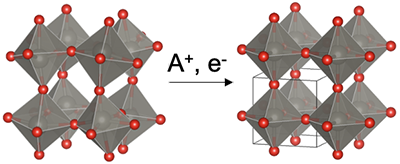
Functional Materials Through Electrochemical Ion Insertion
The Editors of Physical Review Materials are pleased to present the Collection on Functional Materials Through Electrochemical Ion Insertion, highlighting cutting-edge advances in the theory, synthesis, and structural and physical characterization of dynamic property modulation (e.g. optical, electrical, mechanical, chemical) using electrochemical ion insertion into solid state hosts. The Collection is being guest-edited by Veronica Augustyn and Nina Balke of North Carolina State University (USA). Every article published in this collection underwent a rigorous peer review process, adhering to the same high standards applied to all papers. The Physical Review Materials editorial team managed the peer review and made all editorial decisions.
