

Effect of protons on polaron mobility in transition metal oxides
Phys. Rev. Materials 10, 035402 – Published 9 March, 2026
DOI: https://doi.org/10.1103/hds1-yls4
Abstract
Hydrogen-intercalated transition metal oxides such as , and are important functional materials in energy storage and information processing. At low hydrogen concentrations, intercalation introduces protons and polarons, with polaron hopping often acting as the primary mechanism for electronic conduction. However, polarons and protons can interact associatively, and affect the mobility of polarons. Using first-principles calculations at the SCAN+ level, we quantify the polaron-proton association energies and polaron migration barriers that govern polaron mobility in the presence of protons. We find that polaron association with protons significantly increases migration barriers, particularly across the van der Waals gap in layered and oxides. Moreover, beyond electrostatic association, protons affect polaron migration through hydrogen bonding, which distorts the metal–oxygen–metal (M–O–M) bonds and reduces the orbital overlap between metal sites. This results in a counterintuitive outcome: the polaron migration barrier is higher when the migration path goes through the hydroxide ion (M–OH–M), as compared to the path that leads away from the proton (M–O–M). Consequently, this mechanism renders protons to act as “unidirectional valves,” establishing a preferential direction for polaron migration. These findings highlight a nontrivial role of protons in polaron migration in transition metal oxides and offer insights for designing energy-efficient electrochemical devices.
Physics Subject Headings (PhySH)
Collections
This article appears in the following collection:
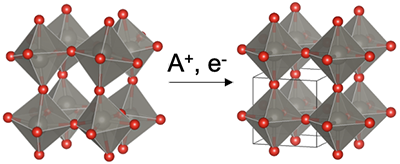
Functional Materials Through Electrochemical Ion Insertion
The Editors of Physical Review Materials are pleased to present the Collection on Functional Materials Through Electrochemical Ion Insertion, highlighting cutting-edge advances in the theory, synthesis, and structural and physical characterization of dynamic property modulation (e.g. optical, electrical, mechanical, chemical) using electrochemical ion insertion into solid state hosts. The Collection is being guest-edited by Veronica Augustyn and Nina Balke of North Carolina State University (USA). Every article published in this collection underwent a rigorous peer review process, adhering to the same high standards applied to all papers. The Physical Review Materials editorial team managed the peer review and made all editorial decisions.
