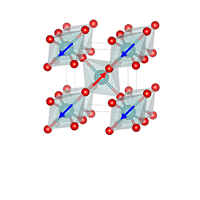
For many years, has served as an exemplar of the one-dimensional Ising model. However, recent experimental and theoretical analyses challenge its applicability to this material. Prior to that, a tailored spin model for systems such as , known as the model, has emerged, featuring Heisenberg (), Kitaev (), and Gamma () interactions. While these interactions are permitted by the symmetry of the system, their role in remains enigmatic. We present a microscopic theory based on spin-orbit entangled states, aimed at elucidating the roles of Kitaev and Gamma interactions in shaping Ising anisotropy. Leveraging strong coupling theory, we identify a dominant ferromagnetic Kitaev interaction. Furthermore, by comparing dynamical structure factors obtained via exact diagonalization with those from inelastic neutron scattering experiments, we find an antiferromagnetic interaction, which dictates the Ising axis and explains the mechanism behind moment pinning. Our theory provides a microscopic origin for Ising behavior in spin-orbit coupled one-dimensional chains and posits as a rare Kitaev chain.