Highlights

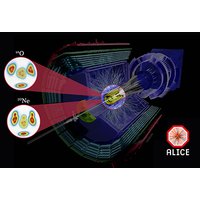
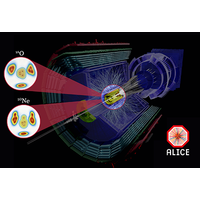
Evidence of Nuclear Geometry-Driven Anisotropic Flow in O+O and Ne+Ne Collisions at sNN=5.36  TeV

I. J. Abualrob et al. (ALICE Collaboration)

Phys. Rev. Lett. 137, 082301 (2026) - Published 17 August, 2026

Light-ion collisions at the LHC reveal collective hydrodynamic flow with a larger elliptic flow in central Ne-Ne collisions than in OO collisions that might be due to the bowling-pin nuclear shape of 20Ne.

Observation of Long-Range Collective Flow in O+O and Ne+Ne Collisions and Implications for Nuclear Structure Studies

A. Hayrapetyan et al. (CMS Collaboration)

Phys. Rev. Lett. 137, 082302 (2026) - Published 17 August, 2026

Light-ion collisions at the LHC reveal collective hydrodynamic flow with a larger elliptic flow in central Ne-Ne collisions than in OO collisions that might be due to the bowling-pin nuclear shape of 20Ne.

Deformation and Magicity in Heavy Actinides: First Observation of the Ground-State Rotational Band of Fm252

R. Orlandi et al.

Phys. Rev. Lett. 137, 082501 (2026) - Published 17 August, 2026

Observation of the ground-state rotational band in 252Fm provides compelling evidence that Z=100 and N=152 act as a deformed doubly magic shell closure.

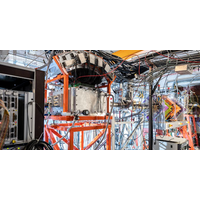
Quenching of the π0p3/2−π0p1/2 Spin-Orbit Splitting in O20 and the Effect of the Tensor Force

J. Lois-Fuentes et al.

Phys. Rev. Lett. 136, 212501 (2026) - Published 27 May, 2026

A new experiment settles a controversy over proton and neutron energies in light nuclei.

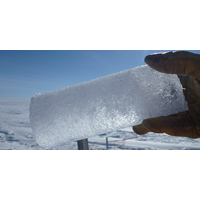
Local Interstellar Cloud Structure Imprinted in Antarctic Ice by Supernova Fe60

Dominik Koll, Annabel Rolofs, Florian Adolphi, Sebastian Fichter, Maria Hoerhold, Johannes Lachner, Stefan Pavetich, Georg Rugel, Stephen Tims, Frank Wilhelms, Sebastian Zwickel, and Anton Wallner

Phys. Rev. Lett. 136, 192701 (2026) - Published 13 May, 2026

Iron-60 buried in Antarctica reveals changes in the local interstellar environment.

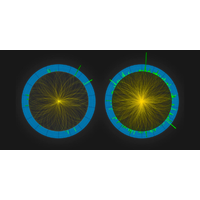
Observation of Suppressed Charged-Particle Production in Ultrarelativistic Oxygen-Oxygen Collisions

A. Hayrapetyan et al. (CMS Collaboration)

Phys. Rev. Lett. 136, 162301 (2026) - Published 22 April, 2026

Researchers at the Large Hadron Collider have observed evidence that indicates that even light nuclei can produce an exotic state of matter called quark–gluon plasma.

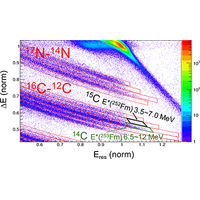
Excitation Spectra of the C12(p,d) Reaction near the η′-Meson Emission Threshold Measured in Coincidence with High-Momentum Protons

R. Sekiya et al. (η-PRiME Collaboration and Super-FRS Experiment Collaboration)

Phys. Rev. Lett. 136, 142501 (2026) - Published 7 April, 2026

Experiments with a proton beam striking a carbon target have uncovered events that may be due to a short-lived meson residing within a nucleus.

Isomer Depletion of Mo93m Triggered by Inelastic Nuclear Scattering Rather than Nuclear Excitation by Electron Capture

B. Ding (丁兵) et al.

Phys. Rev. Lett. 136, 052502 (2026) - Published 6 February, 2026

A new experiment shows that isomer depletion can be effectively induced when the highly charged isomeric ions slow down in a solid media.

From Spin to Pseudospin Symmetry: The Origin of Magic Numbers in Nuclear Structure

C. R. Ding, C. C. Wang, J. M. Yao, H. Hergert, H. Z. Liang, and S. K. Bogner

Phys. Rev. Lett. 136, 052501 (2026) - Published 2 February, 2026

Calculations show how the mysterious “magic numbers” that stabilize nuclear structures emerge naturally from nuclear forces—once these are described with appropriate spatial resolution.

Evidence for the Collective Nature of Radial Flow in Pb+Pb Collisions with the ATLAS Detector

G. Aad et al. (ATLAS Collaboration)

Phys. Rev. Lett. 136, 032301 (2026) - Published 22 January, 2026

Two different LHC measurements of a novel observable v0(pT) for the radial flow of quark-gluon plasma again confirms the collective hydrodynamic behavior of the plasma.

Long-Range Transverse-Momentum Correlations and Radial Flow in Pb-Pb Collisions at the LHC

S. Acharya et al. (ALICE Collaboration)

Phys. Rev. Lett. 136, 032302 (2026) - Published 22 January, 2026

Two different LHC measurements of a novel observable v0(pT) for the radial flow of quark-gluon plasma again confirms the collective hydrodynamic behavior of the plasma.

Sign-Problem-Free Nuclear Quantum Monte Carlo Simulation

Zhong-Wang Niu and Bing-Nan Lu

Phys. Rev. Lett. 135, 222504 (2025) - Published 26 November, 2025

The construction of a sign-problem-free nuclear quantum Monte Carlo simulation is able to reproduce binding energies of a wide range of nuclei.

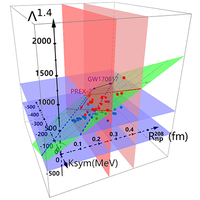
Reconciliation between Neutron Skin Thickness from PREX-2 Experiment and Neutron-Star Tidal Polarizability from GW170817 Event: The Key Role of Symmetry Energy Curvature

Z. Y. Guan (管中原) and Y. F. Niu (牛一斐)

Phys. Rev. Lett. 135, 172701 (2025) - Published 24 October, 2025

A tension between the tidal deformability inferred from neutron star merger GW170818 and the neutron skin measurement of 208Pb by the PREX-2 experiment has been resolved.

Precision Measurement of Net-Proton-Number Fluctuations in Au+Au Collisions at RHIC

B. E. Aboona et al. (STAR Collaboration)

Phys. Rev. Lett. 135, 142301 (2025) - Published 29 September, 2025

Experiments at the Relativistic Heavy Ion Collider give the first hints of a critical point in the hot quark–gluon “soup” that is thought to have pervaded the infant Universe.

Probing Gluon Fluctuations in Nuclei with the First Energy-Dependent Measurement of Incoherent J/ψ Photoproduction in Ultraperipheral PbPb Collisions

V. Chekhovsky et al. (CMS Collaboration)

Phys. Rev. Lett. 135, 112301 (2025) - Published 9 September, 2025

The first measurement of incoherent J/ψ photoproduction in ultraperipheral lead-lead collisions provides new constraints on gluon fluctuations within nuclei at previously unexplored small-x values.

EMC Effect of Tritium and Helium-3 from the JLab MARATHON Experiment

D. Abrams et al. (Jefferson Lab Hall A Tritium Collaboration)

Phys. Rev. Lett. 135, 062502 (2025) - Published 7 August, 2025

Measurements of the EMC effect in tritium and helium-3 mirror nuclei are expected to provide unique input for the study of the isovector component of the partonic structure of these few-body nuclear systems especially in the valence quark region.

Probing the Shell Effects on Fission: The New Superheavy Nucleus Sg257

P. Mosat, J. Khuyagbaatar, J. Ballof, R. A. Cantemir, D. Dietzel, Ch. E. Düllmann, K. Hermainski, F. P. Heßberger, E. Jäger, B. Kindler, J. Krier, N. Kurz, B. Lommel, S. Löchner, M. Maiti, T. K. Sato, B. Schausten, J. Uusitalo, P. Wieczorek, and A. Yakushev

Phys. Rev. Lett. 134, 232501 (2025) - Published 11 June, 2025

A new isotope 257Sg, decaying by both spontaneous fission and α-particle emission, was discovered at GSI’s gas-filled recoil separator TASCA.

Locating Critical Points Using Ratios of Lee-Yang Zeros

Tatsuya Wada, Masakiyo Kitazawa, and Kazuyuki Kanaya

Phys. Rev. Lett. 134, 162302 (2025) - Published 24 April, 2025

A computational method using ratios of Lee-Yang zeros can locate precisely the critical points in general systems by suppressing finite-size effects, with potential applications ranging from QCD to spin models.

First Measurement of A=4 Hypernuclei and Antihypernuclei at the LHC

S. Acharya et al. (ALICE Collaboration)

Phys. Rev. Lett. 134, 162301 (2025) - Published 23 April, 2025

Experiments at the Large Hadron Collider have revealed a previously unseen nucleus known as antihyperhelium-4.

Observation of tt¯ Production in Pb+Pb Collisions at sNN=5.02  TeV with the ATLAS Detector

G. Aad et al. (ATLAS Collaboration)

Phys. Rev. Lett. 134, 142301 (2025) - Published 7 April, 2025
Top quarks and antiquarks have been detected in heavy-ion collisions at the Large Hadron Collider, showing that all six quark flavors were present in the Universe’s first moments.

Sign In to Your Journals Account

Filter

Section

Filter

Article Lookup

Enter a citation