Highlights

Resolving the Tevatron Top Quark Forward-Backward Asymmetry Puzzle: Fully Differential Next-to-Next-to-Leading-Order Calculation

Michal Czakon, Paul Fiedler, and Alexander Mitov

Phys. Rev. Lett. 115, 052001 (2015) - Published 28 July, 2015

Fully differential two loop calculations in the Standard Model explain the excess of top quarks in the direction of the proton beam in pp¯ collisions at the Tevatron collider.

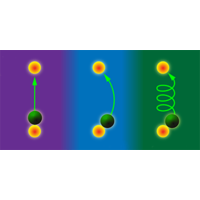
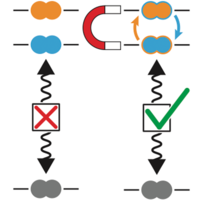
Control of Optical Transitions with Magnetic Fields in Weakly Bound Molecules

B. H. McGuyer, M. McDonald, G. Z. Iwata, W. Skomorowski, R. Moszynski, and T. Zelevinsky

Phys. Rev. Lett. 115, 053001 (2015) - Published 28 July, 2015

Magnetic fields can be used to make a normally forbidden molecular transition accessible to optical excitation, using much lower fields than would be needed to achieve the same with the constituent atoms.

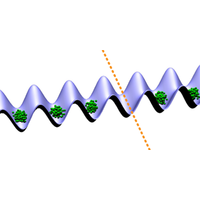
Negative Differential Conductivity in an Interacting Quantum Gas

Ralf Labouvie, Bodhaditya Santra, Simon Heun, Sandro Wimberger, and Herwig Ott

Phys. Rev. Lett. 115, 050601 (2015) - Published 27 July, 2015

Rubidium atoms in an optical trap have been made to exhibit negative differential conductance, a phenomenon normally found in semiconductor diodes.

Atom-Light Hybrid Interferometer

Bing Chen, Cheng Qiu, Shuying Chen, Jinxian Guo, L. Q. Chen, Z. Y. Ou, and Weiping Zhang

Phys. Rev. Lett. 115, 043602 (2015) - Published 24 July, 2015

A new type of interferometer, sensitive to the phases of an atomic spin wave and a light wave is experimentally demonstrated.

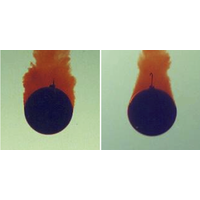
Drag Moderation by the Melting of an Ice Surface in Contact with Water

Ivan U. Vakarelski, Derek Y. C. Chan, and Sigurdur T. Thoroddsen

Phys. Rev. Lett. 115, 044501 (2015) - Published 24 July, 2015

An ice coating can halve the drag of an object moving in water by reducing the turbulent wake behind it.

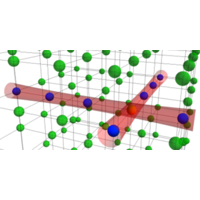
Coherent Addressing of Individual Neutral Atoms in a 3D Optical Lattice

Yang Wang, Xianli Zhang, Theodore A. Corcovilos, Aishwarya Kumar, and David S. Weiss

Phys. Rev. Lett. 115, 043003 (2015) - Published 23 July, 2015

Researchers manipulate atomic qubits individually in a three-dimensional optical lattice.

Temperature-Dependent Three-Dimensional Anisotropy of the Magnetoresistance in WTe2

L. R. Thoutam, Y. L. Wang, Z. L. Xiao, S. Das, A. Luican-Mayer, R. Divan, G. W. Crabtree, and W. K. Kwok

Phys. Rev. Lett. 115, 046602 (2015) - Published 22 July, 2015

Tungsten-ditelluride cleaves easily into atomically thin layers, but its electrons conduct almost isotropically, suggesting a rare case of good charge conduction across weak mechanical bonds.

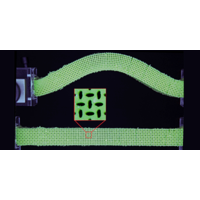
Discontinuous Buckling of Wide Beams and Metabeams

Corentin Coulais, Johannes T. B. Overvelde, Luuk A. Lubbers, Katia Bertoldi, and Martin van Hecke

Phys. Rev. Lett. 115, 044301 (2015) - Published 21 July, 2015

The buckling of mechanical beams under a compressive force can be tuned by adding holes into the beam.

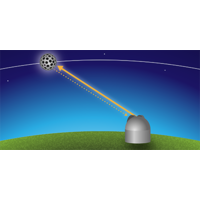
Experimental Satellite Quantum Communications

Giuseppe Vallone, Davide Bacco, Daniele Dequal, Simone Gaiarin, Vincenza Luceri, Giuseppe Bianco, and Paolo Villoresi

Phys. Rev. Lett. 115, 040502 (2015) - Published 20 July, 2015

Fragile photon states useful for quantum communication can be faithfully transmitted and distinguished over a link between an orbiting satellite and a telescope on Earth.

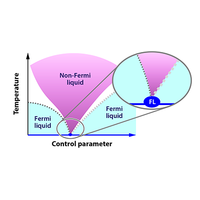
Thermal Conductivity through the Quantum Critical Point in YbRh2Si2 at Very Low Temperature

M. Taupin, G. Knebel, T. D. Matsuda, G. Lapertot, Y. Machida, K. Izawa, J.-P. Brison, and J. Flouquet

Phys. Rev. Lett. 115, 046402 (2015) - Published 20 July, 2015

Experiments with heavy-fermion materials show that quasiparticles exist at the critical point of a quantum phase transition.

Thin Films in Partial Wetting: Internal Selection of Contact-Line Dynamics

Amir Alizadeh Pahlavan, Luis Cueto-Felgueroso, Gareth H. McKinley, and Ruben Juanes

Phys. Rev. Lett. 115, 034502 (2015) - Published 17 July, 2015

Classical fluid theory can’t explain a puddle that spreads and then stops. A new theory solves the problem by incorporating intermolecular forces between the liquid and the solid underneath.

Evidence of Wγγ Production in pp Collisions at s=8  TeV and Limits on Anomalous Quartic Gauge Couplings with the ATLAS Detector

G. Aad et al. (ATLAS Collaboration)

Phys. Rev. Lett. 115, 031802 (2015) - Published 16 July, 2015

The first measurement of triple gauge boson production (W boson and two photons) at the LHC provides new limits on interactions beyond the standard model.

Coupling Ferroelectricity with Spin-Valley Physics in Oxide-Based Heterostructures

Kunihiko Yamauchi, Paolo Barone, Tatsuya Shishidou, Tamio Oguchi, and Silvia Picozzi

Phys. Rev. Lett. 115, 037602 (2015) - Published 16 July, 2015

A theoretically proposed oxide-based heterostructure indicates how coupling of spin and valley degrees of freedom may be engineered and controlled via the ferroelectric properties typical of transition-metal oxides.

THz-Pulse-Induced Selective Catalytic CO Oxidation on Ru

Jerry L. LaRue, Tetsuo Katayama, Aaron Lindenberg, Alan S. Fisher, Henrik Öström, Anders Nilsson, and Hirohito Ogasawara

Phys. Rev. Lett. 115, 036103 (2015) - Published 15 July, 2015

Terahertz pulses drive certain reactions on a metal surface by selectively exciting some of the adsorbed molecules.

Physical Limit to Concentration Sensing Amid Spurious Ligands

Thierry Mora

Phys. Rev. Lett. 115, 038102 (2015) - Published 15 July, 2015

The accuracy with which a cell can sense a specific ligand is limited by the concentration of incorrect ligands that can bind to and interfere with the cell receptors.

Density-Functional Theory for Strongly Correlated Bosonic and Fermionic Ultracold Dipolar and Ionic Gases

F. Malet, A. Mirtschink, C. B. Mendl, J. Bjerlin, E. Ö. Karabulut, S. M. Reimann, and Paola Gori-Giorgi

Phys. Rev. Lett. 115, 033006 (2015) - Published 14 July, 2015

An alternative functional for DFT calculations enables simulations of ultracold gases with long-ranged interactions.

Dzyaloshinskii-Moriya Interaction and Hall Effects in the Skyrmion Phase of Mn1−xFexGe

J. Gayles, F. Freimuth, T. Schena, G. Lani, P. Mavropoulos, R. A. Duine, S. Blügel, J. Sinova, and Y. Mokrousov

Phys. Rev. Lett. 115, 036602 (2015) - Published 14 July, 2015

A new theoretical treatment of Skyrmions in ferromagnets shows that electron dynamics are governed by Berry phase physics.

Experimental Test of Entropic Noise-Disturbance Uncertainty Relations for Spin-1/2 Measurements

Georg Sulyok, Stephan Sponar, Bülent Demirel, Francesco Buscemi, Michael J. W. Hall, Masanao Ozawa, and Yuji Hasegawa

Phys. Rev. Lett. 115, 030401 (2015) - Published 13 July, 2015

Experiments on neutrons confirm an information-theoretic formulation of Heisenberg’s noise-disturbance uncertainty principle: There is a reciprocal trade-off in knowledge of two incompatible spin observables.

Spatially Resolved Detection of a Spin-Entanglement Wave in a Bose-Hubbard Chain

Takeshi Fukuhara, Sebastian Hild, Johannes Zeiher, Peter Schauß, Immanuel Bloch, Manuel Endres, and Christian Gross

Phys. Rev. Lett. 115, 035302 (2015) - Published 13 July, 2015

A quantum microscope images a propagating wave of entanglement between atoms trapped in an optical lattice.

Electronic Magnetization of a Quantum Point Contact Measured by Nuclear Magnetic Resonance

Minoru Kawamura, Keiji Ono, Peter Stano, Kimitoshi Kono, and Tomosuke Aono

Phys. Rev. Lett. 115, 036601 (2015) - Published 13 July, 2015
Nuclear magnetic moments inside a quantum point contact (QPC) can be polarized by a DC current. This polarization influences the QPC conductance at 0.7*2e2/h, where a conductance plateau has previously been observed.

Sign In to Your Journals Account

Filter

Section

Filter

Article Lookup

Enter a citation