Browse Issues:

HIGHLIGHTED ARTICLES

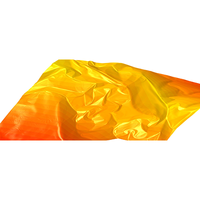
Pancake making and surface coating: Optimal control of a gravity-driven liquid film

E. Boujo and M. Sellier

Phys. Rev. Fluids 4, 064802 (2019) - Published 11 June, 2019

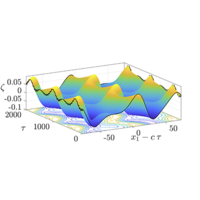
Imagine a thin liquid film that must cover the substrate it spreads over before solidifying: tilting the substrate is useful to get a little push from gravity, but obtaining a uniform film thickness is challenging. Here, an adjoint method finds time-dependent motions that improve uniformity.

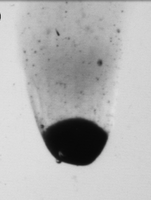
Salt comets in hand sanitizer: A simple probe of microgel collapse dynamics

Arash Nowbahar, Art O'Connor, Vincent Mansard, Patrick Spicer, and Todd M. Squires

Phys. Rev. Fluids 4, 061301(R) (2019) - Published 6 June, 2019

A single grain of salt, placed on the surface of everyday hand sanitizer, slowly bores a hole through it, leaving a milky “comet trail” in its wake. The fall speed does not depend on the size of the salt grain, but does depend on salt type, and reveals subtle aspects of collapsing microgels.

Regularized Stokeslet rings: An efficient method for axisymmetric Stokes flow with application to the growing pollen tube

J. Tyrrell, D. J. Smith, and R. J. Dyson

Phys. Rev. Fluids 4, 063102 (2019) - Published 6 June, 2019

The “regularized ringlet,” which is the fundamental solution to axisymmetric Stokes flow driven by a ring of smoothed point forces, is derived and used to model cytosolic flow in the growing pollen tube.

Resolvent-based modeling of coherent wave packets in a turbulent jet

Lutz Lesshafft, Onofrio Semeraro, Vincent Jaunet, André V. G. Cavalieri, and Peter Jordan

Phys. Rev. Fluids 4, 063901 (2019) - Published 6 June, 2019

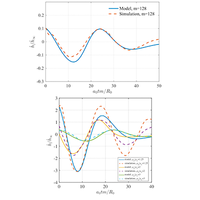
Linear instability analysis, performed on the mean flow of a fully turbulent jet, provides quantitatively correct predictions of the energetic coherent turbulent structures found in experiments. It is concluded that the most energetic structures in jet turbulence are governed by linear dynamics.

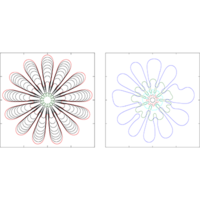
Self-similar and disordered front propagation in a radial Hele-Shaw channel with time-varying cell depth

C. Vaquero-Stainer, M. Heil, A. Juel, and D. Pihler-Puzović

Phys. Rev. Fluids 4, 064002 (2019) - Published 6 June, 2019

An air bubble expanding into a viscous liquid in the small gap between parallel plates deforms into highly branched, continuously evolving interfacial fingering patterns. By separating the plates following a power law in time, it is found that the interface can also form self-similar fingering patterns.

RAPID COMMUNICATIONS

Complex and Non-Newtonian Fluids

Salt comets in hand sanitizer: A simple probe of microgel collapse dynamics

Arash Nowbahar, Art O'Connor, Vincent Mansard, Patrick Spicer, and Todd M. Squires

Phys. Rev. Fluids 4, 061301(R) (2019) - Published 6 June, 2019

A single grain of salt, placed on the surface of everyday hand sanitizer, slowly bores a hole through it, leaving a milky “comet trail” in its wake. The fall speed does not depend on the size of the salt grain, but does depend on salt type, and reveals subtle aspects of collapsing microgels.
Electrokinetic Phenomena, Electrohydrodynamics, and Magnetohydrodynamics

Propulsion driven by self-oscillation via an electrohydrodynamic instability

Lailai Zhu and Howard A. Stone

Phys. Rev. Fluids 4, 061701(R) (2019) - Published 24 June, 2019

When a flexible elastic filament is attached to a Quincke rotating sphere, an elasto-electro-hydrodynamic instability leads to self-propulsion of the composite system.

Multiphase, Granular, and Particle-Laden Flows

Effect of elastic walls on suspension flow

Marco Edoardo Rosti, Mehdi Niazi Ardekani, and Luca Brandt

Phys. Rev. Fluids 4, 062301(R) (2019) - Published 21 June, 2019

A suspension of rigid particles in plane Couette flow with elastic boundaries is simulated numerically. Reduction in apparent viscosity for the more deformable boundaries is modeled as a concentration reduction as the volume for particles expands in amount equal to the boundary elastic deformation.

ARTICLES

Biological and Biomedical Flows

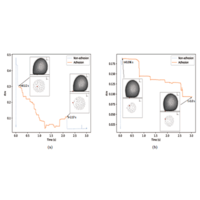
Investigation of shear rates of rolling adhesion on leukocytes with bending of microvilli

Tai-Hsien Wu and Dewei Qi

Phys. Rev. Fluids 4, 063101 (2019) - Published 5 June, 2019

A leukocyte model is used to show how different flow shear rates affect bending deformation of the microvilli and adhesive bond forces.

Regularized Stokeslet rings: An efficient method for axisymmetric Stokes flow with application to the growing pollen tube

J. Tyrrell, D. J. Smith, and R. J. Dyson

Phys. Rev. Fluids 4, 063102 (2019) - Published 6 June, 2019

The “regularized ringlet,” which is the fundamental solution to axisymmetric Stokes flow driven by a ring of smoothed point forces, is derived and used to model cytosolic flow in the growing pollen tube.

Role of the near-tip region of a fin in fish propulsion

F. J. Huera-Huarte and Morteza Gharib

Phys. Rev. Fluids 4, 063103 (2019) - Published 17 June, 2019

We examine the effects of locally altering the tip region of a periodic flapping fin system with a low order robotic model and load, motion, and wake measurements. This actuation modifies propulsive performance and unveils the importance of the phase difference between the fin and the tip.

Combustion Fluid Mechanics and Reacting Flows

Analysis of nonequidiffusive premixed flames in obstructed channels

Abdulafeez Adebiyi, Olatunde Abidakun, Gbolahan Idowu, Damir Valiev, and V’yacheslav Akkerman

Phys. Rev. Fluids 4, 063201 (2019) - Published 11 June, 2019

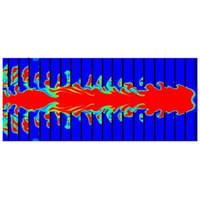
The impact of the Lewis number on ultrafast premixed flame acceleration in channels equipped with comb-shaped arrays of tightly spaced obstacles attached to the walls is studied by the computational simulations of the reacting flow equations, including fully compressible hydrodynamics.

Unresolved stress tensor modeling in turbulent premixed V-flames using iterative deconvolution: An a priori assessment

Z. M. Nikolaou, Y. Minamoto, and L. Vervisch

Phys. Rev. Fluids 4, 063202 (2019) - Published 11 June, 2019

The application of an iterative deconvolution modeling framework for the unresolved stresses in turbulent and reacting flows is demonstrated using high-fidelity direct numerical simulation data of premixed rod-stabilized V-flames.

Vectorial structure of the near-wall premixed flame

Peipei Zhao, Lipo Wang, and Nilanjan Chakraborty

Phys. Rev. Fluids 4, 063203 (2019) - Published 12 June, 2019

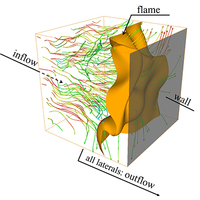
A turbulent premixed flame anchored by a solid wall can reach a statistically stationary state. Overall the configuration is counterflowlike. Flame-wall interactions under such conditions are key to understanding combustion in a confined space and in developing wall flame models. A numerical study is presented.

Complex and Non-Newtonian Fluids

Experimental and numerical determination of Darcy's law for yield stress fluids in porous media

D. Bauer, L. Talon, Y. Peysson, H. B. Ly, G. Batôt, T. Chevalier, and M. Fleury

Phys. Rev. Fluids 4, 063301 (2019) - Published 5 June, 2019

Experiments and three-dimensional numerical simulations of yield stress fluids in heterogeneous porous media show that, as a result of this disorder, the fluid flows through a single channel near a critical pressure. Beyond that, the number of open channels increases with the pressure applied.

Drag coefficient for a sedimenting and rotating sphere in a viscoelastic fluid

Alfonso Castillo, William L. Murch, Jonas Einarsson, Baltasar Mena, Eric S. G. Shaqfeh, and Roberto Zenit

Phys. Rev. Fluids 4, 063302 (2019) - Published 7 June, 2019

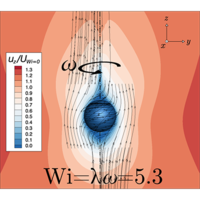
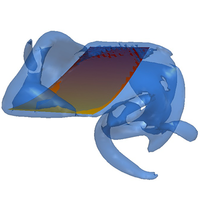
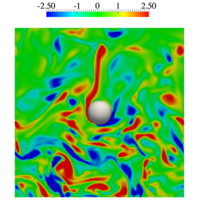
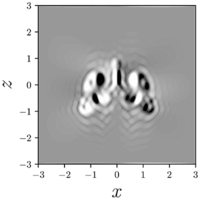
The image shows the flow field around a sphere that sediments and rotates simultaneously in a viscoelastic liquid.

Anomalous percolation flow transition of yield stress fluids in porous media

Nicolas Waisbord, Norbert Stoop, Derek M. Walkama, Jörn Dunkel, and Jeffrey S. Guasto

Phys. Rev. Fluids 4, 063303 (2019) - Published 7 June, 2019

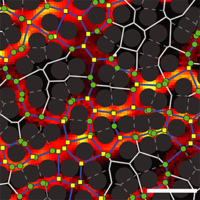
Microfluidic experiments and simulations reveal an anomalous percolation transition for the flow of a yield stress fluid through a random porous medium. The evolution of the fluidized network results in a highly nonlinear flow conductivity and reveals a novel dispersion mechanism.

Dynamic jamming of dense suspensions under tilted impact

Endao Han, Liang Zhao, Nigel Van Ha, S. Tonia Hsieh, Daniel B. Szyld, and Heinrich M. Jaeger

Phys. Rev. Fluids 4, 063304 (2019) - Published 21 June, 2019

High-speed ultrasound imaging is used to reconstruct the three-dimensional flow field of dense cornstarch suspensions under tilted impact. Experiments show how jamming fronts propagate and get deformed in a nonaxisymmetric manner under different impact angles.

Dynamics of gravity-driven viscoelastic films on wavy walls

Arjun Sharma, Prasun K. Ray, and Demetrios T. Papageorgiou

Phys. Rev. Fluids 4, 063305 (2019) - Published 24 June, 2019

An investigation finds that instability in gravity-driven thin viscoelastic films can be substantively enhanced or suppressed by sinusoidal wall topography with an appropriately chosen wavelength. Topography also introduces finer temporal scales in the film dynamics, and simulations produce a broad range of nonlinear states.

Drops, Bubbles, Capsules, and Vesicles

Slightly deformable Darcy drop in linear flows

Y.-N. Young, Yoichiro Mori, and Michael J. Miksis

Phys. Rev. Fluids 4, 063601 (2019) - Published 5 June, 2019

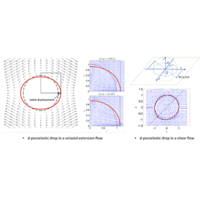
When a poroelastic spherical drop is under a uniaxial extension flow or a shear flow, the elastic network deforms in response to the external fluid viscous stress. A small-deformation analysis is conducted to investigate effects of interfacial slip and permeability on flow around the drop.

Computational study of the collapse of a cloud with 12500 gas bubbles in a liquid

U. Rasthofer, F. Wermelinger, P. Karnakov, J. Šukys, and P. Koumoutsakos

Phys. Rev. Fluids 4, 063602 (2019) - Published 7 June, 2019

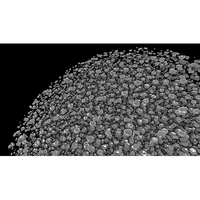
The collapse of a spherical cloud composed of 12 500 gas bubbles in water is studied. Wave propagation is captured and compared to existing reduced order models. Microjet formation is quantified and a dependence between microjet velocity magnitude and the strength of the collapse wave is identified.
Influence of a small amount of noncondensable gas on shock wave generation inside a collapsing vapor bubble

Kyohei Yamamoto, Kazumichi Kobayashi, Masao Watanabe, Hiroyuki Fujii, Misaki Kon, and Hiroyuki Takahira

Phys. Rev. Fluids 4, 063603 (2019) - Published 11 June, 2019
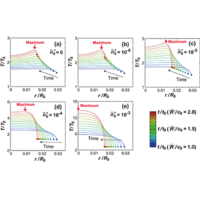
A numerical study of the collapse of a vapor bubble finds that a small amount of noncondensable molecules affects the temperature profile inside the collapsing vapor bubble, preventing shock wave generation inside the collapsing bubble.

Electrokinetic Phenomena, Electrohydrodynamics, and Magnetohydrodynamics

Electroosmotic flow in soft microchannels at high grafting densities

Arman Sadeghi, Milad Azari, and Steffen Hardt

Phys. Rev. Fluids 4, 063701 (2019) - Published 24 June, 2019

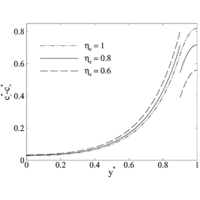
The ion partitioning effect due to polyelectrolyte layer (PEL)-electrolyte permittivity contrast in soft microchannels leads to depletion of electrolyte ions within the PEL. This effect, surprisingly, magnifies the electroosmotic flow rate because of the space charge increase outside the PEL.

Instability, Transition, and Control

Resolvent-based modeling of coherent wave packets in a turbulent jet

Lutz Lesshafft, Onofrio Semeraro, Vincent Jaunet, André V. G. Cavalieri, and Peter Jordan

Phys. Rev. Fluids 4, 063901 (2019) - Published 6 June, 2019

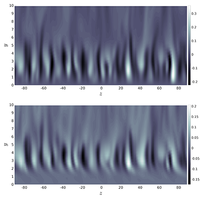
Linear instability analysis, performed on the mean flow of a fully turbulent jet, provides quantitatively correct predictions of the energetic coherent turbulent structures found in experiments. It is concluded that the most energetic structures in jet turbulence are governed by linear dynamics.

Sensitivity of vortex pairing and mixing to initial perturbations in stratified shear flows

Wenjing Dong, E. W. Tedford, M. Rahmani, and G. A. Lawrence

Phys. Rev. Fluids 4, 063902 (2019) - Published 7 June, 2019

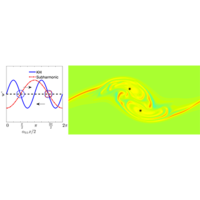
An investigation of the phase relationship between the Kelvin-Helmholtz mode and its subharmonic mode finds that it has important implications for vortex pairing and mixing in the flow by ensuring the instability. Results are consistent with laboratory observations for suppression of the subharmonic mode near an unfavorable phase.

Vortex merging in a laminar separation bubble under natural and forced conditions

J. W. Kurelek, S. Yarusevych, and M. Kotsonis

Phys. Rev. Fluids 4, 063903 (2019) - Published 11 June, 2019

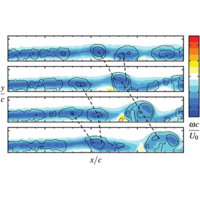
Experiments find that vortex merging occurs naturally in a laminar separation bubble. Acoustic forcing at the subharmonic and fundamental vortex shedding frequency promotes and inhibits merging, respectively. In all cases, merging occurs in the aft portion of the bubble in a spanwise nonuniform manner.

Bypass transition delay using oscillations of spanwise wall velocity

Prabal S. Negi, Maneesh Mishra, Philipp Schlatter, and Martin Skote

Phys. Rev. Fluids 4, 063904 (2019) - Published 17 June, 2019

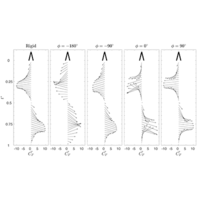
Bypass transition in boundary layers is governed by streak instability. An investigation of the effect of oscillatory wall-control on bypass transition shows that transition delay is due to streak attenuation via the modification of the eigenfunction of the Orr-Sommerfeld operator.

Group theory analysis of early-time scale-dependent dynamics of the Rayleigh-Taylor instability with time varying acceleration

Desmond L. Hill, Aklant K. Bhowmick, Dan V. Ilyin, and Snezhana I. Abarzhi

Phys. Rev. Fluids 4, 063905 (2019) - Published 21 June, 2019

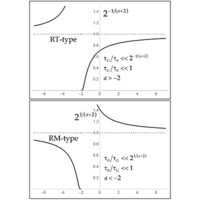
Group theory analysis of the Rayleigh-Taylor instability with an acceleration varying in time finds that the early time behavior depends on whether the acceleration decays faster or slower than 1/t2.

Incompressible models of magnetohydrodynamic Richtmyer-Meshkov instability in cylindrical geometry

A. Bakhsh and R. Samtaney

Phys. Rev. Fluids 4, 063906 (2019) - Published 27 June, 2019

With a cylindrical and incompressible model of an impulsively accelerated conducting fluid interface, effects of normal or azimuthal magnetic fields on interface growth rates are studied. In the normal case growth decays at late times and in the azimuthal one a growth perturbation oscillates.

Pore-scale study of dissolution-driven density instability with reaction A+B→C in porous media

Timan Lei and Kai H. Luo

Phys. Rev. Fluids 4, 063907 (2019) - Published 28 June, 2019

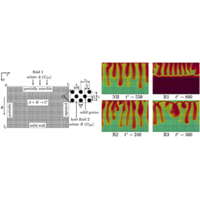
A dissolution-driven density instability with reaction A+B→C is simulated in both homogeneous and heterogeneous media at pore scale. Six types of fingering scenarios are found in each medium, and it is shown that media with large pore size in the top layer can enhance the storage of solute A in the host fluid.

Interfacial Phenomena and Flows

Faraday waves on band pattern under zero gravity conditions

T. Lyubimova, A. Ivantsov, Y. Garrabos, C. Lecoutre, and D. Beysens

Phys. Rev. Fluids 4, 064001 (2019) - Published 3 June, 2019

Coupled Faraday waves can develop under weightlessness on liquid-vapor bands induced by vibrations. The instability appears above a threshold that is determined by theoretical analysis and numerical simulation. It compares well with sounding rocket experiments in CO2 near its critical point.

Self-similar and disordered front propagation in a radial Hele-Shaw channel with time-varying cell depth

C. Vaquero-Stainer, M. Heil, A. Juel, and D. Pihler-Puzović

Phys. Rev. Fluids 4, 064002 (2019) - Published 6 June, 2019

An air bubble expanding into a viscous liquid in the small gap between parallel plates deforms into highly branched, continuously evolving interfacial fingering patterns. By separating the plates following a power law in time, it is found that the interface can also form self-similar fingering patterns.

Particle size selection in capillary instability of locally heated coaxial fiber

Saviz Mowlavi, Isha Shukla, P.-T. Brun, and François Gallaire

Phys. Rev. Fluids 4, 064003 (2019) - Published 18 June, 2019

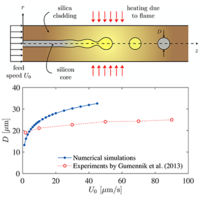
An analysis of the drop-size selection mechanism in a locally heated silicon-in-silica coaxial fiber is presented. Surprisingly, it is found that the size of the silicon drops is independent of the linear stability properties of the system and is instead set by nonlinear effects.

Drop impact on hairy surfaces

Alice Nasto, P.-T. Brun, and A. E. Hosoi

Phys. Rev. Fluids 4, 064004 (2019) - Published 26 June, 2019

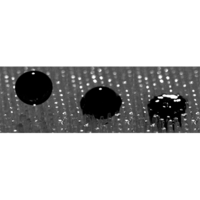
A study of the impact of liquid drops on millimeter-scale hairy surfaces finds that the behavior of the impacting drops depends on the amount of kinetic energy dissipated through the hairs via a balance of inertia, viscosity, and surface tension.

Laminar and Viscous Flows

Turning strategies for plunging elastic plate propulsor

Peter D. Yeh, Ersan Demirer, and Alexander Alexeev

Phys. Rev. Fluids 4, 064101 (2019) - Published 12 June, 2019

Complex actuation of a caudal fin can generate turning moments enabling underwater swimmer navigation. A numerical study explores the hydrodynamics resulting from two actuation strategies leading to pitching and yaw moments.

Micro- and Nanofluidics

Universal molecular-kinetic scaling relation for slip of a simple fluid at a solid boundary

Gerald J. Wang and Nicolas G. Hadjiconstantinou

Phys. Rev. Fluids 4, 064201 (2019) - Published 26 June, 2019

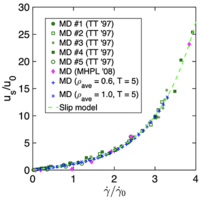
A molecular-kinetic model, based on thermally activated processes, is developed for the slip of a simple fluid on a smooth solid boundary. Navier slip is recovered at low shear-rates. Predictions at higher shear-rates are tested against experiments and MD simulations.

Multiphase, Granular, and Particle-Laden Flows

Inertial effects on the dynamics of rigid heavy fibers in isotropic turbulence

Sofia Kuperman, Lilach Sabban, and René van Hout

Phys. Rev. Fluids 4, 064301 (2019) - Published 12 June, 2019

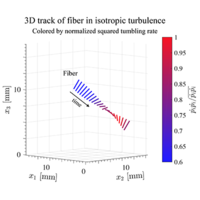
Holographic cinematography is used to measure rotational and translational dynamics of inertial fibers in isotropic turbulence. Results show that for the present parameter range, translational motion is similar to that for spheres. In contrast, tumbling rates peaked at an intermediate Stokes number.

Quantitative study of the rheology of frictional suspensions: Influence of friction coefficient in a large range of viscous numbers

William Chèvremont, Bruno Chareyre, and Hugues Bodiguel

Phys. Rev. Fluids 4, 064302 (2019) - Published 12 June, 2019

A numerical study of sheared suspensions of frictional and frictionless rigid spheres finds that macroscopic friction in granular suspensions is nearly independent of interparticle contact friction, and besides contact lubrication, the viscous contribution of the pore fluid is negligibly small.

Small-scale flow topologies in decaying isotropic turbulence laden with finite-size droplets

Michael S. Dodd and Lluís Jofre

Phys. Rev. Fluids 4, 064303 (2019) - Published 13 June, 2019

The small-scale flow topologies in droplet-resolved direct numerical simulations of isotropic turbulence are classified using tensor invariants. The results show that when approaching the droplet surface, the flow topologies fundamentally change from those found in isotropic turbulence to boundary-layer-like structures.

Rotational dynamics of a particle in a turbulent stream

Yayun Wang, Adam Sierakowski, and Andrea Prosperetti

Phys. Rev. Fluids 4, 064304 (2019) - Published 19 June, 2019

Numerical simulations of turbulent flow past a sphere immersed in decaying turbulence, free to rotate around a fixed center, are presented. This arrangement allows the same simulations with and without the sphere, thus permitting the identification of the flow features that most affect the sphere rotation.

Transport and Mixing

Transport across a bathymetric interface in quasi-two-dimensional flow

Lei Fang and Nicholas T. Ouellette

Phys. Rev. Fluids 4, 064501 (2019) - Published 3 June, 2019

In many geophysical situations, variable bathymetry can affect surface transport and mixing. Experiments show that the effect of bathymetry is to produce a porous transport barrier leading to asymmetric transport. These results may help to explain the dynamics of phenomena such as ocean dead zones.

Topological mixing of yield stress materials

D. R. Lester and A. Chryss

Phys. Rev. Fluids 4, 064502 (2019) - Published 14 June, 2019

Chaotic mixing of yield stress fluids is considered in a novel static mixer that imparts uniformly efficient mixing due to the underlying topology of the device. Experimental and computational studies indicate that mixing is largely insensitive to flow dynamics, boundary conditions, and fluid rheology.

Turbulent Flows

Statistical properties of an incompressible passive vector convected by isotropic turbulence

Jingyuan Yang, Toshiyuki Gotoh, Hideaki Miura, and Takeshi Watanabe

Phys. Rev. Fluids 4, 064601 (2019) - Published 3 June, 2019

Statistical properties of an incompressible passive vector in isotropic turbulence are compared with the velocity and passive scalar in order to explore the physics behind their differences and similarities.

Emergence of skewed non-Gaussian distributions of velocity increments in isotropic turbulence

W. Sosa-Correa, R. M. Pereira, A. M. S. Macêdo, E. P. Raposo, D. S. P. Salazar, and G. L. Vasconcelos

Phys. Rev. Fluids 4, 064602 (2019) - Published 3 June, 2019

A theoretical framework, the H-theory, is applied to describe the skewed non-Gaussian distribution of velocity increments as a weighted mixture of asymmetric Gaussians. The weighing distribution is obtained from a hierarchical stochastic model of intermittency. Good agreement with direct numerical simulation data is found.

Synthetic turbulent inflow generator using machine learning

Kai Fukami, Yusuke Nabae, Ken Kawai, and Koji Fukagata

Phys. Rev. Fluids 4, 064603 (2019) - Published 4 June, 2019

Machine-learning-based turbulence generators are developed to generate unsteady inflow conditions for turbulent flow simulations. The proposed method can provide inflow conditions with reasonable turbulence statistics without spurious periodicity and at a low computational cost.

Self-organization in purely viscous non-Newtonian turbulence

H. J. Seybold, H. A. Carmona, H. J. Herrmann, and J. S. Andrade, Jr.

Phys. Rev. Fluids 4, 064604 (2019) - Published 6 June, 2019

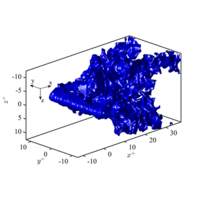
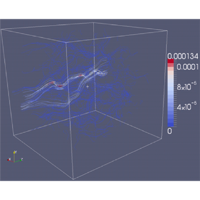
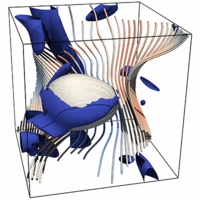
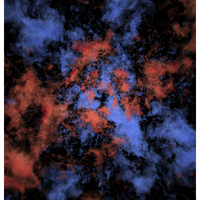
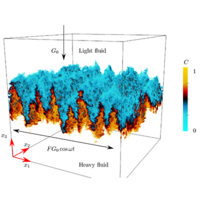
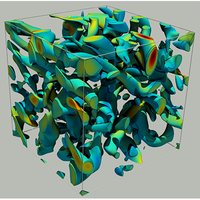
Snapshot of vortex structure in a shear-thickening fluid in fully developed turbulence. Colors from blue to red go from low to high vorticities. Relative to Newtonian fluids, shear-thinning fluids adjust to have an augmented dissipation inside vortices, the opposite of shear-thickening fluids.

Lagrangian description of the unsteady flow induced by a single pulse of a jellyfish

Jin-Tae Kim and Leonardo P. Chamorro

Phys. Rev. Fluids 4, 064605 (2019) - Published 6 June, 2019

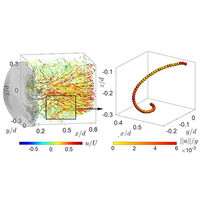
Lagrangian statistics and pair dispersion induced by an isolated pulse of a small jellyfish are quantified with 3D particle tracking velocimetry. Lagrangian velocity shows more intense mixing in the radial direction and reveals three stages dominated by flow acceleration, mixing, and dissipation.

Lagrangian acceleration timescales in anisotropic turbulence

Peter D. Huck, Nathanael Machicoane, and Romain Volk

Phys. Rev. Fluids 4, 064606 (2019) - Published 10 June, 2019

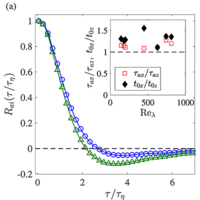
In a Lagrangian point of view, anisotropy in small time scales of turbulent flow is not yet well understood. Using Particle Tracking Velocimetry over nearly a decade in Taylor-scale based Reynolds numbers, we theoretically predict anisotropic acceleration correlation times of tracer particles in turbulent flow.

Kinetic energy budget of the largest scales in turbulent pipe flow

C. Bauer, A. von Kameke, and C. Wagner

Phys. Rev. Fluids 4, 064607 (2019) - Published 10 June, 2019

Very-large-scale motions contribute significantly to the kinetic energy in turbulent pipe flow. An analysis of the scale energy budget reveals a similar production mechanism compared to the small scales, but the interscale energy exchange is found to be quite different.

Frozen waves in turbulent mixing layers

Benoît-Joseph Gréa and Antoine Briard

Phys. Rev. Fluids 4, 064608 (2019) - Published 13 June, 2019

The horizontal vibrations of an interface between miscible fluids trigger a parametric instability, leading to frozen wave patterns. Theory and numerical simulations reveal that the mixing layer size varies as the square of the forcing amplitude in the turbulent regime.

Vortex Dynamics

Resonant response and optimal energy harvesting of an elastically mounted pitching and heaving hydrofoil

Yunxing Su and Kenneth Breuer

Phys. Rev. Fluids 4, 064701 (2019) - Published 20 June, 2019

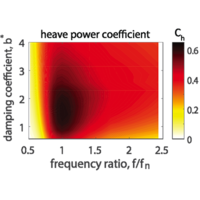
Experiments using a cyber-physical hydrofoil, tested over a wide range of stiffness and damping coefficients, reveal that the optimal response is achieved at the structural resonant frequency where the leading-edge vortex formation is synchronized with the foil pithing and heaving.

Wave Dynamics, Free Surface Flows, Stratified, and Rotating Flows

Flow and air-entrainment around partially submerged vertical cylinders

Valentin Ageorges, Jorge Peixinho, and Gaële Perret

Phys. Rev. Fluids 4, 064801 (2019) - Published 10 June, 2019

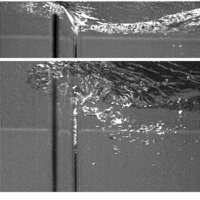
When a partially submerged vertical cylinder is moved at constant speed through water, the motion induces a turbulent wake, free-surface deformations up to the rupture, and air entrainment within the flow. Two modes of air entrainment are uncovered and the critical velocity is compared to a model.

Pancake making and surface coating: Optimal control of a gravity-driven liquid film

E. Boujo and M. Sellier

Phys. Rev. Fluids 4, 064802 (2019) - Published 11 June, 2019

Imagine a thin liquid film that must cover the substrate it spreads over before solidifying: tilting the substrate is useful to get a little push from gravity, but obtaining a uniform film thickness is challenging. Here, an adjoint method finds time-dependent motions that improve uniformity.

Evolution of a line vortex in stratified flow

Surupa Shaw and John P. McHugh

Phys. Rev. Fluids 4, 064803 (2019) - Published 12 June, 2019

A pair of distributed vortices in stratified flow disintegrate sooner than a traditional vortex pair and form multiple coherent vortex structures.

Strong turbulence for vibrating plates: Emergence of a Kolmogorov spectrum

Gustavo Düring, Christophe Josserand, Giorgio Krstulovic, and Sergio Rica

Phys. Rev. Fluids 4, 064804 (2019) - Published 13 June, 2019

In the low viscosity liquid and zero thickness vibrating elastic sheet, turbulent behavior is observed. We find the same Kolmogorov spectrum cascade for energy redistribution per scale Ek∼P2/3k−5/3 in both, apparently, completely disparate physical situations.

Sign In to Your Journals Account

Filter

Filter

Article Lookup

Enter a citation