Jian-Xun Wang
Phys. Rev. Fluids 11, 090502 (2026) – Published 21 September, 2026

Physical Review Fluids publishes a collection of papers associated with the invited talks presented at the 78th Annual Meeting of the APS Division of Fluid Dynamics in Houston, Texas in November 2025.
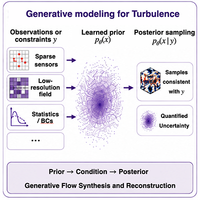
Turbulence modeling increasingly requires probabilistic tools that can generate, condition, and complete instantaneous flow fields under sparse data and high simulation cost. This Perspective presents transport-based generative models, including diffusion and flow matching, as reusable probabilistic priors for spatiotemporal turbulence. Through training-free conditional sampling, a single learned prior can unify forward generation, reconstruction, data assimilation, restoration, and solver-constrained inference. This framework offers a path toward conditionable, uncertainty-aware statistical backbones for future turbulence foundation models.
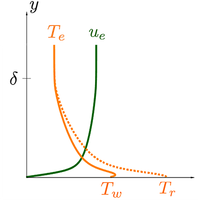
The conversion of kinetic energy into internal energy in high-speed boundary layers creates non-uniform density and viscosity fields, which invalidate many foundational theoretical models of wall-bounded turbulence flow, most notably the incompressible log-law for the mean velocity profile. The paper sets up the general problem and describes the author’s personal perspective on our current theoretical understanding of it, along with what has worked and what remains to be solved in this research area.
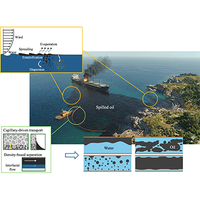
Marine oil-spill response remains largely field-driven, only loosely related to advances in multiphase-flow and interfacial physics. The IMO 2020 sulfur cap has signified this situation by introducing low-sulfur fuel oils (LSFOs), whose wax-driven, temperature-sensitive rheology and strong adhesion violate assumptions of classical spreading, recovery, and transport models. Using fluid mechanics we synthesize how LSFO’s compositional differences from conventional heavy fuel oils affect spreading, capillary- and density-based recovery, and pipeline fouling, and outlines how multiphase-flow and data-driven strategies could improve recovery robustness and transport efficiency for these fuels.
Droplet behavior in high-speed and detonative flows is governed by tightly coupled aerodynamic, thermodynamic, and phase-change processes, yet a unified framework for classifying these interactions is still lacking. This work introduces a physics-based regime diagram using two dimensionless groups that quantify thermodynamic loading and the competition between phase-transition and aerodynamic time scales. The framework connects shock–droplet interactions, liquid-fueled detonations, and rotating detonation engines, identifying conditions that favor breakup, rapid phase transition, and sustained detonation coupling.
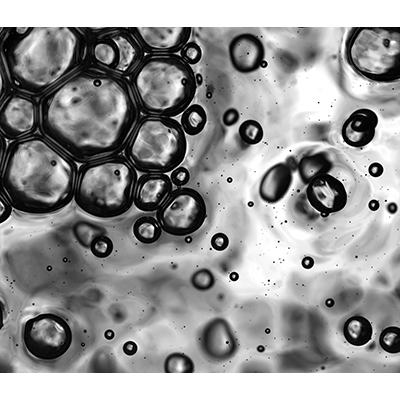
We review recent results on the emission of oceanic aerosols through bubble bursting, focusing on the impacts of contamination and salt. Experimental setups at various scales are used to identify the multiple roles that surfactants can play in this problem: Modulation of lifetime and drainage of a single bubble, collective effects during bubble bursting, or enhanced aerosol production in the presence of salt.
Insects were the first animals to evolve flight and are key to understanding the origin and evolution of flight. This paper describes mathematical models, computational methods, and behavioral experiments developed to explain unsteady aerodynamic mechanisms in flapping flight and to reveal the connection between the physics of flight and insects’ evolved neural control algorithms. Highlights include new criteria for flight stability, with implications for evolutionary questions and robotics, analyses of fly’s equilibrium reflex and dragonfly’s righting reflex, and methods for computing flapping flight.