

Minimally dissipative multibit logical operations
Phys. Rev. E 113, 014109 – Published 9 January, 2026
DOI: https://doi.org/10.1103/bs35-xp2c
Abstract
Modern computing architectures are vastly more energy dissipative than fundamental thermodynamic limits suggest, motivating the search for principled approaches to low-dissipation logical operations. We formulate multibit logical gates (bit erasure, nand) as optimal transport problems, extending beyond classical one-dimensional bit erasure to scenarios where existing methods fail. Using entropically regularized unbalanced optimal transport, we derive tractable solutions and establish general energy-speed-accuracy tradeoffs that demonstrate that faster, more accurate operations necessarily dissipate more energy. Furthermore, we demonstrate that the Landauer limits cannot be trivially overcome in higher-dimensional geometries. We develop practical algorithms combining optimal transport with generative modeling techniques to construct dynamical controllers that follow Wasserstein geodesics. These protocols achieve near-optimal dissipation and can, in principle, be implemented in realistic experimentally setups. The framework bridges fundamental thermodynamic limits with scalable computational design for energy-efficient information processing.
Physics Subject Headings (PhySH)
Collections
This article appears in the following collection:
Controlling Stochastic Dynamics Across Scales
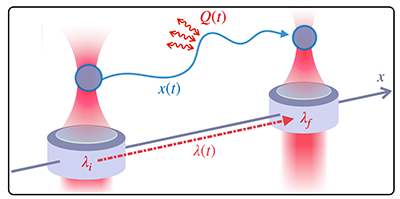
We present a Collection of papers on Controlling Stochastic Dynamics Across Scales. It seeks to highlight novel studies on controlling the dynamics of complex stochastic systems with a rich phenomenology. Guest editors of the Collection are Étienne Fodor of the University of Luxembourg and Todd Gingrich of Northwestern University.
