- Open Access
Searching for dark matter with MeVCube
Phys. Rev. D 111, 123041 – Published 25 June, 2025
DOI: https://doi.org/10.1103/15dd-mw83
Abstract
CubeSat technology is an emerging alternative to large-scale space telescopes due to its short development time and cost effectiveness. MeVCube is a proposed CubeSat mission to study the least explored MeV gamma-ray sky, also known as the “MeV gap.” Besides being sensitive to a plethora of astrophysical phenomena, MeVCube can also be important in the hunt for dark matter. If dark matter is made up of evaporating primordial black holes, then it can produce photons in the sensitivity range of MeVCube. Besides, particle dark matter can also decay or annihilate to produce final state gamma-ray photons. We perform the first comprehensive study of dark matter discovery potential of a near-future MeVCube CubeSat mission. In all cases, we find that MeVCube will have much better discovery reach compared to existing limits in the parameter space. This may be an important step towards discovering dark matter through its nongravitational interactions.
Physics Subject Headings (PhySH)
Article Text
References (198)
- G. Bertone and D. Hooper, History of dark matter, Rev. Mod. Phys. 90, 045002 (2018).
- N. Aghanim et al. (Planck Collaboration), Planck 2018 results. VI. Cosmological parameters, Astron. Astrophys. 641, A6 (2020).
- M. Cirelli, A. Strumia, and J. Zupan, Dark matter, arXiv:2406.01705.
- L. E. Strigari, Galactic searches for dark matter, Phys. Rep. 531, 1 (2013).
- M. Lisanti, Lectures on dark matter physics, in Theoretical Advanced Study Institute in Elementary Particle Physics: New Frontiers in Fields and Strings (World Scientific, 2017), pp. 399–446, 10.1142/9789813149441_0007.
- T. R. Slatyer, Indirect detection of dark matter, in Theoretical Advanced Study Institute in Elementary Particle Physics: Anticipating the Next Discoveries in Particle Physics (2018), pp. 297–353, 10.1142/9789813233348_0005.
- T. Lin, Dark matter models and direct detection, Proc. Sci. TASI2018 (2019) 009 [arXiv:1904.07915].
- Y. B. Zel’dovich and I. D. Novikov, The hypothesis of cores retarded during expansion and the hot cosmological model, Sov. Astron. 10, 602 (1967).
- S. Hawking, Gravitationally collapsed objects of very low mass, Mon. Not. R. Astron. Soc. 152, 75 (1971).
- S. W. Hawking, Black hole explosions?, Nature (London) 248, 30 (1974).
- S. W. Hawking, Particle creation by black holes, Commun. Math. Phys. 43, 199 (1975).
- B. J. Carr, The primordial black hole mass spectrum, Astrophys. J. 201, 1 (1975).
- J. Knödlseder, The future of gamma-ray astronomy, C. R. Phys. 17, 663 (2016).
- K. Engel et al., The future of gamma-ray experiments in the MeV-EeV range, in Snowmass 2021 (2022), arXiv:2203.07360.
- C. Kierans, T. Takahashi, and G. Kanbach, Compton telescopes for gamma-ray astrophysics, arXiv:2208.07819.
- V. Schoenfelder, H. Aarts, K. Bennett, H. de Boer, J. Clear, W. Collmar et al., Instrument description and performance of the imaging gamma-ray telescope COMPTEL aboard the Compton gamma-ray observatory, Astrophys. J. Suppl. Ser. 86, 657 (1993).
- J. A. Tomsick et al., The Compton spectrometer and imager, arXiv:1908.04334.
- R. Caputo et al. (AMEGO Collaboration), All-sky medium energy gamma-ray observatory: Exploring the extreme multimessenger universe, arXiv:1907.07558.
- H. Fleischhack, AMEGO-X: MeV gamma-ray astronomy in the multi-messenger era, Proc. Sci. ICRC2021 (2021) 649 [arXiv:2108.02860].
- M. Tavani et al. (e-ASTROGAM Collaboration), Science with e-ASTROGAM: A space mission for MeV–GeV gamma-ray astrophysics, J. High Energy Astrophys. 19, 1 (2018).
- E. Orlando et al., Exploring the MeV sky with a combined coded mask and Compton telescope: The galactic explorer with a coded aperture mask Compton telescope (GECCO), J. Cosmol. Astropart. Phys. 07 (2022) 036.
- T. Dzhatdoev and E. Podlesnyi, Massive argon space telescope (MAST): A concept of heavy time projection chamber for -ray astronomy in the 100 MeV–1 TeV energy range, Astropart. Phys. 112, 1 (2019).
- T. Aramaki, P. Hansson Adrian, G. Karagiorgi, and H. Odaka, Dual MeV gamma-ray and dark matter observatory—GRAMS project, Astropart. Phys. 114, 107 (2020).
- X. Wu, M. Su, A. Bravar, J. Chang, Y. Fan, M. Pohl et al., PANGU: A high resolution gamma-ray space telescope, Proc. SPIE Int. Soc. Opt. Eng. 9144, 91440F (2014).
- https://science.nasa.gov/mission/cosi/.
- https://www.cubesat.org/cubesatinfo.
- G. Lucchetta, M. Ackermann, D. Berge, and R. Bühler, Introducing the MeVCube concept: A CubeSat for MeV observations, J. Cosmol. Astropart. Phys. 08 (2022) 013.
- G. Lucchetta, M. Ackermann, D. Berge, I. Bloch, R. Bühler, H. Kolanoski et al., Characterization of a CdZnTe detector for a low-power CubeSat application, J. Instrum. 17, P08004 (2022).
- K. K. Boddy and J. Kumar, Indirect detection of dark matter using MeV-range gamma-ray telescopes, Phys. Rev. D 92, 023533 (2015).
- A. Ray, R. Laha, J. B. Muñoz, and R. Caputo, Near future MeV telescopes can discover asteroid-mass primordial black hole dark matter, Phys. Rev. D 104, 023516 (2021).
- A. Coogan, L. Morrison, and S. Profumo, Direct detection of Hawking radiation from asteroid-mass primordial black holes, Phys. Rev. Lett. 126, 171101 (2021).
- A. Coogan, L. Morrison, and S. Profumo, Precision gamma-ray constraints for sub-GeV dark matter models, J. Cosmol. Astropart. Phys. 08 (2021) 044.
- A. Caputo, M. Negro, M. Regis, and M. Taoso, Dark matter prospects with COSI: ALPs, PBHs and sub-GeV dark matter, J. Cosmol. Astropart. Phys. 02 (2023) 006.
- A. Coogan et al., Hunting for dark matter and new physics with GECCO, Phys. Rev. D 107, 023022 (2023).
- D. Ghosh, D. Sachdeva, and P. Singh, Future constraints on primordial black holes from XGIS-THESEUS, Phys. Rev. D 106, 023022 (2022).
- P.-Y. Tseng and Y.-M. Yeh, 511 keV line and primordial black holes from first-order phase transitions, J. Cosmol. Astropart. Phys. 08 (2023) 035.
- P. Carenza and P. De la Torre Luque, Detecting neutrino-boosted axion dark matter in the MeV gap, Eur. Phys. J. C 83, 110 (2023).
- K.-P. Xie, Pinning down the primordial black hole formation mechanism with gamma-rays and gravitational waves, J. Cosmol. Astropart. Phys. 06 (2023) 008.
- A. Berlin, G. Krnjaic, and E. Pinetti, Reviving MeV-GeV indirect detection with inelastic dark matter, Phys. Rev. D 110, 035015 (2024).
- M. Calzà, J. G. Rosa, and F. Serrano, Primordial black hole superradiance and evaporation in the string axiverse, J. High Energy Phys. 05 (2024) 140.
- S. Kasuya, M. Kawasaki, and N. Tsuji, MeV gamma rays from Q-ball decay, Phys. Rev. D 109, 083039 (2024).
- H.-R. Cui, Y. Tsai, and T. Xu, Hawking radiation of nonrelativistic scalars: Applications to pion and axion production, J. High Energy Phys. 11 (2024) 071.
- K. E. O’Donnell and T. R. Slatyer, Constraints on dark matter with future MeV gamma-ray telescopes, Phys. Rev. D 111, 083037 (2025).
- J. B. Dent, B. Dutta, and T. Xu, Multi-messenger probes of asteroid mass primordial black holes: Superradiance spectroscopy, Hawking radiation, and microlensing, Phys. Lett. B 861, 139254 (2025).
- Z. Xie, B. Liu, J. Liu, Y.-F. Cai, and R. Yang, Limits on the primordial black holes dark matter with future MeV detectors, Phys. Rev. D 109, 043020 (2024).
- K. Agashe, M. Buen-Abad, J. H. Chang, S. J. Clark, B. Dutta, Y. Tsai et al., Light in the shadows: Primordial black holes making dark matter shine, J. High Energy Phys. 02 (2025) 051.
- F. Compagnin, S. Profumo, and N. Fornengo, MeV dark matter with MeV dark photons in Abelian kinetic mixing theories, J. Cosmol. Astropart. Phys. 03 (2023) 061.
- A. Abusleme et al. (JUNO Collaboration), JUNO sensitivity to the annihilation of MeV dark matter in the galactic halo, J. Cosmol. Astropart. Phys. 09 (2023) 001.
- K. K. Boddy, B. Dutta, A. J. Evans, W.-C. Huang, S. Moltner, and L. E. Strigari, Indirect detection of dark matter absorption in the Galactic Center, J. Cosmol. Astropart. Phys. 02 (2025) 017.
- C. A. Manzari, Y. Park, B. R. Safdi, and I. Savoray, Supernova axions convert to gamma rays in magnetic fields of progenitor stars, Phys. Rev. Lett. 133, 211002 (2024).
- P. Alpine et al., DarkNESS: Developing a Skipper-CCD instrument to search for dark matter from low earth orbit, arXiv:2412.12084.
- J. H. Buckley, P. S. B. Dev, F. Ferrer, and T. Okawa, Probing heavy axion-like particles from massive stars with x-rays and gamma rays, arXiv:2412.21163.
- C. Boehm and P. Fayet, Scalar dark matter candidates, Nucl. Phys. B683, 219 (2004).
- M. Pospelov, A. Ritz, and M. B. Voloshin, Secluded WIMP dark matter, Phys. Lett. B 662, 53 (2008).
- Y. Hochberg, E. Kuflik, T. Volansky, and J. G. Wacker, Mechanism for thermal relic dark matter of strongly interacting massive particles, Phys. Rev. Lett. 113, 171301 (2014).
- A. Boyarsky, M. Drewes, T. Lasserre, S. Mertens, and O. Ruchayskiy, Sterile neutrino dark matter, Prog. Part. Nucl. Phys. 104, 1 (2019).
- J. A. Evans, A. Ghalsasi, S. Gori, M. Tammaro, and J. Zupan, Light dark matter from entropy dilution, J. High Energy Phys. 02 (2020) 151.
- B. Dasgupta and J. Kopp, Sterile neutrinos, Phys. Rep. 928, 1 (2021).
- X. Chu, J.-L. Kuo, and J. Pradler, Toward a full description of MeV dark matter decoupling: A self-consistent determination of relic abundance and , Phys. Rev. D 106, 055022 (2022).
- T. Linden, T. T. Q. Nguyen, and T. M. P. Tait, X-ray constraints on dark photon tridents, arXiv:2406.19445.
- T. T. Q. Nguyen, I. John, T. Linden, and T. M. P. Tait, Strong constraints on dark photon and scalar dark matter decay from INTEGRAL and AMS-02, arXiv:2412.00180.
- S. Balan et al., Resonant or asymmetric: The status of sub-GeV dark matter, J. Cosmol. Astropart. Phys. 01 (2025) 053.
- T. Bringmann and C. Weniger, Gamma ray signals from dark matter: Concepts, status and prospects, Phys. Dark Universe 1, 194 (2012).
- M. Shibata and M. Sasaki, Black hole formation in the Friedmann universe: Formulation and computation in numerical relativity, Phys. Rev. D 60, 084002 (1999).
- T. Harada, C.-M. Yoo, and K. Kohri, Threshold of primordial black hole formation, Phys. Rev. D 88, 084051 (2013).
- I. Musco, K. Jedamzik, and S. Young, Primordial black hole formation during the QCD phase transition: Threshold, mass distribution, and abundance, Phys. Rev. D 109, 083506 (2024).
- T. Harada, C.-M. Yoo, K. Kohri, K.-i. Nakao, and S. Jhingan, Primordial black hole formation in the matter-dominated phase of the Universe, Astrophys. J. 833, 61 (2016).
- J. C. Niemeyer and K. Jedamzik, Dynamics of primordial black hole formation, Phys. Rev. D 59, 124013 (1999).
- I. Musco, Threshold for primordial black holes: Dependence on the shape of the cosmological perturbations, Phys. Rev. D 100, 123524 (2019).
- B. J. Carr and S. W. Hawking, Black holes in the early Universe, Mon. Not. R. Astron. Soc. 168, 399 (1974).
- C.-M. Yoo, T. Harada, and H. Okawa, Threshold of primordial black hole formation in nonspherical collapse, Phys. Rev. D 102, 043526 (2020).
- S. Clesse and J. García-Bellido, Massive primordial black holes from hybrid inflation as dark matter and the seeds of galaxies, Phys. Rev. D 92, 023524 (2015).
- K. Jedamzik, Primordial black hole formation during the QCD epoch, Phys. Rev. D 55, R5871 (1997).
- S. Bhattacharya, S. Mohanty, and P. Parashari, Primordial black holes and gravitational waves in nonstandard cosmologies, Phys. Rev. D 102, 043522 (2020).
- N. Bhaumik and R. K. Jain, Primordial black holes dark matter from inflection point models of inflation and the effects of reheating, J. Cosmol. Astropart. Phys. 01 (2020) 037.
- N. Bhaumik and R. K. Jain, Small scale induced gravitational waves from primordial black holes, a stringent lower mass bound, and the imprints of an early matter to radiation transition, Phys. Rev. D 104, 023531 (2021).
- A. Escrivà, C. Germani, and R. K. Sheth, Universal threshold for primordial black hole formation, Phys. Rev. D 101, 044022 (2020).
- A. Escrivà, E. Bagui, and S. Clesse, Simulations of PBH formation at the QCD epoch and comparison with the GWTC-3 catalog, J. Cosmol. Astropart. Phys. 05 (2023) 004.
- A. Escrivà and C.-M. Yoo, Simulations of ellipsoidal primordial black hole formation, arXiv:2410.03452.
- D. N. Page, Particle emission rates from a black hole: Massless particles from an uncharged, nonrotating hole, Phys. Rev. D 13, 198 (1976).
- D. N. Page, Particle emission rates from a black hole. 2. Massless particles from a rotating hole, Phys. Rev. D 14, 3260 (1976).
- J. H. MacGibbon and B. R. Webber, Quark and gluon jet emission from primordial black holes: The instantaneous spectra, Phys. Rev. D 41, 3052 (1990).
- A. Arbey and J. Auffinger, blackhawk: A public code for calculating the Hawking evaporation spectra of any black hole distribution, Eur. Phys. J. C 79, 693 (2019).
- A. Arbey and J. Auffinger, Physics beyond the standard model with blackhawk v2.0, Eur. Phys. J. C 81, 910 (2021).
- A. Coogan, L. Morrison, and S. Profumo, hazma: A python toolkit for studying indirect detection of sub-GeV dark matter, J. Cosmol. Astropart. Phys. 01 (2020) 056.
- M. Cirelli, N. Fornengo, B. J. Kavanagh, and E. Pinetti, Integral x-ray constraints on sub-GeV dark matter, Phys. Rev. D 103, 063022 (2021).
- J. Goodman, M. Ibe, A. Rajaraman, W. Shepherd, T. M. P. Tait, and H.-B. Yu, Gamma ray line constraints on effective theories of dark matter, Nucl. Phys. B844, 55 (2011).
- A. Rajaraman, T. M. P. Tait, and D. Whiteson, Two lines or not two lines? That is the question of gamma ray spectra, J. Cosmol. Astropart. Phys. 09 (2012) 003.
- L. Bergstrom, G. Bertone, J. Conrad, C. Farnier, and C. Weniger, Investigating gamma-ray lines from dark matter with future observatories, J. Cosmol. Astropart. Phys. 11 (2012) 025.
- A. Ibarra, S. Lopez Gehler, and M. Pato, Dark matter constraints from box-shaped gamma-ray features, J. Cosmol. Astropart. Phys. 07 (2012) 043.
- L. Li, G. Huang, S. Xi, S. Zhang, C. Zhou, D. Liu et al., -ray energy spectrum response tailing in CdZnTe detector, Nucl. Instrum. Methods Phys. Res., Sect. A 1037, 166922 (2022).
- T. Schlesinger, J. Toney, H. Yoon, E. Lee, B. Brunett, L. Franks et al., Cadmium zinc telluride and its use as a nuclear radiation detector material, Mater. Sci. Eng. 32, 103 (2001).
- https://cztlab.engin.umich.edu/wp-content/uploads/sites/187/2015/03/Willy-Kaye.pdf.
- R. Bartels, D. Gaggero, and C. Weniger, Prospects for indirect dark matter searches with MeV photons, J. Cosmol. Astropart. Phys. 05 (2017) 001.
- J. F. Beacom and H. Yuksel, Stringent constraint on galactic positron production, Phys. Rev. Lett. 97, 071102 (2006).
- A. W. Strong, R. Diehl, H. Halloin, V. Schönfelder, L. Bouchet, P. Mandrou et al., Gamma-ray continuum emission from the inner galactic region as observed with INTEGRAL/SPI, Astron. Astrophys. 444, 495 (2005).
- A. W. Strong, H. Bloemen, R. Diehl, W. Hermsen, and V. Schoenfelder, Comptel skymapping: A new approach using parallel computing, Astrophys. Lett. Commun. 39, 209 (1999).
- G. Ballesteros, J. Coronado-Blázquez, and D. Gaggero, X-ray and gamma-ray limits on the primordial black hole abundance from Hawking radiation, Phys. Lett. B 808, 135624 (2020).
- T. Bringmann, M. Doro, and M. Fornasa, Dark matter signals from Draco and Willman 1: Prospects for MAGIC II and CTA, J. Cosmol. Astropart. Phys. 01 (2009) 016.
- T. D. P. Edwards and C. Weniger, A fresh approach to forecasting in astroparticle physics and dark matter searches, J. Cosmol. Astropart. Phys. 02 (2018) 021.
- B. Dasgupta, R. Laha, and A. Ray, Neutrino and positron constraints on spinning primordial black hole dark matter, Phys. Rev. Lett. 125, 101101 (2020).
- R. Laha, P. Lu, and V. Takhistov, Gas heating from spinning and non-spinning evaporating primordial black holes, Phys. Lett. B 820, 136459 (2021).
- H. Kim, A constraint on light primordial black holes from the interstellar medium temperature, Mon. Not. R. Astron. Soc. 504, 5475 (2021).
- N. Bernal, V. Muñoz Albornoz, S. Palomares-Ruiz, and P. Villanueva-Domingo, Current and future neutrino limits on the abundance of primordial black holes, J. Cosmol. Astropart. Phys. 10 (2022) 068.
- S. Wang, D.-M. Xia, X. Zhang, S. Zhou, and Z. Chang, Constraining primordial black holes as dark matter at JUNO, Phys. Rev. D 103, 043010 (2021).
- Q. Liu and K. C. Y. Ng, Sensitivity floor for primordial black holes in neutrino searches, Phys. Rev. D 110, 063024 (2024).
- V. De Romeri, P. Martínez-Miravé, and M. Tórtola, Signatures of primordial black hole dark matter at DUNE and THEIA, J. Cosmol. Astropart. Phys. 10 (2021) 051.
- S. Clark, B. Dutta, Y. Gao, Y.-Z. Ma, and L. E. Strigari, 21 cm limits on decaying dark matter and primordial black holes, Phys. Rev. D 98, 043006 (2018).
- S. Mittal, A. Ray, G. Kulkarni, and B. Dasgupta, Constraining primordial black holes as dark matter using the global 21-cm signal with x-ray heating and excess radio background, J. Cosmol. Astropart. Phys. 03 (2022) 030.
- A. K. Saha and R. Laha, Sensitivities on nonspinning and spinning primordial black hole dark matter with global 21-cm troughs, Phys. Rev. D 105, 103026 (2022).
- P. K. Natwariya, A. C. Nayak, and T. Srivastava, Constraining spinning primordial black holes with global 21-cm signal, Mon. Not. R. Astron. Soc. 510, 4236 (2021).
- A. K. Saha, A. Singh, P. Parashari, and R. Laha, Hunting primordial black hole dark matter in Lyman- forest, arXiv:2409.10617.
- M. Boudaud and M. Cirelli, Voyager 1 further constrain primordial black holes as dark matter, Phys. Rev. Lett. 122, 041104 (2019).
- M. H. Chan and C. M. Lee, Constraining primordial black hole fraction at the Galactic Centre using radio observational data, Mon. Not. R. Astron. Soc. 497, 1212 (2020).
- A. Gould, Femtolensing of gamma-ray bursters, Astrophys. J. Lett. 386, L5 (1992).
- A. Katz, J. Kopp, S. Sibiryakov, and W. Xue, Femtolensing by dark matter revisited, J. Cosmol. Astropart. Phys. 12 (2018) 005.
- R. J. Nemiroff and A. Gould, Probing for MACHOs of mass to with gamma-ray burst parallax spacecraft, Astrophys. J. Lett. 452, L111 (1995).
- S. Jung and T. Kim, Gamma-ray burst lensing parallax: Closing the primordial black hole dark matter mass window, Phys. Rev. Res. 2, 013113 (2020).
- Y. Bai and N. Orlofsky, Microlensing of x-ray pulsars: A method to detect primordial black hole dark matter, Phys. Rev. D 99, 123019 (2019).
- R. Laha, Lensing of fast radio bursts: Future constraints on primordial black hole density with an extended mass function and a new probe of exotic compact fermion and boson stars, Phys. Rev. D 102, 023016 (2020).
- P. Montero-Camacho, X. Fang, G. Vasquez, M. Silva, and C. M. Hirata, Revisiting constraints on asteroid-mass primordial black holes as dark matter candidates, J. Cosmol. Astropart. Phys. 08 (2019) 031.
- D. Ghosh and A. K. Mishra, Gravitation wave signal from asteroid mass primordial black hole dark matter, Phys. Rev. D 109, 043537 (2024).
- T. X. Tran, S. R. Geller, B. V. Lehmann, and D. I. Kaiser, Close encounters of the primordial kind: A new observable for primordial black holes as dark matter, Phys. Rev. D 110, 063533 (2024).
- P. Gawade, S. More, and V. Bhalerao, On the feasibility of primordial black hole abundance constraints using lensing parallax of GRBs, Mon. Not. R. Astron. Soc. 527, 3306 (2023).
- M. Tamta, N. Raj, and P. Sharma, Breaking into the window of primordial black hole dark matter with x-ray microlensing, Phys. Rev. D 111, 043043 (2025).
- F. Crescimbeni, G. Franciolini, P. Pani, and A. Riotto, Can we identify primordial black holes? Tidal tests for subsolar-mass gravitational-wave observations, Phys. Rev. D 109, 124063 (2024).
- V. Thoss and A. Burkert, Primordial black holes in the solar system, Astrophys. J. 980, 238 (2025).
- F. Crescimbeni, G. Franciolini, P. Pani, and M. Vaglio, Cosmology and nuclear-physics implications of a subsolar gravitational-wave event, Phys. Rev. D 111, 083538 (2025).
- R. Laha, Primordial black holes as a dark matter candidate are severely constrained by the Galactic Center 511 keV -ray line, Phys. Rev. Lett. 123, 251101 (2019).
- P. De la Torre Luque, J. Koechler, and S. Balaji, Refining galactic primordial black hole evaporation constraints, Phys. Rev. D 110, 123022 (2024).
- A. Coogan, L. Morrison, and S. Profumo, Direct detection of Hawking radiation from asteroid-mass primordial black holes, Phys. Rev. Lett. 126, 171101 (2021).
- R. Laha, J. B. Muñoz, and T. R. Slatyer, INTEGRAL constraints on primordial black holes and particle dark matter, Phys. Rev. D 101, 123514 (2020).
- J. Berteaud, F. Calore, J. Iguaz, P. D. Serpico, and T. Siegert, Strong constraints on primordial black hole dark matter from 16 years of INTEGRAL/SPI observations, Phys. Rev. D 106, 023030 (2022).
- A. Arbey, J. Auffinger, and J. Silk, Constraining primordial black hole masses with the isotropic gamma ray background, Phys. Rev. D 101, 023010 (2020).
- S. Chen, H.-H. Zhang, and G. Long, Revisiting the constraints on primordial black hole abundance with the isotropic gamma ray background, Phys. Rev. D 105, 063008 (2022).
- S. Clark, B. Dutta, Y. Gao, L. E. Strigari, and S. Watson, Planck constraint on relic primordial black holes, Phys. Rev. D 95, 083006 (2017).
- T. Siegert, C. Boehm, F. Calore, R. Diehl, M. G. H. Krause, P. D. Serpico et al., An INTEGRAL/SPI view of reticulum II: Particle dark matter and primordial black holes limits in the MeV range, Mon. Not. R. Astron. Soc. 511, 914 (2022).
- R. Essig, E. Kuflik, S. D. McDermott, T. Volansky, and K. M. Zurek, Constraining light dark matter with diffuse x-ray and gamma-ray observations, J. High Energy Phys. 11 (2013) 193.
- T. R. Slatyer, Indirect dark matter signatures in the cosmic dark ages. I. Generalizing the bound on s-wave dark matter annihilation from Planck results, Phys. Rev. D 93, 023527 (2016).
- H. Liu, T. R. Slatyer, and J. Zavala, Contributions to cosmic reionization from dark matter annihilation and decay, Phys. Rev. D 94, 063507 (2016).
- F. Calore, A. Dekker, P. D. Serpico, and T. Siegert, Constraints on light decaying dark matter candidates from 16 yr of INTEGRAL/SPI observations, Mon. Not. R. Astron. Soc. 520, 4167 (2023).
- D. Wadekar and Z. Wang, Strong constraints on decay and annihilation of dark matter from heating of gas-rich dwarf galaxies, Phys. Rev. D 106, 075007 (2022).
- M. Boudaud, J. Lavalle, and P. Salati, Novel cosmic-ray electron and positron constraints on MeV dark matter particles, Phys. Rev. Lett. 119, 021103 (2017).
- M. Cirelli, N. Fornengo, J. Koechler, E. Pinetti, and B. M. Roach, Putting all the X in one basket: Updated x-ray constraints on sub-GeV dark matter, J. Cosmol. Astropart. Phys. 07 (2023) 026.
- P. De la Torre Luque, S. Balaji, and J. Koechler, Importance of cosmic-ray propagation on sub-GeV dark matter constraints, Astrophys. J. 968, 46 (2024).
- P. De la Torre Luque, S. Balaji, and J. Silk, New 511 keV line data provide strongest sub-GeV dark matter constraints, Astrophys. J. Lett. 973, L6 (2024).
- P. De la Torre Luque, S. Balaji, M. Fairbairn, F. Sala, and J. Silk, 511 keV galactic photons from a dark matter spike, arXiv:2410.16379.
- P. Cumani, M. Hernanz, J. Kiener, V. Tatischeff, and A. Zoglauer, Background for a gamma-ray satellite on a low-Earth orbit, Exp. Astron. 47, 273 (2019).
- A. Bhoonah, J. Bramante, B. Courtman, and N. Song, Etched plastic searches for dark matter, Phys. Rev. D 103, 103001 (2021).
- Y. Li, Z. Liu, and Y. Xue, XQC and CSR constraints on strongly interacting dark matter with spin and velocity dependent cross sections, J. Cosmol. Astropart. Phys. 05 (2023) 060.
- B. D. Wandelt, R. Dave, G. R. Farrar, P. C. McGuire, D. N. Spergel, and P. J. Steinhardt, Selfinteracting dark matter, in Proceedings of the 4th International Symposium on Sources and Detection of Dark Matter in the Universe (DM 2000) (2000), pp. 263–274, arXiv:astro-ph/0006344.
- P. Du, R. Essig, B. J. Rauscher, and H. Xu, Constraints on strongly-interacting dark matter from the James Webb Space Telescope, arXiv:2412.13131.
- T. Tamagawa et al., NinjaSat: Astronomical x-ray CubeSat Observatory, arXiv:2412.03016.
- https://cosi.ssl.berkeley.edu/.
- K. Brown, T. G. Rose, B. K. Malphrus, J. A. Kruth, E. T. Thomas, M. S. Combs et al., The cosmic x-ray background nanosat (CXBN): Measuring the cosmic x-ray background using the CubeSat form factor (2012), https://api.semanticscholar.org/CorpusID:116848642.
- W. Weiss, A. Moffat, A. Schwarzenberg-Czerny, O. Koudelka, C. Grant, R. Zee et al., Brite-constellation: Nanosatellites for precision photometry of bright stars, Publ. Astron. Soc. Pac. 126, 573 (2014).
- J. P. Mason, T. N. Woods, A. Caspi, P. C. Chamberlin, C. Moore, A. Jones et al., Miniature x-ray solar spectrometer (MinXSS)—A science-oriented, university 3U CubeSat, arXiv:1508.05354.
- B. R. Johnson, C. J. Vourch, T. D. Drysdale, A. Kalman, S. Fujikawa, B. Keating et al., A CubeSat for calibrating ground-based and sub-orbital millimeter-wave polarimeters (CalSat), J. Astron. Instrum. 04, 1550007 (2015).
- T. Chattopadhyay, A. D. Falcone, D. N. Burrows, D. B. Fox, and D. Palmer, BlackCAT CubeSat: A soft x-ray sky monitor, transient finder, and burst detector for high-energy and multimessenger astrophysics, arXiv:1807.03333.
- M. Iuzzolino, D. Accardo, G. Rufino, E. Oliva, A. Tozzi, and P. Schipani, A CubeSat payload for exoplanet detection, Sensors 17, 493 (2017).
- P. Kaaret et al., HaloSat: A CubeSat to study the hot galactic halo, Astrophys. J. 884, 162 (2019).
- C.-Y. Yang, Y.-C. Chang, H.-H. Liang, C.-Y. Chu, J.-Y. Hsiang, J.-L. Chiu et al., Feasibility of observing gamma-ray polarization from Cygnus X-1 using a CubeSat, Astron. J. 160, 54 (2020).
- H. Feng et al., PolarLight: A CubeSat x-ray polarimeter based on the gas pixel detector, Exp. Astron. 47, 225 (2019).
- Y. Yatsu and N. Kawai, CubeSat for ultraviolet time-domain astronomy (2019), https://api.semanticscholar.org/CorpusID:201082491.
- F. Fuschino et al., HERMES: An ultra-wide band X and gamma-ray transient monitor on board a nano-satellite constellation, Nucl. Instrum. Methods Phys. Res., Sect. A 936, 199 (2019).
- A. Elsaesser, F. Merenda, R. K. Lindner, R. Walker, S. Buehler, G. Boer et al., Spectrocube: A European 6U nanosatellite spectroscopy platform for astrobiology and astrochemistry, Acta Astron. 170, 275 (2020).
- S. Fabiani, E. Del Monte, I. Baffo, S. Bonomo, D. Brienza, R. Campana et al., The CubeSat solar polarimeter (CUSP) mission overview, in Space Telescopes and Instrumentation 2024: Ultraviolet to Gamma Ray (SPIE, 2024), Vol. 13093, pp. 850–857.
- N. Solomey et al., Concept for a space-based near-solar neutrino detector, Nucl. Instrum. Methods Phys. Res., Sect. A 1049, 168064 (2023).
- K. France, B. Fleming, A. Egan, J.-M. Desert, L. Fossati, T. T. Koskinen et al., The Colorado ultraviolet transit experiment mission overview, Astron. J. 165, 63 (2023).
- P. F. Bloser, D. Murphy, F. Fiore, and J. Perkins, CubeSats for gamma-ray astronomy, arXiv:2212.11413.
- J. Braga et al., LECX: A CubeSat experiment to detect and localize cosmic explosions in hard x rays, Mon. Not. R. Astron. Soc. 493, 4852 (2020).
- J.-X. Wen, X.-T. Zheng, J.-D. Yu, Y.-P. Che, D.-X. Yang, H.-Z. Gao et al., Compact CubeSat gamma-ray detector for grid mission, Nucl. Sci. Tech. 32, 99 (2021).
- S. Rukdee, Trade-off study of a high-resolution spectrograph on a CubeSat to study exoplanets, in Techniques and Instrumentation for Detection of Exoplanets X, edited by S. B. Shaklan and G. J. Ruane International Society for Optics and Photonics (SPIE, 2021), Vol. 11823, p. 118230K, 10.1117/12.2595859.
- R. Kushwah, T. A. Stana, and M. Pearce, The design and performance of CUBES—A CubeSat x-ray detector, J. Instrum. 16, P08038 (2021).
- D. R. Ardila, E. Shkolnik, P. Scowen, D. Jacobs, D. Gregory, T. Barman et al., The Star-Planet Activity Research CubeSat (SPARCS): Determining inputs to planetary habitability, arXiv:2211.05897.
- A. Lehtolainen, J. Huovelin, S. Korpela, E. Kilpua, H. Andersson, D. Giurisato et al., Sunstorm 1/X-ray Flux Monitor for CubeSats (XFM-CS): Instrument characterization and first results, Nucl. Instrum. Methods Phys. Res., Sect. A 1035, 166865 (2022).
- M. Knapp, S. Seager, B.-O. Demory, A. Krishnamurthy, M. W. Smith, C. M. Pong et al., Demonstrating high-precision photometry with a CubeSat: Asteria observations of 55 Cancri e, Astron. J. 160, 23 (2020).
- G. Raskin, T. Delabie, W. De Munter, H. Sana, B. Vandenbussche, B. Vandoren et al., CUBESPEC: Low-cost space-based astronomical spectroscopy, in Space Telescopes and Instrumentation 2018: Optical, Infrared, and Millimeter Wave (SPIE, 2018), Vol. 10698, pp. 1639–1650.
- A. Pál et al., GRBAlpha: The smallest astrophysical space observatory—I. Detector design, system description, and satellite operations, Astron. Astrophys. 677, A40 (2023).
- N. Werner et al. (CAMELOT Collaboration), CAMELOT: Cubesats applied for measuring and localising transients—mission overview, Proc. SPIE Int. Soc. Opt. Eng. 10699, 106992P (2018).
- J. Zhu et al., MeV Astrophysical Spectroscopic Surveyor (MASS): A compton telescope mission concept, Exp. Astron. 57, 2 (2024).
- R. Diwan, K. de Kuijper, P. S. Pal, A. Ritter, P. Saz Parkinson, A. C. T. Kong et al., Performance evaluation of a silicon-based 6U CubeSat detector for soft -ray astronomy, arXiv:2308.09266.
- K. de Kuijper, R. Diwan, P. S. Pal, A. Ritter, P. M. Saz Parkinson, A. C. T. Kong et al., Evaluation of the performance of a CdZnTe-based soft -ray detector for CubeSat payloads, Exp. Astron. 57, 16 (2024).
- S. Lacour, M. Nowak, P. Bourget, F. Vincent, A. Kellerer, V. Lapeyrère et al., SAGE: Using CubeSats for gravitational wave detection, Proc. SPIE Int. Soc. Opt. Eng. 10699, 106992R (2018).
- A. Albrecht et al., Report of the dark energy task force, arXiv:astro-ph/0609591.
- D. Wittman, Fisher matrix for beginners, https://wittman.physics.ucdavis.edu/Fisher-matrix-guide.pdf.
- A. Albrecht, L. Amendola, G. Bernstein, D. Clowe, D. Eisenstein, L. Guzzo et al., Findings of the joint dark energy mission figure of merit science working group, arXiv:0901.0721.
- D. Coe, Fisher matrices and confidence ellipses: A quick-start guide and software, arXiv:0906.4123.
- L. Wolz, M. Kilbinger, J. Weller, and T. Giannantonio, On the validity of cosmological Fisher matrix forecasts, J. Cosmol. Astropart. Phys. 09 (2012) 009.
- A. S. Lamperstorfer, Spectral features from dark matter annihilations and decays in indirect searches, Ph.D. thesis, Technical University, Munich, 2015.
- https://www.nasa.gov/news-release/nasa-awards-launch-services-contract-for-space-telescope-mission/.
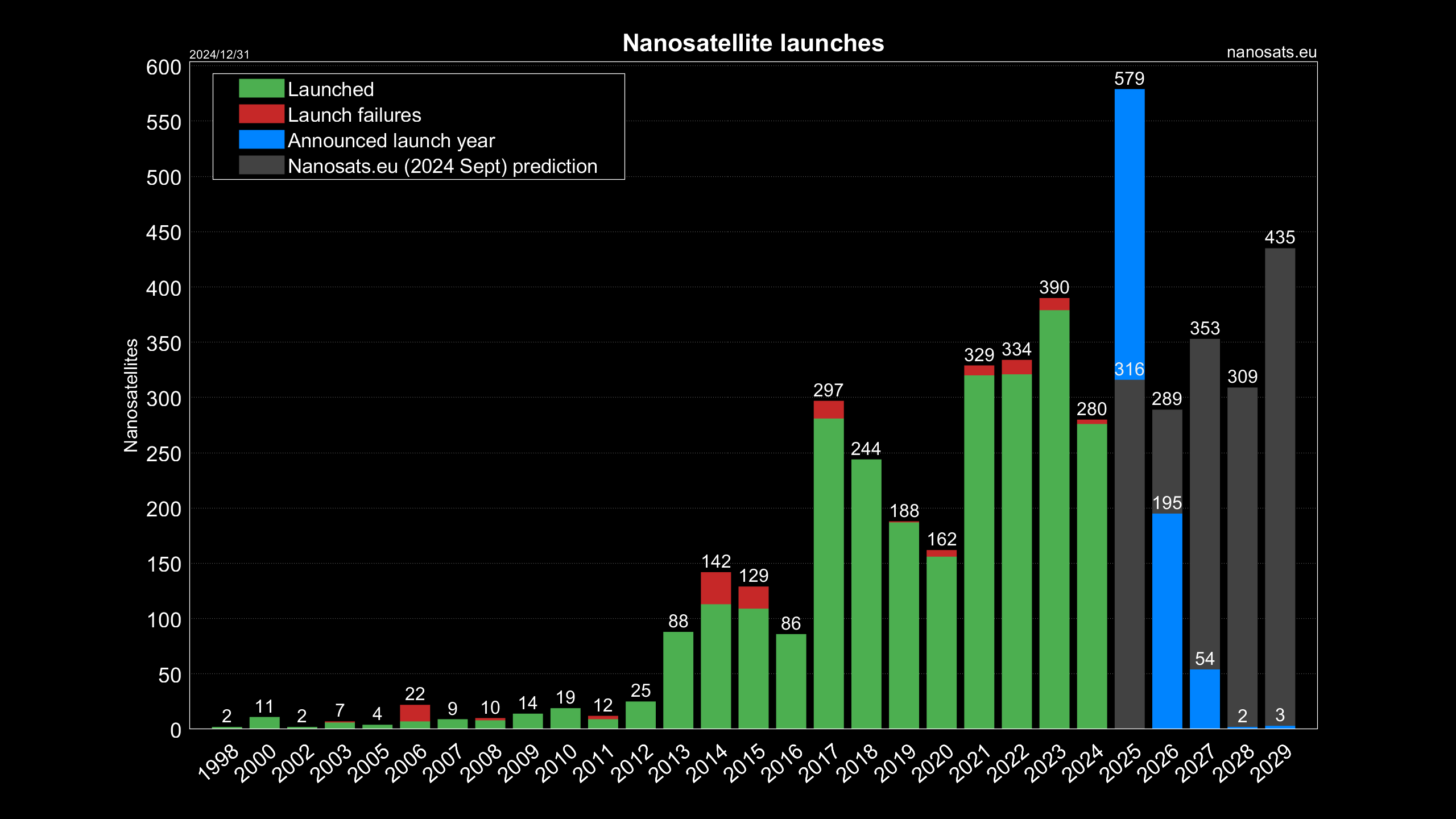
- https://www.nanosats.eu/.
- https://www.nanosats.eu/img/fig/Nanosats_years_black_2024-12-31_large.png.
- https://www.spacex.com/rideshare/.
- https://www.rocketlabusa.com/launch/electron/.
- V. Tatischeff, P. Ubertini, T. Mizuno, and L. Natalucci, Orbits and background of gamma-ray space instruments, 10.1007/978-981-16-4544-0_47-1 (2022).
- J. Řípa, G. Dilillo, R. Campana, and G. Galgóczi, A comparison of trapped particle models in low earth orbit, in Space Telescopes and Instrumentation 2020: Ultraviolet to Gamma Ray (SPIE, 2020), Vol. 11444, pp. 597–606.
- https://www.eoportal.org/satellite-missions/integral#eop-quick-facts-section