Recent Articles

Signatures of Majorana fermions in an elliptical quantum ring

Areg Ghazaryan, Aram Manaselyan, and Tapash Chakraborty

Phys. Rev. B 93, 245108 (2016) - Published 3 June, 2016

Hole spins in an InAs/GaAs quantum dot molecule subject to lateral electric fields

Xiangyu Ma, Garnett W. Bryant, and Matthew F. Doty

Phys. Rev. B 93, 245402 (2016) - Published 3 June, 2016

Local temperature of an interacting quantum system far from equilibrium

Charles A. Stafford

Phys. Rev. B 93, 245403 (2016) - Published 3 June, 2016

Interpretation of unexpected behavior of infrared absorption spectra of ScF3 beyond the quasiharmonic approximation

Sergei Piskunov, Pjotrs A. Žguns, Dmitry Bocharov, Alexei Kuzmin, Juris Purans, Aleksandr Kalinko, Robert A. Evarestov, Shehab E. Ali, and Francesco Rocca

Phys. Rev. B 93, 214101 (2016) - Published 2 June, 2016

Quantum model for entropic springs

Chiao-Hsuan Wang and Jacob M. Taylor

Phys. Rev. B 93, 214102 (2016) - Published 2 June, 2016

Magnetic transitions in the topological magnon insulator Cu(1,3-bdc)

R. Chisnell, J. S. Helton, D. E. Freedman, D. K. Singh, F. Demmel, C. Stock, D. G. Nocera, and Y. S. Lee

Phys. Rev. B 93, 214403 (2016) - Published 2 June, 2016

Applicability of effective medium description to photonic crystals in higher bands: Theory and numerical analysis

Vadim A. Markel and Igor Tsukerman

Phys. Rev. B 93, 224202 (2016) - Published 2 June, 2016

Magnetic dipoles at topological defects in the Meissner state of a nanostructured superconductor

Jun-Yi Ge, Vladimir N. Gladilin, Cun Xue, Jacques Tempere, Jozef T. Devreese, Joris Van de Vondel, Youhe Zhou, and Victor V. Moshchalkov

Phys. Rev. B 93, 224502 (2016) - Published 2 June, 2016

Electronic vortex structure of Fe-based superconductors: Application to LiFeAs

B. Mencia Uranga, Maria N. Gastiasoro, and Brian M. Andersen

Phys. Rev. B 93, 224503 (2016) - Published 2 June, 2016

The understanding of the microscopic origin of electron pairing in strongly correlated electron systems remains an ultimate goal in the field of unconventional superconductivity. Detailed tunneling spectroscopy of vortex core states can provide important insight to the momentum structure of the superconducting order parameter, which is closely related to the nature of the electron pairing. The authors performed a fully self-consistent real-space BdG study of vortex core states in five-orbital models relevant to Fe-based superconductors. The superconducting order was stabilized by spin fluctuation-derived pairing vertices generating an s±-wave gap structure. By application to LiFeAs, they find striking agreement with STS measurements by Hanaguri et al. on this compound. In particular, the details of the energy dependence and the spatial structure seems in almost quantitative agreement without any tuning parameters. From this fact they conclude that their model provides a reasonable description of LiFeAs, without the necessity to invoke more exotic paring states of this material.

Vortex crossing, trapping, and pinning in superconducting nanowires of a NbSe2 two-dimensional crystal

Shaun A. Mills, Jacob J. Wisser, Chenyi Shen, Zhuan Xu, and Ying Liu

Phys. Rev. B 93, 224504 (2016) - Published 2 June, 2016

Nonequilibrium self-energy functional approach to the dynamical Mott transition

Felix Hofmann, Martin Eckstein, and Michael Potthoff

Phys. Rev. B 93, 235104 (2016) - Published 2 June, 2016

Stability of a spin-triplet nematic state near to a quantum critical point

G. Hannappel, C. J. Pedder, F. Krüger, and A. G. Green

Phys. Rev. B 93, 235105 (2016) - Published 2 June, 2016

Multiple negative differential conductance regions and inelastic phonon assisted tunneling in graphene/h−BN/graphene structures

B. Amorim, R. M. Ribeiro, and N. M. R. Peres

Phys. Rev. B 93, 235403 (2016) - Published 2 June, 2016

Effective gating and tunable magnetic proximity effects in two-dimensional heterostructures

Predrag Lazić, K. D. Belashchenko, and Igor Žutić

Phys. Rev. B 93, 241401(R) (2016) - Published 2 June, 2016

Non-stripe charge order in dimerized organic conductors

Takehiko Mori

Phys. Rev. B 93, 245104 (2016) - Published 2 June, 2016

Modeling the angle-dependent magnetoresistance oscillations of Fermi surfaces with hexagonal symmetry

Joseph C. A. Prentice and Amalia I. Coldea

Phys. Rev. B 93, 245105 (2016) - Published 2 June, 2016

Adiabatic perturbation theory of electronic stopping in insulators

Andrew P. Horsfield, Anthony Lim, W. M. C. Foulkes, and Alfredo A. Correa

Phys. Rev. B 93, 245106 (2016) - Published 2 June, 2016

Excitation energy transfer from long-persistent phosphors for enhancing power conversion of dye-sensitized solar cells

Ajinkya Puntambekar and Vidhya Chakrapani

Phys. Rev. B 93, 245301 (2016) - Published 2 June, 2016

Magnetoelectric and structural properties of Y2CoMnO6: The role of antisite defects

J. Blasco, J. García, G. Subías, J. Stankiewicz, J. A. Rodríguez-Velamazán, C. Ritter, J. L. García-Muñoz, and F. Fauth

Phys. Rev. B 93, 214401 (2016) - Published 1 June, 2016

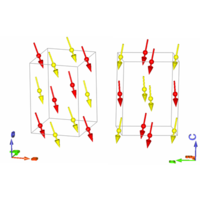
The finding of new multiferroic materials, where electric and magnetic orders coexist, is a challenging task currently. The double perovskite Y2CoMnO6 shows spontaneous magnetization and electrical polarization at low temperature. Previous investigations of this compound did not reach agreement about the type of magnetic structure present. This study demonstrates that this compound exhibits a collinear ferromagnetic ordering of Co2+ and Mn4+ moments in the ac plane with a small antiferromagnetic canting along the b axis. A thorough characterization of the dielectric properties reveals the absence of any related anomaly in the dielectric permittivity and the lack of spontaneous electrical polarization (P) in the P(E, electric field) loops. The pyroelectric current is strongly dependent on the number of antisite defects in the Co/Mn arrangement, the heating rate, and the poling field. Thus, the observed electric polarization is due to thermally stimulated depolarization currents ascribed to defect dipoles mainly placed at the antiphase boundaries. No ferroelectric transition occurs in this material, disproving the existence of intrinsic magnetoelectric multiferroicity.

One-dimensional frustrated plaquette compass model: Nematic phase and spontaneous multimerization

Wojciech Brzezicki and Andrzej M. Oleś

Phys. Rev. B 93, 214402 (2016) - Published 1 June, 2016

Sign In to Your Journals Account

Filter

Recent Issues

Vol. 114, Iss. 30
15 November 2026
Vol. 114, Iss. 29
15 November 2026
Vol. 114, Iss. 28
15 November 2026
Vol. 114, Iss. 27
1 November 2026
Category
Article Type
Section

Filter

Article Lookup

Enter a citation