Recent Articles

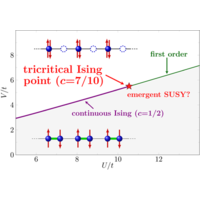
Ising tricriticality in the extended Hubbard model with bond dimerization

Satoshi Ejima, Fabian H. L. Essler, Florian Lange, and Holger Fehske

Phys. Rev. B 93, 235118 (2016) - Published 10 June, 2016

The tricritical Ising universality class emerges at the end point of a line of continuous Ising phase transitions, above which the transition is first order. In 1+1 dimensions, it is described by the second minimal model of conformal field theory (CFT) with central charge c=7/10. Recently, there has been a revival of interest in the tricritical Ising model due to its emergent space-time supersymmetry. Combining numerical (infinite density-matrix renormalization group) and field theoretical (bosonization and CFT) techniques, there authors demonstrate here that Ising tricriticality occurs in a paradigmatic extended one dimensional Hubbard model with explicit bond dimerization. The low-energy sector can be described by a triple sine-Gordon model, which, in the transition region, reduces to the tricritical Ising CFT. The theoretically predicted decay of various two-point correlation functions is found to be in excellent agreement with the density-matrix renormalization group data.

Dislocations in stacking and commensurate-incommensurate phase transition in bilayer graphene and hexagonal boron nitride

Irina V. Lebedeva, Alexander V. Lebedev, Andrey M. Popov, and Andrey A. Knizhnik

Phys. Rev. B 93, 235414 (2016) - Published 10 June, 2016

In situ hard x-ray photoemission spectroscopy of barrier-height control at metal/PMN-PT interfaces

E. Kröger, A. Petraru, A. Quer, R. Soni, M. Kalläne, N. A. Pertsev, H. Kohlstedt, and K. Rossnagel

Phys. Rev. B 93, 235415 (2016) - Published 10 June, 2016

Ferroelectrics exhibit switchable spontaneous polarization, a functionality that can be harnessed in nonvolatile memory devices. The main characteristics of these devices are governed by the electronic band alignment at the interfaces, particularly at the metallic contacts. Here, the authors study such an interface using state-of-the-art high-energy x-ray photoelectron spectroscopy, with in situ polarization reversal achieved by applying poling voltage. They confirm a result central to the physics of ferroelectric devices: an electrode-dependent potential drop at the interface that is linear in the spontaneous polarization. They also reveal a novel effect: electric-field-dependent increase of the energy offset due to the field-induced strain in the ferroelectric material.

One-dimensional carbon nanostructures for terahertz electron-beam radiation

Khwanchai Tantiwanichapan, Anna K. Swan, and Roberto Paiella

Phys. Rev. B 93, 235416 (2016) - Published 10 June, 2016

Anisotropic softening of magnetic excitations in lightly electron-doped Sr2IrO4

X. Liu, M. P. M. Dean, Z. Y. Meng, M. H. Upton, T. Qi, T. Gog, Y. Cao, J. Q. Lin, D. Meyers, H. Ding, G. Cao, and J. P. Hill

Phys. Rev. B 93, 241102(R) (2016) - Published 10 June, 2016

Magnetic moments in a helical edge can make weak correlations seem strong

Jukka I. Väyrynen, Florian Geissler, and Leonid I. Glazman

Phys. Rev. B 93, 241301(R) (2016) - Published 10 June, 2016

Origin and distribution of charge carriers in LaAlO3−SrTiO3 oxide heterostructures in the high carrier density limit

Sumanta Mukherjee, Banabir Pal, Debraj Choudhury, Indranil Sarkar, Wolfgang Drube, Mihaela Gorgoi, Olof Karis, H. Takagi, Jobu Matsuno, and D. D. Sarma

Phys. Rev. B 93, 245124 (2016) - Published 10 June, 2016

Giant plasmon instability in a dual-grating-gate graphene field-effect transistor

Y. Koseki, V. Ryzhii, T. Otsuji, V. V. Popov, and A. Satou

Phys. Rev. B 93, 245408 (2016) - Published 10 June, 2016

Quantum theory of an electron waiting time clock

David Dasenbrook and Christian Flindt

Phys. Rev. B 93, 245409 (2016) - Published 10 June, 2016

Phonon-glass dynamics in thermoelectric clathrates

Yaping Liu, Qing Xi, Jun Zhou, Tsuneyoshi Nakayama, and Baowen Li

Phys. Rev. B 93, 214305 (2016) - Published 9 June, 2016

Ground-state candidate for the classical dipolar kagome Ising antiferromagnet

I. A. Chioar, N. Rougemaille, and B. Canals

Phys. Rev. B 93, 214410 (2016) - Published 9 June, 2016

Topological superconductivity in quantum Hall–superconductor hybrid systems

Björn Zocher and Bernd Rosenow

Phys. Rev. B 93, 214504 (2016) - Published 9 June, 2016

Read-Green resonances in a topological superconductor coupled to a bath

Pieter W. Claeys, Stijn De Baerdemacker, and Dimitri Van Neck

Phys. Rev. B 93, 220503(R) (2016) - Published 9 June, 2016

Strong impact of lattice vibrations on electronic and magnetic properties of paramagnetic Fe revealed by disordered local moments molecular dynamics

B. Alling, F. Körmann, B. Grabowski, A. Glensk, I. A. Abrikosov, and J. Neugebauer

Phys. Rev. B 93, 224411 (2016) - Published 9 June, 2016

Superradiance in spherical layered nanostructures

S. V. Goupalov

Phys. Rev. B 93, 235302 (2016) - Published 9 June, 2016

Photoluminescence upconversion at GaAs/InGaP2 interfaces driven by a sequential two-photon absorption mechanism

N. P. Hylton, T. F. Hinrichsen, A. R. Vaquero-Stainer, M. Yoshida, A. Pusch, M. Hopkinson, O. Hess, C. C. Phillips, and N. J. Ekins-Daukes

Phys. Rev. B 93, 235303 (2016) - Published 9 June, 2016

Optimal geometry of lateral GaAs and Si/SiGe quantum dots for electrical control of spin qubits

Ognjen Malkoc, Peter Stano, and Daniel Loss

Phys. Rev. B 93, 235413 (2016) - Published 9 June, 2016

Evidencing the need for high spatial resolution in angle-resolved photoemission experiments

Frédéric Joucken, Nicolas Reckinger, Stéphane Lorcy, José Avila, Chaoyu Chen, Jérôme Lagoute, Jean-François Colomer, Jacques Ghijsen, Maria Carmen Asensio, and Robert Sporken

Phys. Rev. B 93, 241101(R) (2016) - Published 9 June, 2016

Angle-resolved photoemission spectroscopy (ARPES) provides direct access to the electronic band structure of materials. Very recently, the spatial resolution of ARPES setups has dramatically increased, with a spot size at the sample shrinking from 50×50 μm2, typical of most synchrotron-based setups, down to 100×100 nm2 or less. In this work, the authors demonstrate the impact of increased spatial resolution by evidencing faint spatial inhomogeneity in the ARPES signal of a graphene sample that would go undetected in ARPES setups possessing lower spatial resolution.

Surface plasmon polaritons in topological Weyl semimetals

Johannes Hofmann and Sankar Das Sarma

Phys. Rev. B 93, 241402(R) (2016) - Published 9 June, 2016

Energy gaps of atomically precise armchair graphene sidewall nanoribbons

Wen-Xiao Wang, Mei Zhou, Xinqi Li, Si-Yu Li, Xiaosong Wu, Wenhui Duan, and Lin He

Phys. Rev. B 93, 241403(R) (2016) - Published 9 June, 2016
Sign In to Your Journals Account

Filter

Recent Issues

Vol. 114, Iss. 30
15 November 2026
Vol. 114, Iss. 29
15 November 2026
Vol. 114, Iss. 28
15 November 2026
Vol. 114, Iss. 27
1 November 2026
Category
Article Type
Section

Filter

Article Lookup

Enter a citation