Recent Articles

Itinerant G-type antiferromagnetism in D03-type V3Z (Z=Al, Ga, In) compounds: A first-principles study

Iosif Galanakis, Şaban Tırpancı, Kemal Özdoğan, and Ersoy Şaşıoğlu

Phys. Rev. B 94, 064401 (2016) - Published 1 August, 2016

Antiferromagnet-induced perpendicular magnetic anisotropy in ferromagnetic/antiferromagnetic/ferromagnetic trilayers

Bo-Yao Wang, Po-Han Lin, Ming-Shian Tsai, Chun-Wei Shih, Meng-Ju Lee, Chun-Wei Huang, Nae-Yeou Jih, and Der-Hsin Wei

Phys. Rev. B 94, 064402 (2016) - Published 1 August, 2016

Magnetic anisotropy in the frustrated spin-chain compound β−TeVO4

F. Weickert, N. Harrison, B. L. Scott, M. Jaime, A. Leitmäe, I. Heinmaa, R. Stern, O. Janson, H. Berger, H. Rosner, and A. A. Tsirlin

Phys. Rev. B 94, 064403 (2016) - Published 1 August, 2016

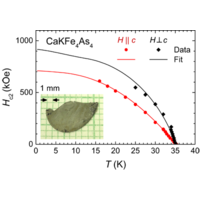
Anisotropic thermodynamic and transport properties of single-crystalline CaKFe4As4

W. R. Meier, T. Kong, U. S. Kaluarachchi, V. Taufour, N. H. Jo, G. Drachuck, A. E. Böhmer, S. M. Saunders, A. Sapkota, A. Kreyssig, M. A. Tanatar, R. Prozorov, A. I. Goldman, Fedor F. Balakirev, Alex Gurevich, S. L. Bud'ko, and P. C. Canfield

Phys. Rev. B 94, 064501 (2016) - Published 1 August, 2016

Since 2008, iron-based superconductors have been the focus of intense research. Unfortunately, the higher transition temperatures and most promising high-magnetic field properties have been associated with compounds that have to be chemically disordered, making it hard to fully understand their intrinsic properties. A fully ordered compound with near optimal properties would be ideal and CaKFe4As4 appears to be that compound. In this work, the authors present detailed anisotropic, structural, thermodynamic, and transport measurements that, in addition to revealing high upper critical fields, also provide the basis for further understanding of this fully ordered, high-Tc, iron-based superconductor. It is shown that CaKFe4As4 has exceptionally large upper critical fields (in excess of 650 kOe and possibly as high as 900 kOe) as well as high Tc values (35 K), which can be obtained and studied without any disorder-related effects obscuring or complicating the results.

Emergent particle-hole symmetry in the half-filled Landau level

Michael Mulligan, S. Raghu, and Matthew P. A. Fisher

Phys. Rev. B 94, 075101 (2016) - Published 1 August, 2016

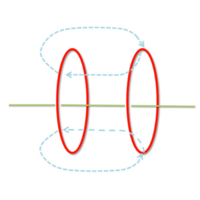
Here, the authors investigate the possibility that particle-hole symmetry in the lowest Landau level at half filling arises as an emergent low-energy symmetry. Specifically, they start with the traditional approach to the half-filled Landau level: an effective field theory known as the composite Fermi liquid pioneered by Halperin, Lee, and Read. In this theory, composite fermions arise when flux is attached to electrons in a half-filled Landau level. However, an equivalent starting point is one where one starts with a filled Landau level, depletes electrons (or equivalently, adds holes) to the point of half filling. One then attaches flux to the holes, and the resulting composite hole description is another viable description of the half-filled Landau level. The authors construct a particle-hole symmetric theory by studying a system consisting of alternating quasi-one-dimensional strips of composite Fermi liquid (CFL) and composite hole liquid (CHL), both of which break particle-hole symmetry. Gauge invariance requires the existence of gapless edge modes at the interface between the CFL and CHL. Out of these modes, they construct a neutral Dirac fermion coupled to an emergent U(1) gauge field. Thus, at distances long compared to the strip width, they demonstrate that the system is described by a Dirac fermion coupled to an emergent gauge field, with an anti-unitary particle-hole symmetry, precisely the form conjectured recently by Son to be the low-energy description of a particle-hole symmetric half-filled Landau level.

Breakdown of the Kondo insulating state in SmB6 by introducing Sm vacancies

Michael E. Valentine, Seyed Koohpayeh, W. Adam Phelan, Tyrel M. McQueen, Priscila F. S. Rosa, Zachary Fisk, and Natalia Drichko

Phys. Rev. B 94, 075102 (2016) - Published 1 August, 2016

Topological phases of two-component bosons in species-dependent artificial gauge potentials

Ying-Hai Wu and Tao Shi

Phys. Rev. B 94, 075103 (2016) - Published 1 August, 2016

Magnon Dirac materials

J. Fransson, A. M. Black-Schaffer, and A. V. Balatsky

Phys. Rev. B 94, 075401 (2016) - Published 1 August, 2016

Interplay between resonant tunneling and spin precession oscillations in all-electric all-semiconductor spin transistors

M. I. Alomar, Llorenç Serra, and David Sánchez

Phys. Rev. B 94, 075402 (2016) - Published 1 August, 2016

Analog of microwave-induced resistance oscillations induced in GaAs heterostructures by terahertz radiation

T. Herrmann, I. A. Dmitriev, D. A. Kozlov, M. Schneider, B. Jentzsch, Z. D. Kvon, P. Olbrich, V. V. Bel'kov, A. Bayer, D. Schuh, D. Bougeard, T. Kuczmik, M. Oltscher, D. Weiss, and S. D. Ganichev

Phys. Rev. B 94, 081301(R) (2016) - Published 1 August, 2016

Free-standing electronic character of monolayer MoS2 in van der Waals epitaxy

HoKwon Kim (김호권), Dumitru Dumcenco, Mathieu Frégnaux, Anass Benayad, Ming-Wei Chen, Yen-Cheng Kung, Andras Kis, and Olivier Renault

Phys. Rev. B 94, 081401(R) (2016) - Published 1 August, 2016

Nano-optical imaging of WSe2 waveguide modes revealing light-exciton interactions

Z. Fei, M. E. Scott, D. J. Gosztola, J. J. Foley, IV, J. Yan, D. G. Mandrus, H. Wen, P. Zhou, D. W. Zhang, Y. Sun, J. R. Guest, S. K. Gray, W. Bao, G. P. Wiederrecht, and X. Xu

Phys. Rev. B 94, 081402(R) (2016) - Published 1 August, 2016

The authors perform near-field nanoimaging of various waveguide modes inside thin flakes of WSe2 by using state-of-the-art near-field scanning optical microscopy. This compound is a prototypical transition metal dichalcogenide with strongly bound excitons. The nanoimaging data provides direct evidence of strong coupling between waveguide photon modes and excitons. Such coupling generates hybrid polaritonic modes that are imaged for the first time as propagative modes in real space. This work uncovers in real space the physics of nanoscale light-matter interactions in van der Waals semiconductors and thus provides guidelines for future applications of this class of materials in nanophotonics and optoelectronics.

Tensor network quotient takes the vacuum to the thermal state

Bartłomiej Czech, Glen Evenbly, Lampros Lamprou, Samuel McCandlish, Xiao-liang Qi, James Sully, and Guifré Vidal

Phys. Rev. B 94, 085101 (2016) - Published 1 August, 2016

Response properties of axion insulators and Weyl semimetals driven by screw dislocations and dynamical axion strings

Yizhi You, Gil Young Cho, and Taylor L. Hughes

Phys. Rev. B 94, 085102 (2016) - Published 1 August, 2016

The authors here explore the properties of Weyl semimetals and axion insulators coupled to geometry. The novel interplay between axion strings and lattice dislocation defects are studied through both effective field theory and microscopic arguments. Various new phenomena are proposed for a Weyl semimetal with dislocations. This work should be of great interest both in the context of topological semimetal/insulators and for the problem of topological defects in strongly correlated systems.

Nongeneric dispersion of excitons in the bulk of WSe2

R. Schuster, Y. Wan, M. Knupfer, and B. Büchner

Phys. Rev. B 94, 085201 (2016) - Published 1 August, 2016

Uniaxial strain-induced Kohn anomaly and electron-phonon coupling in acoustic phonons of graphene

M. E. Cifuentes-Quintal, O. de la Peña-Seaman, R. Heid, R. de Coss, and K.-P. Bohnen

Phys. Rev. B 94, 085401 (2016) - Published 1 August, 2016

Strain engineering in graphene is of high current interest because of the possibility to induce new physical phenomena by means of mechanical strain. The authors of this work study the effect of strain on the electron-phonon interaction that plays an important role in the vibrational, thermal, and transport properties of graphene. It has been commonly assumed that Kohn anomalies and electron-phonon coupling in strained graphene occur only for the longitudinal and transverse optical phonons, as in pristine graphene. In contrast, this study shows that uniaxial strain in graphene induces a Kohn anomaly and enhancement of the electron-phonon coupling in the longitudinal acoustic phonon branch. This feature is a major difference between pristine and uniaxially strained graphene, due to the presence of a new intervalley phonon-scattering channel for electronic states close to the Dirac point.

Vacancy-mediated fcc/bcc phase separation in Fe1−xNix ultrathin films

T. O. Menteş, N. Stojić, E. Vescovo, J. M. Ablett, M. A. Niño, and A. Locatelli

Phys. Rev. B 94, 085402 (2016) - Published 1 August, 2016

Multiple strain-induced phase transitions in LaNiO3 thin films

M. C. Weber, M. Guennou, N. Dix, D. Pesquera, F. Sánchez, G. Herranz, J. Fontcuberta, L. López-Conesa, S. Estradé, F. Peiró, Jorge Iñiguez, and J. Kreisel

Phys. Rev. B 94, 014118 (2016) - Published 29 July, 2016

Optical find of hypersonic surface acoustic waves in bulk transparent materials

Rafael J. Jiménez Riobóo, Alberto Sánchez-Sánchez, and Carlos Prieto

Phys. Rev. B 94, 014313 (2016) - Published 29 July, 2016

Crystal-field states of Kondo lattice heavy fermions CeRuSn3 and CeRhSn3

V. K. Anand, D. T. Adroja, D. Britz, A. M. Strydom, J. W. Taylor, and W. Kockelmann

Phys. Rev. B 94, 014440 (2016) - Published 29 July, 2016
Sign In to Your Journals Account

Filter

Recent Issues

Vol. 114, Iss. 30
15 November 2026
Vol. 114, Iss. 29
15 November 2026
Vol. 114, Iss. 28
15 November 2026
Vol. 114, Iss. 27
1 November 2026
Category
Article Type
Section

Filter

Article Lookup

Enter a citation