Recent Articles

Ultrafast shift and rectification photocurrents in GaAs quantum wells: Excitation intensity dependence and the importance of band mixing

Huynh Thanh Duc, Reinold Podzimski, Shekhar Priyadarshi, Mark Bieler, and Torsten Meier

Phys. Rev. B 94, 085305 (2016) - Published 11 August, 2016

Hidden quantum mirage by negative refraction in semiconductor P-N junctions

Shu-Hui Zhang, Jia-Ji Zhu, Wen Yang, Hai-Qing Lin, and Kai Chang

Phys. Rev. B 94, 085408 (2016) - Published 11 August, 2016

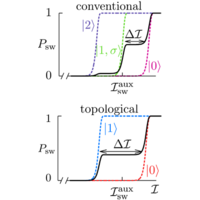
Signatures of topological Josephson junctions

Yang Peng, Falko Pientka, Erez Berg, Yuval Oreg, and Felix von Oppen

Phys. Rev. B 94, 085409 (2016) - Published 11 August, 2016

The fractional Josephson effect is of the most striking phenomena heralding topological superconductivity and Majorana bound states. In contrast to the conventional Josephson current that is 2π-periodic in the applied phase difference, the periodicity is 4π in the junctions connecting topological superconductors. Unfortunately, this effect can be easily masked in experiments due to the quasiparticle poisoning processes resulting from inelastic transitions between the localized subgap states of the junction and delocalized states in the quasiparticle continuum. The authors propose a simple and feasible solution to this problem by embedding the topological Josephson junction in a SQUID setup. They show that signatures of the topological junction can be found in the switching probability of the supercurrent through the SQUID, even in the presence of quasiparticle poisoning processes.

Carbon-rich icosahedral boron carbides beyond B4C and their thermodynamic stabilities at high temperature and pressure from first principles

A. Ektarawong, S. I. Simak, and B. Alling

Phys. Rev. B 94, 054104 (2016) - Published 10 August, 2016

Dislocations via incompatibilities in phase-field models of microstructure evolution

R. Gröger, B. Marchand, and T. Lookman

Phys. Rev. B 94, 054105 (2016) - Published 10 August, 2016

Off-easy-plane antiferromagnetic spin canting in coupled FePt/NiO bilayer structure with perpendicular exchange bias

Tenghua Gao, Nobuhide Itokawa, Jian Wang, Youxing Yu, Takashi Harumoto, Yoshio Nakamura, and Ji Shi

Phys. Rev. B 94, 054412 (2016) - Published 10 August, 2016

Competing effects of Mn and Y doping on the low-energy excitations and phase diagram of La1−yYyFe1−xMnxAsO0.89F0.11 iron-based superconductors

M. Moroni, S. Sanna, G. Lamura, T. Shiroka, R. De Renzi, R. Kappenberger, M. A. Afrassa, S. Wurmehl, A. U. B. Wolter, B. Büchner, and P. Carretta

Phys. Rev. B 94, 054508 (2016) - Published 10 August, 2016

Dendritic flux instabilities in YBa2Cu3O7−x films: Effects of temperature and magnetic field ramp rate

E. Baruch-El, M. Baziljevich, B. Ya. Shapiro, T. H. Johansen, A. Shaulov, and Y. Yeshurun

Phys. Rev. B 94, 054509 (2016) - Published 10 August, 2016

Multiscale approach to modeling intrinsic dissipation in solids

K. Kunal and N. R. Aluru

Phys. Rev. B 94, 064103 (2016) - Published 10 August, 2016

Phase stability and magnetic behavior of hexagonal phase of N2−O2 system with kagome lattice under high pressure and low temperature

Y. Akahama, D. Ishihara, H. Yamashita, H. Fujihisa, N. Hirao, and Y. Ohishi

Phys. Rev. B 94, 064104 (2016) - Published 10 August, 2016

Two types of all-optical magnetization switching mechanisms using femtosecond laser pulses

M. S. El Hadri, P. Pirro, C.-H. Lambert, S. Petit-Watelot, Y. Quessab, M. Hehn, F. Montaigne, G. Malinowski, and S. Mangin

Phys. Rev. B 94, 064412 (2016) - Published 10 August, 2016

Band structure and electron-phonon coupling in H3S: A tight-binding model

L. Ortenzi, E. Cappelluti, and L. Pietronero

Phys. Rev. B 94, 064507 (2016) - Published 10 August, 2016

Leggett modes and multiband superconductivity in Sr2RuO4

Wen Huang, Thomas Scaffidi, Manfred Sigrist, and Catherine Kallin

Phys. Rev. B 94, 064508 (2016) - Published 10 August, 2016

Coupling erbium spins to a three-dimensional superconducting cavity at zero magnetic field

Yu-Hui Chen, Xavier Fernandez-Gonzalvo, and Jevon J. Longdell

Phys. Rev. B 94, 075117 (2016) - Published 10 August, 2016

Efficient simulations with electronic open boundaries

Andrew P. Horsfield, Max Boleininger, Roberto D'Agosta, Vyas Iyer, Aaron Thong, Tchavdar N. Todorov, and Catherine White

Phys. Rev. B 94, 075118 (2016) - Published 10 August, 2016

Magnetic properties and pairing tendencies of the iron-based superconducting ladder BaFe2S3: Combined ab initio and density matrix renormalization group study

Niravkumar D. Patel, Alberto Nocera, Gonzalo Alvarez, Ryotaro Arita, Adriana Moreo, and Elbio Dagotto

Phys. Rev. B 94, 075119 (2016) - Published 10 August, 2016

Properties of carbon impurities in ZnO: A hybrid functional study

Ping Li and Weidong Luo

Phys. Rev. B 94, 075202 (2016) - Published 10 August, 2016

Ternary semiconductors NiZrSn and CoZrBi with half-Heusler structure: A first-principles study

Gregor Fiedler and Peter Kratzer

Phys. Rev. B 94, 075203 (2016) - Published 10 August, 2016

Graphene transverse electric surface plasmon detection using nonreciprocity modal discrimination

Nima Chamanara and Christophe Caloz

Phys. Rev. B 94, 075413 (2016) - Published 10 August, 2016

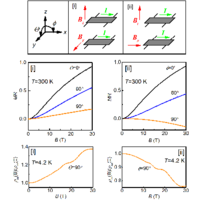
Anisotropic and strong negative magnetoresistance in the three-dimensional topological insulator Bi2Se3

S. Wiedmann, A. Jost, B. Fauqué, J. van Dijk, M. J. Meijer, T. Khouri, S. Pezzini, S. Grauer, S. Schreyeck, C. Brüne, H. Buhmann, L. W. Molenkamp, and N. E. Hussey

Phys. Rev. B 94, 081302(R) (2016) - Published 10 August, 2016

Magnetoresistance studies are one of the simplest yet powerful tools to investigate the electronic properties of solids. The authors here report on high-field angle-dependent magnetotransport measurements on epitaxial thin films of Bi2Se3, a three-dimensional topological insulator. At low temperature, they observe quantum oscillations that demonstrate the simultaneous presence of bulk and surface carriers. Their key observation is a strong anisotropy in the magnetoresistance in Bi2Se3 that depends on the orientation of the applied current (electric field) with respect to the applied magnetic field. When the magnetic field is applied parallel to the electric field, they find a strong negative longitudinal magnetoresistance (NLMR) that, quite strikingly, persists even up to room temperature. With this finding, the authors demonstrate that the observation of a NLMR is not unique to topological semimetals, such as Weyl semimetals, and therefore cannot by itself be taken as a diagnostic tool and as conclusive evidence for the existence of Weyl fermions. These results could pave the way towards a general understanding of the emergence of the axial anomaly that is suggested to be a universal phenomenon for generic three-dimensional metals in the presence of parallel electric and magnetic fields.

Sign In to Your Journals Account

Filter

Recent Issues

Vol. 114, Iss. 30
15 November 2026
Vol. 114, Iss. 29
15 November 2026
Vol. 114, Iss. 28
15 November 2026
Vol. 114, Iss. 27
1 November 2026
Category
Article Type
Section

Filter

Article Lookup

Enter a citation