Recent Articles

Attractive critical point from weak antilocalization on fractals

Doru Sticlet and Anton Akhmerov

Phys. Rev. B 94, 161115(R) (2016) - Published 13 October, 2016

Spin-induced anomalous magnetoresistance at the (100) surface of hydrogen-terminated diamond

Yamaguchi Takahide, Yosuke Sasama, Masashi Tanaka, Hiroyuki Takeya, Yoshihiko Takano, Taisuke Kageura, and Hiroshi Kawarada

Phys. Rev. B 94, 161301(R) (2016) - Published 13 October, 2016

Resonant inelastic x-ray scattering as a probe of band structure effects in cuprates

M. Kanász-Nagy, Y. Shi, I. Klich, and E. A. Demler

Phys. Rev. B 94, 165127 (2016) - Published 13 October, 2016

Interacting composite fermions: Nature of the 4/5, 5/7, 6/7, and 6/17 fractional quantum Hall states

Ajit C. Balram

Phys. Rev. B 94, 165303 (2016) - Published 13 October, 2016

Coupling of three-spin qubits to their electric environment

Maximilian Russ, Florian Ginzel, and Guido Burkard

Phys. Rev. B 94, 165411 (2016) - Published 13 October, 2016

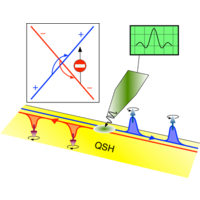
Photoexcitation of electron wave packets in quantum spin Hall edge states: Effects of chiral anomaly from a localized electric pulse

Fabrizio Dolcini, Rita Claudia Iotti, Arianna Montorsi, and Fausto Rossi

Phys. Rev. B 94, 165412 (2016) - Published 13 October, 2016

In the helical edge states of a quantum spin Hall (QSH) bar, the phenomenon of electron photoexcitation is quite different from systems commonly used in optoelectronics. The vertical electric dipole transitions typically occurring between valence and conduction bands of conventional semiconductor-based devices are forbidden in QSH edge states due to a selection rule. Also, electrons in QSH edge states are described by a massless Dirac fermion theory rather than the conventional Schrödinger-like parabolic band, so their response to an electromagnetic field is intrinsically affected by a peculiar effect known as the chiral anomaly. Here, the authors analyze this problem in the mesoscopic regime. They show that, when a spatially localized electric pulse is applied at the edge of a QSH system, helical electron wave packets can be photoexcited by purely intrabranch electrical transitions, without invoking the magnetic Zeeman coupling or transitions to bulk states. At the end of the pulse, the wave packets counter propagate with opposite spin orientations, keeping their space profile unaltered. Notably, the authors find that the space profile of the photoexcited electron wave packets is independent of the temperature and chemical potential of the initial equilibrium state. Instead, the profile depends purely on the applied electric pulse, in a linear manner, as a signature of the chiral anomaly. Then authors discuss how the wave packet profile can be tailored by the electric pulse parameters, for both low and finite frequencies.

Atomistic migration mechanisms of atomically flat, stepped, and kinked grain boundaries

R. Hadian, B. Grabowski, C. P. Race, and J. Neugebauer

Phys. Rev. B 94, 165413 (2016) - Published 13 October, 2016

Transport and localization in a topological phononic lattice with correlated disorder

Zhun-Yong Ong and Ching Hua Lee

Phys. Rev. B 94, 134203 (2016) - Published 12 October, 2016

Entanglement entropy in a periodically driven quantum Ising ring

Tony J. G. Apollaro, G. Massimo Palma, and Jamir Marino

Phys. Rev. B 94, 134304 (2016) - Published 12 October, 2016

Employing soft x-ray resonant magnetic scattering to study domain sizes and anisotropy in Co/Pd multilayers

Kai Bagschik, Robert Frömter, Judith Bach, Björn Beyersdorff, Leonard Müller, Stefan Schleitzer, Magnus Hårdensson Berntsen, Christian Weier, Roman Adam, Jens Viefhaus, Claus Michael Schneider, Gerhard Grübel, and Hans Peter Oepen

Phys. Rev. B 94, 134413 (2016) - Published 12 October, 2016

Relation between the structural phase transition and superconductivity in CuxIrTe2−ySey

M. Kamitani, H. Sakai, Y. Tokura, and S. Ishiwata

Phys. Rev. B 94, 134507 (2016) - Published 12 October, 2016

Drude weight in hard-core boson systems: Possibility of a finite-temperature ideal conductor

Gourab Majumder and Arti Garg

Phys. Rev. B 94, 134508 (2016) - Published 12 October, 2016

Robustness of superconductivity to competing magnetic phases in tetragonal FeS

Franziska K. K. Kirschner, Franz Lang, Craig V. Topping, Peter J. Baker, Francis L. Pratt, Sophie E. Wright, Daniel N. Woodruff, Simon J. Clarke, and Stephen J. Blundell

Phys. Rev. B 94, 134509 (2016) - Published 12 October, 2016

Persistent magnetism in silver-doped BaFe2As2 crystals

Li Li, Huibo Cao, David S. Parker, Stephen J. Kuhn, and Athena S. Sefat

Phys. Rev. B 94, 134510 (2016) - Published 12 October, 2016

Determining the spin-orbit coupling via spin-polarized spectroscopy of magnetic impurities

V. Kaladzhyan, P. Simon, and C. Bena

Phys. Rev. B 94, 134511 (2016) - Published 12 October, 2016

The well known spin-orbit coupling is a peculiar type of interaction that links the direction of electron motion to its intrinsic magnetic moment, called spin. The role of the spin orbit is believed to be particularly important in giving rise to exotic states of matter, such as topological insulators and topological superconductors, that could host, for example, Majorana fermions. Despite several methods of measuring the spin-orbit constant having already been developed, given the rapid progress in the discovery and possible applications of new materials with strong spin-orbit coupling, it is important to provide experimentalists with novel and general approaches to unequivocally measure the value of this coupling. Here, the authors show theoretically that the spin-orbit coupling in two-dimensional and one-dimensional systems, both superconducting and metallic, can be read off directly and unambiguously via spin-resolved scanning tunneling microscopy (STM). The authors analyze the Friedel oscillations in the local density of state occurring due to scattering by localized magnetic impurities. In particular, they focus on the Fourier transform (FT) of the Friedel oscillations and note that the FT features observed in non-spin-polarized measurements split when using spin-polarized STM, and the splitting is exactly equal to twice the inverse spin-orbit length. Moreover, the superconducting systems exhibit extra high-intensity FT features with respect to the metallic systems, at a wavevector given by twice the inverse spin-orbit length. Such features provide a direct measure of the spin-orbit coupling in these materials.

Unveiling the scattering behavior of small spheres

Dimitrios C. Tzarouchis, Pasi Ylä-Oijala, and Ari Sihvola

Phys. Rev. B 94, 140301(R) (2016) - Published 12 October, 2016

Magnetic-field-induced topological reorganization of a p-wave superconductor

Maria Teresa Mercaldo, Mario Cuoco, and Panagiotis Kotetes

Phys. Rev. B 94, 140503(R) (2016) - Published 12 October, 2016

Fractional magnetization plateaus of the spin-12 Heisenberg orthogonal-dimer chain: Strong-coupling approach developed from the exactly solved Ising-Heisenberg model

Taras Verkholyak and Jozef Strečka

Phys. Rev. B 94, 144410 (2016) - Published 12 October, 2016

Polarization memory in the nonpolar magnetic ground state of multiferroic CuFeO2

J. Beilsten-Edmands, S. J. Magorrian, F. R. Foronda, D. Prabhakaran, P. G. Radaelli, and R. D. Johnson

Phys. Rev. B 94, 144411 (2016) - Published 12 October, 2016

Type-II multiferroics –- materials where magnetic order induces ferroelectricty -– offer great potential for novel electronic devices due to the strong intrinsic coupling between order parameters. Such coupling is found in CuFeO2, where ferroelectricity is driven by proper-screw “helical” magnetic ordering for applied magnetic fields between 7.5 and 13 T at low temperatures. Here, the authors report a polarization memory effect in CuFeO2, whereby the nonpolar antiferromagnetic ground state retains a strong memory of the high-magnetic-field ferroelectric phase. The dependence of the polarization on the magnetothermal history is investigated, and it is found that the direction and almost the full polarization magnitude is “remembered” after cycling through the zero-field nonpolar phase. This polarization memory persists in samples in which multiple crystallographic domains are suppressed by applied stress, ruling out crystallographic boundaries as the cause of the observed memory. Instead, the authors propose that the memory is carried by Bloch-type antiferromagnetic domain walls with definite helicity. As similar memory effects have been also been reported for other multiferroics, such as MnWO4 and CuO, the proposed mechanism could be a general feature of phase transitions between collinear-antiferromagnetic and incommensurate magnetic phases.

First-principles study of the magnetic ground state and magnetization process of the kagome francisites Cu3Bi(SeO3)2O2X(X=Cl,Br)

S. A. Nikolaev, V. V. Mazurenko, A. A. Tsirlin, and V. G. Mazurenko

Phys. Rev. B 94, 144412 (2016) - Published 12 October, 2016
Sign In to Your Journals Account

Filter

Recent Issues

Vol. 114, Iss. 30
15 November 2026
Vol. 114, Iss. 29
15 November 2026
Vol. 114, Iss. 28
15 November 2026
Vol. 114, Iss. 27
1 November 2026
Category
Article Type
Section

Filter

Article Lookup

Enter a citation