Recent Articles

Sensitivity of mixing-current technique to detect nanomechanical motion

Yue Wang and Fabio Pistolesi

Phys. Rev. B 95, 035410 (2017) - Published 10 January, 2017

Erratum: Analytic model of the energy spectrum of a graphene quantum dot in a perpendicular magnetic field [Phys. Rev. B 78, 195427 (2008)]

S. Schnez, Klaus Ensslin, M. Sigrist, and T. Ihn

Phys. Rev. B 95, 039901 (2017) - Published 10 January, 2017

Gapped excitation in dense Kondo lattice CePtZn

L. Harriger, S. M. Disseler, J. Gunasekera, J. Rodriguez-Rivera, J. Pixley, P. Manfrinetti, S. K. Dhar, and D. K. Singh

Phys. Rev. B 95, 041102(R) (2017) - Published 10 January, 2017

Three-dimensional organic Dirac-line materials due to nonsymmorphic symmetry: A data mining approach

R. Matthias Geilhufe, Adrien Bouhon, Stanislav S. Borysov, and Alexander V. Balatsky

Phys. Rev. B 95, 041103(R) (2017) - Published 10 January, 2017

Kitaev honeycomb tensor networks: Exact unitary circuits and applications

Philipp Schmoll and Román Orús

Phys. Rev. B 95, 045112 (2017) - Published 10 January, 2017

Quantum anomalous Hall effect in ferromagnetic transition metal halides

Chengxi Huang, Jian Zhou, Haiping Wu, Kaiming Deng, Puru Jena, and Erjun Kan

Phys. Rev. B 95, 045113 (2017) - Published 10 January, 2017

Quantum many-body intermetallics: Phase stability of Fe3Al and small-gap formation in Fe2VAl

Oleg Kristanovski, Raphael Richter, Igor Krivenko, Alexander I. Lichtenstein, and Frank Lechermann

Phys. Rev. B 95, 045114 (2017) - Published 10 January, 2017

BiTeCl and BiTeBr: A comparative high-pressure optical study

I. Crassee, F. Borondics, M. K. Tran, G. Autès, A. Magrez, P. Bugnon, H. Berger, J. Teyssier, O. V. Yazyev, M. Orlita, and A. Akrap

Phys. Rev. B 95, 045201 (2017) - Published 10 January, 2017

Tunable finite-sized chains to control magnetic relaxation

Paul D. Ekstrand, Daniel J. Javier, and Thomas Gredig

Phys. Rev. B 95, 014406 (2017) - Published 9 January, 2017

Growth of EuO single crystals at reduced temperatures

Daniel C. Ramirez, Tiglet Besara, Jeffrey B. Whalen, and Theo Siegrist

Phys. Rev. B 95, 014407 (2017) - Published 9 January, 2017

Impurity effects on BCS-BEC crossover in ultracold atomic Fermi gases

Yanming Che, Leifeng Zhang, Jibiao Wang, and Qijin Chen

Phys. Rev. B 95, 014504 (2017) - Published 9 January, 2017

8π-periodic dissipationless ac Josephson effect on a quantum spin Hall edge via a quantum magnetic impurity

Hoi-Yin Hui and Jay D. Sau

Phys. Rev. B 95, 014505 (2017) - Published 9 January, 2017

Pressure-induced structural evaluation and insulator-metal transition in the mixed spinel ferrite Zn0.2Mg0.8Fe2O4

S. Rahman, Sudeshna Samanta, D. Errandonea, Shuai Yan, Ke Yang, Junling Lu, and Lin Wang

Phys. Rev. B 95, 024107 (2017) - Published 9 January, 2017

Effect of negative chemical pressure on the prototypical itinerant magnet MnSi

C. Dhital, M. A. Khan, M. Saghayezhian, W. A. Phelan, D. P. Young, R. Y. Jin, and J. F. DiTusa

Phys. Rev. B 95, 024407 (2017) - Published 9 January, 2017

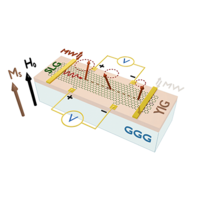
Chiral charge pumping in graphene deposited on a magnetic insulator

Michael Evelt, Hector Ochoa, Oleksandr Dzyapko, Vladislav E. Demidov, Avgust Yurgens, Jie Sun, Yaroslav Tserkovnyak, Vladimir Bessonov, Anatoliy B. Rinkevich, and Sergej O. Demokritov

Phys. Rev. B 95, 024408 (2017) - Published 9 January, 2017

Yttrium iron garnet (YIG) holds a special place among all magnetic materials since it shows an unprecedentedly small magnetic damping, resulting in the narrowest known line in ferromagnetic resonance and enabling propagation of spin waves over long distances. Due to these unique characteristics, YIG films have been recently considered as a promising material for spintronic and magnonic applications. By combining YIG and a single layer of graphene in a bilayer, one obtains a unique model system for investigations of magnetic interfacial effects. Here, the authors demonstrate experimentally that the system shows a sizable chiral charge pumping, which could arise from an imbalance of screw dislocations. The effect, which cannot be attributed to the ordinary spin pumping, reveals itself in the creation of a dc electric field/voltage in graphene as a response to the dynamic magnetic excitations (spin waves) in an adjacent out-of-plane magnetized YIG film. The authors show that the induced voltage changes its sign when the orientation of the static magnetization is reversed, clearly indicating the broken mirror reflection symmetry about the planes normal to the graphene/YIG interface. The strength of effect shows a nonmonotonic dependence on the spin-wave frequency, in agreement with the proposed theoretical model.

Development of spin-wave-like dispersive excitations below the pseudogap temperature in the high-temperature superconductor La2−xSrxCuO4

M. Matsuura, S. Kawamura, M. Fujita, R. Kajimoto, and K. Yamada

Phys. Rev. B 95, 024504 (2017) - Published 9 January, 2017

Resolving the VO2 controversy: Mott mechanism dominates the insulator-to-metal transition

O. Nájera, M. Civelli, V. Dobrosavljević, and M. J. Rozenberg

Phys. Rev. B 95, 035113 (2017) - Published 9 January, 2017

High-order harmonic generation from gapped graphene: Perturbative response and transition to nonperturbative regime

Darko Dimitrovski, Lars Bojer Madsen, and Thomas Garm Pedersen

Phys. Rev. B 95, 035405 (2017) - Published 9 January, 2017

High and low thermal conductivity of amorphous macromolecules

Xu Xie, Kexin Yang, Dongyao Li, Tsung-Han Tsai, Jungwoo Shin, Paul V. Braun, and David G. Cahill

Phys. Rev. B 95, 035406 (2017) - Published 9 January, 2017

Quantum oscillations without magnetic field

Tianyu Liu, D. I. Pikulin, and M. Franz

Phys. Rev. B 95, 041201(R) (2017) - Published 9 January, 2017

Quantum oscillations are the fundamental measurement made when studying metals and semimetals. They provide information about the Fermi surface by measuring interference of particles drifting around it in a magnetic field. So far it was only possible to measure them by applying an external magnetic field. Here, the authors argue that the deformation of the Dirac/Weyl semimetal can produce a strong enough pseudo-magnetic field to measure quantum oscillations in the strength of the strain. They argue that the effect of the strain is identical to the effect of the real magnetic field at energies close to the Dirac/Weyl points. They propose a setup in which the strain can be tuned continuously, and in which the quantum oscillations can be first observed in the complete absence of a magnetic field.

Sign In to Your Journals Account

Filter

Recent Issues

Vol. 114, Iss. 30
15 November 2026
Vol. 114, Iss. 29
15 November 2026
Vol. 114, Iss. 28
15 November 2026
Vol. 114, Iss. 27
1 November 2026
Category
Article Type
Section

Filter

Article Lookup

Enter a citation