Recent Articles

Magnetic properties of two-dimensional hydrocarbon networks of sp2 and sp3 C atoms

Jun-ya Sorimachi and Susumu Okada

Phys. Rev. B 96, 024103 (2017) - Published 13 July, 2017

Magnetization reversal in Py/Gd heterostructures

Pavel N. Lapa, Junjia Ding, John E. Pearson, Valentine Novosad, J. S. Jiang, and Axel Hoffmann

Phys. Rev. B 96, 024418 (2017) - Published 13 July, 2017

Interfacial room temperature magnetism and enhanced magnetocaloric effect in strained La0.66Ca0.34MnO3/BaTiO3 heterostructures

N. S. Bingham, A. K. Suszka, C. A. F. Vaz, H. Kim, and L. J. Heyderman

Phys. Rev. B 96, 024419 (2017) - Published 13 July, 2017

Generalized electromagnetism of subdimensional particles: A spin liquid story

Michael Pretko

Phys. Rev. B 96, 035119 (2017) - Published 13 July, 2017

Kinetic orbital moments and nonlocal transport in disordered metals with nontrivial band geometry

J. Rou, C. Şahin, J. Ma, and D. A. Pesin

Phys. Rev. B 96, 035120 (2017) - Published 13 July, 2017

Low quasiparticle coherence temperature in the one-band Hubbard model: A slave-boson approach

Alejandro Mezio and Ross H. McKenzie

Phys. Rev. B 96, 035121 (2017) - Published 13 July, 2017

Substrate effects on the exciton fine structure of black phosphorus quantum dots

J. S. de Sousa, M. A. Lino, D. R. da Costa, A. Chaves, J. M. Pereira, Jr., and G. A. Farias

Phys. Rev. B 96, 035122 (2017) - Published 13 July, 2017

New group-V elemental bilayers: A tunable structure model with four-, six-, and eight-atom rings

Xiangru Kong, Linyang Li, Ortwin Leenaerts, Xiong-Jun Liu, and François M. Peeters

Phys. Rev. B 96, 035123 (2017) - Published 13 July, 2017

Elastic and inelastic diffraction of fast atoms, Debye-Waller factor, and Mössbauer-Lamb-Dicke regime

Philippe Roncin and Maxime Debiossac

Phys. Rev. B 96, 035415 (2017) - Published 13 July, 2017

Encrypting Majorana fermion qubits as bound states in the continuum

L. H. Guessi, F. A. Dessotti, Y. Marques, L. S. Ricco, G. M. Pereira, P. Menegasso, M. de Souza, and A. C. Seridonio

Phys. Rev. B 96, 041114(R) (2017) - Published 13 July, 2017

Field-induced quantum criticality in the Kitaev system α−RuCl3

A. U. B. Wolter, L. T. Corredor, L. Janssen, K. Nenkov, S. Schönecker, S.-H. Do, K.-Y. Choi, R. Albrecht, J. Hunger, T. Doert, M. Vojta, and B. Büchner

Phys. Rev. B 96, 041405(R) (2017) - Published 13 July, 2017

LDA+DMFT approach to core-level spectroscopy: Application to 3d transition metal compounds

Atsushi Hariki, Takayuki Uozumi, and Jan Kuneš

Phys. Rev. B 96, 045111 (2017) - Published 13 July, 2017

Chiral anomaly and longitudinal magnetotransport in type-II Weyl semimetals

Gargee Sharma, Pallab Goswami, and Sumanta Tewari

Phys. Rev. B 96, 045112 (2017) - Published 13 July, 2017

Nonisovalent Si-III-V and Si-II-VI alloys: Covalent, ionic, and mixed phases

Joongoo Kang, Ji-Sang Park, Pauls Stradins, and Su-Huai Wei

Phys. Rev. B 96, 045203 (2017) - Published 13 July, 2017

Inversion of the exciton built-in dipole moment in In(Ga)As quantum dots via nonlinear piezoelectric effect

Johannes Aberl, Petr Klenovský, Johannes S. Wildmann, Javier Martín-Sánchez, Thomas Fromherz, Eugenio Zallo, Josef Humlíček, Armando Rastelli, and Rinaldo Trotta

Phys. Rev. B 96, 045414 (2017) - Published 13 July, 2017

Piezoelectric effects can strongly affect the position and shape of the electron and hole wave functions in compound semiconductors quantum dots (QDs). From the point of view of theoretical semiconductor physics, this is a well-documented notion. From an experimental point of view, however, the extreme sensitivity of the electronic properties of QDs to tiny variations of their shape, size, and composition makes it very challenging to single out the effect of piezoelectricity, which is often neglected in the analysis of experimental data. Here, the authors demonstrate that externally induced piezoelectric fields can be used for wave function engineering and to even force an inversion of the exciton built-in dipole moment in the very same QD. Detailed calculations based on k.p theory disclose that the inversion of the exciton dipole is driven by the nonlinear terms of the piezoelectric fields. These findings shine new light on the role and the possible exploitation of piezoelectric effects in semiconductor QDs.

Tuning magnetic response of epitaxial iron-silicide nanoislands by controlled self-assembled growth

I. Goldfarb, Y. Camus, M. Dascalu, F. Cesura, R. Chalasani, and A. Kohn

Phys. Rev. B 96, 045415 (2017) - Published 13 July, 2017

Robustness of the cluster expansion: Assessing the roles of relaxation and numerical error

Andrew H. Nguyen, Conrad W. Rosenbrock, C. Shane Reese, and Gus L. W. Hart

Phys. Rev. B 96, 014107 (2017) - Published 12 July, 2017

Energy confinement and thermal boundary conductance effects on short-pulsed thermal ablation thresholds in thin films

John A. Tomko, Ashutosh Giri, Brian F. Donovan, Daniel M. Bubb, Sean M. O'Malley, and Patrick E. Hopkins

Phys. Rev. B 96, 014108 (2017) - Published 12 July, 2017

Loschmidt echo in many-body localized phases

Maksym Serbyn and Dmitry A. Abanin

Phys. Rev. B 96, 014202 (2017) - Published 12 July, 2017

Quantum critical phase with infinite projected entangled paired states

Didier Poilblanc and Matthieu Mambrini

Phys. Rev. B 96, 014414 (2017) - Published 12 July, 2017

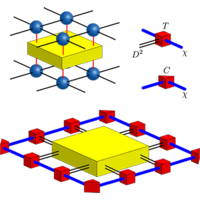
Whether two-dimensional tensor networks, such as the so-called projected entangled pair states (PEPS), have the potential to describe a genuine quantum critical point or quantum critical phases separating two ordered phases is of much interest for the understanding of frustrated magnets and strongly correlated systems. Here, the authors identify a specific family of SU(2)-invariant PEPS, which provides excellent variational energies for the J1-J2 frustrated Heisenberg model at large frustration. Using a full-update infinite-PEPS scheme directly in the thermodynamic limit, the authors provide evidence of diverging correlation lengths in both the singlet and triplet channels. It is argued that such PEPS give a qualitative description of the critical point or critical phase of the J1-J2 model.

Sign In to Your Journals Account

Filter

Recent Issues

Vol. 114, Iss. 30
15 November 2026
Vol. 114, Iss. 29
15 November 2026
Vol. 114, Iss. 28
15 November 2026
Vol. 114, Iss. 27
1 November 2026
Category
Article Type
Section

Filter

Article Lookup

Enter a citation