Recent Articles

Raman scattering study of the ferroelectric phase transition in BaTi2O5

Shinya Tsukada, Yasuhiro Fujii, Yasuhiro Yoneda, Hiroki Moriwake, Ayako Konishi, and Yukikuni Akishige

Phys. Rev. B 97, 024116 (2018) - Published 31 January, 2018

Spin-isotropic continuum of spin excitations in antiferromagnetically ordered Fe1.07Te

Yu Song, Xingye Lu, L.-P. Regnault, Yixi Su, Hsin-Hua Lai, Wen-Jun Hu, Qimiao Si, and Pengcheng Dai

Phys. Rev. B 97, 024519 (2018) - Published 31 January, 2018

Landau levels from neutral Bogoliubov particles in two-dimensional nodal superconductors under strain and doping gradients

Emilian M. Nica and Marcel Franz

Phys. Rev. B 97, 024520 (2018) - Published 31 January, 2018

Multiloop functional renormalization group for general models

Fabian B. Kugler and Jan von Delft

Phys. Rev. B 97, 035162 (2018) - Published 31 January, 2018

Many-body localization and level repulsion

Jonas A. Kjäll

Phys. Rev. B 97, 035163 (2018) - Published 31 January, 2018

Topological photonic crystals with zero Berry curvature

Feng Liu, Hai-Yao Deng, and Katsunori Wakabayashi

Phys. Rev. B 97, 035442 (2018) - Published 31 January, 2018

Weyl nodes in Andreev spectra of multiterminal Josephson junctions: Chern numbers, conductances, and supercurrents

Hong-Yi Xie, Maxim G. Vavilov, and Alex Levchenko

Phys. Rev. B 97, 035443 (2018) - Published 31 January, 2018

Conduction-band valley spin splitting in single-layer H-Tl2O

Yandong Ma, Liangzhi Kou, Aijun Du, Baibiao Huang, Ying Dai, and Thomas Heine

Phys. Rev. B 97, 035444 (2018) - Published 31 January, 2018

Universal interaction-driven gap in metallic carbon nanotubes

Mitchell J. Senger, Daniel R. McCulley, Neda Lotfizadeh, Vikram V. Deshpande, and Ethan D. Minot

Phys. Rev. B 97, 035445 (2018) - Published 31 January, 2018

Clean experimental testing grounds for strongly interacting electrons confined to one dimension are hard to find. Thus, suspended carbon nanotubes (CNTs) are a unique model system. Previous work showed that electron transport in suspended metallic CNTs can be frozen by strong electron-electron interactions. However, a detailed understanding of this exotic insulating phase has remained elusive. Here, the authors characterize the energy gap associated with the insulating phase in nominally metallic CNTs, and compare the gap to precise measurements of CNT diameter and chirality.

Publisher's Note: Convergence behavior of the random phase approximation renormalized correlation energy [Phys. Rev. B 95, 195158 (2017)]

Jefferson E. Bates, Jonathon Sensenig, and Adrienn Ruzsinszky

Phys. Rev. B 97, 039905 (2018) - Published 31 January, 2018

Controllable continuous evolution of electronic states in a single quantum ring

Tapash Chakraborty, Aram Manaselyan, Manuk Barseghyan, and David Laroze

Phys. Rev. B 97, 041304(R) (2018) - Published 31 January, 2018

Dynamic current susceptibility as a probe of Majorana bound states in nanowire-based Josephson junctions

Mircea Trif, Olesia Dmytruk, Hélène Bouchiat, Ramón Aguado, and Pascal Simon

Phys. Rev. B 97, 041415(R) (2018) - Published 31 January, 2018

Probing the energy reactance with adiabatically driven quantum dots

María Florencia Ludovico, Liliana Arrachea, Michael Moskalets, and David Sánchez

Phys. Rev. B 97, 041416(R) (2018) - Published 31 January, 2018

Quantum oscillations in insulators with neutral Fermi surfaces

Inti Sodemann, Debanjan Chowdhury, and T. Senthil

Phys. Rev. B 97, 045152 (2018) - Published 31 January, 2018

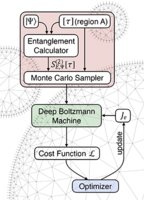
Machine learning spatial geometry from entanglement features

Yi-Zhuang You, Zhao Yang, and Xiao-Liang Qi

Phys. Rev. B 97, 045153 (2018) - Published 31 January, 2018

Machine learning is a fast developing area that finds applications in all disciplines of science. Here, the authors demonstrate that the machine learning (in particular deep learning) technique can be applied to understand the emergence of spatial geometry from learning the features of quantum many-body entanglement, an idea that was proposed in a recent study of the holography duality in quantum gravity. This work is the first to successfully demonstrate the idea of “geometry emerging from learning”.

Anomalous behavior of the excited state of the A exciton in bulk WS2

Vishwas Jindal, Sumi Bhuyan, Thorsten Deilmann, and Sandip Ghosh

Phys. Rev. B 97, 045211 (2018) - Published 31 January, 2018

Magnetic field assisted transmission of THz waves through a graphene layer combined with a periodically perforated metallic film

Yu. V. Bludov, M. I. Vasilevskiy, and N. M. R. Peres

Phys. Rev. B 97, 045433 (2018) - Published 31 January, 2018

Bound acoustic modes in the radiation continuum in isotropic layered systems without periodic structures

A. A. Maznev and A. G. Every

Phys. Rev. B 97, 014108 (2018) - Published 30 January, 2018

Multiscale modeling of shock wave localization in porous energetic material

M. A. Wood, D. E. Kittell, C. D. Yarrington, and A. P. Thompson

Phys. Rev. B 97, 014109 (2018) - Published 30 January, 2018

Entanglement between pairing and screening in the Gorkov-Melik-Barkhudarov correction to the critical temperature throughout the BCS-BEC crossover

L. Pisani, A. Perali, P. Pieri, and G. Calvanese Strinati

Phys. Rev. B 97, 014528 (2018) - Published 30 January, 2018

Sign In to Your Journals Account

Filter

Recent Issues

Vol. 114, Iss. 30
15 November 2026
Vol. 114, Iss. 29
15 November 2026
Vol. 114, Iss. 28
15 November 2026
Vol. 114, Iss. 27
1 November 2026
Category
Article Type
Section

Filter

Article Lookup

Enter a citation