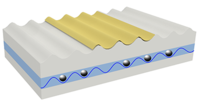
We study a three-level quantum dot in the singly occupied cotunneling regime coupled via a generic tunneling matrix to several multichannel leads in equilibrium or nonequilibrium. Denoting the three possible states of the quantum dot by the quark flavors up (), down (), and strange (), we derive an effective model where also each reservoir has three flavors labeled by , and with an effective density of states polarized with respect to an eight-dimensional spin corresponding to the eight generators of . In equilibrium we perform a standard poor man's scaling analysis and show that tunneling via virtual intermediate states induces flavor fluctuations on the dot which become symmetric at a characteristic and exponentially small low-energy scale . Close to the system is described by a single isotropic Kondo coupling diverging at . Using the numerical renormalization group, we study in detail the linear conductance and confirm the -symmetric Kondo fixed point with universal conductance for various tunneling setups by tuning the level spacings on the dot. We also identify regions of the level positions where the Kondo fixed point is obtained and find a rather complex dependence of the various Kondo temperatures as function of the gate voltage and the tunneling couplings. In contrast to the equilibrium case, we find in nonequilibrium that the fixed-point model is not symmetric but characterized by rotated spins for each reservoir with total vanishing sum. At large voltage we analyze the -spin magnetization and the current in Fermi's golden rule as function of a longitudinal () and perpendicular () magnetic field for the isospin and the level spacing to the strange quark. As a smoking gun to detect the nonequilibrium fixed point we find that the curve of zero -spin magnetization in space is a circle when projected onto the plane. We propose that our findings can be generalized to the case of quantum dots with an arbitrary number of levels.