Recent Articles

Coulomb interaction in monolayer transition-metal dichalcogenides

Dinh Van Tuan, Min Yang, and Hanan Dery

Phys. Rev. B 98, 125308 (2018) - Published 27 September, 2018

Hole-capture competition between a single quantum dot and an ionized acceptor

J. Wiegand, D. S. Smirnov, J. Osberghaus, L. Abaspour, J. Hübner, and M. Oestreich

Phys. Rev. B 98, 125426 (2018) - Published 27 September, 2018

Enhancing correlation times for edge spins through dissipation

Loredana M. Vasiloiu, Federico Carollo, and Juan P. Garrahan

Phys. Rev. B 98, 094308 (2018) - Published 26 September, 2018

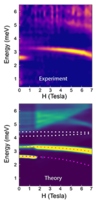
Field evolution of magnons in α−RuCl3 by high-resolution polarized terahertz spectroscopy

Liang Wu, A. Little, E. E. Aldape, D. Rees, E. Thewalt, P. Lampen-Kelley, A. Banerjee, C. A. Bridges, J.-Q. Yan, D. Boone, S. Patankar, D. Goldhaber-Gordon, D. Mandrus, S. E. Nagler, E. Altman, and J. Orenstein

Phys. Rev. B 98, 094425 (2018) - Published 26 September, 2018

The quantum spin liquid (QSL) – a phase of matter with no ordered ground state – is of fundamental interest as excitations in this phase may break the molds of bosons and fermions and develop more complicated properties. The honeycomb magnet α-RuCl3 has emerged as a candidate for realization of a QSL. Although it orders at low temperature, an in-plane magnetic field of around 7 Tesla destroys the order; the nature of this transition is intensely studied. Here, the authors use polarized time-domain terahertz spectroscopy to study the spectrum of magnetic excitations in α-RuCl3 in an applied field. Motivated by the unusual evolution of the spectra, the authors develop a linear spin wave theory to describe the data with strikingly good agreement. These results provide clarity for ongoing work on this compound, and inform future studies aiming to detect field-induced QSL states.

Local environment dependence of Mn magnetism in bcc iron-manganese alloys: A first-principles study

Anton Schneider, Chu-Chun Fu, and Cyrille Barreteau

Phys. Rev. B 98, 094426 (2018) - Published 26 September, 2018

Orbital- and spin-driven lattice instabilities in quasi-one-dimensional CaV2O4

T. Watanabe, S. Kobayashi, Y. Hara, J. Xu, B. Lake, J.-Q. Yan, A. Niazi, and D. C. Johnston

Phys. Rev. B 98, 094427 (2018) - Published 26 September, 2018

Thermoelectric studies of Ir1−xRhxTe2 (0≤x≤0.3)

Yu Liu (刘育), Hechang Lei (雷和畅), Kefeng Wang (王克锋), Milinda Abeykoon, J. B. Warren, Emil Bozin, and C. Petrovic

Phys. Rev. B 98, 094519 (2018) - Published 26 September, 2018

Density functional theory modeling of vortex shedding in superfluid He4

Adam Freund, Daniel Gonzalez, Xavier Buelna, Francesco Ancilotto, and Jussi Eloranta

Phys. Rev. B 98, 094520 (2018) - Published 26 September, 2018

Micron-scale measurements of low anisotropic strain response of local Tc in Sr2RuO4

Christopher A. Watson, Alexandra S. Gibbs, Andrew P. Mackenzie, Clifford W. Hicks, and Kathryn A. Moler

Phys. Rev. B 98, 094521 (2018) - Published 26 September, 2018

Topological superconductivity is of both fundamental and technological interest as a novel state of matter with potential applications in quantum information processing. Among the most promising materials for exhibiting intrinsic topological superconductivity is Sr2RuO4, which has shown evidence of triplet pairing and time-reversal symmetry breaking. Here, the authors use a scanning SQUID microscope to measure the local change in the critical temperature under application of anisotropic strain to test for a linear cusp at small strains, a key prediction of existing models for the superconducting state. The reported absence of such a cusp constrains future descriptions of this enigmatic material.

Dynamics and superconductivity in compressed lanthanum superhydride

Hanyu Liu, Ivan I. Naumov, Zachary M. Geballe, Maddury Somayazulu, John S. Tse, and Russell J. Hemley

Phys. Rev. B 98, 100102(R) (2018) - Published 26 September, 2018

Bond ordering and phase transitions in Na2IrO3 under high pressure

Kaige Hu, Zhimou Zhou, Yi-Wen Wei, Chao-Kai Li, and Ji Feng

Phys. Rev. B 98, 100103(R) (2018) - Published 26 September, 2018

Selective probe of coherent polar phonon and quasiferromagnetic resonance modes in multiferroic GdFeO3

Y. M. Sheu, N. Ogawa, Y. Tokunaga, H. C. Chan, and Y. Tokura

Phys. Rev. B 98, 100301(R) (2018) - Published 26 September, 2018

Quantum dynamics with stochastic reset

B. Mukherjee, K. Sengupta, and Satya N. Majumdar

Phys. Rev. B 98, 104309 (2018) - Published 26 September, 2018

Correlation between the Dzyaloshinskii-Moriya interaction and spin-mixing conductance at an antiferromagnet/ferromagnet interface

Xin Ma, Guoqiang Yu, Seyed A. Razavi, Liang Chang, Lei Deng, Zhaodong Chu, Congli He, Kang L. Wang, and Xiaoqin Li

Phys. Rev. B 98, 104428 (2018) - Published 26 September, 2018

Cluster mean-field study of the Heisenberg model for CuInVO5

Ayushi Singhania and Sanjeev Kumar

Phys. Rev. B 98, 104429 (2018) - Published 26 September, 2018

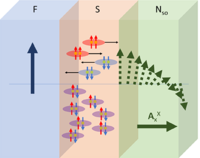
Generation of pure superconducting spin current in magnetic heterostructures via nonlocally induced magnetism due to Landau Fermi liquid effects

X. Montiel and M. Eschrig

Phys. Rev. B 98, 104513 (2018) - Published 26 September, 2018

The authors propose a novel mechanism for the creation of superconducting spin currents in a ferromagnet/superconductor/normal-metal heterostructure via a non-locally induced exchange field in the normal layer, which exhibits Landau Fermi liquid interactions. When the structure enters the superconducting state, spin-triplet superconducting correlations transfer spin across the superconductor and induce remotely a magnetization in the normal layer. The authors then show that in the presence of strong spin-orbit interaction in the normal-metal layer, the induced magnetization is rotated with respect to the magnetization in the ferromagnet. This magnetization misalignment leads to a spin torque on both magnetizations and causes a superconducting spin current to flow across the superconductor. These results open new avenues for designing devices for superconducting spintronics.

Infrared spectroscopic studies of the topological properties in CaMnSb2

Ziyang Qiu, Congcong Le, Yaomin Dai, Bing Xu, J. B. He, Run Yang, Genfu Chen, Jiangping Hu, and Xianggang Qiu

Phys. Rev. B 98, 115151 (2018) - Published 26 September, 2018

Inclusion-exclusion principle for many-body diagrammatics

Aviel Boag, Emanuel Gull, and Guy Cohen

Phys. Rev. B 98, 115152 (2018) - Published 26 September, 2018

Diagrammatic resummation techniques have recently enabled new classes of quantum Monte Carlo algorithms, but are restricted by the need to sum over factorially large sets of diagrams. Here, the authors present a fast algorithm for summing over the diagrams appearing in Inchworm hybridization expansions. The method relies on the inclusion-exclusion principle to reduce the scaling from factorial to exponential. For the Inchworm hybridization expansion, when compared to the previous state of the art, the new algorithm is shown to provide practical performance gains of approximately two orders of magnitude.

Effects of orientation and strain on the topological characteristics of CdTe/α-Sn quantum wells

G. J. de Coster, P. A. Folkes, P. J. Taylor, and O. A. Vail

Phys. Rev. B 98, 115153 (2018) - Published 26 September, 2018

Symmetry change of Co 3d orbital associated with the 500-K spin crossover accompanied by insulator-to-metal transition in LaCoO3

Y. Kobayashi, Y. Sakurai, N. Tsuji, K. Sato, and K. Asai

Phys. Rev. B 98, 115154 (2018) - Published 26 September, 2018

Sign In to Your Journals Account

Filter

Recent Issues

Vol. 114, Iss. 30
15 November 2026
Vol. 114, Iss. 29
15 November 2026
Vol. 114, Iss. 28
15 November 2026
Vol. 114, Iss. 27
1 November 2026
Category
Article Type
Section

Filter

Article Lookup

Enter a citation