Recent Articles

Abnormal phase flip in the coherent phonon oscillations of Ca2RuO4

Min-Cheol Lee, Choong H. Kim, Inho Kwak, J. Kim, S. Yoon, Byung Cheol Park, Bumjoo Lee, F. Nakamura, C. Sow, Y. Maeno, T. W. Noh, and K. W. Kim

Phys. Rev. B 98, 161115(R) (2018) - Published 17 October, 2018

Temperature dependence of the NMR Knight shift in pnictides: Proximity to a van Hove singularity

R. Nourafkan and S. Acheche

Phys. Rev. B 98, 161116(R) (2018) - Published 17 October, 2018

Strong exciton regulation of Raman scattering in monolayer MoS2

Yuanxi Wang, Bruno R. Carvalho, and Vincent H. Crespi

Phys. Rev. B 98, 161405(R) (2018) - Published 17 October, 2018

Movable but not removable band degeneracies in a symmorphic crystal

Mariana Malard, Paulo Eduardo de Brito, Stellan Östlund, and Henrik Johannesson

Phys. Rev. B 98, 165127 (2018) - Published 17 October, 2018

Continuously tunable topological pump in high-dimensional cold atomic gases

Yan-Bin Yang, L.-M. Duan, and Yong Xu

Phys. Rev. B 98, 165128 (2018) - Published 17 October, 2018

PT phase transitions of edge states at PT symmetric interfaces in non-Hermitian topological insulators

Xiang Ni, Daria Smirnova, Alexander Poddubny, Daniel Leykam, Yidong Chong, and Alexander B. Khanikaev

Phys. Rev. B 98, 165129 (2018) - Published 17 October, 2018

Universality of electronic characteristics and photocatalyst applications in the two-dimensional Janus transition metal dichalcogenides

Congxin Xia, Wenqi Xiong, Juan Du, Tianxing Wang, Yuting Peng, and Jingbo Li

Phys. Rev. B 98, 165424 (2018) - Published 17 October, 2018

Linear and nonlinear optical and spin-optical response of gapped and proximitized graphene

Thomas Garm Pedersen

Phys. Rev. B 98, 165425 (2018) - Published 17 October, 2018

Braiding Majorana zero modes using quantum dots

Corneliu Malciu, Leonardo Mazza, and Christophe Mora

Phys. Rev. B 98, 165426 (2018) - Published 17 October, 2018

Ab initio calculations of carbon and boron nitride allotropes and their structural phase transitions using periodic coupled cluster theory

Thomas Gruber and Andreas Grüneis

Phys. Rev. B 98, 134108 (2018) - Published 16 October, 2018

Akhiezer mechanism limits coherent heat conduction in phononic crystals

Yuxuan Liao, Takuma Shiga, Makoto Kashiwagi, and Junichiro Shiomi

Phys. Rev. B 98, 134307 (2018) - Published 16 October, 2018

Robustness of magnons near the quantum critical point in the heavy-fermion superconductor CeCu2Si2

Zita Huesges, Karin Schmalzl, Christoph Geibel, Manuel Brando, Frank Steglich, and Oliver Stockert

Phys. Rev. B 98, 134425 (2018) - Published 16 October, 2018

Randomness-induced quantum spin liquid behavior in the s=12 random J1−J2 Heisenberg antiferromagnet on the square lattice

Kazuki Uematsu and Hikaru Kawamura

Phys. Rev. B 98, 134427 (2018) - Published 16 October, 2018

Unconventional transport properties of the itinerant ferromagnet EuTi1−xNbxO3(x=0.10–0.20)

Susmita Roy, Nazir Khan, and Prabhat Mandal

Phys. Rev. B 98, 134428 (2018) - Published 16 October, 2018

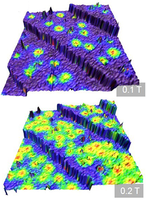
Unconventional superconductivity in the single-atom-layer alloy Si(111)−√3×√3−(Tl,Pb)

T. Nakamura, H. Kim, S. Ichinokura, A. Takayama, A. V. Zotov, A. A. Saranin, Y. Hasegawa, and S. Hasegawa

Phys. Rev. B 98, 134505 (2018) - Published 16 October, 2018

The Si(111)-3×3-(Tl, Pb) surface has recently emerged as being a two-dimensional one-atom thick superconductor with spin-split bands, due to the Rashba-Bychkov effect. Here, the authors use scanning tunneling microscopy and spectroscopy to measure its superconductivity. They observe the unconventional nature, the anisotropy of the superconducting gap, and the pseudogap structure under a magnetic field. These results promote further experimental and theoretical investigations of possible parity-broken superconductors.

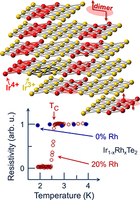
Phase separation at the dimer-superconductor transition in Ir1−xRhxTe2

R. Yu, S. Banerjee, H. Lei, M. Abeykoon, C. Petrovic, Z. Guguchia, and E. S. Bozin

Phys. Rev. B 98, 134506 (2018) - Published 16 October, 2018

Unconventional superconductivity often appears in proximity of symmetry-breaking electronic and magnetic orders. The relevance of spatiotemporal fluctuations of these orders for the superconducting pairing remains an open question. Here, nanoscale broken-symmetry states are probed by high-energy x-rays in a layered iridium ditelluride superconductor, where superconductivity emerges from an ordered dimer state. The study finds no fingerprints of dimer fluctuations in the superconducting compositional regime, yet provides evidence for the coexistence of superconductivity and nanoscale dimerization close to the phase boundary of these two electronic states.

Force field preconditioned ab initio structure relaxation method

Liping Liu, Zhanghui Chen, Yugui Yao, and Lin-Wang Wang

Phys. Rev. B 98, 144109 (2018) - Published 16 October, 2018

Asymptotic theory of bimodal quarter-wave impedance matching for full mode-converting transmission

Xiongwei Yang and Yoon Young Kim

Phys. Rev. B 98, 144110 (2018) - Published 16 October, 2018

Anomalous pressure effect on the thermal conductivity of ZnO, GaN, and AlN from first-principles calculations

Kunpeng Yuan, Xiaoliang Zhang, Dawei Tang, and Ming Hu

Phys. Rev. B 98, 144303 (2018) - Published 16 October, 2018

Velocity-dependent Lyapunov exponents in many-body quantum, semiclassical, and classical chaos

Vedika Khemani, David A. Huse, and Adam Nahum

Phys. Rev. B 98, 144304 (2018) - Published 16 October, 2018

It has been a long-standing challenge to expand the notion of exponential sensitivity to small perturbations in the initial conditions from the realm of classical chaos to that of many-body quantum systems. Recently, exponential growth in a measure known as the out-of-time-order commutator (OTOC) has been proposed as a diagnostic of chaos in the setting of many-body quantum systems. The authors examine the behavior of the OTOC along rays of different velocities for a variety of spatially local extended many-body quantum systems, both integrable and nonintegrable. They find that the velocity-dependent Lyapunov exponents are negative for velocities greater than a characteristic “butterfly speed”, which defines the light cone for the spreading of operators. It is demonstrated that a regime with well-defined positive Lyapunov exponents inside the light-cone may only exist for classical, semiclassical, weakly interacting, or large-N systems, but not for fully quantum systems with strong short-range interactions and local Hilbert space dimensions of order one.

Sign In to Your Journals Account

Filter

Recent Issues

Vol. 114, Iss. 30
15 November 2026
Vol. 114, Iss. 29
15 November 2026
Vol. 114, Iss. 28
15 November 2026
Vol. 114, Iss. 27
1 November 2026
Category
Article Type
Section

Filter

Article Lookup

Enter a citation