Recent Articles

Helical spin thermoelectrics controlled by a side-coupled magnetic quantum dot in the quantum spin Hall state

Pablo Roura-Bas, Liliana Arrachea, and Eduardo Fradkin

Phys. Rev. B 98, 195429 (2018) - Published 19 November, 2018

Optical conductivity and transparency in an effective model for graphene

Horacio Falomir, Marcelo Loewe, Enrique Muñoz, and Alfredo Raya

Phys. Rev. B 98, 195430 (2018) - Published 19 November, 2018

Photoinduced electric currents in Bose-Einstein condensates

V. M. Kovalev and I. G. Savenko

Phys. Rev. B 98, 201405(R) (2018) - Published 19 November, 2018

The authors suggest an alternative way to monitor the formation of a Bose-Einstein condensate of compound particles, such as indirect excitons, by measuring the spectrum of electric current under the action of an external electromagnetic field. The current consists of two principal components. One of them is specific for condensates, being mediated by the emission of Bogoliubov quasiparticles. The outstanding result of this paper is that this component soon becomes predominant when the frequency of light exceeds the ionization potential.

Emergence of non-Fermi-liquid type Weyl metals driven by doped magnetic impurities in spin-orbit coupled semiconductors

Kyoung-Min Kim, Jinsu Kim, Soo-Whan Kim, Myung-Hwa Jung, and Ki-Seok Kim

Phys. Rev. B 98, 205133 (2018) - Published 19 November, 2018

Nodal points of Weyl semimetals survive the presence of moderate disorder

Michael Buchhold, Sebastian Diehl, and Alexander Altland

Phys. Rev. B 98, 205134 (2018) - Published 19 November, 2018

Origin of the deep band-gap state in TiO2(110): ddσ bonds between Ti-Ti pairs

Tingwei Chen, Ya-nan Hao, Fan Jin, Min Wei, Jin Feng, Ran Jia, Zhijun Yi, Michael Rohlfing, Chengbu Liu, and Yuchen Ma

Phys. Rev. B 98, 205135 (2018) - Published 19 November, 2018

Quantum Zeno effect and the many-body entanglement transition

Yaodong Li, Xiao Chen, and Matthew P. A. Fisher

Phys. Rev. B 98, 205136 (2018) - Published 19 November, 2018

Spin-current density-functional theory for a correct treatment of spin-orbit interactions and its application to topological phase transitions

Egor Trushin and Andreas Görling

Phys. Rev. B 98, 205137 (2018) - Published 19 November, 2018

Orbital-dependent band renormalization in WTe2 revealed by angle-resolved photoemission spectroscopy

R. Matsumoto, T. Sugimoto, T. Mizokawa, N. L. Saini, M. Arita, R. Jha, R. Higashinaka, T. D. Matsuda, and Y. Aoki

Phys. Rev. B 98, 205138 (2018) - Published 19 November, 2018

Berry curvature force and Lorentz force comparison in the magnetotransport of Weyl semimetals

Muhammad Imran and Selman Hershfield

Phys. Rev. B 98, 205139 (2018) - Published 19 November, 2018

Three-particle electron-hole complexes in two-dimensional electron systems

V. A. Kuznetsov, L. V. Kulik, M. D. Velikanov, A. S. Zhuravlev, A. V. Gorbunov, S. Schmult, and I. V. Kukushkin

Phys. Rev. B 98, 205303 (2018) - Published 19 November, 2018

Bulk versus surface contributions to the Rashba spin splitting of Shockley surface states

H. Ishida

Phys. Rev. B 98, 205412 (2018) - Published 19 November, 2018

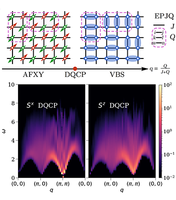
Dynamical signature of fractionalization at a deconfined quantum critical point

Nvsen Ma, Guang-Yu Sun, Yi-Zhuang You, Cenke Xu, Ashvin Vishwanath, Anders W. Sandvik, and Zi Yang Meng

Phys. Rev. B 98, 174421 (2018) - Published 16 November, 2018

Recent theoretical research has focused on exciting new types of phase transitions that do not appear to fit within standard paradigms. In so-called deconfined quantum phase transitions, the conventional quasiparticle used in standard mathematical descriptions must be replaced by fractionalized (“split-up”) quasiparticles. Here, the authors present calculations aimed directly at the most promising experimental investigations, where the quasiparticles or their fractionalized parts are directly probed, for example, by neutron scattering. They present calculations of the spectral functions measured in such experiments to exhibit the deconfined transition and fractionalization phenomenon therein between a magnetic and a nonmagnetic phase. These results are useful for interpreting experimental results and guiding searches for deconfined phase transitions in quantum materials consisting of layered structures, in which the interactions between electrons are strong and lead to unconventional electronic and magnetic properties.

Erratum: Observation of transient lattice disorder at the onset of multiferroic ordering in Eu1−xHoxMnO3 by Raman spectroscopy [Phys. Rev. B 97, 224307 (2018)]

S. Elsässer, A. A. Mukhin, A. M. Balbashov, and J. Geurts

Phys. Rev. B 98, 179901 (2018) - Published 16 November, 2018

All-optical radio-frequency modulation of Anderson-localized modes

G. Arregui, D. Navarro-Urrios, N. Kehagias, C. M. Sotomayor Torres, and P. D. García

Phys. Rev. B 98, 180202(R) (2018) - Published 16 November, 2018

NMR study of optically hyperpolarized phosphorus donor nuclei in silicon

P. Gumann, H. Haas, S. Sheldon, L. Zhu, R. Deshpande, T. Alexander, M. L. W. Thewalt, D. G. Cory, and C. Ramanathan

Phys. Rev. B 98, 180405(R) (2018) - Published 16 November, 2018

Tunable auxetic properties in group-IV monochalcogenide monolayers

Xian Kong, Junkai Deng, Lou Li, Yilun Liu, Xiangdong Ding, Jun Sun, and Jefferson Zhe Liu

Phys. Rev. B 98, 184104 (2018) - Published 16 November, 2018

Singularities in large deviations of work in quantum quenches

P. Rotondo, J. Minář, J. P. Garrahan, I. Lesanovsky, and M. Marcuzzi

Phys. Rev. B 98, 184303 (2018) - Published 16 November, 2018

Tuning spin-charge interconversion with quantum confinement in ultrathin bismuth films

C. Zucchetti, M.-T. Dau, F. Bottegoni, C. Vergnaud, T. Guillet, A. Marty, C. Beigné, S. Gambarelli, A. Picone, A. Calloni, G. Bussetti, A. Brambilla, L. Duò, F. Ciccacci, P. K. Das, J. Fujii, I. Vobornik, M. Finazzi, and M. Jamet

Phys. Rev. B 98, 184418 (2018) - Published 16 November, 2018

Spin-charge interconversion (SCI) phenomena are now at the core of the field of spin-orbitronics. They allow to generate or detect spin currents in nonmagnetic materials and to manipulate the magnetization of nanomagnets by spin-orbit torque. Here, the authors show that spin-charge interconversion can be tuned by quantum size effects in ultrathin bismuth films. Epitaxially grown on germanium, bismuth first forms nanocrystals with a size less than the electron Fermi wavelength. Quantum confinement in these nanocrystals leads to high bulk resistance which can be interpreted as a semimetal-to-semiconductor transition. They also exhibit metallic surface states with a characteristic helical spin texture at the Fermi contour as shown by spin-resolved photoemission spectroscopy. Hence, when generating a spin current in germanium, it is converted into a charge current uniquely in the bottom surface states of bismuth nanocrystals. When increasing the amount of deposited bismuth, nanocrystals grow and begin to form a continuous semimetallic film suppressing quantum confinement. The spin-to-charge conversions into the top and bottom surfaces cancel each other. Thus, quantum confinement can turn on and off SCI in ultrathin bismuth films.

Structural correlation with the Griffiths phase in disordered magnetic systems

Krishanu Ghosh, Chandan Mazumdar, R. Ranganathan, S. Mukherjee, and Molly De Raychaudhury

Phys. Rev. B 98, 184419 (2018) - Published 16 November, 2018

Sign In to Your Journals Account

Filter

Recent Issues

Vol. 114, Iss. 30
15 November 2026
Vol. 114, Iss. 29
15 November 2026
Vol. 114, Iss. 28
15 November 2026
Vol. 114, Iss. 27
1 November 2026
Category
Article Type
Section

Filter

Article Lookup

Enter a citation