Recent Articles

Voltage-induced metal-insulator transition in a one-dimensional charge density wave

Giuliano Chiriacò and Andrew J. Millis

Phys. Rev. B 98, 205152 (2018) - Published 29 November, 2018

Phonon-induced linewidths of graphene electronic states

Bo Hellsing, Thomas Frederiksen, Federico Mazzola, Thiagarajan Balasubramanian, and Justin W. Wells

Phys. Rev. B 98, 205428 (2018) - Published 29 November, 2018

Lateral scattering potential of the PTCDA/Ag(111) interface state

A. Sabitova, R. Temirov, and F. S. Tautz

Phys. Rev. B 98, 205429 (2018) - Published 29 November, 2018

T2-limited sensing of static magnetic fields via fast rotation of quantum spins

A. A. Wood, A. G. Aeppli, E. Lilette, Y. Y. Fein, A. Stacey, L. C. L. Hollenberg, R. E. Scholten, and A. M. Martin

Phys. Rev. B 98, 174114 (2018) - Published 28 November, 2018

Magnetic field effect on the chiral magnetism of noncentrosymmetric UPtGe: Experiment and theory

Atsushi Miyake, Leonid M. Sandratskii, Ai Nakamura, Fuminori Honda, Yusei Shimizu, Dexin Li, Yoshiya Homma, Masashi Tokunaga, and Dai Aoki

Phys. Rev. B 98, 174436 (2018) - Published 28 November, 2018

Binding a hopfion in a chiral magnet nanodisk

Yizhou Liu, Roger K. Lake, and Jiadong Zang

Phys. Rev. B 98, 174437 (2018) - Published 28 November, 2018

Dynamical exchange and phase induced switching of a localized molecular spin

H. Hammar and J. Fransson

Phys. Rev. B 98, 174438 (2018) - Published 28 November, 2018

Magnetoelastic phenomena in antiferromagnetic uranium intermetallics: The UAu2Si2 case

M. Vališka, H. Saito, T. Yanagisawa, C. Tabata, H. Amitsuka, K. Uhlířová, J. Prokleška, P. Proschek, J. Valenta, M. Míšek, D. I. Gorbunov, J. Wosnitza, and V. Sechovský

Phys. Rev. B 98, 174439 (2018) - Published 28 November, 2018

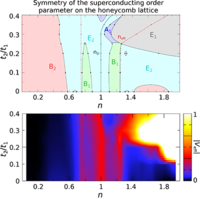
Unconventional superconductivity in the extended Hubbard model: Weak-coupling renormalization group

Sebastian Wolf, Thomas L. Schmidt, and Stephan Rachel

Phys. Rev. B 98, 174515 (2018) - Published 28 November, 2018

In superconducting phases, repulsive interactions between the electrons usually lead to higher-angular momentum Cooper pairing. Here, the authors employ the weak-coupling renormalization group approach to study unconventional superconducting phases emerging in the extended, repulsive Hubbard model on paradigmatic two-dimensional lattices. Among their findings are extended regions of chiral topological superconductivity on the square, triangular, and honeycomb lattices. They provide detailed superconducting phase diagrams as well as the coupling strengths that quantify the corresponding critical temperatures depending on the band-structure parameters, band filling, and interaction parameters. The importance of the resolution and accuracy of the numerical integration for the method is discussed and a way to higher numerical efficiency provided.

Proposal for dynamic imaging of antiferromagnetic domain wall via quantum-impurity relaxometry

B. Flebus, H. Ochoa, P. Upadhyaya, and Y. Tserkovnyak

Phys. Rev. B 98, 180409(R) (2018) - Published 28 November, 2018

Ultrafast dynamics of single-pulse femtosecond laser-induced periodic ripples on the surface of a gold film

Ke Cheng, Jukun Liu, Kaiqiang Cao, Long Chen, Yuchan Zhang, Qilin Jiang, Donghai Feng, Shian Zhang, Zhenrong Sun, and Tianqing Jia

Phys. Rev. B 98, 184106 (2018) - Published 28 November, 2018

Infrared reflectance, transmittance, and emittance spectra of MgO from first principles

Giorgia Fugallo, Benoit Rousseau, and Michele Lazzeri

Phys. Rev. B 98, 184307 (2018) - Published 28 November, 2018

Magnetization and ac susceptibility study of the cubic chiral magnet Mn1−xFexSi

L. J. Bannenberg, F. Weber, A. J. E. Lefering, T. Wolf, and C. Pappas

Phys. Rev. B 98, 184430 (2018) - Published 28 November, 2018

Evolution of helimagnetic correlations in Mn1−xFexSi with doping: A small-angle neutron scattering study

L. J. Bannenberg, R. M. Dalgliesh, T. Wolf, F. Weber, and C. Pappas

Phys. Rev. B 98, 184431 (2018) - Published 28 November, 2018

Tuning the interactions in magnetic materials by pressure or chemical substitution is a much visited route to discover new and exotic phases of condensed matter. A well known example is doping the archetype chiral magnet MnSi with Fe. Here, the authors use small-angle neutron scattering to track the evolution of the helimagnetic order in Mn1−xFexSi with Fe doping. They discover that the long-range helimagnetic order found in MnSi is suppressed already at x* ≈ 0.11, well before the critical concentration of x ≈ 0.17. Finite isotropic helimagnetic correlations persist for x > x* that can only be partly aligned by magnetic fields through a complex magnetization process.

Josephson critical currents in annular superconductors with Pearl vortices

A. Badía-Majós

Phys. Rev. B 98, 184518 (2018) - Published 28 November, 2018

Plasmon-pole approximation for many-body effects in extrinsic graphene

E. H. Hwang, Robert E. Throckmorton, and S. Das Sarma

Phys. Rev. B 98, 195140 (2018) - Published 28 November, 2018

Geometry-diversified Coulomb excitations in trilayer AAB stacking graphene

Chiun-Yan Lin, Bor-Luen Huang, Ching-Hong Ho, Godfrey Gumbs, and Ming-Fa Lin

Phys. Rev. B 98, 195442 (2018) - Published 28 November, 2018

Modifying the geometric and electronic structure of hexagonal boron nitride on Ir(111) by Cs adsorption and intercalation

Jiaqi Cai, Wouter Jolie, Caio C. Silva, Marin Petrović, Christoph Schlueter, Thomas Michely, Marko Kralj, Tien-Lin Lee, and Carsten Busse

Phys. Rev. B 98, 195443 (2018) - Published 28 November, 2018

An anomalous higher-order topological insulator

S. Franca, J. van den Brink, and I. C. Fulga

Phys. Rev. B 98, 201114(R) (2018) - Published 28 November, 2018

Topological phases of matter that have an insulating bulk and robust gapless boundary states can exist both in static materials and when system parameters are changed periodically in time. In the latter case, the periodic driving can lead to so called “anomalous” topological phases. Here, the authors show that, in the newly introduced higher-order topological insulators, anomalous phases can exist even if the system is static, and provide an example of such behavior using a two-dimensional model with topological corner charges. This work opens up the possibility of studying anomalous phases without the inherent difficulties associated with time-periodic changes of a material, such as the risk that it will “heat up” due to the driving field and lose its topological features.

Inverted orbital polarization in strained correlated oxide films

Paul C. Rogge, Robert J. Green, Padraic Shafer, Gilberto Fabbris, Andi M. Barbour, Benjamin M. Lefler, Elke Arenholz, Mark P. M. Dean, and Steven J. May

Phys. Rev. B 98, 201115(R) (2018) - Published 28 November, 2018
Sign In to Your Journals Account

Filter

Recent Issues

Vol. 114, Iss. 30
15 November 2026
Vol. 114, Iss. 29
15 November 2026
Vol. 114, Iss. 28
15 November 2026
Vol. 114, Iss. 27
1 November 2026
Category
Article Type
Section

Filter

Article Lookup

Enter a citation