Recent Articles

Ballistic photocurrents in semiconductor quantum wells caused by the excitation of asymmetric excitons

Huynh Thanh Duc, Cong Ngo, and Torsten Meier

Phys. Rev. B 100, 045308 (2019) - Published 22 July, 2019

Interaction without back action in the context of quantum manipulation

V. P. Michal and Y. V. Nazarov

Phys. Rev. B 100, 045416 (2019) - Published 22 July, 2019

Tunable magnetism of a hexagonal Anderson droplet on the triangular lattice

Mi Jiang

Phys. Rev. B 100, 014422 (2019) - Published 19 July, 2019

Complex magnetic phase diagram of metamagnetic MnPtSi

M. B. Gamża, W. Schnelle, H. Rosner, S.-V. Ackerbauer, Yu. Grin, and A. Leithe-Jasper

Phys. Rev. B 100, 014423 (2019) - Published 19 July, 2019

Weak localization in systems with chiral spin textures and skyrmion crystals

K. S. Denisov and L. E. Golub

Phys. Rev. B 100, 014424 (2019) - Published 19 July, 2019

Hopfions in a lattice dimer model

Grigory Bednik

Phys. Rev. B 100, 024420 (2019) - Published 19 July, 2019

Feasible model for photoinduced interband pairing

S. Porta, L. Privitera, N. Traverso Ziani, M. Sassetti, F. Cavaliere, and B. Trauzettel

Phys. Rev. B 100, 024513 (2019) - Published 19 July, 2019

Mott gapping in 3dABO3 perovskites without Mott-Hubbard interelectronic repulsion energy U

Julien Varignon, Manuel Bibes, and Alex Zunger

Phys. Rev. B 100, 035119 (2019) - Published 19 July, 2019

Electronic and vibrational properties of the two-dimensional Mott insulator V0.9PS3 under pressure

Matthew John Coak, Yong-Hyun Kim, Yoo Soo Yi, Suhan Son, Sung Keun Lee, and Je-Geun Park

Phys. Rev. B 100, 035120 (2019) - Published 19 July, 2019

Free-electron effects on the optical absorption of the hybrid perovskite CH3NH3PbI3 from first principles

Joshua Leveillee and André Schleife

Phys. Rev. B 100, 035205 (2019) - Published 19 July, 2019

Magnetically controlled exciton transfer in hybrid quantum-dot–quantum-well nanostructures

V. Laurindo, Jr., Yu. I. Mazur, E. R. Cardozo de Oliveira, B. Alén, M. E. Ware, E. Marega, Jr., Z. Ya. Zhuchenko, G. G. Tarasov, G. E. Marques, M. D. Teodoro, and G. J. Salamo

Phys. Rev. B 100, 035309 (2019) - Published 19 July, 2019

Phonon-induced relaxation and decoherence times of the hybrid qubit in silicon quantum dots

E. Ferraro, M. Fanciulli, and M. De Michielis

Phys. Rev. B 100, 035310 (2019) - Published 19 July, 2019

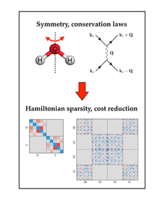
Hamiltonian symmetries in auxiliary-field quantum Monte Carlo calculations for electronic structure

Mario Motta, Shiwei Zhang, and Garnet Kin-Lic Chan

Phys. Rev. B 100, 045127 (2019) - Published 19 July, 2019

Quantum Monte Carlo simulations provide a powerful tool to compute static properties of quantum many-particle models and realistic systems. Here, the authors present a technique to reduce the computational cost of computing ground-state energies, properties, and correlation functions in the framework of the auxiliary-field quantum Monte Carlo method. This is based on a simple application of group theory, and can be readily transferred to other computational methodologies for many-particle systems.

Poor man's topological quantum gate based on the Su-Schrieffer-Heeger model

Péter Boross, János K. Asbóth, Gábor Széchenyi, László Oroszlány, and András Pályi

Phys. Rev. B 100, 045414 (2019) - Published 19 July, 2019

Electronic, vibrational, elastic, and piezoelectric properties of monolayer Janus MoSTe phases: A first-principles study

M. Yagmurcukardes, C. Sevik, and F. M. Peeters

Phys. Rev. B 100, 045415 (2019) - Published 19 July, 2019

Self-induced topological transition in phononic crystals by nonlinearity management

Rajesh Chaunsali and Georgios Theocharis

Phys. Rev. B 100, 014302 (2019) - Published 18 July, 2019

Group theoretical approach to computing phonons and their interactions

Lyuwen Fu, Mordechai Kornbluth, Zhengqian Cheng, and Chris A. Marianetti

Phys. Rev. B 100, 014303 (2019) - Published 18 July, 2019

The authors introduce a formalism for computing phonons and their interactions based upon space group irreducible derivatives, yielding an approach that satisfies all symmetries by construction. The formalism provides the most efficient finite-displacement algorithm allowed by group theory, resulting in speedups of more than an order of magnitude compared to competing approaches. These gains will make possible the study of vibrations in far more complex materials by means of DFT in addition to allowing expensive methods beyond DFT to be employed.

Asymmetry induces long-lasting energy current transients inside molecular loop circuits

Fabienne Michelini and Katawoura Beltako

Phys. Rev. B 100, 024308 (2019) - Published 18 July, 2019

Quantum computing with sine-Gordon qubits

Dong-Sheng Wang

Phys. Rev. B 100, 024418 (2019) - Published 18 July, 2019

Anisotropy and orbital moment in Sm-Co permanent magnets

Bhaskar Das, Renu Choudhary, Ralph Skomski, Balamurugan Balasubramanian, Arjun K. Pathak, Durga Paudyal, and David J. Sellmyer

Phys. Rev. B 100, 024419 (2019) - Published 18 July, 2019
Sign In to Your Journals Account

Filter

Recent Issues

Vol. 114, Iss. 30
15 November 2026
Vol. 114, Iss. 29
15 November 2026
Vol. 114, Iss. 28
15 November 2026
Vol. 114, Iss. 27
1 November 2026
Category
Article Type
Section

Filter

Article Lookup

Enter a citation