Recent Articles

Superconductivity-driven helical magnetic structure in EuRbFe4As4 ferromagnetic superconductor

Zh. Devizorova and A. Buzdin

Phys. Rev. B 100, 104523 (2019) - Published 23 September, 2019

Real time time-dependent density functional theory using higher order finite-element methods

Bikash Kanungo and Vikram Gavini

Phys. Rev. B 100, 115148 (2019) - Published 23 September, 2019

Assessing exchange-correlation functional performance in the chalcogenide lacunar spinels GaM4Q8 (M=Mo, V, Nb, Ta; Q=S,Se)

Yiqun Wang, Danilo Puggioni, and James M. Rondinelli

Phys. Rev. B 100, 115149 (2019) - Published 23 September, 2019

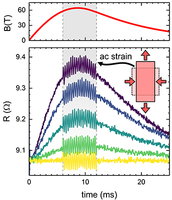
Growth of nematic susceptibility in the field-induced normal state of an iron-based superconductor revealed by elastoresistivity measurements in a 65 T pulsed magnet

J. A. W. Straquadine, J. C. Palmstrom, P. Walmsley, A. T. Hristov, F. Weickert, F. F. Balakirev, M. Jaime, R. McDonald, and I. R. Fisher

Phys. Rev. B 100, 125147 (2019) - Published 23 September, 2019

In iron-based superconductors, questions surrounding a putative nematic quantum critical point motivate study of the nematic susceptibility at low temperatures. By suppressing superconductivity with pulsed magnetic fields, this work extends the range of elastoresistivity measurements in nearly optimally doped Ba(CoxFe1−x)2As2 an order of magnitude lower in temperature. The authors show that the nematic susceptibility in the field-induced normal state grows monotonically as temperature decreases. This is consistent with the existence of a nearby quantum critical point with nematic character.

From coupled-wire construction of quantum Hall states to wave functions and hydrodynamics

Yukihisa Imamura, Keisuke Totsuka, and T. H. Hansson

Phys. Rev. B 100, 125148 (2019) - Published 23 September, 2019

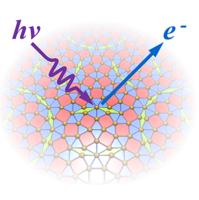
Electronic band structure of a two-dimensional oxide quasicrystal

Cheng-Tien Chiang, Martin Ellguth, Florian O. Schumann, Christian Tusche, Richard Kraska, Stefan Förster, and Wolf Widdra

Phys. Rev. B 100, 125149 (2019) - Published 23 September, 2019

Since the discovery of quasicrystals, the study of their electronic structure has been a challenging topic due to the absence of translational symmetry. Here, the valence bands of a novel two-dimensional ultrathin BaTiO3-derived oxide quasicrystal are determined by momentum-resolved photoelectron spectroscopy. The dispersion of the oxygen 2p bands and the occupation of the Ti 3d states are identified. They bridge the knowledge deriving from free-electron-like wave functions in bulk quasicrystals to that of the more localized electrons in confined dimensions.

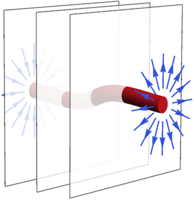
Fractonic matter in symmetry-enriched U(1) gauge theory

Dominic J. Williamson, Zhen Bi, and Meng Cheng

Phys. Rev. B 100, 125150 (2019) - Published 23 September, 2019

This study reveals the relation between symmetry restrictions on the mobility of quasiparticles and symmetry-enriched topological order, where the actions of translation and global symmetries on quasiparticle excitations do not commute. The approach is demonstrably fruitful as one can systematically classify U(1) gauge theories enriched by translation and certain global symmetry and identify new examples of fractonic matter. It is conjectured that all such theories can be constructed by gauging layered symmetry-protected topological phases.

Optical and photoelectrical studies on anisotropic metal-insulator transition of RuAs

Yuki Nakajima, Zenjiro Mita, Hiroshi Watanabe, Yoshiyuki Ohtsubo, Takahiro Ito, Hisashi Kotegawa, Hitoshi Sugawara, Hideki Tou, and Shin-ichi Kimura

Phys. Rev. B 100, 125151 (2019) - Published 23 September, 2019

SU(3) fermions in a three-band graphene-like model

Ankur Das and Sumiran Pujari

Phys. Rev. B 100, 125152 (2019) - Published 23 September, 2019

Multiphonon Raman scattering mediated by the exciton states in monolayer transition metal chalcogenides

Zi-Wu Wang, Yao Xiao, Jia-Pei Deng, Yu Cui, and Zhi-Qing Li

Phys. Rev. B 100, 125308 (2019) - Published 23 September, 2019

Making trotters sprint: A variational imaginary time ansatz for quantum many-body systems

Matthew J. S. Beach, Roger G. Melko, Tarun Grover, and Timothy H. Hsieh

Phys. Rev. B 100, 094434 (2019) - Published 20 September, 2019

Magnetic circular dichroism in hard x-ray Raman scattering as a probe of local spin polarization

Manabu Takahashi and Nozomu Hiraoka

Phys. Rev. B 100, 094435 (2019) - Published 20 September, 2019

Microscopic evidence of a quantum magnetization process in the S=12 triangular-lattice Heisenberg-like antiferromagnet Ba3CoSb2O9

X. Z. Liu, O. Prokhnenko, D. Yamamoto, M. Bartkowiak, N. Kurita, and H. Tanaka

Phys. Rev. B 100, 094436 (2019) - Published 20 September, 2019

Evolution of topological superconductivity by orbital-selective confinement in oxide nanowires

C. A. Perroni, V. Cataudella, M. Salluzzo, M. Cuoco, and R. Citro

Phys. Rev. B 100, 094526 (2019) - Published 20 September, 2019

Dimerization and effective decoupling in two spin-1 generalizations of the spin-12 Majumdar-Ghosh chain

Natalia Chepiga and Frédéric Mila

Phys. Rev. B 100, 104426 (2019) - Published 20 September, 2019

Excitation of unidirectional exchange spin waves by a nanoscale magnetic grating

Jilei Chen, Tao Yu, Chuanpu Liu, Tao Liu, Marco Madami, Ka Shen, Jianyu Zhang, Sa Tu, Md Shah Alam, Ke Xia, Mingzhong Wu, Gianluca Gubbiotti, Yaroslav M. Blanter, Gerrit E. W. Bauer, and Haiming Yu

Phys. Rev. B 100, 104427 (2019) - Published 20 September, 2019

Unidirectional propagation of spin waves is key to the realization of magnonic logic devices. Here, the authors experimentally demonstrate excitations of unidirectional exchange spin waves by a nanoscale magnetic grating fabricated on an ultrathin yttrium iron garnet film. The authors explain and model the nearly perfect unidirectional excitation by the chirality of the magnetodipolar interactions. Reversal of the magnetic configurations changes the direction of the exchange spin waves. Such results raise the prospect of a chiral magnonic logic without the need for fragile surface states.

Nature of the superconducting fluctuations in photoexcited systems

Ryuta Iwazaki, Naoto Tsuji, and Shintaro Hoshino

Phys. Rev. B 100, 104521 (2019) - Published 20 September, 2019

Numerically exact study of Weyl superconductivity

Peter Rosenberg, Niraj Aryal, and Efstratios Manousakis

Phys. Rev. B 100, 104522 (2019) - Published 20 September, 2019

Symmetry fractionalization, defects, and gauging of topological phases

Maissam Barkeshli, Parsa Bonderson, Meng Cheng, and Zhenghan Wang

Phys. Rev. B 100, 115147 (2019) - Published 20 September, 2019

This paper develops a comprehensive theory of symmetry fractionalization together with the properties of symmetry defects in topologically ordered phases of matter in two spatial dimensions. To do this, the authors also introduce the full set of data, consistency conditions, and equivalences for a mathematical theory, known as a G-crossed braided tensor category, that characterizes the algebraic braiding and fusion properties of symmetry defects. This theoretical framework can completely characterize and classify symmetry-enriched topological phases of matter in the presence of arbitrarily strong interactions in quantum many-body systems in two spatial dimensions.

Topological resonance and single-optical-cycle valley polarization in gapped graphene

S. Azar Oliaei Motlagh, Fatemeh Nematollahi, Vadym Apalkov, and Mark I. Stockman

Phys. Rev. B 100, 115431 (2019) - Published 20 September, 2019

Sign In to Your Journals Account

Filter

Recent Issues

Vol. 114, Iss. 30
15 November 2026
Vol. 114, Iss. 29
15 November 2026
Vol. 114, Iss. 28
15 November 2026
Vol. 114, Iss. 27
1 November 2026
Category
Article Type
Section

Filter

Article Lookup

Enter a citation