Recent Articles

Engineering spin-valley physics in bilayers of MoSe2

Poonam Kumari, Joydeep Chatterjee, and Priya Mahadevan

Phys. Rev. B 101, 045432 (2020) - Published 30 January, 2020

Probing interacting two-level systems with rare-earth ions

Dapeng Ding, David van Driel, Lino M. C. Pereira, Jared F. Bauters, Martijn J. R. Heck, Gesa Welker, Michiel J. A. de Dood, André Vantomme, John E. Bowers, Wolfgang Löffler, and Dirk Bouwmeester

Phys. Rev. B 101, 014209 (2020) - Published 29 January, 2020

Ab initio typical medium theory of substitutional disorder

A. Östlin, Y. Zhang, H. Terletska, F. Beiuşeanu, V. Popescu, K. Byczuk, L. Vitos, M. Jarrell, D. Vollhardt, and L. Chioncel

Phys. Rev. B 101, 014210 (2020) - Published 29 January, 2020

Temperature dependence of exchange stiffness in an off-stoichiometric Ni2MnIn Heusler alloy

K. Niitsu, X. Xu, R. Y. Umetsu, R. Kainuma, and K. Harada

Phys. Rev. B 101, 014443 (2020) - Published 29 January, 2020

Self-consistent local mean-field theory for phase transitions and magnetic properties of FeRh

Brianne R. McGrath, Robert E. Camley, and Karen L. Livesey

Phys. Rev. B 101, 014444 (2020) - Published 29 January, 2020

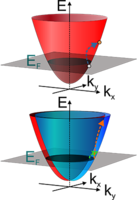
Field and temperature dependence of the skyrmion lattice phase in chiral magnet membranes

David M. Burn, Shasha Wang, Weiwei Wang, Gerrit van der Laan, Shilei Zhang, Haifeng Du, and Thorsten Hesjedal

Phys. Rev. B 101, 014446 (2020) - Published 29 January, 2020

Using high-resolution small-angle resonant elastic x-ray scattering, the authors study here the field and temperature dependence of the skyrmion lattice in FeGe membranes. In stark contrast to Cu2OSeO3, the lattice constant and skyrmion size undergo a continuous evolution within the skyrmion phase pocket, whereby the lattice constant changes by up to 15%. Micromagnetic modeling shows that the competing energy terms contributing to the formation of the skyrmion lattice fully explain the observed breathing behavior.

Electric field modulation of exchange bias at the Co/CoOx interface

T. Hirai, T. Koyama, and D. Chiba

Phys. Rev. B 101, 014447 (2020) - Published 29 January, 2020

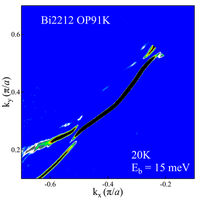
Selective hybridization between the main band and the superstructure band in the Bi2Sr2CaCu2O8+δ superconductor

Qiang Gao, Hongtao Yan, Jing Liu, Ping Ai, Yongqing Cai, Cong Li, Xiangyu Luo, Cheng Hu, Chunyao Song, Jianwei Huang, Hongtao Rong, Yuan Huang, Qingyan Wang, Guodong Liu, Genda Gu, Fengfeng Zhang, Feng Yang, Shenjin Zhang, Qinjun Peng, Zuyan Xu, Lin Zhao, Tao Xiang, and X. J. Zhou

Phys. Rev. B 101, 014513 (2020) - Published 29 January, 2020

Unexpected hybridization between the main band and the superstructure band in the Bi2Sr2CaCu2O8+δ (Bi2212) superconductor is revealed by high-resolution laser-based angle-resolved photoemission measurements. It can be understood by considering the selective hybridization of bands from the bilayer splitting in Bi2212. These observations indicate that the origin of the superstructure bands is intrinsic to the CuO2 planes. Understanding the physical properties and superconductivity in Bi2212 needs consideration of the complete Fermi surface topology, involving the main bands, the superstructure bands, and their interactions.

Quantum many-body scar states with emergent kinetic constraints and finite-entanglement revivals

Thomas Iadecola and Michael Schecter

Phys. Rev. B 101, 024306 (2020) - Published 29 January, 2020

Strongly interacting systems with quantum many-body scars exhibit persistent fidelity oscillations when prepared in a certain class of initial states, but otherwise undergo ergodic dynamics. Previous examples of scars have interpreted the characteristic periodic dynamics in terms of the precession of a macroscopic SU(2) spin in an effective magnetic field. Here, the authors uncover a new exactly solvable example of many-body scars in a spin-½ model and show that the scarred dynamics in this model evades such an interpretation. This unusual coherent dynamics arises due to an emergent kinetic constraint that endows the time-evolving many-body state with constant area-law entanglement. The model studied in this work is relevant to experiments on Rydberg-atom quantum simulators in the antiblockade regime.

Diameter-dependent thermal conductivity of ultrathin GaP nanowires: A molecular dynamics study

Subash Gireesan, Pol Torres, F. Xavier Alvarez, and Peter A. Bobbert

Phys. Rev. B 101, 024307 (2020) - Published 29 January, 2020

Magnetization switching in bistable nanomagnets by picosecond pulses of surface acoustic waves

Vladimir S. Vlasov, Alexey M. Lomonosov, Anton V. Golov, Leonid N. Kotov, Valentin Besse, Alexandr Alekhin, Dmitry A. Kuzmin, Igor V. Bychkov, and Vasily V. Temnov

Phys. Rev. B 101, 024425 (2020) - Published 29 January, 2020

Interacting Majorana modes at surfaces of noncentrosymmetric superconductors

Janna E. Rückert, Gergő Roósz, and Carsten Timm

Phys. Rev. B 101, 024519 (2020) - Published 29 January, 2020

Majorana modes are currently receiving a lot of attention, in part because they may be useful for quantum computation. One proposed platform to realize a large number of Majorana zero-energy modes involves flat bands at surfaces of superconductors lacking inversion symmetry. Here, the authors investigate what happens to these flat Majorana bands if interactions beyond BCS mean-field theory are taken into account. They find that the resulting strongly interacting system exhibits both interesting topological properties and spontaneous symmetry breaking.

Time dynamics with matrix product states: Many-body localization transition of large systems revisited

Titas Chanda, Piotr Sierant, and Jakub Zakrzewski

Phys. Rev. B 101, 035148 (2020) - Published 29 January, 2020

Quantum critical behavior and thermodynamics of the repulsive one-dimensional Hubbard model in a magnetic field

Ovidiu I. Pâţu, Andreas Klümper, and Angela Foerster

Phys. Rev. B 101, 035149 (2020) - Published 29 January, 2020

Charge ordering and low-temperature lattice distortion in the β′-(BEDT-TTF)2CF3CF2SO3 dimer Mott insulator

I. Olejniczak, R. Wesołowski, H. O. Jeschke, R. Valentí, B. Barszcz, and J. A. Schlueter

Phys. Rev. B 101, 035150 (2020) - Published 29 January, 2020

Depth-resolved core level spectroscopy of noncentrosymmetric solid BiPd

Arindam Pramanik, Ram Prakash Pandeya, Khadiza Ali, Bhanu Joshi, Indranil Sarkar, Paolo Moras, Polina M. Sheverdyaeva, Asish K. Kundu, Carlo Carbone, A. Thamizhavel, S. Ramakrishnan, and Kalobaran Maiti

Phys. Rev. B 101, 035426 (2020) - Published 29 January, 2020

Inelastic light scattering by intrasubband spin-density excitations in GaAs-AlGaAs quantum wells with balanced Bychkov-Rashba and Dresselhaus spin-orbit interaction: Quantitative determination of the spin-orbit field

S. Gelfert, C. Frankerl, C. Reichl, D. Schuh, G. Salis, W. Wegscheider, D. Bougeard, T. Korn, and C. Schüller

Phys. Rev. B 101, 035427 (2020) - Published 29 January, 2020

The theoretically infinite spin lifetime makes the persistent spin helix (PSH) a very interesting candidate for spintronic research. Resonant Raman scattering on spin-density excitations permits insights into subtle many-body effects. Utilizing electronic Raman scattering, the authors present here a precise mapping of the huge spin-splitting anisotropy for two different configurations of the PSH. By modulating the effective spin-orbit fields with an external magnetic field, they reveal electron g factors for the two different configurations, probably influenced by collective effects in the intrasubband spin-density excitations.

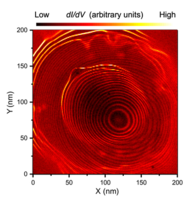
Tuning single-electron charging and interactions between compressible Landau level islands in graphene

Daniel Walkup, Fereshte Ghahari, Christopher Gutiérrez, Kenji Watanabe, Takashi Taniguchi, Nikolai B. Zhitenev, and Joseph A. Stroscio

Phys. Rev. B 101, 035428 (2020) - Published 29 January, 2020

Interacting and tunable quantum dots (QDs) provide a powerful testbed in condensed matter physics and quantum information science. Here, the authors use a low-temperature scanning tunneling microscope to both create and directly image a new type of coupled QD system in graphene. In a strong magnetic field, the carriers condense into Landau levels (LLs), and the successive LLs form concentric spatially isolated Coulomb islands (compressible rings) within the confining electric potential well that behave as controllably coupled QDs.

Reentrance of the topological phase in a spin-1 frustrated Heisenberg chain

Yuan Yang, Shi-Ju Ran, Xi Chen, Zheng-Zhi Sun, Shou-Shu Gong, Zhengchuan Wang, and Gang Su

Phys. Rev. B 101, 045133 (2020) - Published 29 January, 2020

High-precision numerical solution of the Fermi polaron problem and large-order behavior of its diagrammatic series

Kris Van Houcke, Félix Werner, and Riccardo Rossi

Phys. Rev. B 101, 045134 (2020) - Published 29 January, 2020

The Fermi polaron is a quasiparticle that emerges when a mobile impurity is coupled to an ideal Fermi gas through a short-range interaction. Here, the authors introduce a simple Monte Carlo algorithm to compute its ground-state properties by evaluating the Feynman diagrammatic series. The fermionic sign does not cause any fundamental problem when going to high diagrammatic orders, and order N=30 is easily reached. Resummation of the divergent series through a conformal mapping yields the polaron energy with record accuracy.

Sign In to Your Journals Account

Filter

Recent Issues

Vol. 114, Iss. 30
15 November 2026
Vol. 114, Iss. 29
15 November 2026
Vol. 114, Iss. 28
15 November 2026
Vol. 114, Iss. 27
1 November 2026
Category
Article Type
Section

Filter

Article Lookup

Enter a citation