Recent Articles

Nonlinear ac Hall effect in two-dimensional superconductors

K. Sonowal, A. V. Parafilo, V. M. Kovalev, and I. G. Savenko

Phys. Rev. B 110, 205413 (2024) - Published 8 November, 2024

Angle-resolved photoelectron spectroscopy of the (8.88×8.88) incommensurate surface reconstruction of Cu on Ge(111)

Mathis Cameau, Tristan Cren, Pascal David, François Debontridder, Natalia Olszowska, Marcin Rosmus, Mathieu G. Silly, and Marie D'angelo

Phys. Rev. B 110, 205414 (2024) - Published 8 November, 2024

Two-dimensional higher-order topological metals

Lizhou Liu, Cheng-Ming Miao, Qing-Feng Sun, and Ying-Tao Zhang

Phys. Rev. B 110, 205415 (2024) - Published 8 November, 2024

Absorption of electromagnetic waves in a screened two-dimensional electron system

V. M. Muravev, I. V. Andreev, N. D. Semenov, P. A. Gusikhin, and I. V. Kukushkin

Phys. Rev. B 110, 205416 (2024) - Published 8 November, 2024

Neural network enabled molecular dynamics study of HfO2 phase transitions

Sebastian Bichelmaier, Jesús Carrete, and Georg K. H. Madsen

Phys. Rev. B 110, 174105 (2024) - Published 7 November, 2024

Ga vacancies as dominant intrinsic acceptors in Sn-doped β−Ga2O3 revealed by positron annihilation spectroscopy

Y. H. Li, Y. Dong, G. W. Xu, Y. Z. Bu, Q. L. Sai, H. J. Qi, S. B. Long, Z. Q. Chen, B. J. Ye, and H. J. Zhang

Phys. Rev. B 110, 174106 (2024) - Published 7 November, 2024

Microscopic theory of spin Nernst effect

Junji Fujimoto, Taiki Matsushita, and Masao Ogata

Phys. Rev. B 110, 174411 (2024) - Published 7 November, 2024

Topological magnon in exchange frustration driven incommensurate spin spiral of kagome-lattice YMn6Sn6

Banasree Sadhukhan, Anders Bergman, Patrik Thunström, Manuel Pereiro Lopez, Olle Eriksson, and Anna Delin

Phys. Rev. B 110, 174412 (2024) - Published 7 November, 2024

Excitation of fundamental multiple dark solitons from forced biharmonic oscillations in a magnonic active ring

Alexey B. Ustinov, Leonid S. Vedernikov, Ivan Y. Tatsenko, and Andrey A. Stashkevich

Phys. Rev. B 110, 174413 (2024) - Published 7 November, 2024

Raman spectroscopic study on Bi2Rh3Se2: Two-dimensional Ising charge density wave and quantum fluctuations

Fei Jiao, Yonghui Zhou, Shuyang Wang, Chao An, Xuliang Chen, Ying Zhou, Min Zhang, Liang Cao, Xigang Luo, Yimin Xiong, and Zhaorong Yang

Phys. Rev. B 110, 174505 (2024) - Published 7 November, 2024

Relationship between orbital moment anisotropy, magnetocrystalline anisotropy, and Dzyaloshinskii-Moriya interaction in W/Co/Pt trilayers

Zhendong Chi, Yong-Chang Lau, Vanessa Li Zhang, Goro Shibata, Shoya Sakamoto, Yosuke Nonaka, Keisuke Ikeda, Yuxuan Wan, Masahiro Suzuki, Masashi Kawaguchi, Masako Suzuki-Sakamaki, Kenta Amemiya, Naomi Kawamura, Masaichiro Mizumaki, Motohiro Suzuki, Hyunsoo Yang, Masamitsu Hayashi, and Atsushi Fujimori

Phys. Rev. B 110, 184401 (2024) - Published 7 November, 2024

Magnetism and field-induced effects in the S=52 honeycomb lattice antiferromagnet FeP3SiO11

J. Khatua, M. Gomilšek, Kwang-Yong Choi, and P. Khuntia

Phys. Rev. B 110, 184402 (2024) - Published 7 November, 2024

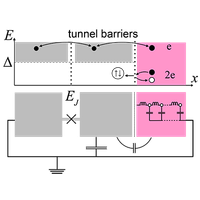
Limitations of Caldeira-Leggett model for description of phase transitions in superconducting circuits

O. Kashuba and R.-P. Riwar

Phys. Rev. B 110, 184505 (2024) - Published 7 November, 2024

Accurate modeling of system-bath interactions in quantum systems is a challenge of intrinsic complexity. Here, the authors show that seemingly minute changes in the model approximations heavily impact the renormalization group flow and phase diagram of resistive superconducting circuits. A modified Caldeira-Leggett model is presented with four instead of two control parameters. While the Schmid-Bulgadaev phase transition persists in the transmon regime, it is driven exclusively by capacitive coupling. The Cooper pair box limit maps to the anisotropic Kondo model with a forbidden ferromagnetic phase.

Effect of correlated disorder on superconductivity in a kagome lattice: A Bogoliubov–de Gennes analysis

Ravi Kiran, Sudipta Biswas, and Monodeep Chakraborty

Phys. Rev. B 110, 184506 (2024) - Published 7 November, 2024

Spin orbital lattice entanglement in the ideal j=12 compound K2IrCl6

P. Warzanowski, M. Magnaterra, Ch. J. Sahle, M. Moretti Sala, P. Becker, L. Bohatý, I. Císařová, G. Monaco, T. Lorenz, P. H. M. van Loosdrecht, J. van den Brink, and M. Grüninger

Phys. Rev. B 110, 195120 (2024) - Published 7 November, 2024

Materials with spin-orbit entangled j=½ moments provide a rich playground for frustrated quantum magnetism. Combining resonant inelastic x-ray scattering, optical spectroscopy, and x-ray diffraction, the authors show here that cubic K2IrCl6 hosts ideal spin-orbit entangled j=½ moments. Importantly, they also show that the j=³⁄₂ excited states hybridize with vibrational states leading to spin orbital lattice entanglement in K2IrCl6, thereby substantially enriching the field of spin-orbit entangled materials physics.

Tunable surface electron gas and effect of phonons in Sr2CuO3: A first-principles study

Xin Du, Hui-Hui He, Xiao-Xiao Man, Zhong-Yi Lu, and Kai Liu

Phys. Rev. B 110, 195121 (2024) - Published 7 November, 2024

Insulator-to-insulator transition and sign problem in the periodic Anderson model with a staggered potential

Mengfan Wang, Danqing Hu, and Yi-feng Yang

Phys. Rev. B 110, 195122 (2024) - Published 7 November, 2024

Ferromagnetic ferroelectricity due to the Kugel-Khomskii mechanism of orbital ordering assisted by atomic Hund's second rule effects

I. V. Solovyev, R. Ono, and S. A. Nikolaev

Phys. Rev. B 110, 205116 (2024) - Published 7 November, 2024

Ferromagnetic ferroelectricity is a fundamentally interesting and technologically important phenomenon. Nevertheless, the coexistence of ferroelectricity and ferromagnetism is extremely rare in nature. Here, the authors propose how the ferromagnetic ferroelectricity can be induced by the orbital degrees of freedom: if two magnetic sites are connected by the spatial inversion and the system can freely choose which orbitals to occupy, the occupation of unlike orbitals across the inversion center will not only stabilize the ferromagnetic coupling, but also break the inversion symmetry, thus resulting in the ferroelectric-ferromagnetic ground state. The phenomenon is expected in the layered van der Waals ferromagnet VI3, where atomic Hund’s second rule effects provide a sufficient flexibility for the orbital degrees of freedom to form the ordered pattern with broken inversion symmetry.

Thermodynamics of strain engineering in RNiO3 (R=Sm,Nd)

Yin Shi and Long-Qing Chen

Phys. Rev. B 110, 205117 (2024) - Published 7 November, 2024

Electronic topological transitions in cadmium under pressure studied via theoretical and experimental x-ray absorption spectroscopy

Jasmine K. Hinton, Daniel Schacher, Wonseok Lee, G. Alexander Smith, Emily Siska, Changyong Park, Paul B. Ellison, Scott K. Cushing, Craig P. Schwartz, Keith V. Lawler, and Ashkan Salamat

Phys. Rev. B 110, 205118 (2024) - Published 7 November, 2024
Sign In to Your Journals Account

Filter

Recent Issues

Vol. 114, Iss. 30
15 November 2026
Vol. 114, Iss. 29
15 November 2026
Vol. 114, Iss. 28
15 November 2026
Vol. 114, Iss. 27
1 November 2026
Category
Article Type
Section

Filter

Article Lookup

Enter a citation