Recent Articles

Microscopic origin of gray tracks in KTiOPO4

A. Bocchini, U. Gerstmann, and W. G. Schmidt

Phys. Rev. B 111, 104103 (2025) - Published 7 March, 2025

Spectral and entanglement properties of the random-exchange Heisenberg chain

Yilun Gao and Rudolf A. Römer

Phys. Rev. B 111, 104202 (2025) - Published 7 March, 2025

Ergodicity-breaking phase diagram and fractal dimensions in long-range models with generically correlated disorder

Shilpi Roy, Saurabh Basu, and Ivan M. Khaymovich

Phys. Rev. B 111, 104203 (2025) - Published 7 March, 2025

Quantum spin liquid ground state in the rare-earth triangular antiferromagnet SmTa7O19

Dhanpal Bairwa, Abhisek Bandyopadhyay, Devashibhai Adroja, G. B. G. Stenning, Hubertus Luetkens, Thomas James Hicken, Jonas A. Krieger, G. Cibin, M. Rotter, S. Rayaprol, P. D. Babu, and Suja Elizabeth

Phys. Rev. B 111, 104413 (2025) - Published 7 March, 2025

A quantum spin liquid (QSL) is a novel state of matter that hosts long-range quantum entanglement, absence of magnetic ordering, and exotic fractionalized quasiparticle excitations. The geometrically frustrated magnets promote strong quantum fluctuations at low-T, which offer an excellent route to stabilize the QSL phase. Here, the authors demonstrate a gapless QSL ground state of the triangular lattice antiferromagnet Sm-heptatantalate SmTa7O19 through combined dc and ac magnetization, specific heat, universal scaling analysis, and muon spin relaxation/rotation (μSR) study down to 30 mK. The zero-field μSR discards magnetic ordering transition, while the longitudinal field muon-decoupling measurements show the emphasis of the dynamic nature of the magnetic ground state.

Anomalous charge transport in the sine-Gordon model

Frederik Møller, Botond C. Nagy, Márton Kormos, and Gábor Takács

Phys. Rev. B 111, 115121 (2025) - Published 7 March, 2025

Spin Hall conductivity, magnetoresistance, and nontrivial topology in BeAu

Arka Bhowmick, Jaspreet Singh, and V. Kanchana

Phys. Rev. B 111, 115122 (2025) - Published 7 March, 2025

Electron-phonon coupling in half-Heusler compounds: A comparative study of TiCoSb and TiNiSn

Ran Zhou, Han-Pu Liang, Hongliang Shi, and Yifeng Duan

Phys. Rev. B 111, 115201 (2025) - Published 7 March, 2025

Dynamics for unstable self-induced plasma field of electrons driven by a transient electric field in a quantum wire

Xuejun Lu, Danhong Huang, Godfrey Gumbs, Timothy T. Clark, and Ashwani Sharma

Phys. Rev. B 111, 115302 (2025) - Published 7 March, 2025

Lattice dynamics and spin-phonon coupling in the kagome spin ice HoAgGe

Shangfei Wu, Lingxiao Zhao, Wei Song, Mingshu Tan, Feng Jin, Tianping Ying, Jia-Xin Yin, and Qingming Zhang

Phys. Rev. B 111, 125116 (2025) - Published 7 March, 2025

Enhanced magnetic ordering in the heavy lanthanide Er metal under megabar pressures

Hongyu Liu, Jing Song, Wei Wu, Baosen Min, Sijia Zhang, Shaomin Feng, Xiancheng Wang, and Changqing Jin

Phys. Rev. B 111, 125117 (2025) - Published 7 March, 2025

Lifshitz transition and triplet p-wave pairing from the induced ferromagnetic plaquette via spin differentiated nonlocal interaction

Rayan Farid, Daria Gazizova, B. D. E. McNiven, and J. P. F. LeBlanc

Phys. Rev. B 111, 125118 (2025) - Published 7 March, 2025

Influence of Fermi level pinning on contact potential difference measurements using Kelvin probe force microscopy

Nobuyuki Ishida

Phys. Rev. B 111, 125304 (2025) - Published 7 March, 2025

Auto-organization of 2H|3R lateral boundaries in bilayer WSe2 grown by chemical vapor deposition

Gaia Di Berardino, Meryem Bouaziz, Gilles Patriarche, Julien Chaste, Abdelkarim Ouerghi, and Fabrice Oehler

Phys. Rev. B 111, 125403 (2025) - Published 7 March, 2025

Probing the temperature-induced phase transition mechanism in PbTiO3−BiM0.5Ti0.5O3 ferroelectrics across the morphotropic phase boundary

B. Mihailova, L. Bayarjargal, I. Margaritescu, K. Datta, and J. Chen

Phys. Rev. B 111, 094105 (2025) - Published 6 March, 2025

Third harmonic resistance in ferromagnet/heavy-metal bilayers

Yuteng Ma, Hang Xie, Yuxin Si, Bin Rong, Jiaqi Wang, Hongsheng Zheng, Yanghui Liu, Yihong Wu, and Yumeng Yang

Phys. Rev. B 111, 094409 (2025) - Published 6 March, 2025

Unconventional superconductivity mediated by nematic fluctuations in a multiorbital system: Application to doped FeSe

Kazi Ranjibul Islam and Andrey Chubukov

Phys. Rev. B 111, 094503 (2025) - Published 6 March, 2025

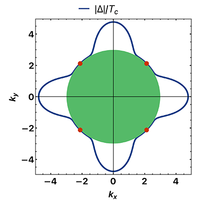
In unconventional superconductors, pairing is believed to be of electronic origin, and linked to critical collective fluctuations. Here, the authors investigate how nematic fluctuations, responsible for orbital polarization, mediate pairing in doped FeSe. They show that nematic-mediated pairing is highly unconventional and leads to a highly anisotropic gap structure. This in turn gives rise to pronounced non-BCS behavior of observables. The authors compute thermodynamic, spectroscopic, and transport characteristics, find good agreement with the experimental data, and propose further experiments to test their predictions.

Melting curves of atomic hydrogen and deuterium calculated using path-integral Monte Carlo

Kevin K. Ly and David M. Ceperley

Phys. Rev. B 111, 104102 (2025) - Published 6 March, 2025

Anomalous Hall effect in the polar magnet Gd3Ni8Sn4: A candidate for hosting skyrmions

Arnab Bhattacharya, Afsar Ahmed, Apurba Dutta, Ajay Kumar, Prashant Singh, Anis Biswas, Yaroslav Mudryk, and I. Das

Phys. Rev. B 111, 104410 (2025) - Published 6 March, 2025

Tuning fieldlike torque by the orbital Hall effect in Ta/ferromagnetic metal structures

Zezheng Zhang, Jun Zhang, Zhenyi Weng, Jiahao Li, Heyuan Song, and Weinan Lin

Phys. Rev. B 111, 104412 (2025) - Published 6 March, 2025

Phase-dependent supercurrent and microwave dissipation of HgTe quantum well Josephson junctions

Wei Liu, Stanislau U. Piatrusha, Lena Fürst, Lukas Lunczer, Tatiana Borzenko, Martin P. Stehno, and Laurens W. Molenkamp

Phys. Rev. B 111, 104503 (2025) - Published 6 March, 2025

Future applications of semiconductor-superconductor heterostructures in quantum information science rely on careful engineering of proximity-induced quantum states. The authors apply here microwave admittance measurements to extract the current-phase relation and phase-dependent microwave dissipation in gated HgTe quantum well Josephson junctions. The experimental results are in good agreement with modeling of the Andreev bound state spectrum based on tight-binding simulations of the Bogoliubov–de Gennes equations. This allows to disentangle the effects of interface transparency, disorder, and magnitude of the superconducting energy gap.

Sign In to Your Journals Account

Filter

Recent Issues

Vol. 114, Iss. 30
15 November 2026
Vol. 114, Iss. 29
15 November 2026
Vol. 114, Iss. 28
15 November 2026
Vol. 114, Iss. 27
1 November 2026
Category
Article Type
Section

Filter

Article Lookup

Enter a citation