Recent Articles

Interlayer couplings in cuprates: Structural origins, analytical forms, and structural estimators

Zheting Jin and Sohrab Ismail-Beigi

Phys. Rev. B 111, 165103 (2025) - Published 1 April, 2025

Hall field induced resistance oscillations by designed random obstacle arrays

F. Bartels, J. Strobel, B. Horn-Cosfeld, M. Cerchez, K. Pierz, H. W. Schumacher, D. Mailly, and T. Heinzel

Phys. Rev. B 111, 165301 (2025) - Published 1 April, 2025

Biermann battery effect in laser-excited metals

Ivan Oladyshkin

Phys. Rev. B 111, L140301 (2025) - Published 1 April, 2025

Efficient electric field control of the magnetic phase in bilayer magnets via interlayer hopping modulation

B. Liu, J. S. Feng, H. J. Xiang, Z. Dai, and Zhi-Xin Guo

Phys. Rev. B 111, L140401 (2025) - Published 1 April, 2025

Near room-temperature ferromagnetism from double exchange in the van der Waals material CrGeTe3: Evidence from optical conductivity under pressure

Jihaan Ebad-Allah, Daniel Guterding, Meera Varma, Mangesh Diware, Shraddha Ganorkar, Harald O. Jeschke, and Christine A. Kuntscher

Phys. Rev. B 111, L140402 (2025) - Published 1 April, 2025

The van der Waals material CrGeTe3 is a ferromagnetic charge-transfer insulator at ambient pressure. When compressed, the material transforms into a semimetal with near room temperature ferromagnetism. Here, the authors present temperature- and pressure-dependent measurements of its optical conductivity, combined with density functional theory and dynamical mean-field theory calculations. A novel approach to analyzing the experimental data reveals that the pressure-induced insulator-to-metal transition alters the mechanism of ferromagnetism in CrGeTe3 from superexchange to double exchange.

Supercurrent through a single transverse mode in nanowire Josephson junctions

B. Zhang, Z. Li, H. Wu, M. Pendharkar, C. Dempsey, J. S. Lee, S. D. Harrington, C. J. Palmstrøm, and S. M. Frolov

Phys. Rev. B 111, L161401 (2025) - Published 1 April, 2025

Operator dynamics in Floquet many-body systems

Takato Yoshimura, Samuel J. Garratt, and J. T. Chalker

Phys. Rev. B 111, 094316 (2025) - Published 31 March, 2025

Large flexomagnetic response enabled by topological magnetic textures in monolayer CrN

Qihua Gong, Ziming Tang, and Min Yi

Phys. Rev. B 111, 094441 (2025) - Published 31 March, 2025

Low fractional volume superconductivity in single crystals of Pr4Ni3O10 under pressure

Xinglong Chen, E. H. T. Poldi, Shuyuan Huyan, R. Chapai, H. Zheng, S. L. Bud'ko, U. Welp, P. C. Canfield, Russell J. Hemley, J. F. Mitchell, and D. Phelan

Phys. Rev. B 111, 094525 (2025) - Published 31 March, 2025

Continuum model of strong light-matter coupling for molecular polaritons

Suman Gunasekaran, Ryan F. Pinard, and Andrew J. Musser

Phys. Rev. B 111, 104209 (2025) - Published 31 March, 2025

Field-induced ordered phases in anisotropic spin-12 Kitaev chains

Mandev Bhullar, Haoting Xu, and Hae-Young Kee

Phys. Rev. B 111, 104439 (2025) - Published 31 March, 2025

Local noncentrosymmetric effect on antiferromagnetic ordering in the tetragonal crystal structure phase of Eu3Ir4Sn13

Takanobu Kumada, Yotaro Suzuki, Kazuaki Iwasa, Keitaro Kuwahara, Hajime Sagayama, Hironori Nakao, Motoyuki Ishikado, and Akinori Hoshikawa

Phys. Rev. B 111, 104440 (2025) - Published 31 March, 2025

Classification of 1+1D gapless symmetry protected phases via topological holography

Rui Wen and Andrew C. Potter

Phys. Rev. B 111, 115161 (2025) - Published 31 March, 2025

Classifying gapless phases of matter remains a fundamental challenge in condensed matter theory. The authors pioneer here a systematic classification of 1+1D bosonic gapless symmetry-protected topological phases via the Symmetry Topological Field Theory (SymTFT) framework. They derive, from physical considerations, the algebra of symmetry operators in a 1+1D bosonic gSPT and show that it precisely matches the structure of condensable algebras in the SymTFT. This study marks the first systematic classification of gapless quantum phases in the SymTFT paradigm.

Bisognano-Wichmann Hamiltonian for the entanglement spectroscopy of fractional quantum Hall states

A. Nardin, R. Lopes, M. Rizzi, L. Mazza, and S. Nascimbene

Phys. Rev. B 111, 115162 (2025) - Published 31 March, 2025

Tunably polarized driving light controls the phase diagram of one-dimensional quasicrystals and two-dimensional quantum Hall matter

Yifei Bai and David M. Weld

Phys. Rev. B 111, 115163 (2025) - Published 31 March, 2025

Merging bound states in the continuum for ultrahigh-Q near-perfect absorption in all-dielectric gratings

Haosen Zhang, Kedi Wu, and Guo Ping Wang

Phys. Rev. B 111, 115430 (2025) - Published 31 March, 2025

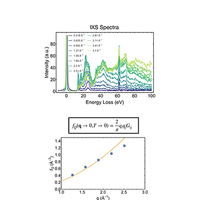
Quantum entanglement and quantum geometry measured with inelastic x-ray scattering

David Bałut, Barry Bradlyn, and Peter Abbamonte

Phys. Rev. B 111, 125161 (2025) - Published 31 March, 2025

The authors experimentally investigate here the quantum geometry and quantum information in the insulator LiF. Using sum rules for the measured density-density response, the authors compute the quantum Fisher information of LiF associated with density perturbations, and from these extrapolate a component of the quantum metric tensor. These results serve as a proof of principle that scattering techniques can quantify state-of-the-art quantum geometric quantities in materials, and establishes the quantum Fisher information as an experimentally accessible generalization of quantum geometry to real materials.

Gapless Floquet topology

Gabriel Cardoso, Hsiu-Chung Yeh, Leonid Korneev, Alexander G. Abanov, and Aditi Mitra

Phys. Rev. B 111, 125162 (2025) - Published 31 March, 2025

FeGe as a building block for the kagome 1:1, 1:6:6, and 1:3:5 families: Hidden d-orbital decoupling of flat band sectors, effective models, and interaction Hamiltonians

Yi Jiang, Haoyu Hu, Dumitru Călugăru, Claudia Felser, Santiago Blanco-Canosa, Hongming Weng, Yuanfeng Xu, and B. Andrei Bernevig

Phys. Rev. B 111, 125163 (2025) - Published 31 March, 2025

The authors develop here a trustworthy framework to model the electronic structure and interactions in kagome metals, starting with FeGe. By identifying symmetry-based orbital groupings, they construct minimal models that capture flat bands, von Hove singularities, and topology. Using these “LEGO-like” building blocks, they extend their approach to a wide range of kagome materials in the 1:1, 1:6:6, and 1:3:5 families, including MgFe6Ge6 and CsCr3Sb5. This framework provides realistic many-body models in order to explore interaction-driven phases in kagome and other materials.

Emergent non-Hermitian conservation laws at exceptional points

Zuo Wang and Liang He

Phys. Rev. B 111, L100305 (2025) - Published 31 March, 2025

Sign In to Your Journals Account

Filter

Recent Issues

Vol. 114, Iss. 30
15 November 2026
Vol. 114, Iss. 29
15 November 2026
Vol. 114, Iss. 28
15 November 2026
Vol. 114, Iss. 27
1 November 2026
Category
Article Type
Section

Filter

Article Lookup

Enter a citation