Recent Articles

Pressure- and temperature-induced phase transition in the semiconductor SnS

Yuyang Shi, Min Wu, Kai Wang, Jie Luo, Hanyu Liu, Ye Wu, and Haijun Huang

Phys. Rev. B 111, 174107 (2025) - Published 14 May, 2025

Significantly enhanced stability of hybrid improper ferroelectricity in Sr3Zr2O7 by isovalent Ca substitution

Q. Luo, Y. S. Lan, H. G. Zhang, P. Wang, C. F. Li, Z. B. Yan, and J.-M. Liu

Phys. Rev. B 111, 174108 (2025) - Published 14 May, 2025

Superconductivity from incoherent Cooper pairs in the strong-coupling regime

Alexander A. Zyuzin and A. Yu. Zyuzin

Phys. Rev. B 111, 174517 (2025) - Published 14 May, 2025

Spin-charge separation and unconventional superconductivity in the t−J model on the honeycomb lattice

Jian-Jian Miao, Zheng-Yuan Yue, Hao Zhang, Wei-Qiang Chen, and Zheng-Cheng Gu

Phys. Rev. B 111, 174518 (2025) - Published 14 May, 2025

Flat-band zero-energy states and anomalous proximity effects in p-wave magnet–superconductor hybrid systems

Yutaro Nagae, Leo Katayama, and Satoshi Ikegaya

Phys. Rev. B 111, 174519 (2025) - Published 14 May, 2025

Models of interacting bosons with exact ground states: A unified approach

Zhaoyu Han and Steven A. Kivelson

Phys. Rev. B 111, 174520 (2025) - Published 14 May, 2025

Improved actions using the renormalization group

Guy Segall, Snir Gazit, and Daniel Podolsky

Phys. Rev. B 111, 184413 (2025) - Published 14 May, 2025

Defect-induced spin textures in magnetic solids

M. E. Zhitomirsky, Vijay B. Shenoy, and Roderich Moessner

Phys. Rev. B 111, 184414 (2025) - Published 14 May, 2025

Capturing the dynamics of the phase transition of skyrmions with a nonstationary machine learning approach

Long Xiong, Neng-Ji Zhou, Shi-Qian Hu, Lei-Lei Nian, and Bo Zheng

Phys. Rev. B 111, 184415 (2025) - Published 14 May, 2025

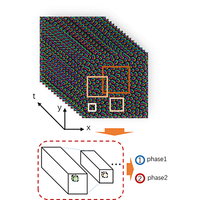
The authors propose here a nonstationary machine learning approach specifically designed for analyzing dynamic phase transitions. By employing a subsampling technique in the short-time regime, this method overcomes the difficulty of critical slowing down. It demonstrates high effectiveness and generalization in determining critical points, and static and dynamic critical exponents in the depinning transition of skyrmions.

Temperature dependence of exchange stiffness and energy barrier in compensated ferrimagnets

Roberto Moreno, Paula G. Bercoff, Unai Atxitia, Richard F. L. Evans, and Oksana Chubykalo-Fesenko

Phys. Rev. B 111, 184416 (2025) - Published 14 May, 2025

Crescent domain-wall pairs in an anisotropic two-dimensional MnOI monolayer with fast dynamics

Yijun Yang, Zhong Shen, Jun Chen, Shuai Dong, and Xiaoyan Yao

Phys. Rev. B 111, 184417 (2025) - Published 14 May, 2025

Maximal critical temperature dependence on the number of layers in hole-doped cuprates due to phonon d-wave pairing

Baruch Rosenstein, B. Ya. Shapiro, and Guy Leshem

Phys. Rev. B 111, 184511 (2025) - Published 14 May, 2025

Magnetic polarons due to spin-length fluctuations in d4 spin-orbit Mott systems

Jan Revenda, Krzysztof Wohlfeld, and Jiří Chaloupka

Phys. Rev. B 111, 195125 (2025) - Published 14 May, 2025

Yukawa-Lorentz symmetry of tilted non-Hermitian Dirac semimetals at quantum criticality

Sergio Pino-Alarcón and Vladimir Juričić

Phys. Rev. B 111, 195126 (2025) - Published 14 May, 2025

Dual role of the stripe phase in superconducting correlations in a bilayer square lattice

Ting Guo, Lufeng Zhang, Tianxing Ma, and Hai-Qing Lin

Phys. Rev. B 111, 195127 (2025) - Published 14 May, 2025

Existence of dual topological phases in Sn-based ternary chalcogenides

Ramesh Kumar and Mukhtiyar Singh

Phys. Rev. B 111, 195128 (2025) - Published 14 May, 2025

Transition metal–hydrogen complexes in SnO2

F. Herklotz, I. Chaplygin, E. V. Lavrov, V. V. Melnikov, Z. Galazka, and L. Vines

Phys. Rev. B 111, 195208 (2025) - Published 14 May, 2025

The authors investigate here transition metal–hydrogen complexes in SnO2 using infrared spectroscopy, SIMS, and first-principles calculations. They identify distinct OH vibrational modes linked to Fe and Cr substitutional centers, and observe a new electronic transition tentatively assigned to Ir. These findings clarify how hydrogen interacts with dopants in SnO2, offering insights into defect structures that influence conductivity, catalytic activity, and optical properties, critical for optimizing this material in sensing, electronics, and energy applications.

Exceptional thermoelectric performance and strong high-order phonon anharmonicity in the ternary tellurides XAgTe(X=K,Rb,Cs)

Xuhao Song, Kang Li, Dan Liu, and Jie Guan

Phys. Rev. B 111, 195209 (2025) - Published 14 May, 2025

Floquet engineering of point-gapped topological superconductors

Xiang Ji, Hao Geng, Naeem Akhtar, and Xiaosen Yang

Phys. Rev. B 111, 195419 (2025) - Published 14 May, 2025

Disorder-order interface propagating over the ferromagnetic ground state in the transverse field Ising chain

Vanja Marić, Florent Ferro, and Maurizio Fagotti

Phys. Rev. B 111, 205118 (2025) - Published 14 May, 2025

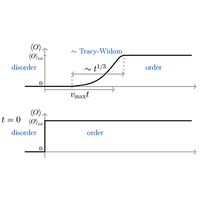
When matter in different phases is brought into contact, an interface with unexpected properties can emerge. In the transverse-field Ising chain, the authors investigate the interface formed by joining a disordered state with a ferromagnetically ordered one. They show that, within this emergent region, order parameters and entanglement asymmetries of subsystems exhibit universal behavior. Correlations extend across the entire region, and the Wigner–Yanase skew information of large subsystems reveals macroscopic multipartite entanglement.

Sign In to Your Journals Account

Filter

Recent Issues

Vol. 114, Iss. 30
15 November 2026
Vol. 114, Iss. 29
15 November 2026
Vol. 114, Iss. 28
15 November 2026
Vol. 114, Iss. 27
1 November 2026
Category
Article Type
Section

Filter

Article Lookup

Enter a citation