Browse Issues:

HIGHLIGHTED ARTICLES

Generalization of Bloch's theorem for arbitrary boundary conditions: Theory

Abhijeet Alase, Emilio Cobanera, Gerardo Ortiz, and Lorenza Viola

Phys. Rev. B 96, 195133 (2017) - Published 15 November, 2017

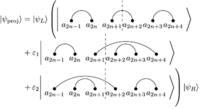
Can one steer a material by its surface? A generalization of Bloch’s theorem to arbitrary boundary conditions reveals actionable links going from surface physics towards changing overall electronic properties. Furthermore, it predicts the existence, in short-range systems, of topological zero-energy modes with power-law corrections, and answers basic questions about system sizes, for which bulk and surface properties merge. The theorem yields exact inversion-free diagonalization algorithms, potentially of interest for large-scale band-structure calculations, by leveraging two new constructs: the analytic continuation of the Bloch Hamiltonian off the Brillouin zone and the boundary matrix that efficiently encodes the interplay between bulk and boundary conditions.

Observation of Volkov-Pankratov states in topological HgTe heterojunctions using high-frequency compressibility

A. Inhofer, S. Tchoumakov, B. A. Assaf, G. Fève, J. M. Berroir, V. Jouffrey, D. Carpentier, M. O. Goerbig, B. Plaçais, K. Bendias, D. M. Mahler, E. Bocquillon, R. Schlereth, C. Brüne, H. Buhmann, and L. W. Molenkamp

Phys. Rev. B 96, 195104 (2017) - Published 1 November, 2017

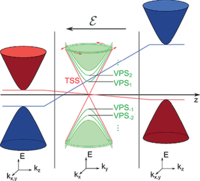
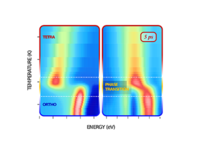
A smooth heterojunction between a topological (left panel of figure) and a trivial (right panel) hosts not only chiral Dirac states but also massive Volkov-Pankratov states (VPSs). The authors show that VPSs behave in a relativistic manner in a strong electric field: not only are they populated in increasing chemical potential, but their energy is lowered in a Lorentz boost by the electric field thus enhancing their visibility. Signatures of this relativistic field effect are reported in HgTe/CdHgTe heterojunctions using high-frequency transport measurements. These include anomalous charge screening (Dirac screening), its breakdown at the VPS band edge, and evidence of multiple VPSs.

Out-of-equilibrium dynamics in a quantum impurity model: Numerics for particle transport and entanglement entropy

Kemal Bidzhiev and Grégoire Misguich

Phys. Rev. B 96, 195117 (2017) - Published 8 November, 2017

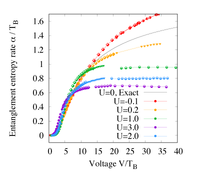
Here, the authors investigate the out-of-equilibrium properties of a simple quantum impurity model: the interacting resonant level model. They focus on the scaling regime, where the bandwidth of the fermions in the leads is larger than all the other energies, so that the lattice and the continuum versions of the model become equivalent. Using time-dependent density matrix renormalization group simulations, the new results cover a range of parameters, complementing previous analytical results that exist for only a few points in parameter space. The chief results are a demonstration of scaling collapse for I-V curves and for entanglement in terms of the Kondo temperature.

Correlation-driven metal-insulator transition in proximity to an iron-based superconductor

A. Charnukha, Z. P. Yin, Y. Song, C. D. Cao, Pengcheng Dai, K. Haule, G. Kotliar, and D. N. Basov

Phys. Rev. B 96, 195121 (2017) - Published 9 November, 2017

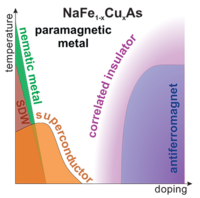
The search for higher-Tc superconductivity is in the vanguard of contemporary physics. Most unconventional high-Tc superconductors exist near a correlated-insulator phase. Unexpectedly, no such phase has been discovered in the family of unconventional iron-based high-temperature superconductors despite almost a decade of intensive search. Here, the authors perform detailed optical spectroscopy and ab initio studies of NaFe1-xCuxAs that reveal the existence of critically strong electronic correlations in this family of iron-based materials, culminating in a novel correlation-driven insulating parent phase with a large spectroscopic gap in the excitation spectrum. These results may lead to the discovery of new types of superconductivity in proximity to the novel correlated insulator.

Charge puddles in the bulk and on the surface of the topological insulator BiSbTeSe2 studied by scanning tunneling microscopy and optical spectroscopy

T. Knispel, W. Jolie, N. Borgwardt, J. Lux, Zhiwei Wang, Yoichi Ando, A. Rosch, T. Michely, and M. Grüninger

Phys. Rev. B 96, 195135 (2017) - Published 16 November, 2017

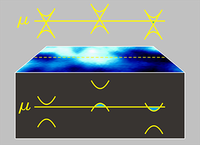
The peculiar surface transport properties of topological insulators often require tuning of the Fermi level close to the Dirac point. This, however, reduces the screening capabilities of the Dirac-like surface carriers and thus enhances the sensitivity to Coulomb disorder present in compensated materials. Coulomb disorder drives the formation of puddles, local accumulations of charge carriers both in the bulk and on the surface. In the topological insulator BiSbTeSe2, the coexistence of surface puddles and bulk puddles is revealed by scanning tunneling spectroscopy and optical spectroscopy. Quantitative analysis shows that bulk puddles contribute to the screening of surface potential fluctuations in this undoped compound. Understanding and controlling the puddles will be a key to realizing novel phenomena in 3D topological materials.

Entanglement spectroscopy on a quantum computer

Sonika Johri, Damian S. Steiger, and Matthias Troyer

Phys. Rev. B 96, 195136 (2017) - Published 20 November, 2017

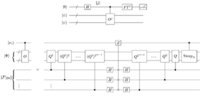
The efficient simulation of many-body quantum systems is an important application of quantum computers. However, extracting useful information from a system of qubits is not straightforward. The quantum computing equivalent of the vast array of diagnostic tools that extract information from classical numerical simulation are still being developed. This paper addresses the efficient calculation of quantities that characterize entanglement between different parts of a quantum state using a quantum computer. Illustrative examples of applications as diverse as many-body localization and fractional quantum Hall effect are discussed.

Machine learning topological states

Dong-Ling Deng, Xiaopeng Li, and S. Das Sarma

Phys. Rev. B 96, 195145 (2017) - Published 22 November, 2017

Machine learning, the core of artificial intelligence and data science, is a very active field, with vast applications throughout science and technology. Recently, machine learning techniques have been adopted to tackle intricate quantum many-body problems and phase transitions. In this work, the authors construct exact mappings from exotic quantum states to machine learning network models. This work shows for the first time that the restricted Boltzmann machine can be used to study both symmetry-protected topological phases and intrinsic topological order. The exact results are expected to provide a substantial boost to the field of machine learning of phases of matter.

Quantum disentangled liquid in the half-filled Hubbard model

Thomas Veness, Fabian H. L. Essler, and Matthew P. A. Fisher

Phys. Rev. B 96, 195153 (2017) - Published 27 November, 2017

Our expectation of thermalization is one borne of experience, and it is interesting to understand how conventional statistical mechanics may fail. The so-called quantum disentangled liquid (QDL) is a paradigm outside of the (Generalized) Gibbs description, but also without spatial disorder, precluding many-body localization. In this paper, the authors provide evidence that this QDL behavior exists in the Hubbard model. The QDL diagnostic involves bipartite entanglement entropies after a partial measurement. Both integrability in 1D and strong-coupling techniques are used to argue that the QDL diagnostic is indeed satisfied.

Cuprate phase diagram and the influence of nanoscale inhomogeneities

N. Zaki, H.-B. Yang, J. D. Rameau, P. D. Johnson, H. Claus, and D. G. Hinks

Phys. Rev. B 96, 195163 (2017) - Published 28 November, 2017

The phase diagram associated with cuprate superconductors is complicated by an array of different ground states. The parent material represents an antiferromagnetic insulator, but becomes a high-temperature superconductor upon doping. The underdoped region of the phase diagram is dominated by the so-called pseudogap phenomena, whose understanding presents one of the great challenges for the field. However, another aspect of these complex systems that is frequently overlooked is the tendency to phase separate into nanoscale regions upon hole doping. The overdoped region allowed the authors to examine the influence of the latter on the overall structure of the phase diagram.

Ultrafast optical snapshots of hybrid perovskites reveal the origin of multiband electronic transitions

Kannatassen Appavoo, Wanyi Nie, Jean-Christophe Blancon, Jacky Even, Aditya D. Mohite, and Matthew Y. Sfeir

Phys. Rev. B 96, 195308 (2017) - Published 28 November, 2017

Hybrid organic-inorganic perovskites are a promising class of materials for low-temperature solution-processed thin-film optoelectronic technologies. Here, the authors assign the visible and near-infrared optical transitions in large-grain thin films, using variable temperature transient absorption measurements that provide a sensitive probe of the electronic energy levels. These studies address an ongoing controversy concerning the nature of higher-order subband transitions. The strong visible absorption band is assigned to nearly degenerate transitions originating from different momentum states within the multivalley electronic band structure using symmetry analysis and the response of the optical resonances during the low-temperature structural phase transition.

Nonlocal transport and the Hall viscosity of two-dimensional hydrodynamic electron liquids

Francesco M. D. Pellegrino, Iacopo Torre, and Marco Polini

Phys. Rev. B 96, 195401 (2017) - Published 1 November, 2017

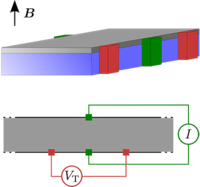
Hydrodynamics is a powerful theory for the description of transport in materials where the electron-electron mean-free path is much smaller than all the other length scales of the problem. Such a nonperturbative theory relies on a small number of coefficients, such as bulk and shear viscosities and thermal conductivity. When time-reversal symmetry is broken, a new dissipationless term, controlled by the Hall viscosity, appears in the Navier-Stokes equation. Here, the authors demonstrate that measurements of nonlocal resistances in multiterminal Hall-bar devices allow one to access the Hall viscosity of a two-dimensional electron liquid.

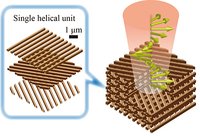
Circularly polarized vacuum field in three-dimensional chiral photonic crystals probed by quantum dot emission

S. Takahashi, Y. Ota, T. Tajiri, J. Tatebayashi, S. Iwamoto, and Y. Arakawa

Phys. Rev. B 96, 195404 (2017) - Published 3 November, 2017

The modification of a circularly polarized vacuum field in three-dimensional chiral photonic crystals was measured by spontaneous emission from quantum dots in the structures. Due to the circularly polarized eigenmodes along the helical axis in the GaAs-based mirror-asymmetric structures involved, the authors observed highly circularly-polarized emission from the quantum dots. Both spectroscopic and time-resolved measurements confirmed that the obtained circularly-polarized light was influenced by a large difference in the photonic density of states between the orthogonal components of the circular polarization in the vacuum field.

ARTICLES

Electronic structure and strongly correlated systems

Dimensional reduction and topological invariants of symmetry-protected topological phases

Nathanan Tantivasadakarn

Phys. Rev. B 96, 195101 (2017) - Published 1 November, 2017

Dynamic electronic correlation effects in NbO2 as compared to VO2

W. H. Brito, M. C. O. Aguiar, K. Haule, and G. Kotliar

Phys. Rev. B 96, 195102 (2017) - Published 1 November, 2017

Electronic properties and bonding in ZrHx thin films investigated by valence-band x-ray photoelectron spectroscopy

Martin Magnuson, Susann Schmidt, Lars Hultman, and Hans Högberg

Phys. Rev. B 96, 195103 (2017) - Published 1 November, 2017

Observation of Volkov-Pankratov states in topological HgTe heterojunctions using high-frequency compressibility

A. Inhofer, S. Tchoumakov, B. A. Assaf, G. Fève, J. M. Berroir, V. Jouffrey, D. Carpentier, M. O. Goerbig, B. Plaçais, K. Bendias, D. M. Mahler, E. Bocquillon, R. Schlereth, C. Brüne, H. Buhmann, and L. W. Molenkamp

Phys. Rev. B 96, 195104 (2017) - Published 1 November, 2017

A smooth heterojunction between a topological (left panel of figure) and a trivial (right panel) hosts not only chiral Dirac states but also massive Volkov-Pankratov states (VPSs). The authors show that VPSs behave in a relativistic manner in a strong electric field: not only are they populated in increasing chemical potential, but their energy is lowered in a Lorentz boost by the electric field thus enhancing their visibility. Signatures of this relativistic field effect are reported in HgTe/CdHgTe heterojunctions using high-frequency transport measurements. These include anomalous charge screening (Dirac screening), its breakdown at the VPS band edge, and evidence of multiple VPSs.

Anomaly manifestation of Lieb-Schultz-Mattis theorem and topological phases

Gil Young Cho, Chang-Tse Hsieh, and Shinsei Ryu

Phys. Rev. B 96, 195105 (2017) - Published 2 November, 2017

Numerically exploring the 1D-2D dimensional crossover on spin dynamics in the doped Hubbard model

Y. F. Kung, C. Bazin, K. Wohlfeld, Yao Wang, C.-C. Chen, C. J. Jia, S. Johnston, B. Moritz, F. Mila, and T. P. Devereaux

Phys. Rev. B 96, 195106 (2017) - Published 2 November, 2017

Magnetotransport properties of MoP2

Aifeng Wang (王爱峰), D. Graf, Aaron Stein, Yu Liu (刘育), Weiguo Yin (尹卫国), and C. Petrovic

Phys. Rev. B 96, 195107 (2017) - Published 2 November, 2017

Tunable band structures in digital oxides with layered crystal habits

Yongjin Shin and James M. Rondinelli

Phys. Rev. B 96, 195108 (2017) - Published 2 November, 2017

Bott periodicity for the topological classification of gapped states of matter with reflection symmetry

Luka Trifunovic and Piet Brouwer

Phys. Rev. B 96, 195109 (2017) - Published 2 November, 2017

Dynamical generation of superconducting order of different symmetries in hexagonal lattices

Hossein Dehghani and Aditi Mitra

Phys. Rev. B 96, 195110 (2017) - Published 2 November, 2017

Density-matrix renormalization group method for the conductance of one-dimensional correlated systems using the Kubo formula

Jan-Moritz Bischoff and Eric Jeckelmann

Phys. Rev. B 96, 195111 (2017) - Published 3 November, 2017

Electronic signature of the vacancy ordering in NbO(Nb3O3)

A. K. Efimenko, N. Hollmann, K. Hoefer, J. Weinen, D. Takegami, K. K. Wolff, S. G. Altendorf, Z. Hu, A. D. Rata, A. C. Komarek, A. A. Nugroho, Y. F. Liao, K.-D. Tsuei, H. H. Hsieh, H.-J. Lin, C. T. Chen, L. H. Tjeng, and D. Kasinathan

Phys. Rev. B 96, 195112 (2017) - Published 6 November, 2017

Nature of crossover between localized and itinerant 5f states in URu2Si2 evidenced by Si29-NMR measurement

N. Emi, R. Hamabata, T. Koyama, G. Motoyama, K. Ueda, T. Kohara, and T. Mito

Phys. Rev. B 96, 195113 (2017) - Published 7 November, 2017

Pseudogap-to-metal transition in the anisotropic two-dimensional Hubbard model

J. P. L. Faye and D. Sénéchal

Phys. Rev. B 96, 195114 (2017) - Published 7 November, 2017

Effects of film thickness and magnetism on the electronic structure of MnO films

Asish K. Kundu, Sukanta Barman, and Krishnakumar S. R. Menon

Phys. Rev. B 96, 195116 (2017) - Published 7 November, 2017

Out-of-equilibrium dynamics in a quantum impurity model: Numerics for particle transport and entanglement entropy

Kemal Bidzhiev and Grégoire Misguich

Phys. Rev. B 96, 195117 (2017) - Published 8 November, 2017

Here, the authors investigate the out-of-equilibrium properties of a simple quantum impurity model: the interacting resonant level model. They focus on the scaling regime, where the bandwidth of the fermions in the leads is larger than all the other energies, so that the lattice and the continuum versions of the model become equivalent. Using time-dependent density matrix renormalization group simulations, the new results cover a range of parameters, complementing previous analytical results that exist for only a few points in parameter space. The chief results are a demonstration of scaling collapse for I-V curves and for entanglement in terms of the Kondo temperature.

Nature of continuous phase transitions in interacting topological insulators

Tian-Sheng Zeng, W. Zhu, Jian-Xin Zhu, and D. N. Sheng

Phys. Rev. B 96, 195118 (2017) - Published 8 November, 2017

Nernst effect in Dirac and inversion-asymmetric Weyl semimetals

Gargee Sharma, Christopher Moore, Subhodip Saha, and Sumanta Tewari

Phys. Rev. B 96, 195119 (2017) - Published 9 November, 2017

Soft x-ray absorption spectroscopy study of the electronic structures of the MnFe Prussian blue analogs (RbxBay)Mn[3−(x+2y)]/2[Fe(CN)6]H2O

Eunsook Lee, Seungho Seong, Hyun Woo Kim, D. H. Kim, Nidhi Thakur, S. M. Yusuf, Bongjae Kim, B. I. Min, Younghak Kim, J.-Y. Kim, F. M. F. de Groot, and J.-S. Kang

Phys. Rev. B 96, 195120 (2017) - Published 9 November, 2017

Correlation-driven metal-insulator transition in proximity to an iron-based superconductor

A. Charnukha, Z. P. Yin, Y. Song, C. D. Cao, Pengcheng Dai, K. Haule, G. Kotliar, and D. N. Basov

Phys. Rev. B 96, 195121 (2017) - Published 9 November, 2017

The search for higher-Tc superconductivity is in the vanguard of contemporary physics. Most unconventional high-Tc superconductors exist near a correlated-insulator phase. Unexpectedly, no such phase has been discovered in the family of unconventional iron-based high-temperature superconductors despite almost a decade of intensive search. Here, the authors perform detailed optical spectroscopy and ab initio studies of NaFe1-xCuxAs that reveal the existence of critically strong electronic correlations in this family of iron-based materials, culminating in a novel correlation-driven insulating parent phase with a large spectroscopic gap in the excitation spectrum. These results may lead to the discovery of new types of superconductivity in proximity to the novel correlated insulator.

Critical examination of quantum oscillations in SmB6

Peter S. Riseborough and Z. Fisk

Phys. Rev. B 96, 195122 (2017) - Published 9 November, 2017

Fractional quantum Hall effect in the interacting Hofstadter model via tensor networks

M. Gerster, M. Rizzi, P. Silvi, M. Dalmonte, and S. Montangero

Phys. Rev. B 96, 195123 (2017) - Published 13 November, 2017

Understanding the Mössbauer spectrum of magnetite below the Verwey transition: Ab initio calculations, simulation, and experiment

R. Řezníček, V. Chlan, H. Štěpánková, P. Novák, J. Żukrowski, A. Kozłowski, Z. Kąkol, Z. Tarnawski, and J. M. Honig

Phys. Rev. B 96, 195124 (2017) - Published 13 November, 2017

Quasiparticle interference in ZrSiS: Strongly band-selective scattering depending on impurity lattice site

Christopher J. Butler, Yu-Mi Wu, Cheng-Rong Hsing, Yi Tseng, Raman Sankar, Ching-Ming Wei, Fang-Cheng Chou, and Minn-Tsong Lin

Phys. Rev. B 96, 195125 (2017) - Published 13 November, 2017

Emergent Bloch excitations in Mott matter

Nicola Lanatà, Tsung-Han Lee, Yong-Xin Yao, and Vladimir Dobrosavljević

Phys. Rev. B 96, 195126 (2017) - Published 14 November, 2017

Dirac's “magnetic monopoles” in pyrochlore ice U(1) spin liquids: Spectrum and classification

Gang Chen

Phys. Rev. B 96, 195127 (2017) - Published 13 November, 2017

Theory of hydrodynamic transport in fluctuating electronic charge density wave states

Luca V. Delacrétaz, Blaise Goutéraux, Sean A. Hartnoll, and Anna Karlsson

Phys. Rev. B 96, 195128 (2017) - Published 13 November, 2017

Defects between gapped boundaries in two-dimensional topological phases of matter

Iris Cong, Meng Cheng, and Zhenghan Wang

Phys. Rev. B 96, 195129 (2017) - Published 14 November, 2017

Giant magnetoelectric effect in pure manganite-manganite heterostructures

Sanjukta Paul, Ravindra Pankaj, Sudhakar Yarlagadda, Pinaki Majumdar, and Peter B. Littlewood

Phys. Rev. B 96, 195130 (2017) - Published 14 November, 2017

Gapless excitations in the ground state of 1T−TaS2

A. Ribak, I. Silber, C. Baines, K. Chashka, Z. Salman, Y. Dagan, and A. Kanigel

Phys. Rev. B 96, 195131 (2017) - Published 15 November, 2017

Light tunneling anomaly in interlaced metallic wire meshes

Hafssaa Latioui and Mário G. Silveirinha

Phys. Rev. B 96, 195132 (2017) - Published 15 November, 2017

Generalization of Bloch's theorem for arbitrary boundary conditions: Theory

Abhijeet Alase, Emilio Cobanera, Gerardo Ortiz, and Lorenza Viola

Phys. Rev. B 96, 195133 (2017) - Published 15 November, 2017

Can one steer a material by its surface? A generalization of Bloch’s theorem to arbitrary boundary conditions reveals actionable links going from surface physics towards changing overall electronic properties. Furthermore, it predicts the existence, in short-range systems, of topological zero-energy modes with power-law corrections, and answers basic questions about system sizes, for which bulk and surface properties merge. The theorem yields exact inversion-free diagonalization algorithms, potentially of interest for large-scale band-structure calculations, by leveraging two new constructs: the analytic continuation of the Bloch Hamiltonian off the Brillouin zone and the boundary matrix that efficiently encodes the interplay between bulk and boundary conditions.

Topological magnon bound states in periodically modulated Heisenberg XXZ chains

Xizhou Qin (秦锡洲), Feng Mei (梅锋), Yongguan Ke (柯勇贯), Li Zhang (张莉), and Chaohong Lee (李朝红)

Phys. Rev. B 96, 195134 (2017) - Published 15 November, 2017

Charge puddles in the bulk and on the surface of the topological insulator BiSbTeSe2 studied by scanning tunneling microscopy and optical spectroscopy

T. Knispel, W. Jolie, N. Borgwardt, J. Lux, Zhiwei Wang, Yoichi Ando, A. Rosch, T. Michely, and M. Grüninger

Phys. Rev. B 96, 195135 (2017) - Published 16 November, 2017

The peculiar surface transport properties of topological insulators often require tuning of the Fermi level close to the Dirac point. This, however, reduces the screening capabilities of the Dirac-like surface carriers and thus enhances the sensitivity to Coulomb disorder present in compensated materials. Coulomb disorder drives the formation of puddles, local accumulations of charge carriers both in the bulk and on the surface. In the topological insulator BiSbTeSe2, the coexistence of surface puddles and bulk puddles is revealed by scanning tunneling spectroscopy and optical spectroscopy. Quantitative analysis shows that bulk puddles contribute to the screening of surface potential fluctuations in this undoped compound. Understanding and controlling the puddles will be a key to realizing novel phenomena in 3D topological materials.

Entanglement spectroscopy on a quantum computer

Sonika Johri, Damian S. Steiger, and Matthias Troyer

Phys. Rev. B 96, 195136 (2017) - Published 20 November, 2017

The efficient simulation of many-body quantum systems is an important application of quantum computers. However, extracting useful information from a system of qubits is not straightforward. The quantum computing equivalent of the vast array of diagnostic tools that extract information from classical numerical simulation are still being developed. This paper addresses the efficient calculation of quantities that characterize entanglement between different parts of a quantum state using a quantum computer. Illustrative examples of applications as diverse as many-body localization and fractional quantum Hall effect are discussed.

High-pressure versus isoelectronic doping effect on the honeycomb iridate Na2IrO3

V. Hermann, J. Ebad-Allah, F. Freund, I. M. Pietsch, A. Jesche, A. A. Tsirlin, J. Deisenhofer, M. Hanfland, P. Gegenwart, and C. A. Kuntscher

Phys. Rev. B 96, 195137 (2017) - Published 20 November, 2017

Principal component analysis for fermionic critical points

Natanael C. Costa, Wenjian Hu, Z. J. Bai, Richard T. Scalettar, and Rajiv R. P. Singh

Phys. Rev. B 96, 195138 (2017) - Published 20 November, 2017

Quantum field theory of X-cube fracton topological order and robust degeneracy from geometry

Kevin Slagle and Yong Baek Kim

Phys. Rev. B 96, 195139 (2017) - Published 20 November, 2017

Anisotropic pseudopotential characterization of quantum Hall systems under a tilted magnetic field

Bo Yang, Ching Hua Lee, Chi Zhang, and Zi-Xiang Hu

Phys. Rev. B 96, 195140 (2017) - Published 20 November, 2017

Photoinduced absorptions inside the Mott gap in the two-dimensional extended Hubbard model

Kazuya Shinjo and Takami Tohyama

Phys. Rev. B 96, 195141 (2017) - Published 21 November, 2017

Phase diagram of the hexagonal lattice quantum dimer model: Order parameters, ground-state energy, and gaps

Thiago M. Schlittler, Rémy Mosseri, and Thomas Barthel

Phys. Rev. B 96, 195142 (2017) - Published 21 November, 2017

Emergence of gapped bulk and metallic side walls in the zeroth Landau level in Dirac and Weyl semimetals

Ching-Kit Chan and Patrick A. Lee

Phys. Rev. B 96, 195143 (2017) - Published 21 November, 2017

Variational Monte Carlo study of spin dynamics in underdoped cuprates

Zuo-Dong Yu, Yuan Zhou, and Chang-De Gong

Phys. Rev. B 96, 195144 (2017) - Published 22 November, 2017

Machine learning topological states

Dong-Ling Deng, Xiaopeng Li, and S. Das Sarma

Phys. Rev. B 96, 195145 (2017) - Published 22 November, 2017

Machine learning, the core of artificial intelligence and data science, is a very active field, with vast applications throughout science and technology. Recently, machine learning techniques have been adopted to tackle intricate quantum many-body problems and phase transitions. In this work, the authors construct exact mappings from exotic quantum states to machine learning network models. This work shows for the first time that the restricted Boltzmann machine can be used to study both symmetry-protected topological phases and intrinsic topological order. The exact results are expected to provide a substantial boost to the field of machine learning of phases of matter.

Pairing instability near a lattice-influenced nematic quantum critical point

D. Labat and I. Paul

Phys. Rev. B 96, 195146 (2017) - Published 22 November, 2017

Quasi-one-dimensional metallic band dispersion in the commensurate charge density wave of 1T−TaS2

Arlette S. Ngankeu, Sanjoy K. Mahatha, Kevin Guilloy, Marco Bianchi, Charlotte E. Sanders, Kerstin Hanff, Kai Rossnagel, Jill A. Miwa, Christina Breth Nielsen, Martin Bremholm, and Philip Hofmann

Phys. Rev. B 96, 195147 (2017) - Published 27 November, 2017

Anyons are not energy eigenspaces of quantum double Hamiltonians

Anna Kómár and Olivier Landon-Cardinal

Phys. Rev. B 96, 195150 (2017) - Published 27 November, 2017

Dynamics of the spin-12 Heisenberg chain initialized in a domain-wall state

Grégoire Misguich, Kirone Mallick, and P. L. Krapivsky

Phys. Rev. B 96, 195151 (2017) - Published 27 November, 2017

BCS wave function, matrix product states, and the Ising conformal field theory

Sebastián Montes, Javier Rodríguez-Laguna, and Germán Sierra

Phys. Rev. B 96, 195152 (2017) - Published 27 November, 2017

Quantum disentangled liquid in the half-filled Hubbard model

Thomas Veness, Fabian H. L. Essler, and Matthew P. A. Fisher

Phys. Rev. B 96, 195153 (2017) - Published 27 November, 2017

Our expectation of thermalization is one borne of experience, and it is interesting to understand how conventional statistical mechanics may fail. The so-called quantum disentangled liquid (QDL) is a paradigm outside of the (Generalized) Gibbs description, but also without spatial disorder, precluding many-body localization. In this paper, the authors provide evidence that this QDL behavior exists in the Hubbard model. The QDL diagnostic involves bipartite entanglement entropies after a partial measurement. Both integrability in 1D and strong-coupling techniques are used to argue that the QDL diagnostic is indeed satisfied.

Reversibility of magnetic field driven transition from electronic phase separation state to single-phase state in manganites: A microscopic view

Hao Liu, Lingfang Lin, Yang Yu, Hanxuan Lin, Yinyan Zhu, Tian Miao, Yu Bai, Qian Shi, Peng Cai, Yunfang Kou, Fanli Lan, Wenbin Wang, Xiaodong Zhou, Shuai Dong, Lifeng Yin, and Jian Shen

Phys. Rev. B 96, 195154 (2017) - Published 27 November, 2017

Exponential and power-law renormalization in phonon-assisted tunneling

A. Khedri, T. A. Costi, and V. Meden

Phys. Rev. B 96, 195155 (2017) - Published 27 November, 2017

Influence of phonon-assisted tunneling on the linear thermoelectric transport through molecular quantum dots

A. Khedri, V. Meden, and T. A. Costi

Phys. Rev. B 96, 195156 (2017) - Published 27 November, 2017

Collective effects in tilted Weyl cones: Optical conductivity, polarization, and Coulomb interactions reshaping the cone

Fabrizio Detassis, Lars Fritz, and Simonas Grubinskas

Phys. Rev. B 96, 195157 (2017) - Published 27 November, 2017

Weyl rings and enhanced susceptibilities in pyrochlore iridates: k·p analysis of cluster dynamical mean-field theory results

Runzhi Wang, Ara Go, and Andrew Millis

Phys. Rev. B 96, 195158 (2017) - Published 27 November, 2017

Type-II Dirac cone and Dirac cone protected by nonsymmorphic symmetry in the carbon-lithium compound C4Li

Armindo S. Cuamba, Pavan Hosur, Hong-Yan Lu, Lei Hao, and C. S. Ting

Phys. Rev. B 96, 195159 (2017) - Published 27 November, 2017

Instability and topological robustness of Weyl semimetals against Coulomb interaction

Fei Xue and Xiao-Xiao Zhang

Phys. Rev. B 96, 195160 (2017) - Published 28 November, 2017

Itinerant-localized model of strongly correlated electrons: Fermi surface reconstruction

Ilya Ivantsov, Alvaro Ferraz, and Evgenii Kochetov

Phys. Rev. B 96, 195161 (2017) - Published 28 November, 2017

Fermion-induced quantum critical points in two-dimensional Dirac semimetals

Shao-Kai Jian and Hong Yao

Phys. Rev. B 96, 195162 (2017) - Published 28 November, 2017

Cuprate phase diagram and the influence of nanoscale inhomogeneities

N. Zaki, H.-B. Yang, J. D. Rameau, P. D. Johnson, H. Claus, and D. G. Hinks

Phys. Rev. B 96, 195163 (2017) - Published 28 November, 2017

The phase diagram associated with cuprate superconductors is complicated by an array of different ground states. The parent material represents an antiferromagnetic insulator, but becomes a high-temperature superconductor upon doping. The underdoped region of the phase diagram is dominated by the so-called pseudogap phenomena, whose understanding presents one of the great challenges for the field. However, another aspect of these complex systems that is frequently overlooked is the tendency to phase separate into nanoscale regions upon hole doping. The overdoped region allowed the authors to examine the influence of the latter on the overall structure of the phase diagram.

Measuring space-group symmetry fractionalization in Z2 spin liquids

Michael P. Zaletel, Yuan-Ming Lu, and Ashvin Vishwanath

Phys. Rev. B 96, 195164 (2017) - Published 29 November, 2017

Polaron-induced phonon localization and stiffening in rutile TiO2

Grigory Kolesov, Boris A. Kolesov, and Efthimios Kaxiras

Phys. Rev. B 96, 195165 (2017) - Published 29 November, 2017

Pseudocanalization regime for magnetic dark-field hyperlenses

Taavi Repän, Andrey Novitsky, Morten Willatzen, and Andrei V. Lavrinenko

Phys. Rev. B 96, 195166 (2017) - Published 29 November, 2017

Magnetic two-dimensional electron gas at the manganite-buffered LaAlO3/SrTiO3 interface

H. R. Zhang, Y. Zhang, H. Zhang, J. Zhang, X. Shen, X. X. Guan, Y. Z. Chen, R. C. Yu, N. Pryds, Y. S. Chen, B. G. Shen, and J. R. Sun

Phys. Rev. B 96, 195167 (2017) - Published 29 November, 2017

Electronic structure of Cr2AlC as observed by angle-resolved photoemission spectroscopy

Takahiro Ito, Damir Pinek, Taishi Fujita, Masashi Nakatake, Shin-ichiro Ideta, Kiyohisa Tanaka, and Thierry Ouisse

Phys. Rev. B 96, 195168 (2017) - Published 30 November, 2017

Semiconductors I: bulk

Thermal conductivity changes across a structural phase transition: The case of high-pressure silica

Hugo Aramberri, Riccardo Rurali, and Jorge Íñiguez

Phys. Rev. B 96, 195201 (2017) - Published 6 November, 2017

Calculating polaron mobility in halide perovskites

Jarvist Moore Frost

Phys. Rev. B 96, 195202 (2017) - Published 7 November, 2017

Charge transport in hybrid halide perovskites

Mingliang Zhang, Xu Zhang, Ling-Yi Huang, Hai-Qing Lin, and Gang Lu

Phys. Rev. B 96, 195203 (2017) - Published 7 November, 2017

Impact of the glass transition on exciton dynamics in polymer thin films

Philipp Ehrenreich, Daniel Proepper, Alexander Graf, Stefan Jores, Alexander V. Boris, and Lukas Schmidt-Mende

Phys. Rev. B 96, 195204 (2017) - Published 9 November, 2017

Role of the transition state in muon implantation

R. C. Vilão, R. B. L. Vieira, H. V. Alberto, J. M. Gil, and A. Weidinger

Phys. Rev. B 96, 195205 (2017) - Published 16 November, 2017

Current-induced spin polarization in InGaAs and GaAs epilayers with varying doping densities

M. Luengo-Kovac, S. Huang, D. Del Gaudio, J. Occena, R. S. Goldman, R. Raimondi, and V. Sih

Phys. Rev. B 96, 195206 (2017) - Published 16 November, 2017

Geometrical phase shift in Friedel oscillations

C. Dutreix and P. Delplace

Phys. Rev. B 96, 195207 (2017) - Published 16 November, 2017

Field dependence of hopping mobility: Lattice models against spatial disorder

J. O. Oelerich, A. V. Nenashev, A. V. Dvurechenskii, F. Gebhard, and S. D. Baranovskii

Phys. Rev. B 96, 195208 (2017) - Published 21 November, 2017

Direct experimental observation of nonclassicality in ensembles of single-photon emitters

E. Moreva, P. Traina, J. Forneris, I. P. Degiovanni, S. Ditalia Tchernij, F. Picollo, G. Brida, P. Olivero, and M. Genovese

Phys. Rev. B 96, 195209 (2017) - Published 27 November, 2017

Faraday rotation by the undisturbed bulk and by photoinduced giant polarons in EuTe

A. B. Henriques and P. A. Usachev

Phys. Rev. B 96, 195210 (2017) - Published 27 November, 2017

Semiconductors II: surfaces, interfaces, microstructures, and related topics

Exciton confinement in strain-engineered metamorphic InAs/InxGa1–xAs quantum dots

S. A. Khattak, M. Hayne, J. Huang, J. Vanacken, V. V. Moshchalkov, L. Seravalli, G. Trevisi, and P. Frigeri

Phys. Rev. B 96, 195301 (2017) - Published 8 November, 2017

Composite fermions on a torus

Songyang Pu, Ying-Hai Wu, and J. K. Jain

Phys. Rev. B 96, 195302 (2017) - Published 7 November, 2017

Topological invariants of Floquet systems: General formulation, special properties, and Floquet topological defects

Shunyu Yao, Zhongbo Yan, and Zhong Wang

Phys. Rev. B 96, 195303 (2017) - Published 10 November, 2017

Structure and evolution of semiconducting buffer graphene grown on SiC(0001)

M. Conrad, J. Rault, Y. Utsumi, Y. Garreau, A. Vlad, A. Coati, J.-P. Rueff, P. F. Miceli, and E. H. Conrad

Phys. Rev. B 96, 195304 (2017) - Published 13 November, 2017

Removal of accidental degeneracy in semiconductor quantum dots

Sathwik Bharadwaj, Siddhant Pandey, and L. R. Ram-Mohan

Phys. Rev. B 96, 195305 (2017) - Published 20 November, 2017

Oxygen in silicon: Switch in the diffusion-mediated mechanism

Dilyara Timerkaeva, Damien Caliste, Thierry Deutsch, and Pascal Pochet

Phys. Rev. B 96, 195306 (2017) - Published 21 November, 2017

Even-odd interference effect in a topological superconducting wire

Jie Liu, Juntao Song, Qing-Feng Sun, and X. C. Xie

Phys. Rev. B 96, 195307 (2017) - Published 27 November, 2017

Ultrafast optical snapshots of hybrid perovskites reveal the origin of multiband electronic transitions

Kannatassen Appavoo, Wanyi Nie, Jean-Christophe Blancon, Jacky Even, Aditya D. Mohite, and Matthew Y. Sfeir

Phys. Rev. B 96, 195308 (2017) - Published 28 November, 2017

Hybrid organic-inorganic perovskites are a promising class of materials for low-temperature solution-processed thin-film optoelectronic technologies. Here, the authors assign the visible and near-infrared optical transitions in large-grain thin films, using variable temperature transient absorption measurements that provide a sensitive probe of the electronic energy levels. These studies address an ongoing controversy concerning the nature of higher-order subband transitions. The strong visible absorption band is assigned to nearly degenerate transitions originating from different momentum states within the multivalley electronic band structure using symmetry analysis and the response of the optical resonances during the low-temperature structural phase transition.

First-principles Green's-function method for surface calculations: A pseudopotential localized basis set approach

Søren Smidstrup, Daniele Stradi, Jess Wellendorff, Petr A. Khomyakov, Ulrik G. Vej-Hansen, Maeng-Eun Lee, Tushar Ghosh, Elvar Jónsson, Hannes Jónsson, and Kurt Stokbro

Phys. Rev. B 96, 195309 (2017) - Published 30 November, 2017

Surface physics, nanoscale physics, low-dimensional systems

Nonlocal transport and the Hall viscosity of two-dimensional hydrodynamic electron liquids

Francesco M. D. Pellegrino, Iacopo Torre, and Marco Polini

Phys. Rev. B 96, 195401 (2017) - Published 1 November, 2017

Hydrodynamics is a powerful theory for the description of transport in materials where the electron-electron mean-free path is much smaller than all the other length scales of the problem. Such a nonperturbative theory relies on a small number of coefficients, such as bulk and shear viscosities and thermal conductivity. When time-reversal symmetry is broken, a new dissipationless term, controlled by the Hall viscosity, appears in the Navier-Stokes equation. Here, the authors demonstrate that measurements of nonlocal resistances in multiterminal Hall-bar devices allow one to access the Hall viscosity of a two-dimensional electron liquid.

Emulating Majorana fermions and their braiding by Ising spin chains

Stefan Backens, Alexander Shnirman, Yuriy Makhlin, Yuval Gefen, Johan E. Mooij, and Gerd Schön

Phys. Rev. B 96, 195402 (2017) - Published 1 November, 2017

Malleability at the extreme nanoscale: Slow and fast quakes of few-body systems

Alireza Saffarzadeh and George Kirczenow

Phys. Rev. B 96, 195403 (2017) - Published 2 November, 2017

Circularly polarized vacuum field in three-dimensional chiral photonic crystals probed by quantum dot emission

S. Takahashi, Y. Ota, T. Tajiri, J. Tatebayashi, S. Iwamoto, and Y. Arakawa

Phys. Rev. B 96, 195404 (2017) - Published 3 November, 2017

The modification of a circularly polarized vacuum field in three-dimensional chiral photonic crystals was measured by spontaneous emission from quantum dots in the structures. Due to the circularly polarized eigenmodes along the helical axis in the GaAs-based mirror-asymmetric structures involved, the authors observed highly circularly-polarized emission from the quantum dots. Both spectroscopic and time-resolved measurements confirmed that the obtained circularly-polarized light was influenced by a large difference in the photonic density of states between the orthogonal components of the circular polarization in the vacuum field.

Macroscopic excitation energy transport in a structured Co nanolayer

Igor Khmelinskii and Vladimir I. Makarov

Phys. Rev. B 96, 195405 (2017) - Published 3 November, 2017

Moiré impurities in twisted bilayer black phosphorus: Effects on the carrier mobility

Peng Kang, Wan-Ting Zhang, Vincent Michaud-Rioux, Xiang-Hua Kong, Chen Hu, Guang-Hua Yu, and Hong Guo

Phys. Rev. B 96, 195406 (2017) - Published 6 November, 2017

Helicity-dependent terahertz emission spectroscopy of topological insulator Sb2Te3 thin films

Chien-Ming Tu, Yi-Cheng Chen, Ping Huang, Pei-Yu Chuang, Ming-Yu Lin, Cheng-Maw Cheng, Jiunn-Yuan Lin, Jenh-Yih Juang, Kaung-Hsiung Wu, Jung-Chun A. Huang, Way-Faung Pong, Takayoshi Kobayashi, and Chih-Wei Luo

Phys. Rev. B 96, 195407 (2017) - Published 6 November, 2017

Hybrid Monte Carlo study of monolayer graphene with partially screened Coulomb interactions at finite spin density

Michael Körner, Dominik Smith, Pavel Buividovich, Maksim Ulybyshev, and Lorenz von Smekal

Phys. Rev. B 96, 195408 (2017) - Published 6 November, 2017

Kondo physics in double quantum dot based Cooper pair splitters

Kacper Wrześniewski and Ireneusz Weymann

Phys. Rev. B 96, 195409 (2017) - Published 6 November, 2017

Photoluminescence from an individual double-walled carbon nanotube

Dmitry I. Levshov, Romain Parret, Huy-Nam Tran, Thierry Michel, Thi Thanh Cao, Van Chuc Nguyen, Raul Arenal, Valentin N. Popov, Sergei B. Rochal, Jean-Louis Sauvajol, Ahmed-Azmi Zahab, and Matthieu Paillet

Phys. Rev. B 96, 195410 (2017) - Published 7 November, 2017

Spin angular momentum transfer and plasmogalvanic phenomena

Maxim Durach and Natalia Noginova

Phys. Rev. B 96, 195411 (2017) - Published 7 November, 2017

C4N3H monolayer: A two-dimensional organic Dirac material with high Fermi velocity

Hongzhe Pan, Hongyu Zhang, Yuanyuan Sun, Jianfu Li, Youwei Du, and Nujiang Tang

Phys. Rev. B 96, 195412 (2017) - Published 7 November, 2017

Linear and nonlinear optical response of crystals using length and velocity gauges: Effect of basis truncation

Alireza Taghizadeh, F. Hipolito, and T. G. Pedersen

Phys. Rev. B 96, 195413 (2017) - Published 7 November, 2017

Theoretical prediction of two-dimensional functionalized MXene nitrides as topological insulators

Yunye Liang, Mohammad Khazaei, Ahmad Ranjbar, Masao Arai, Seiji Yunoki, Yoshiyuki Kawazoe, Hongming Weng, and Zhong Fang

Phys. Rev. B 96, 195414 (2017) - Published 8 November, 2017

Pure spin current injection in hydrogenated graphene structures

Reinaldo Zapata-Peña, Bernardo S. Mendoza, and Anatoli I. Shkrebtii

Phys. Rev. B 96, 195415 (2017) - Published 9 November, 2017

Significant decrease of the optical losses in the coupling between colloidal CdSe/CdS nanocrystals and a flat gold film at cryogenic temperature

A. Coste, F. Eloi, C. Arnold, G. Colas des Francs, X. Quélin, S. Buil, A. Bouhelier, J. C. Weeber, M. Nasilowski, B. Dubertret, and J.-P. Hermier

Phys. Rev. B 96, 195416 (2017) - Published 9 November, 2017

Phonon thermal conductivity of scandium nitride for thermoelectrics from first-principles calculations and thin-film growth

Sit Kerdsongpanya, Olle Hellman, Bo Sun, Yee Kan Koh, Jun Lu, Ngo Van Nong, Sergei I. Simak, Björn Alling, and Per Eklund

Phys. Rev. B 96, 195417 (2017) - Published 9 November, 2017

Andreev bound states probed in three-terminal quantum dots

J. Gramich, A. Baumgartner, and C. Schönenberger

Phys. Rev. B 96, 195418 (2017) - Published 9 November, 2017

Using active gain to maximize light absorption

Jie Wang, Dezhuan Han, Ang Chen, Yunyun Dai, Ming Zhou, Xinhua Hu, Zongfu Yu, Xiaohan Liu, Lei Shi, and Jian Zi

Phys. Rev. B 96, 195419 (2017) - Published 13 November, 2017

Nonperturbative harmonic generation in graphene from intense midinfrared pulsed light

M. Taucer, T. J. Hammond, P. B. Corkum, G. Vampa, C. Couture, N. Thiré, B. E. Schmidt, F. Légaré, H. Selvi, N. Unsuree, B. Hamilton, T. J. Echtermeyer, and M. A. Denecke

Phys. Rev. B 96, 195420 (2017) - Published 13 November, 2017

Z4 parafermions in an interacting quantum spin Hall Josephson junction coupled to an impurity spin

Yuval Vinkler-Aviv, Piet W. Brouwer, and Felix von Oppen

Phys. Rev. B 96, 195421 (2017) - Published 14 November, 2017

Second quantization of Leinaas-Myrheim anyons in one dimension and their relation to the Lieb-Liniger model

Thore Posske, Björn Trauzettel, and Michael Thorwart

Phys. Rev. B 96, 195422 (2017) - Published 15 November, 2017

Manipulating quantum Hall edge channels in graphene through scanning gate microscopy

Lennart Bours, Stefano Guiducci, Alina Mreńca-Kolasińska, Bartłomiej Szafran, Jan C. Maan, and Stefan Heun

Phys. Rev. B 96, 195423 (2017) - Published 15 November, 2017

Fast pulse sequences for dynamically corrected gates in singlet-triplet qubits

Robert E. Throckmorton, Chengxian Zhang, Xu-Chen Yang, Xin Wang, Edwin Barnes, and S. Das Sarma

Phys. Rev. B 96, 195424 (2017) - Published 17 November, 2017

Thermoelectric power factor of nanocomposite materials from two-dimensional quantum transport simulations

Samuel Foster, Mischa Thesberg, and Neophytos Neophytou

Phys. Rev. B 96, 195425 (2017) - Published 17 November, 2017

Chemically exfoliated MoS2 layers: Spectroscopic evidence for the semiconducting nature of the dominant trigonal metastable phase

Banabir Pal, Anjali Singh, Sharada G., Pratibha Mahale, Abhinav Kumar, S. Thirupathaiah, H. Sezen, M. Amati, Luca Gregoratti, Umesh V. Waghmare, and D. D. Sarma

Phys. Rev. B 96, 195426 (2017) - Published 20 November, 2017

Interaction between counter-propagating quantum Hall edge channels in the 3D topological insulator BiSbTeSe2

Chuan Li, Bob de Ronde, Artem Nikitin, Yingkai Huang, Mark S. Golden, Anne de Visser, and Alexander Brinkman

Phys. Rev. B 96, 195427 (2017) - Published 20 November, 2017

Spin-orbit coupling, optical transitions, and spin pumping in monolayer and few-layer InSe

S. J. Magorrian, V. Zólyomi, and V. I. Fal'ko

Phys. Rev. B 96, 195428 (2017) - Published 20 November, 2017

Time-dependent Landauer-Büttiker approach to charge pumping in ac-driven graphene nanoribbons

Michael Ridley and Riku Tuovinen

Phys. Rev. B 96, 195429 (2017) - Published 21 November, 2017

Controlling the bound states in a quantum-dot hybrid nanowire

Andrzej Ptok, Aksel Kobiałka, and Tadeusz Domański

Phys. Rev. B 96, 195430 (2017) - Published 22 November, 2017

Moiré-pattern interlayer potentials in van der Waals materials in the random-phase approximation

Nicolas Leconte, Jeil Jung, Sébastien Lebègue, and Tim Gould

Phys. Rev. B 96, 195431 (2017) - Published 27 November, 2017

Charge pumping in strongly coupled molecular quantum dots

Patrick Haughian, Han Hoe Yap, Jiangbin Gong, and Thomas L. Schmidt

Phys. Rev. B 96, 195432 (2017) - Published 27 November, 2017

High-energy x-ray diffraction from surfaces and nanoparticles

U. Hejral, P. Müller, M. Shipilin, J. Gustafson, D. Franz, R. Shayduk, U. Rütt, C. Zhang, L. R. Merte, E. Lundgren, V. Vonk, and A. Stierle

Phys. Rev. B 96, 195433 (2017) - Published 27 November, 2017

Excitonic physics in a Dirac quantum dot

V. Raca and M. V. Milovanović

Phys. Rev. B 96, 195434 (2017) - Published 27 November, 2017

Heat currents in electronic junctions driven by telegraph noise

O. Entin-Wohlman, D. Chowdhury, A. Aharony, and S. Dattagupta

Phys. Rev. B 96, 195435 (2017) - Published 28 November, 2017

Force field potentials for the vibrational properties of II-VI semiconductor nanostructures

Peng Han and Gabriel Bester

Phys. Rev. B 96, 195436 (2017) - Published 28 November, 2017

Probing the dielectric response of the interfacial buffer layer in epitaxial graphene via optical spectroscopy

Heather M. Hill, Albert F. Rigosi, Sugata Chowdhury, Yanfei Yang, Nhan V. Nguyen, Francesca Tavazza, Randolph E. Elmquist, David B. Newell, and Angela R. Hight Walker

Phys. Rev. B 96, 195437 (2017) - Published 28 November, 2017

Hydrodynamic model approach to the formation of plasmonic wakes in graphene

A. J. Chaves, N. M. R. Peres, G. Smirnov, and N. Asger Mortensen

Phys. Rev. B 96, 195438 (2017) - Published 28 November, 2017

Striped, honeycomb, and twisted moiré patterns in surface adsorption systems with highly degenerate commensurate ground states

K. R. Elder, C. V. Achim, E. Granato, S. C. Ying, and T. Ala-Nissila

Phys. Rev. B 96, 195439 (2017) - Published 29 November, 2017

Conditional counting statistics of electrons tunneling through quantum dot systems measured by a quantum point contact

Yen-Jui Chang, Tsung-Kang Yeh, Chao-Hung Wan, D. Wahyu Utami, Gerard J. Milburn, and Hsi-Sheng Goan

Phys. Rev. B 96, 195440 (2017) - Published 29 November, 2017

Breakdown of classical electrostatics in the depolarization of quantum wires and nanotubes

L. Shan and E. G. Mishchenko

Phys. Rev. B 96, 195441 (2017) - Published 30 November, 2017

Dirac cones in two-dimensional borane

Miguel Martinez-Canales, Timur R. Galeev, Alexander I. Boldyrev, and Chris J. Pickard

Phys. Rev. B 96, 195442 (2017) - Published 30 November, 2017

ERRATA

Erratum: Optical selection rules of zigzag graphene nanoribbons [Phys. Rev. B 95, 155438 (2017)]

V. A. Saroka, M. V. Shuba, and M. E. Portnoi

Phys. Rev. B 96, 199901 (2017) - Published 10 November, 2017

Publisher's Note: Quasiparticles and charge transfer at the two surfaces of the honeycomb iridate Na2IrO3 [Phys. Rev. B 96, 161116(R) (2017)]

L. Moreschini, I. Lo Vecchio, N. P. Breznay, S. Moser, S. Ulstrup, R. Koch, J. Wirjo, C. Jozwiak, K. S. Kim, E. Rotenberg, A. Bostwick, J. G. Analytis, and A. Lanzara

Phys. Rev. B 96, 199902 (2017) - Published 10 November, 2017

Erratum: Reliability of Raman measurements of thermal conductivity of single-layer graphene due to selective electron-phonon coupling: A first-principles study [Phys. Rev. B 93, 125432 (2016)]

Ajit K. Vallabhaneni, Dhruv Singh, Hua Bao, Jayathi Murthy, and Xiulin Ruan

Phys. Rev. B 96, 199903 (2017) - Published 16 November, 2017

Erratum: Quantum model for mode locking in pulsed semiconductor quantum dots [Phys. Rev. B 94, 245308 (2016)]

W. Beugeling, Götz S. Uhrig, and Frithjof B. Anders

Phys. Rev. B 96, 199904 (2017) - Published 21 November, 2017

Publisher's Note: Unbinding slave spins in the Anderson impurity model [Phys. Rev. B 96, 201106(R) (2017)]

Daniele Guerci and Michele Fabrizio

Phys. Rev. B 96, 199905 (2017) - Published 27 November, 2017

Erratum: Numerical study on collective excitations in graphene [Phys. Rev. B 94, 155451 (2016)]

Seiji Uryu

Phys. Rev. B 96, 199906 (2017) - Published 27 November, 2017

Sign In to Your Journals Account

Filter

Filter

Article Lookup

Enter a citation