Browse Issues:

HIGHLIGHTED ARTICLES

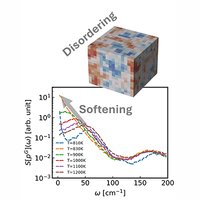
Thermal disorder and phonon softening in the ferroelectric phase transition of lead titanate

Pinchen Xie, Yixiao Chen, Weinan E, and Roberto Car

Phys. Rev. B 111, 094113 (2025) - Published 27 March, 2025

The authors find here, with first-principles molecular dynamics simulations enhanced by machine learning, that on submicrometer scales the first-order ferroelectric phase transition in PbTiO3 is driven by dipolar fluctuations at the nanoscale, while nucleation is suppressed by strong elastic-dipole coupling. The study shows that the ideal “phonon softening” observed in experiments is likely a secondary effect of the Debye relaxation that accompanies an order-disorder transformation, suggesting that spectroscopical softening is not necessarily an indicator of displacive structural transition.

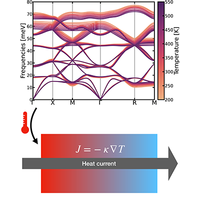
Mode-coupling formulation of heat transport in anharmonic materials

Aloïs Castellano, J. P. Alvarinhas Batista, Olle Hellman, and Matthieu J. Verstraete

Phys. Rev. B 111, 094306 (2025) - Published 17 March, 2025

The authors apply here the recently introduced mode-coupling framework for anharmonic lattice dynamics to derive a general theory of phonon heat transport, which does not depend on the harmonic approximation or perturbation theory. They account for diagonal and off-diagonal contributions to the heat current, with and without collective effects, and describe an efficient implementation of the theory, including Monte Carlo integration of the scattering, which reduces the computational cost by an order of magnitude.

Stripe magnetic order in semimetallic triangular-lattice CeLi3Bi2

M. M. Bordelon, R. Yamamoto, M. O. Ajeesh, C. Girod, J. Wampler, P. Sherpa, A. P. Dioguardi, J. D. Thompson, S. Calder, V. Zapf, F. Ronning, S. M. Thomas, E. D. Bauer, M. Hirata, and P. F. S. Rosa

Phys. Rev. B 111, 094401 (2025) - Published 3 March, 2025

Insulating triangular lattice materials have attracted much attention due to their potential quantum spin liquid ground state. Though metallic counterparts are predicted to host a breadth of exotic quantum states, experimentally recognizing pristine platforms that could be chemically and electronically tuned to generate unconventional states remains an outstanding challenge. This work presents a comprehensive experimental and theoretical investigation of triangular lattice CeLi3Bi2. The finding of stripe antiferromagnetic order in a semimetal places this compound as a promising platform for tuning the interplay between short-range geometric frustration and long-range magnetic interactions.

Hidden magnetic phases in i-MAX compounds

Dror Yahav, Ariel Maniv, Daniel Potashnikov, Asaf Pesach, El'ad N. Caspi, Arneil P. Reyes, Quanzheng Tao, Johanna Rosén, and Eran Maniv

Phys. Rev. B 111, 094427 (2025) - Published 20 March, 2025

The authors uncover a hidden high-field, high-temperature magnetic phase in i-MAX compounds, revealing new complexities in their magnetic behavior. By exploring the influence of rare-earth elements and external fields, they demonstrate an unexpected evolution of magnetic phases. The findings highlight the intricate interplay between composition, temperature, and field strength, providing fresh insights into the fundamental properties of these materials and their potential implications for future studies of magnetism in layered systems.

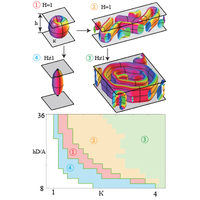
Hopfions in chiral magnetic trilayers

X. C. Hu, X. S. Wang, C. Wang, and X. R. Wang

Phys. Rev. B 111, 094436 (2025) - Published 27 March, 2025

The stabilization of hopfions in chiral magnetic trilayers requires three essential conditions: (1) the middle layer must possess sufficiently strong Dzyaloshinskii-Moriya interaction (DMI) relative to collinear interactions to establish skyrmions as the ground state in a 2D film, yet not so strong as to fragment the spin texture; (2) the layer thickness must provide adequate space for skyrmion tubes to twist and form closed-loop configurations; and (3) two capping layers with strong magnetic anisotropy are necessary to confine the hopfion and prevent its expansion. These combined criteria ensure the formation and stability of hopfion structures in the trilayer system.

Unconventional superconductivity mediated by nematic fluctuations in a multiorbital system: Application to doped FeSe

Kazi Ranjibul Islam and Andrey Chubukov

Phys. Rev. B 111, 094503 (2025) - Published 6 March, 2025

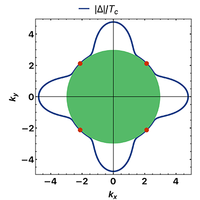
In unconventional superconductors, pairing is believed to be of electronic origin, and linked to critical collective fluctuations. Here, the authors investigate how nematic fluctuations, responsible for orbital polarization, mediate pairing in doped FeSe. They show that nematic-mediated pairing is highly unconventional and leads to a highly anisotropic gap structure. This in turn gives rise to pronounced non-BCS behavior of observables. The authors compute thermodynamic, spectroscopic, and transport characteristics, find good agreement with the experimental data, and propose further experiments to test their predictions.

Nodal points, lines, and surfaces, and topological surface states in superconductor NiBi3

Jie Zhang, Kai-Yue Jiang, Shu-Xiang Qiao, Peng-Cheng Xiao, Na Jiao, Ping Zhang, Hong-Yan Lu, and Qi-Feng Liang

Phys. Rev. B 111, 094508 (2025) - Published 10 March, 2025

Despite the numerous reports on the time-honored superconductor NiBi3, theoretical investigations remain limited. By using first-principles calculations, the authors select here multiple pairs of bands to show its topological structure, including nodal points, lines, and surfaces and topological surface states. The authors also demonstrate that the superconductivity of NiBi3 originates from the p orbitals of Bi and d orbitals of Ni coupling with the Bi vibration. Thus, NiBi3 holds significant potential for realization of topological superconductivity and other exotic phenomena.

Atypical vortex lattice and the magnetic penetration depth in superconducting Sr2RuO4 deduced by μSR

M. Yakovlev, Z. Kartsonas, and J. E. Sonier

Phys. Rev. B 111, 094509 (2025) - Published 11 March, 2025

For three decades, the superconducting order parameter symmetry in Sr2RuO4 has remained elusive. In most superconductors this symmetry manifests in the structure of the magnetic vortex lattice induced by applying a magnetic field. The minimum field of the vortex lattice is typically located at the center of a triangular or square arrangement of vortices. The authors report here on an unusual situation for Sr2RuO4, where the minimum field appears to be between midway between nearest-neighbor vortices in a square lattice. This finding introduces another constraint on possible superconducting order parameters.

ARTICLES

Structure, structural phase transitions, mechanical properties, defects

Electrical resistivity, thermal conductivity, and viscosity of Fe-H alloys at Earth's core conditions

Cong Liu and R. E. Cohen

Phys. Rev. B 111, 094101 (2025) - Published 4 March, 2025

Impact of point defect charge states on the thermal conductivity of AlN

Guotai Li, Zheng Cui, and Ruiqiang Guo

Phys. Rev. B 111, 094102 (2025) - Published 4 March, 2025

Structures of hydrogen at terapascal pressures

Kazutaka Abe

Phys. Rev. B 111, 094103 (2025) - Published 4 March, 2025

Coexistence of ordered and disordered vacancies in tungsten diboride with a broken hexagonal symmetry

Chao Gu, Xiaojun Xiang, Xiaohui Yu, Qiang Zhang, Yusheng Zhao, and Shanmin Wang

Phys. Rev. B 111, 094104 (2025) - Published 5 March, 2025

Probing the temperature-induced phase transition mechanism in PbTiO3−BiM0.5Ti0.5O3 ferroelectrics across the morphotropic phase boundary

B. Mihailova, L. Bayarjargal, I. Margaritescu, K. Datta, and J. Chen

Phys. Rev. B 111, 094105 (2025) - Published 6 March, 2025

Machine learning assisted identification of homobilayer sliding ferroelectrics with large out-of-plane polarization and low sliding energy barriers

Xian Wang, Yifan Li, Ying Zhang, Peng Wang, Yi-Ming Zhao, Jun Zhou, Jie Yang, Xuesen Wang, and Lei Shen

Phys. Rev. B 111, 094106 (2025) - Published 10 March, 2025

Propensity of oxidation of transition metal dichalcogenide monolayers in relation to physical configuration of chalcogen vacancies

Hiroyo Kawai, Fabio Bussolotti, Khoong Hong Khoo, and Kuan Eng Johnson Goh

Phys. Rev. B 111, 094107 (2025) - Published 11 March, 2025

Core bonding in Cs metal under high pressure and its return to close-packed structures

Yuanhui Sun, Abhiyan Pandit, Ling-Jun He, Haiqing Lin, and Maosheng Miao

Phys. Rev. B 111, 094108 (2025) - Published 17 March, 2025

Non-Hermitian Floquet higher-order topological states in two-dimensional quasicrystals

Aoqian Shi, Linsheng Bao, Peng Peng, Jiayun Ning, Zhennan Wang, and Jianjun Liu

Phys. Rev. B 111, 094109 (2025) - Published 17 March, 2025

Hybrid-orbital topological disclination states and wave propagation in defect-induced confined Mie resonance photonic crystals

Yuexin Zhang, Lanxin Luo, Xiaoyu Dai, and Yuanjiang Xiang

Phys. Rev. B 111, 094110 (2025) - Published 19 March, 2025

Self-reasoning assisted learning for non-Abelian gauge fields design

Jinyang Sun, Xi Chen, Xiumei Wang, Dandan Zhu, and Xingping Zhou

Phys. Rev. B 111, 094111 (2025) - Published 19 March, 2025

Temperature shift of magnetic field dependent photoluminescence features of nitrogen-vacancy ensembles in diamond

Irena Rodzoń, Xue Zhang, Viktor Ivády, Huijie Zheng, Arne Wickenbrock, and Dmitry Budker

Phys. Rev. B 111, 094112 (2025) - Published 24 March, 2025

Thermal disorder and phonon softening in the ferroelectric phase transition of lead titanate

Pinchen Xie, Yixiao Chen, Weinan E, and Roberto Car

Phys. Rev. B 111, 094113 (2025) - Published 27 March, 2025

The authors find here, with first-principles molecular dynamics simulations enhanced by machine learning, that on submicrometer scales the first-order ferroelectric phase transition in PbTiO3 is driven by dipolar fluctuations at the nanoscale, while nucleation is suppressed by strong elastic-dipole coupling. The study shows that the ideal “phonon softening” observed in experiments is likely a secondary effect of the Debye relaxation that accompanies an order-disorder transformation, suggesting that spectroscopical softening is not necessarily an indicator of displacive structural transition.

Inhomogeneous, disordered, and partially ordered systems

Tensor network Monte Carlo simulations for the two-dimensional random-bond Ising model

Tao Chen, Erdong Guo, Wanzhou Zhang, Pan Zhang, and Youjin Deng

Phys. Rev. B 111, 094201 (2025) - Published 4 March, 2025

Real space quantum metric of solids

Lucas A. Oliveira and Wei Chen

Phys. Rev. B 111, 094202 (2025) - Published 5 March, 2025

Local structure and anomalous chemical potential shift in the AgBiSe2−2xTexSx system

L. Tortora, A. Seshita, M. Y. Hacisalihoglu, A. Yamashita, G. Tomassucci, F. Minati, A. Skorynina, L. Simonelli, T. Mizokawa, Y. Mizuguchi, and N. L. Saini

Phys. Rev. B 111, 094203 (2025) - Published 7 March, 2025

Long-range hopping in a quasiperiodic potential weakens the non-Hermitian skin effect

Dechi Peng, Shujie Cheng, and Gao Xianlong

Phys. Rev. B 111, 094204 (2025) - Published 11 March, 2025

Density dependence of thermal conductivity in nanoporous and amorphous carbon with machine-learned molecular dynamics

Yanzhou Wang, Zheyong Fan, Ping Qian, Miguel A. Caro, and Tapio Ala-Nissila

Phys. Rev. B 111, 094205 (2025) - Published 18 March, 2025

Two-mode terms in Wigner transport equation elucidate anomalous thermal transport in amorphous silicon

Jin Yang, Xueyan Zhu, Alan J. H. McGaughey, Yee Sin Ang, and Wee-Liat Ong

Phys. Rev. B 111, 094206 (2025) - Published 20 March, 2025

Universal semiclassical dynamics in disordered two-dimensional systems

Łukasz Iwanek, Marcin Mierzejewski, Anatoli Polkovnikov, Dries Sels, and Adam S. Sajna

Phys. Rev. B 111, 094207 (2025) - Published 20 March, 2025

Photoinduced pattern formation and melting of charge density wave order

Lingyu Yang and Gia-Wei Chern

Phys. Rev. B 111, 094208 (2025) - Published 24 March, 2025

Lattice distortion tuning resistivity Invar effect in high-entropy alloys

Hao Chen, Yuanji Xu, Lihua Liu, Yue Chen, Jan Wróbel, Daoyong Cong, Fuyang Tian, and Yang Wang

Phys. Rev. B 111, 094209 (2025) - Published 24 March, 2025

Characterizing dynamical criticality of many-body localization transitions from a Fock-space perspective

Zheng-Hang Sun, Yong-Yi Wang, Jian Cui, Heng Fan, and Markus Heyl

Phys. Rev. B 111, 094210 (2025) - Published 27 March, 2025

Hierarchical analytical approach to universal spectral correlations in Brownian quantum chaos

Tara Kalsi, Alessandro Romito, and Henning Schomerus

Phys. Rev. B 111, 094211 (2025) - Published 27 March, 2025

Phases and phase transitions of the disordered quantum clock model

Pulloor Kuttanikkad Vishnu, Gaurav Khairnar, Rajesh Narayanan, and Thomas Vojta

Phys. Rev. B 111, 094212 (2025) - Published 28 March, 2025

Dynamics, dynamical systems, lattice effects

Pauli weight requirement of the matrix elements in time-evolved local operators: Dependence beyond the equilibration temperature

Carlos Ramos-Marimón, Stefano Carignano, and Luca Tagliacozzo

Phys. Rev. B 111, 094301 (2025) - Published 5 March, 2025

Instability of the engineered dark state in two-band fermions under number-conserving dissipative dynamics

A. A. Lyublinskaya, P. A. Nosov, and I. S. Burmistrov

Phys. Rev. B 111, 094302 (2025) - Published 5 March, 2025

Valley Hall effect in a bilayer graphene phononic crystal without localized Berry curvature

Fang Liu, Peng Kong, Xiaoyun Wang, Jien Wu, Zhaojian He, and Ke Deng

Phys. Rev. B 111, 094303 (2025) - Published 10 March, 2025

Phase transitions in quasiperiodically driven quantum critical systems: Analytical results

Jiyuan Fang, Qi Zhou, and Xueda Wen

Phys. Rev. B 111, 094304 (2025) - Published 11 March, 2025

Mode-coupling formulation of heat transport in anharmonic materials

Aloïs Castellano, J. P. Alvarinhas Batista, Olle Hellman, and Matthieu J. Verstraete

Phys. Rev. B 111, 094306 (2025) - Published 17 March, 2025

The authors apply here the recently introduced mode-coupling framework for anharmonic lattice dynamics to derive a general theory of phonon heat transport, which does not depend on the harmonic approximation or perturbation theory. They account for diagonal and off-diagonal contributions to the heat current, with and without collective effects, and describe an efficient implementation of the theory, including Monte Carlo integration of the scattering, which reduces the computational cost by an order of magnitude.

Static Born charges and quantum capacitance in metals and doped semiconductors

Asier Zabalo, Cyrus E. Dreyer, and Massimiliano Stengel

Phys. Rev. B 111, 094307 (2025) - Published 17 March, 2025

Anisotropic anharmonicity dictates the thermal conductivity of β-Ga2O3

Abdulaziz Alkandari, Zherui Han, Ziqi Guo, Thomas E. Beechem, and Xiulin Ruan

Phys. Rev. B 111, 094308 (2025) - Published 20 March, 2025

Photon-assisted stochastic resonance in nanojunctions

Michael Ridley, Leo Bellassai, Michael Moskalets, Lev Kantorovich, and Riku Tuovinen

Phys. Rev. B 111, 094309 (2025) - Published 24 March, 2025

Adaptive variational quantum dynamics simulations with compressed circuits and fewer measurements

Feng Zhang, Cai-Zhuang Wang, Thomas Iadecola, Peter P. Orth, and Yong-Xin Yao

Phys. Rev. B 111, 094310 (2025) - Published 24 March, 2025

Ultralow lattice thermal conductivity of Li2AgSb due to strong quartic anharmonicity

Qian Guo, Yinchang Zhao, Pengfei Sui, Jun Ni, and Zhenhong Dai

Phys. Rev. B 111, 094312 (2025) - Published 26 March, 2025

Polynomially restricted operator growth in dynamically integrable models

Igor Ermakov, Tim Byrnes, and Oleg Lychkovskiy

Phys. Rev. B 111, 094314 (2025) - Published 26 March, 2025

Symmetry-protection Zeno phase transition in monitored lattice gauge theories

Matteo M. Wauters, Edoardo Ballini, Alberto Biella, and Philipp Hauke

Phys. Rev. B 111, 094315 (2025) - Published 28 March, 2025

Operator dynamics in Floquet many-body systems

Takato Yoshimura, Samuel J. Garratt, and J. T. Chalker

Phys. Rev. B 111, 094316 (2025) - Published 31 March, 2025

Magnetism

Stripe magnetic order in semimetallic triangular-lattice CeLi3Bi2

M. M. Bordelon, R. Yamamoto, M. O. Ajeesh, C. Girod, J. Wampler, P. Sherpa, A. P. Dioguardi, J. D. Thompson, S. Calder, V. Zapf, F. Ronning, S. M. Thomas, E. D. Bauer, M. Hirata, and P. F. S. Rosa

Phys. Rev. B 111, 094401 (2025) - Published 3 March, 2025

Insulating triangular lattice materials have attracted much attention due to their potential quantum spin liquid ground state. Though metallic counterparts are predicted to host a breadth of exotic quantum states, experimentally recognizing pristine platforms that could be chemically and electronically tuned to generate unconventional states remains an outstanding challenge. This work presents a comprehensive experimental and theoretical investigation of triangular lattice CeLi3Bi2. The finding of stripe antiferromagnetic order in a semimetal places this compound as a promising platform for tuning the interplay between short-range geometric frustration and long-range magnetic interactions.

Diverging entanglement of critical magnons in easy-axis antiferromagnets

Jongjun M. Lee, Hyun-Woo Lee, and Myung-Joong Hwang

Phys. Rev. B 111, 094402 (2025) - Published 3 March, 2025

Spin-singlet ground state with spin gap in Seff=12 antiferromagnetic tetramer compound Yb2SiO5

Masashi Hase, Koji Kaneko, Chihiro Tabata, Hiroki Yamauchi, Naohito Tsujii, and Andreas Dönni

Phys. Rev. B 111, 094403 (2025) - Published 3 March, 2025

Electric field driven spin textures in heavy fermion van der Waals magnets

Aayush Vijayvargia, Hao Zhang, Kipton Barros, Shi-Zeng Lin, and Onur Erten

Phys. Rev. B 111, 094404 (2025) - Published 4 March, 2025

Realizing ultrastrong magnon-magnon coupling between ferromagnetic resonances in ferromagnetic coupled bilayers

Yingjie Zhu, Shize Qin, Wenjun Ma, Chaozhong Li, Chi Zhang, C. K. Ong, and Guozhi Chai

Phys. Rev. B 111, 094405 (2025) - Published 4 March, 2025

Phonon dynamics in quantum spin liquid and valence bond crystal states in the barlowite family of kagome magnets

Arthur C. Campello, Jiajia Wen, Yong Q. Cai, Aaron T. Breidenbach, Rebecca W. Smaha, Hong-Chen Jiang, and Young S. Lee

Phys. Rev. B 111, 094406 (2025) - Published 5 March, 2025

Quasiparamagnetic ground state in the hyperhoneycomb lattice compound Na0.5Yb0.5WO4

Rahul Kumar, Anita Gemmy Francis, Rhea Stewart, Peter J. Baker, Swapan K. Pati, and A. Sundaresan

Phys. Rev. B 111, 094407 (2025) - Published 5 March, 2025

Magnetism in the Jeff=12 kagome antiferromagnet Nd3BWO9: Thermodynamics, nuclear magnetic resonance, muon spin resonance, and inelastic neutron scattering studies

A. Yadav, A. Elghandour, T. Arh, D. T. Adroja, M. D. Le, G. B. G. Stenning, M. Aouane, S. Luther, F. Hotz, T. J. Hicken, H. Luetkens, A. Zorko, R. Klingeler, and P. Khuntia

Phys. Rev. B 111, 094408 (2025) - Published 5 March, 2025

Third harmonic resistance in ferromagnet/heavy-metal bilayers

Yuteng Ma, Hang Xie, Yuxin Si, Bin Rong, Jiaqi Wang, Hongsheng Zheng, Yanghui Liu, Yihong Wu, and Yumeng Yang

Phys. Rev. B 111, 094409 (2025) - Published 6 March, 2025

Large orbital to charge conversion in the weak spin orbit coupling element Zr in Zr/Co60Fe20B20 via spin-orbital pumping and spin-orbital Seebeck effect

Nakul Kumar, Nikita Sharma, Soumyarup Hait, Lalit Pandey, Nanhe Kumar Gupta, Nidhi Shukla, Shubhashish Pati, Abhay Pandey, Mitali, and Sujeet Chaudhary

Phys. Rev. B 111, 094410 (2025) - Published 7 March, 2025

Crystal valley Hall effect

Chao-Yang Tan, Ze-Feng Gao, Huan-Cheng Yang, Zheng-Xin Liu, Kai Liu, Peng-Jie Guo, and Zhong-Yi Lu

Phys. Rev. B 111, 094411 (2025) - Published 7 March, 2025

Synthetic altermagnets

Ali Asgharpour, Bert Koopmans, and Rembert A. Duine

Phys. Rev. B 111, 094412 (2025) - Published 7 March, 2025

Spin transport of chiral magnons in ferrimagnet-antiferromagnet heterostructures

Weidi Wang and Ka Shen

Phys. Rev. B 111, 094413 (2025) - Published 10 March, 2025

Possible quantum spin liquid state of CeTa7O19

N. Li, A. Rutherford, Y. Y. Wang, H. Liang, Y. Zhou, Y. Sun, D. D. Wu, P. F. Chen, Q. J. Li, H. Wang, W. Xie, E. S. Choi, S. Z. Zhang, M. Lee, H. D. Zhou, and X. F. Sun

Phys. Rev. B 111, 094414 (2025) - Published 10 March, 2025

Helicity modulus in the bilayer XY model by the Monte Carlo worm algorithm

A. Masini, A. Cuccoli, A. Rettori, A. Trombettoni, and F. Cinti

Phys. Rev. B 111, 094415 (2025) - Published 11 March, 2025

Robust Nernst magnetothermoelectricity in the topological spin semimetal FeCrRhX (X=Si, Ge)

Amit Chanda, Jadupati Nag, Noah Schulz, Derick DeTellem, Aftab Alam, K. G. Suresh, Manh-Huong Phan, and Hariharan Srikanth

Phys. Rev. B 111, 094416 (2025) - Published 17 March, 2025

Noncollinear ground states of solids with a source-free exchange correlation functional

Guy C. Moore, Matthew K. Horton, Aaron D. Kaplan, Omar A. Ashour, Sinéad M. Griffin, and Kristin A. Persson

Phys. Rev. B 111, 094417 (2025) - Published 17 March, 2025

Intersublattice entanglement entropy of ferrimagnetic spin chains

Jongmin Y. Lee and Se Kwon Kim

Phys. Rev. B 111, 094418 (2025) - Published 17 March, 2025

Quantification of spin-orbit effective fields in (Ga,Mn)(As,P) ferromagnetic semiconductor films by second harmonic Hall voltage measurements

Kyung Jae Lee, Sanghoon Lee, Xinyu Liu, and Jacek K. Furdyna

Phys. Rev. B 111, 094419 (2025) - Published 17 March, 2025

Probability maximization of magnetization switching by spin-orbit torques generated by a ferromagnet

Tomohiro Taniguchi, Shinji Isogami, Shuji Okame, Katsuyuki Nakada, Tomoyuki Sasaki, Seiji Mitani, and Masamitsu Hayashi

Phys. Rev. B 111, 094420 (2025) - Published 17 March, 2025

Antisymmetry of chiral domain wall dynamics by intralayer symmetry breaking

Dae-Yun Kim and Kyoung-Whan Kim

Phys. Rev. B 111, 094421 (2025) - Published 17 March, 2025

Stability considerations and dynamic effects in twisted magnetic structures

Brianne McGrath, Karen L. Livesey, and Robert E. Camley

Phys. Rev. B 111, 094422 (2025) - Published 17 March, 2025

Functionalities of frozen domain walls in helical antiferromagnets

A. Sedda, E. Lähderanta, M. Comas, M.-L. Corró, X. Wang, J. Frenzel, G. Eggeler, D. Salazar, E. K. H. Salje, and S. Kustov

Phys. Rev. B 111, 094423 (2025) - Published 18 March, 2025

Vanishing contribution of electron-phonon scattering to the anomalous Hall effect due to phonon softening

Jianlei Shen, Junyan Liu, Tingting Liang, Jinying Yang, Qinhui Yang, Jing Wang, Jiamin Lai, Ruilong Yang, Shen Zhang, Binbin Wang, Guozhi Chai, Enke Liu, and Xiaohong Xu

Phys. Rev. B 111, 094424 (2025) - Published 19 March, 2025

Phase diagram of a coupled trimer system at half filling using the Hubbard model

Sourabh Saha, Hosho Katsura, and Manoranjan Kumar

Phys. Rev. B 111, 094425 (2025) - Published 19 March, 2025

Hidden magnetic phases in i-MAX compounds

Dror Yahav, Ariel Maniv, Daniel Potashnikov, Asaf Pesach, El'ad N. Caspi, Arneil P. Reyes, Quanzheng Tao, Johanna Rosén, and Eran Maniv

Phys. Rev. B 111, 094427 (2025) - Published 20 March, 2025

The authors uncover a hidden high-field, high-temperature magnetic phase in i-MAX compounds, revealing new complexities in their magnetic behavior. By exploring the influence of rare-earth elements and external fields, they demonstrate an unexpected evolution of magnetic phases. The findings highlight the intricate interplay between composition, temperature, and field strength, providing fresh insights into the fundamental properties of these materials and their potential implications for future studies of magnetism in layered systems.

Temperature control of spin-wave spectra in continuously graded epitaxial Pd-Fe alloy films

I. V. Yanilkin, A. I. Gumarov, B. F. Gabbasov, R. V. Yusupov, and L. R. Tagirov

Phys. Rev. B 111, 094428 (2025) - Published 20 March, 2025

Extrinsic suppression of the anomalous Hall effect in the Fe-rich kagome magnet Fe3Sn

Muhua Liu, Li Ma, Guoke Li, Congmian Zhen, Denglu Hou, and Dewei Zhao

Phys. Rev. B 111, 094429 (2025) - Published 21 March, 2025

Magnon-magnon scattering in monolayer CrI3

Dongqi Luo, Andi Cong, Shiyu Wen, Zhe Yuan, Ka Shen, and Yi Liu

Phys. Rev. B 111, 094430 (2025) - Published 24 March, 2025

Thickness scaling of domain size in coexisting ferromagnetic-antiferromagnetic stripe domains

Utkarsh Saha, Tiannan Yang, and Long-Qing Chen

Phys. Rev. B 111, 094431 (2025) - Published 24 March, 2025

Ca2CuWO6: A triclinically distorted double perovskite with low-dimensional magnetic behavior

Xuan Liang, Kazunari Yamaura, Alexander A. Tsirlin, and Alexei A. Belik

Phys. Rev. B 111, 094432 (2025) - Published 24 March, 2025

Nonreciprocal spin-charge interconversion in topological insulator/ferromagnet heterostructures

Shuyuan Shi, Enlong Liu, Fanrui Hu, Guoyi Shi, Aurélien Manchon, and Hyunsoo Yang

Phys. Rev. B 111, 094433 (2025) - Published 25 March, 2025

Ground state and magnetic transitions of the orthorhombic antiferromagnet CaCo2TeO6

Xing Huang, Peiyue Ma, Mengwu Huo, Chaoxin Huang, Hualei Sun, Xiang Chen, Sihao Deng, Lunhua He, Tao Xie, Zhangzhen He, and Meng Wang

Phys. Rev. B 111, 094434 (2025) - Published 27 March, 2025

First-principles investigation of the emergence of multiferroicity and skyrmions in CrI2

Khimananda Acharya, Kai Huang, Evgeny Y. Tsymbal, and Tula R. Paudel

Phys. Rev. B 111, 094435 (2025) - Published 27 March, 2025

Hopfions in chiral magnetic trilayers

X. C. Hu, X. S. Wang, C. Wang, and X. R. Wang

Phys. Rev. B 111, 094436 (2025) - Published 27 March, 2025

The stabilization of hopfions in chiral magnetic trilayers requires three essential conditions: (1) the middle layer must possess sufficiently strong Dzyaloshinskii-Moriya interaction (DMI) relative to collinear interactions to establish skyrmions as the ground state in a 2D film, yet not so strong as to fragment the spin texture; (2) the layer thickness must provide adequate space for skyrmion tubes to twist and form closed-loop configurations; and (3) two capping layers with strong magnetic anisotropy are necessary to confine the hopfion and prevent its expansion. These combined criteria ensure the formation and stability of hopfion structures in the trilayer system.

Chiral eigenbases of the XX and XY quantum spin chains

Xin Zhang, Frank Göhmann, Andreas Klümper, and Vladislav Popkov

Phys. Rev. B 111, 094437 (2025) - Published 27 March, 2025

Actively trained magnetic moment tensor potentials for mechanical, dynamical, and thermal properties of paramagnetic CrN

Alexey S. Kotykhov, Max Hodapp, Christian Tantardini, Konstantin Kravtsov, Ivan Kruglov, Alexander V. Shapeev, and Ivan S. Novikov

Phys. Rev. B 111, 094438 (2025) - Published 27 March, 2025

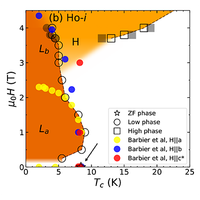
Structure and magnetic properties of the maple leaf antiferromagnet Ho3ScO6

C. Aguilar-Maldonado, R. Feyerherm, K. Prokeš, L. Keller, and B. Lake

Phys. Rev. B 111, 094439 (2025) - Published 27 March, 2025

Microscopic origin of magnetoferroelectricity in monolayer NiBr2 and NiI2

Hui-Shi Yu, Xiao-Sheng Ni, Dao-Xin Yao, and Kun Cao

Phys. Rev. B 111, 094440 (2025) - Published 28 March, 2025

Large flexomagnetic response enabled by topological magnetic textures in monolayer CrN

Qihua Gong, Ziming Tang, and Min Yi

Phys. Rev. B 111, 094441 (2025) - Published 31 March, 2025

Superfluidity and superconductivity

Nonmonotonic superconductivity, nontrivial band topology, and electride state in a beryllene system

Kai-Yue Jiang, Yu-Lin Han, Shu-Xiang Qiao, Ping Zhang, Qiang-Hua Wang, C. S. Ting, and Hong-Yan Lu

Phys. Rev. B 111, 094501 (2025) - Published 4 March, 2025

Chirped amplitude mode in photoexcited superconductors

Thomas Blommel, Jason Kaye, Yuta Murakami, Emanuel Gull, and Denis Golež

Phys. Rev. B 111, 094502 (2025) - Published 4 March, 2025

Unconventional superconductivity mediated by nematic fluctuations in a multiorbital system: Application to doped FeSe

Kazi Ranjibul Islam and Andrey Chubukov

Phys. Rev. B 111, 094503 (2025) - Published 6 March, 2025

In unconventional superconductors, pairing is believed to be of electronic origin, and linked to critical collective fluctuations. Here, the authors investigate how nematic fluctuations, responsible for orbital polarization, mediate pairing in doped FeSe. They show that nematic-mediated pairing is highly unconventional and leads to a highly anisotropic gap structure. This in turn gives rise to pronounced non-BCS behavior of observables. The authors compute thermodynamic, spectroscopic, and transport characteristics, find good agreement with the experimental data, and propose further experiments to test their predictions.

Spin excitations in bilayer La3Ni2O7 superconductors with interlayer pairing

Meiyu Lu and Tao Zhou

Phys. Rev. B 111, 094504 (2025) - Published 7 March, 2025

Self-consistent theory of 2×2 pair density waves in kagome superconductors

Meng Yao, Yan Wang, Da Wang, Jia-Xin Yin, and Qiang-Hua Wang

Phys. Rev. B 111, 094505 (2025) - Published 7 March, 2025

Kondo scattering versus weak localization in overdoped infinite-layer La1−xSrxNiO2 thin films

Xue-Yan Wang, Mei-Hui Chen, Cheng-Xue Chen, Qiang Zhao, Fang-Hui Zhu, Wen-Long Yang, Xing-Yu Chen, Mei-Ling Yan, Rui-Fen Dou, Chang-Min Xiong, and Jia-Cai Nie

Phys. Rev. B 111, 094506 (2025) - Published 10 March, 2025

Intrinsic low-temperature magnetic properties on ultraclean UTe2 with Tc=2.1 K revealed by Te125 NMR

Hiroki Matsumura, Shunsaku Kitagawa, Shiki Ogata, Riku Matsubayashi, Hiroki Fujibayashi, Katsuki Kinjo, Kenji Ishida, Yo Tokunaga, Hironori Sakai, Shinsaku Kambe, Ai Nakamura, Yusei Shimizu, Yoshiya Homma, Dexin Li, Fuminori Honda, Atsushi Miyake, and Dai Aoki

Phys. Rev. B 111, 094507 (2025) - Published 10 March, 2025

Nodal points, lines, and surfaces, and topological surface states in superconductor NiBi3

Jie Zhang, Kai-Yue Jiang, Shu-Xiang Qiao, Peng-Cheng Xiao, Na Jiao, Ping Zhang, Hong-Yan Lu, and Qi-Feng Liang

Phys. Rev. B 111, 094508 (2025) - Published 10 March, 2025

Despite the numerous reports on the time-honored superconductor NiBi3, theoretical investigations remain limited. By using first-principles calculations, the authors select here multiple pairs of bands to show its topological structure, including nodal points, lines, and surfaces and topological surface states. The authors also demonstrate that the superconductivity of NiBi3 originates from the p orbitals of Bi and d orbitals of Ni coupling with the Bi vibration. Thus, NiBi3 holds significant potential for realization of topological superconductivity and other exotic phenomena.

Atypical vortex lattice and the magnetic penetration depth in superconducting Sr2RuO4 deduced by μSR

M. Yakovlev, Z. Kartsonas, and J. E. Sonier

Phys. Rev. B 111, 094509 (2025) - Published 11 March, 2025

For three decades, the superconducting order parameter symmetry in Sr2RuO4 has remained elusive. In most superconductors this symmetry manifests in the structure of the magnetic vortex lattice induced by applying a magnetic field. The minimum field of the vortex lattice is typically located at the center of a triangular or square arrangement of vortices. The authors report here on an unusual situation for Sr2RuO4, where the minimum field appears to be between midway between nearest-neighbor vortices in a square lattice. This finding introduces another constraint on possible superconducting order parameters.

Shapiro response of superconducting diode effect derived from Andreev molecules

Sadashige Matsuo, Russell S. Deacon, Shohei Kobayashi, Yosuke Sato, Tomohiro Yokoyama, Tyler Lindemann, Sergei Gronin, Geoffrey C. Gardner, Koji Ishibashi, Michael J. Manfra, and Seigo Tarucha

Phys. Rev. B 111, 094512 (2025) - Published 12 March, 2025

Impurity strength–temperature phase diagram with phase crystals and competing time-reversal symmetry breaking states in nodal d-wave superconductors

K. M. Seja, N. Wall-Wennerdal, T. Löfwander, A. M. Black-Schaffer, M. Fogelström, and P. Holmvall

Phys. Rev. B 111, 094513 (2025) - Published 13 March, 2025

Unconventional gap structures and the intermediate mixed state: A vortex lattice study of the noncentrosymmetric superconductor BiPd

A. S. Cameron, L. Lemberger, R. Riyat, A. T. Holmes, Y. S. Yerin, A. D. Hillier, B. Joshi, S. Ramakrishnan, J. Gavilano, C. D. Dewhurst, E. M. Forgan, and E. Blackburn

Phys. Rev. B 111, 094514 (2025) - Published 13 March, 2025

Nonlinear diode effect and Berezinskii-Kosterlitz-Thouless transition in purely two-dimensional noncentrosymmetric superconductors

Naratip Nunchot and Youichi Yanase

Phys. Rev. B 111, 094515 (2025) - Published 13 March, 2025

Generic approach for integrating ferroelectricity and superconductivity into a single two-dimensional monolayer

Jianyong Chen, Wen-Yi Tong, Ping Cui, and Zhenyu Zhang

Phys. Rev. B 111, 094516 (2025) - Published 17 March, 2025

Transport properties of (InSe2)xNbSe2 with enhanced Tc and Hc2

Heyao Liu, Yuanlong Li, Jun Ge, Yiyu Liu, Shenglong Liu, He Wang, Jian Wang, and Ying Xing

Phys. Rev. B 111, 094517 (2025) - Published 17 March, 2025

Metal-to-superconductor transition induced by lithium adsorption on monolayer 1T−Nb2C

Lingxiao Xiong, Yuhui Yan, and Feipeng Zheng

Phys. Rev. B 111, 094518 (2025) - Published 17 March, 2025

Dynamical visualization of attractively interacting single vortices in type-II/1 superconducting Nb by magneto-optical imaging

S. Ooi, M. Tachiki, T. Mochiku, H. Ito, T. Kubo, A. Kikuchi, S. Arisawa, and K. Umemori

Phys. Rev. B 111, 094519 (2025) - Published 19 March, 2025

Anisotropic high-Tc superconductivity above 90 K in hole-doped boron-nitrogen clathrates at ambient pressure

Yu-Lin Han, Kai-Yue Jiang, Bao-Tian Wang, Ping Zhang, and Hong-Yan Lu

Phys. Rev. B 111, 094520 (2025) - Published 20 March, 2025

Ambient-pressure topological superconductivity in Ag4H up to 63 K by metallization of hydrogen

Chong Tian, Jun-jie Shi, Pinyuan Wang, Juan Du, Jing Lu, Xinqiang Wang, Yao-hui Zhu, and Hong-xia Zhong

Phys. Rev. B 111, 094521 (2025) - Published 20 March, 2025

Spin-dependent signatures of Majorana vortex fusion within planar Josephson junctions

Krishnan Ganesh, Derek K. K. Lee, and Jiannis K. Pachos

Phys. Rev. B 111, 094522 (2025) - Published 21 March, 2025

Resolving phonon-mediated superconducting pairing symmetries from first-principles calculation

Zimeng Zeng, Xiaoming Zhang, Shunhong Zhang, Jian Wu, and Zheng Liu

Phys. Rev. B 111, 094523 (2025) - Published 26 March, 2025

Fractional spin Josephson effect in topological spin superconductors

Liang Du, Hua Jiang, Yijia Wu, and X. C. Xie

Phys. Rev. B 111, 094524 (2025) - Published 28 March, 2025

Low fractional volume superconductivity in single crystals of Pr4Ni3O10 under pressure

Xinglong Chen, E. H. T. Poldi, Shuyuan Huyan, R. Chapai, H. Zheng, S. L. Bud'ko, U. Welp, P. C. Canfield, Russell J. Hemley, J. F. Mitchell, and D. Phelan

Phys. Rev. B 111, 094525 (2025) - Published 31 March, 2025

Sign In to Your Journals Account

Filter

Filter

Article Lookup

Enter a citation