Browse by Subject

Polarity Control in Group-III Nitrides beyond Pragmatism

Stefan Mohn, Natalia Stolyarchuk, Toni Markurt, Ronny Kirste, Marc P. Hoffmann, Ramón Collazo, Aimeric Courville, Rosa Di Felice, Zlatko Sitar, Philippe Vennéguès, and Martin Albrecht

Phys. Rev. Applied 5, 054004 (2016) - Published 3 May, 2016

Polarity engineering for applications in electronics and nonlinear optics requires the reliable, controllable growth of uniformly polar layers of a compound semiconductor on a nonpolar substrate. So far, this has been developed on a purely empirical basis. The authors use transmission electron microscopy and density-functional theory to see how exchange of aluminum, oxygen, and nitrogen within a sapphire substrate mediates the polarity of an epitaxial film of group-III nitride. Their results shed new light on familiar concepts like substrate nitridation and low-temperature buffers, and may further help to understand polarity control in oxides and other materials.

Reciprocity between Charge Injection and Extraction and Its Influence on the Interpretation of Electroluminescence Spectra in Organic Solar Cells

Thomas Kirchartz, Jenny Nelson, and Uwe Rau

Phys. Rev. Applied 5, 054003 (2016) - Published 3 May, 2016

In optoelectronics, luminescence under applied voltage and photocurrent generation under illumination are central to light-emitting diodes and solar cells, respectively. While in many cases these processes are perfectly reciprocal, and can be related via simple equations, in some relevant situations this symmetry disappears. The authors study the limits of reciprocity for several luminescence-based approaches commonly used to analyze organic solar cells, and find a few situations in which assuming reciprocity could be problematic.

Predictive Mechanistic Model for the Electrical Impedance and Intensity-Modulated Photocurrent and Photovoltage Spectroscopic Responses of an Organic Bulk Heterojunction Solar Cell

Ying Ting Set, Erik Birgersson, and Joachim Luther

Phys. Rev. Applied 5, 054002 (2016) - Published 3 May, 2016

High-resolution, frequency-resolved current-voltage measurements in the time domain are widely used to analyze performance bottlenecks in organic solar cells. The authors develop a quantitative framework to synthesize the information from three important techniques, and a computationally efficient tool to extract physical parameters from the measured spectra. This would supplant equivalent-circuit models, which are neither mechanistic nor predictive, with a clearer, physics-based approach to optimizing photovoltaic devices.

Cavity-Enhanced Second-Order Nonlinear Photonic Logic Circuits

Rahul Trivedi, Uday K. Khankhoje, and Arka Majumdar

Phys. Rev. Applied 5, 054001 (2016) - Published 2 May, 2016

Bits and bytes do not have to be manipulated using charge or spin. This study contributes to the realization of an all-optical computer, by offering a design for optical logic gates with second-order nonlinearity. In terms of power consumption at attainable quality factors, the authors’ scheme is orders of magnitude more efficient than a conventional circuit based on third-order nonlinearity.

Planar Multilayer Circuit Quantum Electrodynamics

Z. K. Minev, K. Serniak, I. M. Pop, Z. Leghtas, K. Sliwa, M. Hatridge, L. Frunzio, R. J. Schoelkopf, and M. H. Devoret

Phys. Rev. Applied 5, 044021 (2016) - Published 29 April, 2016

Circuit quantum electrodynamics promises an efficient realization of the quantum computer, but what should the architecture be? The authors demonstrate a system that successfully marries the advantages of two approaches: the integration capacity of a two-dimensional (planar) layout, plus the high quantum coherence of a three-dimensional structure. This approach is practical for a range of applications, including hybrid systems incorporating semiconducting nanostructures or trapped atoms.

Large Deformations of a Soft Porous Material

Christopher W. MacMinn, Eric R. Dufresne, and John S. Wettlaufer

Phys. Rev. Applied 5, 044020 (2016) - Published 29 April, 2016

Deforming a porous material can squeeze out interstitial fluid, as we know from washing with a kitchen sponge. Many of these materials, including soils, gels, and biological tissues, are soft and can experience very large deformations, which require complex, highly nonlinear mathematical models. The authors discuss an exact kinematic model for large deformations, and show when and how these large deformations change the mechanics of two example problems. Their findings lend a deep physical perspective to applications ranging from biomedical engineering to hydrogeology.

Quench-Induced Degradation of the Quality Factor in Superconducting Resonators

M. Checchin, M. Martinello, A. Romanenko, A. Grassellino, D. A. Sergatskov, S. Posen, O. Melnychuk, and J. F. Zasadzinski

Phys. Rev. Applied 5, 044019 (2016) - Published 28 April, 2016

Cryogenic superconducting niobium resonators are key to accelerators for free-electron lasers and experiments in particle and nuclear physics. A resonator’s performance is often degraded by a magnetic field that is trapped in it during a quench event. Without a clear understanding of this field’s origin, the problem has been addressed by thermal cycling above the cavity’s critical temperature. Now the authors pinpoint the mechanism responsible for the trapped flux, and show how to fully recover the quality factor while staying below the critical temperature, which is of great practical interest.

Measurement of Surface Photovoltage by Atomic Force Microscopy under Pulsed Illumination

Zeno Schumacher, Yoichi Miyahara, Andreas Spielhofer, and Peter Grutter

Phys. Rev. Applied 5, 044018 (2016) - Published 28 April, 2016

To optimize photovoltaics, we need a microscopic understanding of the electronic processes in their collector materials, which begins with empirical measurement. Surface photovoltage is of great interest for studying carrier dynamics and lifetime in semiconductors. The authors use pulsed illumination plus Kelvin probe force microscopy to measure surface photovoltage with an order of magnitude decrease in standard deviation. Their time-domain approach avoids crosstalk that could mislead, and offers progress more generally in molecular electronics and scanning-probe microscopy.

Giant Photoresponsivity of Midinfrared Hyperbolic Metamaterials in the Photon-Assisted-Tunneling Regime

Pai-Yen Chen, Mehdi Hajizadegan, Maryam Sakhdari, and Andrea Alù

Phys. Rev. Applied 5, 041001 (2016) - Published 28 April, 2016

Conventional solar cells cannot collect energy from abundant midinfrared light, because there are no suitable semiconductors of the right band gap. Hyperbolic metamaterials (HMMs) are proposed to realize broadband, omnidirectional, sensitive diodes operating in this spectral region. The authors show how the slow-light modes supported by HMMs can trap incident radiation in metal-insulator-metal tunnel junctions, for ultrafast optical rectification and photon-to-electron energy conversion that is orders of magnitude more efficient than in conventional optical rectennas.

Three-Dimensional Simulations of the Electrothermal and Terahertz Emission Properties of Bi2Sr2CaCu2O8 Intrinsic Josephson Junction Stacks

F. Rudau, R. Wieland, J. Langer, X. J. Zhou, M. Ji, N. Kinev, L. Y. Hao, Y. Huang, J. Li, P. H. Wu, T. Hatano, V. P. Koshelets, H. B. Wang, D. Koelle, and R. Kleiner

Phys. Rev. Applied 5, 044017 (2016) - Published 27 April, 2016

Stacks of intrinsic Josephson junctions (JJs) in cuprate superconductors are promising emitters of terahertz light, which is sought for many applications in imaging, spectroscopy, and communication. The authors simulate JJ stacks in three dimensions, simultaneously solving a Fickian diffusion equation for heat and coupled sine-Gordon equations for current. They predict, and confirm experimentally, that applying a modest magnetic field to a stack’s long side enhances emission significantly—one more step toward efficient devices.

Atomic-Scale Positioning of Single Spins via Multiple Nitrogen-Vacancy Centers

Wen-Long Ma, Shu-Shen Li, Geng-Yu Cao, and Ren-Bao Liu

Phys. Rev. Applied 5, 044016 (2016) - Published 25 April, 2016

Three satellites can be used for global positioning. Similarly, the authors propose using the spins of three nitrogen-vacancy centers in the tip of a diamond nanoprobe as a multipoint quantum sensor, for fast 3D magnetic resonance imaging with subnanometer resolution. This technique offers fast detection of individual spins under ambient conditions, which would advance single-molecule detection in analytical chemistry and molecular biology, for example.

Effect of Split Gate Size on the Electrostatic Potential and 0.7 Anomaly within Quantum Wires on a Modulation-Doped GaAs/AlGaAs Heterostructure

L. W. Smith, H. Al-Taie, A. A. J. Lesage, K. J. Thomas, F. Sfigakis, P. See, J. P. Griffiths, I. Farrer, G. A. C. Jones, D. A. Ritchie, M. J. Kelly, and C. G. Smith

Phys. Rev. Applied 5, 044015 (2016) - Published 25 April, 2016

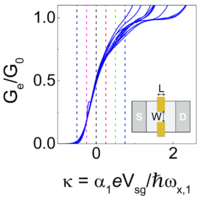
In mesoscopic devices, individual quirks plus quantum effects can lead to variable behavior, including the exact onset of the “0.7 anomaly”, an empirical feature seen around 7/10 of the quantum of conductance. The authors present a systematic study of the impact of gate size on electronic behavior, for a large ensemble of devices. A longer one-dimensional channel reduces the conductance value of the 0.7 feature, and, surprisingly, the background impurity potential is at least as significant as gate size in controlling device electrostatics. Such understanding is important for guaranteeing reliable performance of e.g. mass-produced computer chips.

X-ray Multimodal Tomography Using Speckle-Vector Tracking

Sebastien Berujon and Eric Ziegler

Phys. Rev. Applied 5, 044014 (2016) - Published 20 April, 2016

Advanced x-ray imaging is promising in a host of contexts, including in vivo biological scans that could dramatically advance many medical treatments. This study presents advances in x-ray computed tomography using speckle vectors, an especially attractive technique requiring minimal instrumentation for high sensitivity and resolution. With just a piece of abrasive paper or a filter membrane as optical modulator, multiple image modalities become available at no extra cost, for a given dose of radiation to the specimen. The schemes described here should promote phase-contrast and dark-field three-dimensional imaging, using either synchrotron or laboratory sources.

Competition between Induced-Charge Electro-Osmosis and Electrothermal Effects at Low Frequencies around a Weakly Polarizable Microchannel Corner

Matan Zehavi, Alicia Boymelgreen, and Gilad Yossifon

Phys. Rev. Applied 5, 044013 (2016) - Published 20 April, 2016

Microchannel corners are standard geometric features of planar microfluidic systems and lab-on-a-chip devices, so understanding their influence on flow within the channel is important for device design. The authors show that, depending on system parameters, ejection from a dielectric corner stems from competing nonlinear mechanisms: induced-charge electro-osmosis (ICEO) and electrothermal (ET) effects. Divergence from purely ICEO flow is a result of increasing ET effects due to Joule heating.

Quantum Feedback Amplification

Naoki Yamamoto

Phys. Rev. Applied 5, 044012 (2016) - Published 19 April, 2016

Feedback control has been used for nearly a century to provide reliable operation of electronic systems. Quantum systems introduce new considerations; in particular, quantum devices intrinsically use very small signals and so are highly sensitive to noise, and they require coherence between an original signal and any controlling input. The author demonstrates an approach that allows minimum-noise amplification even with realistic imperfections, for improved applications in computing, secure communication, and metrology.

Discrete Layer-by-Layer Magnetic Switching in Fe/MgO(001) Superlattices

R. Moubah, F. Magnus, T. Warnatz, G. K. Palsson, V. Kapaklis, V. Ukleev, A. Devishvili, J. Palisaitis, P. O. Å. Persson, and B. Hjörvarsson

Phys. Rev. Applied 5, 044011 (2016) - Published 19 April, 2016

Like high-rise apartments for bits, stacked structures offer a means to increase the areal density of components on computer chips, despite the physical limits encountered at the nanoscale. The authors demonstrate a series of back-to-back Fe/MgO magnetic tunnel junctions with tunable interlayer coupling and discrete layer-by-layer switching, opening a path to three-dimensional magnetic storage and logic devices.

Narrow-Linewidth Homogeneous Optical Emitters in Diamond Nanostructures via Silicon Ion Implantation

Ruffin E. Evans, Alp Sipahigil, Denis D. Sukachev, Alexander S. Zibrov, and Mikhail D. Lukin

Phys. Rev. Applied 5, 044010 (2016) - Published 18 April, 2016

Color centers in diamond provide a promising platform for quantum optics in the solid state, but often their desirable properties are spoiled when they are incorporated into actual devices. The authors demonstrate a simple technique to create centers with uniformly high-quality optical properties, even inside nanoscale devices. Their method may well open the gates for quantum information processing based on this type of hardware.

Generation of Equal-Energy Orbital Angular Momentum Beams via Photopatterned Liquid Crystals

Peng Chen, Shi-Jun Ge, Ling-Ling Ma, Wei Hu, Vladimir Chigrinov, and Yan-Qing Lu

Phys. Rev. Applied 5, 044009 (2016) - Published 18 April, 2016

The orbital angular momentum (OAM) of light can be exploited for applications, particularly in high-speed optical communication, and quantum information processing. The authors design and build a liquid-crystal Dammann vortex grating, which can generate a series of equal-energy OAM beams. This technology presents excellent polarization independence, electrical switchability, and tunability, and is promising for OAM generation, manipulation, and detection.

Microscale Electromagnetic Heating in Heterogeneous Energetic Materials Based on X-ray Computed Tomography

W. J. M. Kort-Kamp, N. L. Cordes, A. Ionita, B. B. Glover, A. L. Higginbotham Duque, W. L. Perry, B. M. Patterson, D. A. R. Dalvit, and D. S. Moore

Phys. Rev. Applied 5, 044008 (2016) - Published 15 April, 2016

Detecting explosives without setting them off is, obviously, a prime goal in security applications. Avoiding detonation requires deep understanding of the complex, spatiotemporal interplay of chemistry and heat transport in heterogeneous solids. The authors combine three-dimensional structural data, dielectric data, and simulations to study hot-spot formation and thermal gradients in energetic mesostructures under electromagnetic radiation. They find that enhanced light absorption at hot spots, below the initiation threshold—“tickling the dragon”—could provide alternative signatures for stand-off detection.

Optomechanical Magnetometry with a Macroscopic Resonator

Changqiu Yu, Jiri Janousek, Eoin Sheridan, David L. McAuslan, Halina Rubinsztein-Dunlop, Ping Koy Lam, Yundong Zhang, and Warwick P. Bowen

Phys. Rev. Applied 5, 044007 (2016) - Published 15 April, 2016

Whispering galley mode resonators have many applications, including photonic circuitry, optical clocks, and sensing. They can be used as magnetometers that operate in ambient conditions and require no cryogenics, but so far they have been limited to sensitivities above 100 nT in the crucial 1–1000 Hz frequency range. The authors engineer a combination of optical and mechanical resonances in such a system to detect kHz magnetic fields with sensitivity around 100 pT. This advance of three orders of magnitude opens the door to applications in geological surveying, medical imaging, and other areas.

Sign In to Your Journals Account

Filter

Subject

Filter

Article Lookup

Enter a citation