Highlights

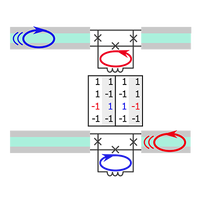
Asynchronous Reversible Computing Unveiled Using Ballistic Shift Registers

K.D. Osborn and W. Wustmann

Phys. Rev. Applied 19, 054034 (2023) - Published 10 May, 2023

Reversible computing exploits thermodynamic principles to replace irreversible Boolean logic with higher-efficiency reversible logic, and could change the future of computers. How best to implement reversible gates and architectures remains an open problem. Superconducting hardware features negligible intrinsic damping, which allows for exploration of many digital circuit types with varying degrees of reversibility. This study simulates Josephson junctions, where single flux quanta serve as bits in this logic type, with the goal of replacing an irreversible shift-register memory. The authors find that asynchronous access, and therefore simpler architecture, is possible.

Nonlinear Response and Crosstalk of Electrically Driven Silicon Spin Qubits

Brennan Undseth, Xiao Xue, Mohammad Mehmandoost, Maximilian Rimbach-Russ, Pieter T. Eendebak, Nodar Samkharadze, Amir Sammak, Viatcheslav V. Dobrovitski, Giordano Scappucci, and Lieven M.K. Vandersypen

Phys. Rev. Applied 19, 044078 (2023) - Published 25 April, 2023

Frequency multiplexing of operations is an attractive strategy to control multiple qubits simultaneously in a spin-based quantum processor with relatively few control lines. However, high-fidelity operation demands good spectral addressability and noncontextual spin dynamics. The authors explore an unexpected crosstalk mechanism, in which the Rabi frequency of one spin changes markedly depending on the simultaneous operation of another. They also connect this behavior to another surprising feature: the nonlinear scaling of Rabi frequency with resonant driving amplitude. These results provide insight into the challenges that such state-of-the-art control methods will face.

Programmable Spatiotemporal Quantum Parametric Mode Sorter

Malvika Garikapati, Santosh Kumar, He Zhang, Yong Meng Sua, and Yu-Ping Huang

Phys. Rev. Applied 19, 044070 (2023) - Published 24 April, 2023

Photons are ideal information carriers for sensing, communication, and computing. In principle, a single photon can carry much information in its spatiotemporal modes; the challenge is to read it out, as linear optical elements are not sensitive to the subtle differences among those modes. This study demonstrates a nonlinear-optical approach in which a single pass through a LiNiO3 waveguide can separate photons according to their detailed spatiotemporal profiles or their superpositions, even if they completely overlap with each other. This provides access to photons’ large Hilbert spaces, pointing to applications in free-space quantum communication, computing, and sensing.

Precision Measurement of the Microwave Dielectric Loss of Sapphire in the Quantum Regime with Parts-per-Billion Sensitivity

Alexander P. Read, Benjamin J. Chapman, Chan U Lei, Jacob C. Curtis, Suhas Ganjam, Lev Krayzman, Luigi Frunzio, and Robert J. Schoelkopf

Phys. Rev. Applied 19, 034064 (2023) - Published 20 March, 2023

To better understand decoherence in superconducting qubits, the authors develop a technique to measure the loss tangent of dielectric substrates and predict the impact of dielectric loss on qubit lifetimes. This is done with no need to fabricate planar devices; the technique is independent of material platform. Measurements of sapphire in a demonstration of the approach suggest that coherence of superconducting qubits on a common form of sapphire is limited significantly by bulk dielectric loss. The same technique also shows that another form of sapphire would substantially mitigate this bulk dielectric loss and prolong qubit coherence.

Parallel Assembly of Arbitrary Defect-Free Atom Arrays with a Multitweezer Algorithm

Weikun Tian, Wen Jun Wee, An Qu, Billy Jun Ming Lim, Prithvi Raj Datla, Vanessa Pei Wen Koh, and Huanqian Loh

Phys. Rev. Applied 19, 034048 (2023) - Published 15 March, 2023

A new algorithm can organize hundreds of atoms into pristine patterns—including a honeycomb lattice, a fractal called a Sierpiński triangle, and a lion’s head.

Time-Dependent Magnetic Flux in Devices for Circuit Quantum Electrodynamics

Jacob Bryon, D.K. Weiss, Xinyuan You, Sara Sussman, Xanthe Croot, Ziwen Huang, Jens Koch, and Andrew A. Houck

Phys. Rev. Applied 19, 034031 (2023) - Published 9 March, 2023

Time-dependent external flux is ubiquitous across circuit quantum electrodynamics and calls for accurate modeling. Contrary to long-held belief, it is recently predicted—but not yet verified—that the allocation of time-dependent flux cannot be arbitrary in the Hamiltonian. This study provides an experimental verification of this prediction by applying fast flux pulses to a fluxonium qubit and taking measurements of the quantum state following the pulses. Given the widespread use of time-dependent flux in experiments with superconducting qubits, verification of this theory is critical to our understanding of circuit quantum electrodynamics.

Scalable Quantum Memory Nodes Using Nuclear Spins in Silicon Carbide

Shravan Kumar Parthasarathy, Birgit Kallinger, Florian Kaiser, Patrick Berwian, Durga B.R. Dasari, Jochen Friedrich, and Roland Nagy

Phys. Rev. Applied 19, 034026 (2023) - Published 8 March, 2023

A distributed quantum network requires versatile and high-fidelity quantum memory nodes, but it remains challenging to make them scalable. This study investigates the use of multiple controllable quantum memories in silicon carbide—an established semiconductor material platform for various quantum technology applications—and provides a viable solution. The authors show that solid-state spins in silicon carbide are ideal quantum memories in a distributed quantum computing network, wherein a controlled generation of highly coherent qubit registers using nuclear spins is possible. This study will impact the future development of quantum networks with solid states spins as quantum memories.

Performance Boost of a Collective Qutrit Refrigerator

Dmytro Kolisnyk and Gernot Schaller

Phys. Rev. Applied 19, 034023 (2023) - Published 8 March, 2023

One of the world’s tiniest autonomous refrigerators can be realized by a single qutrit coupled to three thermal reservoirs. The authors analyze the performance of multiple collectively coupled qutrits, and observe a quantum boost in the steady-state cooling current with a quadratic scaling in the working fluid size. With additional interqutrit interactions, the quantum boost can be maintained also for larger systems and not perfectly collective scenarios, enabling efficient quantum cooling.

High-Fidelity CNOT Gate for Donor Electron Spin Qubits in Silicon

Ludwik Kranz, Stephen Roche, Samuel K. Gorman, Joris. G. Keizer, and Michelle Y. Simmons

Phys. Rev. Applied 19, 024068 (2023) - Published 24 February, 2023

Epitaxial atom-based spin qubits in silicon exhibit excellent properties, and benefit from the outstanding scalability of that material platform. As silicon spin-based qubits now start to meet the 99% fault-tolerance threshold, the authors show how the nuclear spins inherent to the local magnetic environment can be engineered as atomic magnets to boost the fidelities of two-qubit logic gates. Modeling indicates that two-qubit CNOT gate fidelities as high as 99.98% are realistic, through silicon purification and careful engineering. This work provides a roadmap for atom qubits in silicon, showing how to optimize two-qubit gates at both the design and measurement stages.

Multiple Tin-Vacancy Centers in Diamond with Nearly Identical Photon Frequency and Linewidth

Yasuyuki Narita, Peng Wang, Keita Ikeda, Kazuki Oba, Yoshiyuki Miyamoto, Takashi Taniguchi, Shinobu Onoda, Mutsuko Hatano, and Takayuki Iwasaki

Phys. Rev. Applied 19, 024061 (2023) - Published 23 February, 2023

Tin-vacancy (Sn-V) centers in diamond, which possess good optical and spin properties, are a promising system for constructing quantum network nodes. Tin atoms are heavy, though, and generating photons with identical wavelength and linewidth from multiple Sn-V emitters is challenging, due to the strain in the diamond host material. This study shows that multiple Sn-V centers, formed deep within bulk diamond by ion implantation and high-temperature annealing, emit nearly identical photons. This leads to two-photon interference from distant centers, an important step toward building quantum network nodes.

Improved Coherent One-Way Quantum key Distribution for High-Loss Channels

Emilien Lavie and Charles C.-W. Lim

Phys. Rev. Applied 18, 064053 (2022) - Published 19 December, 2022

Coherent one-way quantum key distribution (COW-QKD) is a popular cryptography protocol, due to its fairly simple implementation and passive measurement device. Its security analysis is challenging, though, and extra assumptions or modifications are typically employed. Here the authors propose minor modifications to COW-QKD’s prepared states while retaining the original, fully passive measurement device, and generalize the “universal squashing” framework to analyze their system’s security. The results suggest that performance should be comparable to upper bounds from the literature, making this protocol a viable alternative to one based on phase-modulated coherent states.

Autonomous Estimation of High-Dimensional Coulomb Diamonds from Sparse Measurements

Anasua Chatterjee, Fabio Ansaloni, Torbjørn Rasmussen, Bertram Brovang, Federico Fedele, Heorhii Bohuslavskyi, Oswin Krause, and Ferdinand Kuemmeth

Phys. Rev. Applied 18, 064040 (2022) - Published 14 December, 2022

In spin-based quantum processors, each quantum dot of a qubit is populated by exactly one electron, which requires careful tuning of each gate voltage such that it lies inside the charge-stability region (the “Coulomb diamond”) associated with the dot array. However, mapping the boundary of a multidimensional Coulomb diamond by traditional dense raster scanning would take years, so the authors develop a sparse acquisition technique that autonomously learns Coulomb-diamond boundaries from a small number of measurements. Here we have hardware-triggered line searches in the gate-voltage space of a silicon quadruple dot, with smart search directions proposed by an active-learning algorithm.

Coherence Properties of Electron-Beam-Activated Emitters in Hexagonal Boron Nitride Under Resonant Excitation

Jake Horder, Simon J.U. White, Angus Gale, Chi Li, Kenji Watanabe, Takashi Taniguchi, Mehran Kianinia, Igor Aharonovich, and Milos Toth

Phys. Rev. Applied 18, 064021 (2022) - Published 8 December, 2022

Lattice defects in two-dimensional materials are compelling sources of single photons for applications in quantum information processing. However, the range of emission wavelengths is broad, the defect types vary and the atomic structures of most are unknown, and the inability to fabricate defects systematically on demand has limited progress. This work leverages a robust, site-specific fabrication technique to produce arrays of blue quantum emitters for study via cryogenic spectroscopy. The authors characterize processes that limit emitter coherence and observe Rabi oscillations, demonstrating the potential of these defects for scalable quantum technologies.

Field-Deployable Quantum Memory for Quantum Networking

Yang Wang, Alexander N. Craddock, Rourke Sekelsky, Mael Flament, and Mehdi Namazi

Phys. Rev. Applied 18, 044058 (2022) - Published 25 October, 2022

The quantum Internet will support paradigm shifts in cybersecurity, distributed quantum computing, and sensing. Its realization, however, has been held back by the lack of practical technologies to enable deployment and scalability. To date, most demonstrations have been limited to laboratories with expensive resources such as cryogenic and vacuum systems. The authors overcome this challenge by designing a field-deployable quantum memory, based on warm atomic vapor, that demonstrates high-fidelity performance and robustness to environmental noise. This represents a key technology for distributing quantum entanglement across large-scale quantum networks.

Silicon Photonic Wires for Broadband Polarization Entanglement at Telecommunication Wavelengths

Shivani Sharma, Vivek Venkataraman, and Joyee Ghosh

Phys. Rev. Applied 18, 044043 (2022) - Published 18 October, 2022

Compact and scalable sources of broadband polarization entanglement at telecommunication wavelengths will pave the way for multiuser long-distance quantum communication at enhanced data rates, but progress toward this goal has been hindered due to large birefringence in conventional silicon-on-insulator nanowaveguides. The authors theoretically demonstrate, via dispersion engineering, the successful generation of polarization-entangled photon pairs over a broad range of wavelengths. This work also provides a strategy to avoid entanglement degradation due to polarization-mode dispersion. The proposed devices will be useful building blocks for large-scale quantum communication networks.

Weakly Flux-Tunable Superconducting Qubit

José M. Chávez-Garcia, Firat Solgun, Jared B. Hertzberg, Oblesh Jinka, Markus Brink, and Baleegh Abdo

Phys. Rev. Applied 18, 034057 (2022) - Published 22 September, 2022

Superconducting qubits are building blocks for quantum processors, but they suffer from frequency collisions, which hinder the construction of large qubit lattices. This study introduces weakly tunable qubits, whose frequency can be tuned over a small range via external magnetic flux. Through theoretical derivation and experimental demonstration, the authors show that these transmonlike qubits—without losing the desired key properties—can be used to avoid frequency collisions in large qubit systems while minimizing the sensitivity to flux noise. They can also be applied to operate flux-tuned qubit gates.

Double-Transmon Coupler: Fast Two-Qubit Gate with No Residual Coupling for Highly Detuned Superconducting Qubits

Hayato Goto

Phys. Rev. Applied 18, 034038 (2022) - Published 15 September, 2022

Tunable couplers, which turn on and off the interaction between qubits, have emerged as a key means to achieve low error rates in superconducting quantum computers. Conventional devices using one transmon qubit exhibit unwanted residual coupling, though, especially at the high detuning that is desirable for suppressing crosstalk errors. To solve this critical problem, the author proposes a tunable coupler based on two transmons that satisfies the ideal conditions of no residual coupling and fast two-qubit gate operations at high detuning. This double-transmon coupler is expected to become standard for superconducting architectures by eliminating unwanted coupling during idle time.

Near-Surface Electrical Characterization of Silicon Electronic Devices Using Focused keV-Range Ions

S.G. Robson, P. Räcke, A.M. Jakob, N. Collins, H.R. Firgau, V. Schmitt, V. Mourik, A. Morello, E. Mayes, D. Spemann, and D.N. Jamieson

Phys. Rev. Applied 18, 034037 (2022) - Published 14 September, 2022

Already a building block of modern life, silicon is also poised to power the next leap in information technology, in which the quantum mechanical properties of single impurities located just beneath its surface can be used to create vastly more powerful computers. Here a multinational team presents a specialized microscope to better understand the inner workings of such silicon chips, by scanning a finely focused beam of ultralow-energy ions across the surface. The tiny “click” that each ion makes when it hits the chip is detected and mapped, enabling the identification of manufacturing defects; these results can then be fed back to improve the fabrication process.

Dynamics of Transmon Ionization

Ross Shillito, Alexandru Petrescu, Joachim Cohen, Jackson Beall, Markus Hauru, Martin Ganahl, Adam G.M. Lewis, Guifre Vidal, and Alexandre Blais

Phys. Rev. Applied 18, 034031 (2022) - Published 13 September, 2022

Qubit measurement is an essential step in any quantum computation. In circuit quantum electrodynamics, a leading quantum computer architecture, qubit readout is commonly one of the longest and lowest-fidelity processes. The authors numerically explore the dynamics of a driven transmon-resonator system under strong, nearly resonant measurement drives to better understand this issue. They find clear signs of transmon “ionization”, in which the qubit escapes its confining potential under the influence of the drive, and semiclassical methods then reveal the mechanism. This approach can be used to optimize circuit parameters, suppress these spurious effects, and increase readout fidelity.

Measurement of the Low-Temperature Loss Tangent of High-Resistivity Silicon Using a High-Q Superconducting Resonator

M. Checchin, D. Frolov, A. Lunin, A. Grassellino, and A. Romanenko

Phys. Rev. Applied 18, 034013 (2022) - Published 7 September, 2022

Even though silicon is widely used in superconducting quantum processors as the substrate upon which qubits are fabricated, the effect of silicon on the performance of the qubits is not fully understood. Using ultrahigh-quality microwave cavities to measure dielectric loss with parts-per-billion precision, the authors clearly show that using silicon is detrimental to qubit coherence time. The loss tangent found here is an order of magnitude worse than previously measured. This study sheds light on the physical mechanisms behind dissipation in silicon, and highlights the need for further work to fully understand the origin of these losses, and how to mitigate them.

Sign In to Your Journals Account

Filter

Filter

Article Lookup

Enter a citation