Design of a neutrino source based on beta beams
E. Wildner et al.
Phys. Rev. ST Accel. Beams 17, 071002 (2014) - Published 23 July, 2014
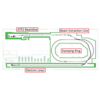
“Beta beams” produce collimated pure electron (anti)neutrino beams by accelerating beta active ions to high energies and having them decay in a racetrack shaped storage ring of 7 km circumference, the decay ring. EUROnu beta beams are based on CERN infrastructures and existing machines. Using existing machines may be an advantage for the cost evaluation, but will also constrain the physics performance. The isotope pair of choice for the beta beam is and . However, before the EUROnu studies one of the required isotopes, , could not be produced in rates that satisfy the needs for physics of the beta beam. Therefore, studies of alternative beta emitters, and , with properties interesting for a beta beam have been proposed and have been studied within EUROnu. These alternative isotopes could be produced by using a small storage ring, in which the beam traverses a target, creating the and isotopes. This production ring, the injection linac and the target system have been evaluated. Measurements of the cross section of the reactions to produce the beta beam isotopes show interesting results. A device to collect the produced isotopes from the target has been developed and tested. However, the yields of and , using the production ring for production of and , is not yet, according to simulations, giving the rates of isotopes that would be needed. Therefore, a new method of producing the isotope has been developed and tested giving good production rates. A 60 GHz ECRIS prototype, the first in the world, was developed and tested for ion production with contributions from EUROnu. The decay ring lattices for the and have been developed and the lattice for and has been optimized to ensure the high intensity ion beam stability.