Highlights

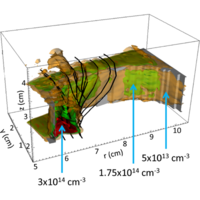
Computational analysis of current-loss mechanisms in a post-hole convolute driven by magnetically insulated transmission lines

D. V. Rose, E. A. Madrid, D. R. Welch, R. E. Clark, C. B. Mostrom, W. A. Stygar, and M. E. Cuneo

Phys. Rev. ST Accel. Beams 18, 030402 (2015) - Published 4 March, 2015

Modeling loss mechanisms in magnetically insulated vacuum transmission line convolutes will guide the design of future pulsed-power systems.

Adaptive electron beam shaping using a photoemission gun and spatial light modulator

Jared Maxson, Hyeri Lee, Adam C. Bartnik, Jacob Kiefer, and Ivan Bazarov

Phys. Rev. ST Accel. Beams 18, 023401 (2015) - Published 23 February, 2015

The transverse distribution of an electron beam generated from a photocathode in a high-voltage dc gun is controlled and shaped by spatial laser profiling using a light modulator.

Longitudinal injection scheme using short pulse kicker for small aperture electron storage rings

M. Aiba, M. Böge, F. Marcellini, Á. Saá Hernández, and A. Streun

Phys. Rev. ST Accel. Beams 18, 020701 (2015) - Published 20 February, 2015

A new synchrotron injection scheme for an electron storage ring is proposed that, although the stored beam is not perturbed, a fast kicker is necessary for the widely used 500 MHz rf system.

High-gradient microelectromechanical system quadrupole electromagnets for particle beam focusing and steering

Jere Harrison, Yongha Hwang, Omeed Paydar, Jimmy Wu, Evan Threlkeld, James Rosenzweig, Pietro Musumeci, and Rob Candler

Phys. Rev. ST Accel. Beams 18, 023501 (2015) - Published 17 February, 2015

Fabrication and beam tests of miniature quadrupole electromagnets with sub-mm gap indicate path to multi-kT/m gradients.

Phase combination for self-cancellation of magnetic force in undulators

Ryota Kinjo and Takashi Tanaka

Phys. Rev. ST Accel. Beams 17, 122401 (2014) - Published 23 December, 2014

Upper and lower permanent-magnet sections can be arranged so as to greatly reduce magnetic forces, thereby enabling the construction of lightweight, compact, and cost-effective undulators.

Accelerator-feasible N-body nonlinear integrable system

V. Danilov and S. Nagaitsev

Phys. Rev. ST Accel. Beams 17, 124402 (2014) - Published 23 December, 2014

A new N-body integrable system including interactions between particles has been found, which could be experimentally realized in particle accelerators, with implications for charged particle beams.

Grid dependent noise and entropy growth in anisotropic 3d particle-in-cell simulation of high intensity beams

I. Hofmann and O. Boine-Frankenheim

Phys. Rev. ST Accel. Beams 17, 124201 (2014) - Published 18 December, 2014

Numerical heating in particle-in-cell-based beam-dynamics simulations leads to an optimum combination of particle number and grid resolution.

Generation of stable subfemtosecond hard x-ray pulses with optimized nonlinear bunch compression

Senlin Huang, Yuantao Ding, Zhirong Huang, and Ji Qiang

Phys. Rev. ST Accel. Beams 17, 120703 (2014) - Published 15 December, 2014

A simple method to generate attosecond x-ray pulses from the optimization of high-harmonic rf linearizer and longitudinal space charge effects is proposed.

Development of experimental techniques for the characterization of ultrashort photon pulses of extreme ultraviolet free-electron lasers

S. Düsterer et al.

Phys. Rev. ST Accel. Beams 17, 120702 (2014) - Published 10 December, 2014

Systematic studies on various methods to characterize photon pulse duration at the FLASH facility are presented.

Back-bombardment compensation in microwave thermionic electron guns

Jeremy M. D. Kowalczyk and John M. J. Madey

Phys. Rev. ST Accel. Beams 17, 120402 (2014) - Published 8 December, 2014

Improved thermionic guns may provide picosecond bunch lengths, gigahertz repetition rates, and high average current.

Mitigation of ground motion effects in linear accelerators via feed-forward control

J. Pfingstner, K. Artoos, C. Charrondiere, St. Janssens, M. Patecki, Y. Renier, D. Schulte, R. Tomás, A. Jeremie, K. Kubo, S. Kuroda, T. Naito, T. Okugi, T. Tauchi, and N. Terunuma

Phys. Rev. ST Accel. Beams 17, 122801 (2014) - Published 4 December, 2014

An effective novel method to control beam orbits in linear colliders is presented and qualified.

Charge state distribution of Kr86 in hydrogen and helium gas charge strippers at 2.7  MeV/nucleon

H. Kuboki, H. Okuno, H. Hasebe, N. Fukunishi, E. Ikezawa, H. Imao, O. Kamigaito, and M. Kase

Phys. Rev. ST Accel. Beams 17, 123501 (2014) - Published 2 December, 2014

Heavy-ion beam charge stripping at 2.7 MeV/u is studied, experimentally and theoretically, for different low-Z gas stripper targets.

Measurement of ultralow vertical emittance using a calibrated vertical undulator

K. P. Wootton, M. J. Boland, and R. P. Rassool

Phys. Rev. ST Accel. Beams 17, 112802 (2014) - Published 14 November, 2014

An ultralow vertical emittances near the quantum limit was measured using a vertical undulator in an electron storage ring.

Pile up management at the high-luminosity LHC and introduction to the crab-kissing concept

Stéphane Fartoukh

Phys. Rev. ST Accel. Beams 17, 111001 (2014) - Published 6 November, 2014

A novel collision scheme, known as “crab kissing,” opens up new possibilities for controlling quantity and quality of physics data at the high-luminosity LHC.

Emittance measurements and minimization at the SwissFEL Injector Test Facility

Eduard Prat, Masamitsu Aiba, Simona Bettoni, Bolko Beutner, Sven Reiche, and Thomas Schietinger

Phys. Rev. ST Accel. Beams 17, 104401 (2014) - Published 13 October, 2014

A detailed analysis of measurement methods and optimization procedures for accurate measurement of the transverse slice and projected emittances of an electron beam in a linear accelerator have yielded measurement errors of 5%. After full optimization, slice emittances of about 200 nm for 200 pC and about 100 nm for 10 pC have been demonstrated at the SwissFEL Injector Test Facility.

Final-focus systems for multi-TeV linear colliders

Hector Garcia Morales and Rogelio Tomás García

Phys. Rev. ST Accel. Beams 17, 101001 (2014) - Published 2 October, 2014

Simulations of final-focus performance for high-energy linear colliders, including realistic imperfections, demonstrating that an improved traditional modular system is much more robust than a compact system.

Echo-enabled tunable terahertz radiation generation with a laser-modulated relativistic electron beam

Zhen Wang, Dazhang Huang, Qiang Gu, Zhentang Zhao, and Dao Xiang

Phys. Rev. ST Accel. Beams 17, 090701 (2014) - Published 2 September, 2014

Narrow band tunable THz radiation using the echo-enabled tunable terahertz scheme is discussed with the longitudinal phase space shown also with down conversion of frequency, not only up conversion.

Simulations and measurements of beam loss patterns at the CERN Large Hadron Collider

R. Bruce, R. W. Assmann, V. Boccone, C. Bracco, M. Brugger, M. Cauchi, F. Cerutti, D. Deboy, A. Ferrari, L. Lari, A. Marsili, A. Mereghetti, D. Mirarchi, E. Quaranta, S. Redaelli, G. Robert-Demolaize, A. Rossi, B. Salvachua, E. Skordis, C. Tambasco, G. Valentino, T. Weiler, V. Vlachoudis, and D. Wollmann

Phys. Rev. ST Accel. Beams 17, 081004 (2014) - Published 21 August, 2014

This paper documents the enormous effort expended by the LHC collimation working group to understand, simulate and measure beam losses around the LHC.

Overcoming horizontal depolarizing resonances with multiple tune jumps

H. Huang, L. A. Ahrens, M. Bai, K. A. Brown, Y. Dutheil, C. Gardner, J. W. Glenn, F. Lin, W. W. MacKay, F. Meot, A. Poblaguev, V. Ranjbar, T. Roser, V. Schoefer, S. Tepikian, N. Tsoupas, K. Yip, A. Zelenski, and K. Zeno

Phys. Rev. ST Accel. Beams 17, 081001 (2014) - Published 11 August, 2014

Dedicated beam manipulation techniques help overcome numerous depolarizing spin resonances when accelerating polarized proton beams in the Brookhaven Alternating Gradient Synchrotron (AGS)

Optimized capture section for a muon accelerator front end

Hisham Kamal Sayed and J. Scott Berg

Phys. Rev. ST Accel. Beams 17, 070102 (2014) - Published 28 July, 2014

An optimized design of the solenoidal capture system for a high-power neutrino factory leads to an increase of the useful pions, while minimizing the transverse and longitudinal emittances.

Sign In to Your Journals Account

Filter

Section

Filter

Article Lookup

Enter a citation