Recent Articles

Protecting quantum states via the super-Zeno effect and anticoherence

C. Chryssomalakos, A. G. Flores-Delgado, E. Guzmán-González, and L. Hanotel

Phys. Rev. A 113, L060404 (2026) - Published 3 June, 2026

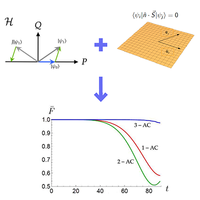
The authors introduce a protocol that combines the quantum super-Zeno effect with spin-anticoherent subspaces to suppress noise arising from spin interactions of polynomial order n in the spin operators. For n=1 a quantum gyroscope is obtained that protects states from unwanted rotations, while a spin-13/2 example achieves average fidelity with short-time scaling 1−F¯∝ t10.

Entanglement-enhanced correlation propagation in the one-dimensional SU(N) Fermi-Hubbard model

Mathias Mikkelsen and Ippei Danshita

Phys. Rev. A 113, L061301 (2026) - Published 3 June, 2026

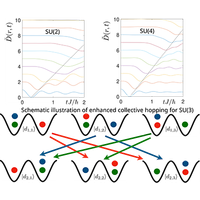
The authors demonstrate enhanced correlation propagation velocity in SU(N) Fermi-Hubbard models for N>2 for entangled initial states based on a simple analytic model of excitations and numeric evidence for N=2,3,4, and 6. This enhancement is bounded by the propagation velocity of the Bose-Hubbard model, which can be reached in the large N limit.

Probing the crossover between dynamical phases with local correlations in a Rydberg-atom array

Xiaofeng Wu, Xin Wang, Sixun Jia, and Bo Xiong

Phys. Rev. A 113, 062204 (2026) - Published 2 June, 2026

Out-of-time-order correlators for the Swanson Hamiltonian with interaction terms

M. W. AlMasri and Marta Reboiro

Phys. Rev. A 113, 062205 (2026) - Published 2 June, 2026

Graph-theoretic quantum contextuality and unextendible product bases

Gurvir Singh and Arvind

Phys. Rev. A 113, 062409 (2026) - Published 2 June, 2026

Non-Clifford quantum gate teleportation with generalized lattice surgery

Yifei Wang and Yingfei Gu

Phys. Rev. A 113, 062410 (2026) - Published 2 June, 2026

Quantum computing approach to atomic and molecular three-body systems

Mohammad Haidar, Hugo D. Nogueira, and Jean-Philippe Karr

Phys. Rev. A 113, 062411 (2026) - Published 2 June, 2026

Time-optimal control of a GdW30 molecular spin qudit

Marc Alsina, Ibério de P. R. Moreira, Guillermo Albareda, and Josep Maria Bofill

Phys. Rev. A 113, 062603 (2026) - Published 2 June, 2026

Benchmarking quantum devices beyond classical capabilities

Rafał Bistroń, Marcin Rudziński, Ryszard Kukulski, and Karol Życzkowski

Phys. Rev. A 113, 062604 (2026) - Published 2 June, 2026

Quantum network-based prediction of cancer driver genes

Patrícia Marques, Andreas Wichert, Duarte Magano, and Bruno Coutinho

Phys. Rev. A 113, 062605 (2026) - Published 2 June, 2026

Heisenberg-limited two-parameter estimation with weighted three-mode Schrödinger cat states in a triple-well Bose-Einstein condensate system

Cong Wang, Wei Shan, Jun-Qiao Pan, and Hai-Jun Xing

Phys. Rev. A 113, 062606 (2026) - Published 2 June, 2026

Solid-state high-order harmonic generation in different bases: Convergence and physical validity of truncated representations

Andi Xin, Liang Li, Pengfei Lan, and Peixiang Lu

Phys. Rev. A 113, 063101 (2026) - Published 2 June, 2026

Photoelectron combs in ionization: Influence of rescattering and nondipole effects

J. Z. Kamiński and K. Krajewska

Phys. Rev. A 113, 063102 (2026) - Published 2 June, 2026

Subcycle light synthesis via space-time plasma mirrors

Rostislav Arkhipov, Mikhail Arkhipov, and Nikolay Rosanov

Phys. Rev. A 113, 063507 (2026) - Published 2 June, 2026

Spin entanglement of two atoms through coupling to their thermal motion

Poramaporn Ruksasakchai, Lucile Sanchez, Marvin Weyland, Mikkel F. Andersen, Scott Parkins, and Stuart S. Szigeti

Phys. Rev. A 113, 062201 (2026) - Published 1 June, 2026

Separation of quantum time evolution into holonomic and dynamical parts

Adam Fredriksson and Erik Sjöqvist

Phys. Rev. A 113, 062202 (2026) - Published 1 June, 2026

Failure of epistemic models to explain the antidistinguishability of quantum mixed preparations

Sagnik Ray, Visweshwaran R, and Debashis Saha

Phys. Rev. A 113, 062203 (2026) - Published 1 June, 2026

Honest-binding quantum bit commitment from separable operations

Ziad Chaoui, Anna Pappa, and Matteo Rosati

Phys. Rev. A 113, 062401 (2026) - Published 1 June, 2026

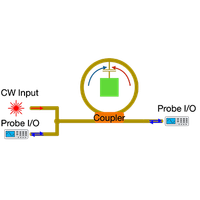
Probing time-reversal-symmetry breaking using a nonlinear superconducting ring resonator

Nicolas Dirnegger, Marie Wesson, Arpit Arora, Ioannis Petrides, Jonathan B. Curtis, Emily M. Been, Amir Yacoby, and Prineha Narang

Phys. Rev. A 113, 062402 (2026) - Published 1 June, 2026

The authors suggest a way to detect time-reversal-symmetry breaking using a driven-dissipative superconducting ring resonator. In particular, nonlinear interactions can enforce symmetric steady-state photon populations, which become asymmetric when even weak symmetry breaking is present, allowing for a sensitive probe of time-reversal-symmetry-breaking effects in quantum materials and providing an interesting use case for superconducting microwave resonators outside of quantum information processing.

Quantum phase recognition via swap-test-based correlation mechanism

Jin-Long Chen, Xin Li, and Zhang-Qi Yin

Phys. Rev. A 113, 062403 (2026) - Published 1 June, 2026
Sign In to Your Journals Account

Filter

Recent Issues

Vol. 114, Iss. 4
October 2026
Vol. 114, Iss. 3
September 2026
Vol. 114, Iss. 2
August 2026
Vol. 114, Iss. 1
July 2026
Category
Article Type
Section

Filter

Article Lookup

Enter a citation