Recent Articles

Stronger sum uncertainty relations for non-Hermitian operators

Xiao-Feng Song, Yi-Fang Ren, Shuang Liu, Xi-Hao Chen, and Yusuf Turek

Phys. Rev. A 111, 012221 (2025) - Published 29 January, 2025

Relativistic quantum field theory approach to electron wave-packet tunneling: A fully causal process

M. Alkhateeb, X. Gutierrez de la Cal, M. Pons, D. Sokolovski, and A. Matzkin

Phys. Rev. A 111, 012222 (2025) - Published 29 January, 2025

Maximal non-Kochen-Specker sets and a lower bound on the size of Kochen-Specker sets

Tom Williams and Andrei Constantin

Phys. Rev. A 111, 012223 (2025) - Published 29 January, 2025

Exploiting symmetry in variational quantum channel coding

Jun Wu, Wei Xie, Hao Fu, Mingzheng Zhu, and Xiang-Yang Li

Phys. Rev. A 111, 012443 (2025) - Published 29 January, 2025

Simulating a quasiparticle on a quantum device

Rimika Jaiswal, Izabella Lovas, and Leon Balents

Phys. Rev. A 111, 012629 (2025) - Published 29 January, 2025

Spin-orbit splitting on photodissociation in open-shell diatomics by intense UV pulses

Yan Rong Liu, Victor Kimberg, Maomao Gong, Yongjun Cheng, Yong Wu, Jian Guo Wang, and Song Bin Zhang

Phys. Rev. A 111, 013122 (2025) - Published 29 January, 2025

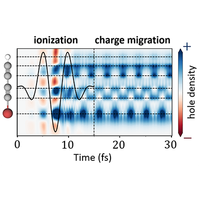
Strong-field ionization with few-cycle, midinfrared laser pulses inducing a localized ionization followed by long-lasting charge migration in halogenated organic molecules

Kyle A. Hamer, François Mauger, Kenneth Lopata, Kenneth J. Schafer, and Mette B. Gaarde

Phys. Rev. A 111, L011101 (2025) - Published 29 January, 2025

The authors use large-scale simulations to investigate how to initiate robust and high-contrast charge migration in halogenated organic molecules. They find that tunnel ionization by an intense few-cycle laser pulse initiates a localized hole on the halogen atom, which in turn leads to charge migration with a periodicity that is independent of the laser wavelength, for a large range of laser parameters.

Quantum harvester enabling energy transfer without entropy transfer

Fei Meng, Junhao Xu, Xiangjing Liu, and Oscar Dahlsten

Phys. Rev. A 111, 012219 (2025) - Published 28 January, 2025

High-dimensional monitoring and the emergence of realism via multiple observers

Alexandre C. Orthey, Jr., Pedro R. Dieguez, Owidiusz Makuta, and Remigiusz Augusiak

Phys. Rev. A 111, 012220 (2025) - Published 28 January, 2025

Stochastic action for the entanglement of a noisy monitored two-qubit system

Dominic Shea and Alessandro Romito

Phys. Rev. A 111, 012442 (2025) - Published 28 January, 2025

Metrology in a two-electron atom: The ionization energy of metastable triplet helium 2S13

Gloria Clausen, Kai Gamlin, Josef A. Agner, Hansjürg Schmutz, and Frédéric Merkt

Phys. Rev. A 111, 012817 (2025) - Published 28 January, 2025

Photoelectron–residual-ion interaction in angle-resolved streaked shake-up ionization of helium

Hongyu Shi and Uwe Thumm

Phys. Rev. A 111, 013119 (2025) - Published 28 January, 2025

Ion-kinetic-energy sampling in a 22-pole trap using ring-electrode evaporation

Miguel Jiménez-Redondo, Dieter Gerlich, Paola Caselli, and Pavol Jusko

Phys. Rev. A 111, 013120 (2025) - Published 28 January, 2025

On-shot, high-intensity laser aberration measurements via ponderomotive electron ejection

A. E. Raymond, S. Ravichandran, S.-W. Bahk, A. Longman, L. Roso, R. Fedosejevs, C. Mileham, I. A. Begishev, S. Qin, N. Dauphin, J. Shamlian, W. T. Hill, III, and H. G. Rinderknecht

Phys. Rev. A 111, 013121 (2025) - Published 28 January, 2025

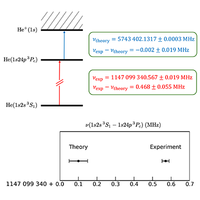
Theory for the Rydberg states of helium: Comparison with experiment for the 1s24pP11 state (n=24)

Aaron T. Bondy, G. W. F. Drake, Cody McLeod, Evan M. R. Petrimoulx, Xiao-Qiu Qi, and Zhen-Xiang Zhong

Phys. Rev. A 111, L010803 (2025) - Published 28 January, 2025

High-lying Rydberg states of helium provide absolute points of reference for the precision metrology of transition frequencies. Agreement between theory and experiment at principal quantum number n=24 confirms a 7σ disagreement between QED theory and experiment for the ionization energy of the metastable 1s2s3S1 state. The discrepancy challenges QED theory.

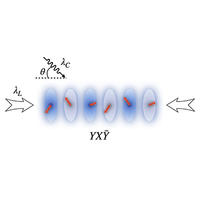
Realization of a period-3 coplanar state in one-dimensional spin-orbit-coupled optical lattices

Yida Chu, Shijie Hu, and Tao Wang

Phys. Rev. A 111, L011304 (2025) - Published 28 January, 2025

The authors propose a three-sublattice spin-flop mechanism for achieving a period-3 coplanar state in a 1D system of alkaline-earth-metal atoms. This innovative mechanism can also be extended to create complex structures with larger period numbers in other spin models or various artificial setups.

Statistical model for quantum spin and photon number states

Sam Powers, Guangpeng Xu, Herbert Fotso, Tim Thomay, and Dejan Stojkovic

Phys. Rev. A 111, 012217 (2025) - Published 27 January, 2025

Robustness of perfect transmission resonances to asymmetric perturbation

Ioannis Kiorpelidis, Panayotis Kalozoumis, Georgios Theocharis, Vassos Achilleos, Fotios K. Diakonos, and Vincent Pagneux

Phys. Rev. A 111, 012218 (2025) - Published 27 January, 2025

Investigating an approach of robustly self-testing two-qubit entangled states

Chan-Ching Lien and Shin-Liang Chen

Phys. Rev. A 111, 012439 (2025) - Published 27 January, 2025

Retrieving nonstabilizerness with neural networks

Antonio Francesco Mello, Guglielmo Lami, and Mario Collura

Phys. Rev. A 111, 012440 (2025) - Published 27 January, 2025

Sign In to Your Journals Account

Filter

Recent Issues

Vol. 114, Iss. 4
October 2026
Vol. 114, Iss. 3
September 2026
Vol. 114, Iss. 2
August 2026
Vol. 114, Iss. 1
July 2026
Category
Article Type
Section

Filter

Article Lookup

Enter a citation